“It is the unvarying rule of secret societies that the real authors never show themselves.” So reported 19th-20th-century British historian Nesta Helen Webster, who researched “subversive movements” for over two decades.
Esoteric and occult organizations can be curious and obscure enough on their own. But, when they seem to crystallize – and gain momentum – seemingly out of nowhere, or when they turn out to be world-historic in their impact, mysteries ramify.
In this video, I will sketch profiles of ten (10) people who are, for all intents and purposes, ciphers. Yet, their influence – meditated through heirs that are much better known – is nearly incalculable.
Caveats and Disclaimers
There are serious doubts about the lives – and even the existence – of some (or perhaps most) of the individuals here profiled. The video is intended for educational or entertainment purposes, only, and should not be understood as the final word on any of the events or people it discusses. The aim is to provide viewers with informational background and research leads for their own investigations.
Additionally, given the arcane nature of the topic, trying to find a credible way to rank our entrants proved difficult. Therefore, with only one major exception (to be identified in good time), the list has been arranged in more or less chronological order. But, without further ado…
The Top Ten
1. The Man Behind Gnosticism: Dositheos
Gnosticism has been a major current in the Western occult tradition.[1]
We introduced the constellation of ideas, and tried to distinguish it from other terms with which it is >often confused,[2] in our video “10 Arcane Words.”
Those with more interest, and a little more time, may be interested to note that we also explored the erotic fixations of so-called “Spermo-Gnostics” in “Top 10 ‘Sex-Magic’ Cults.”
Because these other materials provide an adequate foundation for the relevant concepts, I won’t spend much energy reinventing the wheel, here. Suffice it to say that Gnosticism was a religious worldview – flourishing around the second century A.D. – that focused on spiritual advancement through the acquisition of hidden knowledge. It combined Christian, Jewish, and pagan elements.[3]
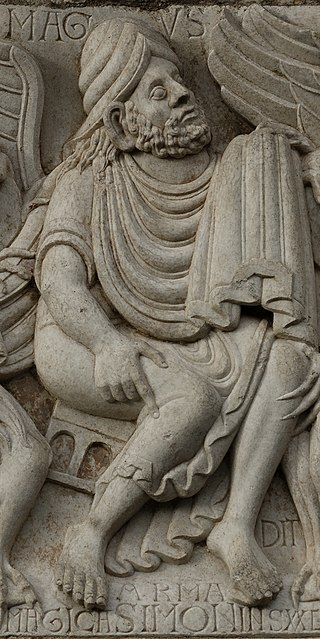
Here’s the relevant bit. The reputed founder of Gnosticism was the Biblical figure Simon Magus. (He’s
also called “Simon, the Sorcerer,” since magos is a Greco-Roman word for “magician.”[4])
Simon appears in the New Testament Book of the Acts of the Apostles, where it says (chapter 8, verse 13) that he became a believer in Jesus Christ. Simon observed the apostles Peter and John effecting the reception of the Holy Spirit. Verse 18 explains that Simon “offered them money” for knowledge of the power they possessed.
This episode that was the seminal instance of Simony, which today is defined by Catholic sources as the sin of buying or selling church favors.
In the Bible, Peter immediately rebukes and dismisses Simon.[5] Thus, our “prototype …heretic and black magician”[6] began traveling with a Phoenician prostitute, gathering his own disciples who were impressed with his occult prowess.
But, would you believe that the story doesn’t actually stop there? – even if it’s telling often does.
For, at some point, the enigmatic Simon Magus was reputed to have been taught by an even more secretive adept named Dositheos.[7]
Although Dositheos was reputed to have been a Samaritan,[8] some legends speak of an Egyptian sojourn, where he – and his disciple, Simon – allegedly acquired fantastic abilities such “as invisibility, levitation, and shape-shifting into …animal” form.[9]
At least some of our modern knowledge about the obscure Dositheos – who was acquainted with John the Baptist and may have had connexions to Essenism – comes by way of discoveries made in caves at Qumran, an archaeological site in the Palestinian Occupied Territory known as the “West Bank.”[10]
The Wikipedia article on Dositheos[11] quotes from the book The Dead Sea Scrolls and Primitive Christianity by the Jesuit Modernist theologian – and later Catholic Cardinal – Jean Daniélou.[12] As a crypto-political aside, Daniélou was discovered dead in 1974, under suspicious circumstances, in the house of a known prostitute.
But speaking of Dositheos and Simon Magus, the duo’s impact was remarkable. Not only did Simonian >Gnosticism persist for centuries, but later writers such as 19th-century French occultist Jules Doinel, 19th-20th-century British Theosophist G. R. S. Mead, and even the “Great Beast” himself, British magician Aleister Crowley, would resurrect it for their own esoteric purposes.
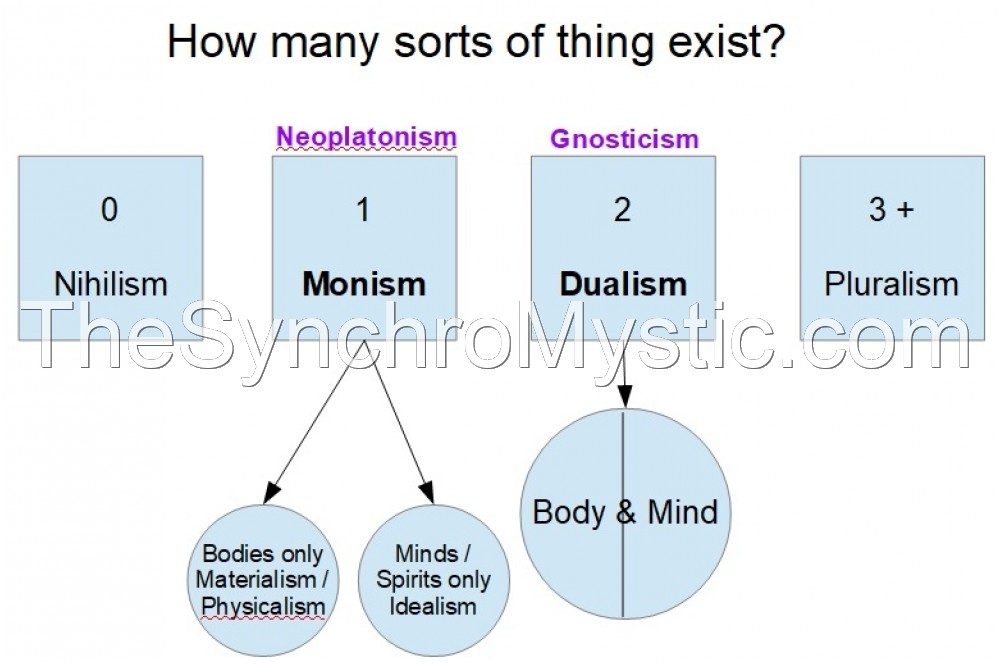
Most simply characterized as an expanded and mystified variety of the famous Greek philosopher Plato’s Theory of Forms, Neoplatonism – as a contributor to the “core” of Western esotericism – has few rivals. One thinks only, for instance, of Hermeticism or Pythagoreanism, …
…the latter being our focus in the video “Pythagoras.”
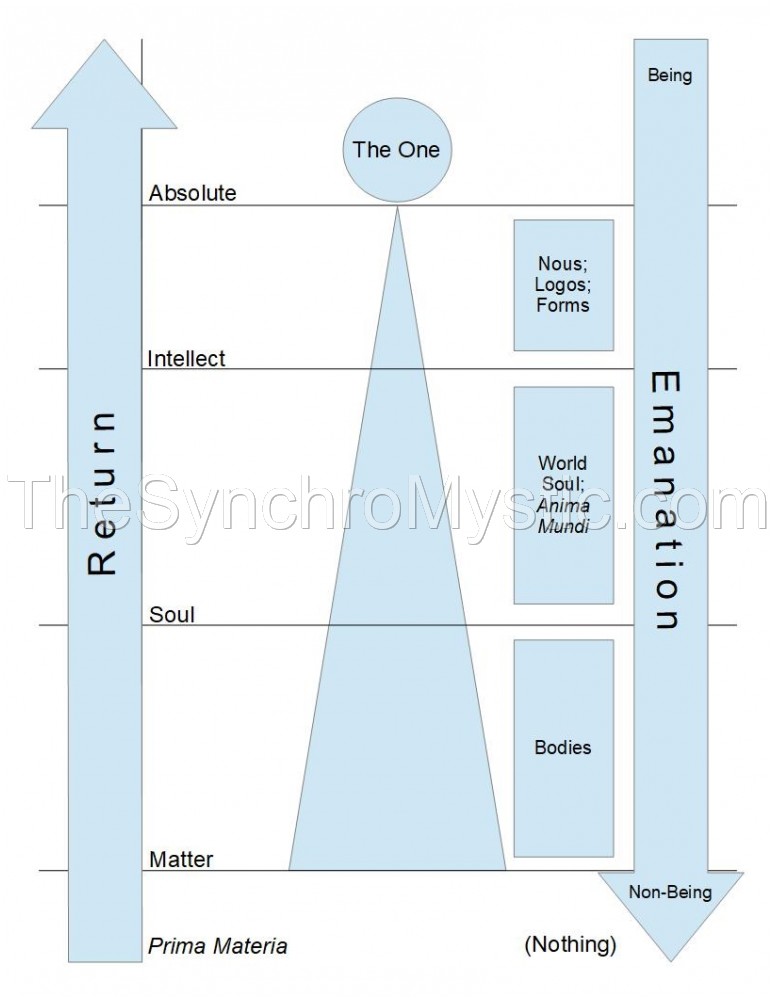
Generally speaking, Neoplatonism presents a picture of a world in which true reality is hidden behind (or above) the mundane realm of appearances. In this way, the worldview underwrites practical magic. For consider that, on Neoplatonic assumptions – several of which are echoed in Eastern thought – “…every event in the visible world is the effect of an ‘image,’ that is, of an idea in the unseen world. …[E]verything that happens on earth is only a reproduction, as it were, of an event in a world beyond our sense perception… [S]ages …have access to these ideas …and are …able to intervene decisively in events in the world.”[13]
I intend to expound on the history and philosophy of Neoplatonism in a future video. But, for now, I’ll just say that there are four names usually listed as being among “the most visible [ancient] Neoplatonists in later esoteric literature.”[14]
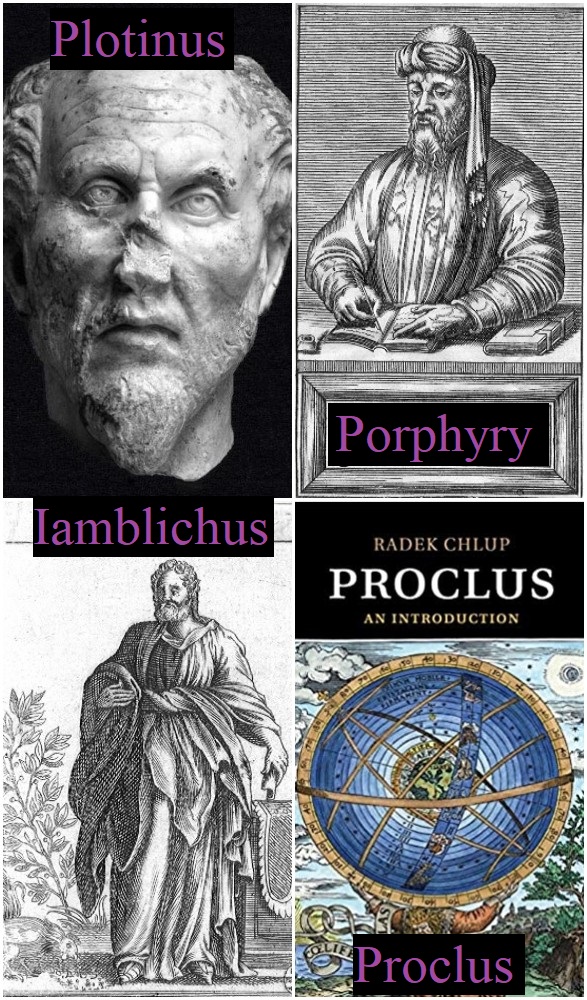
In reverse chronological order, these are the 5th-century expositor Proclus, the 3rd-4th-century magician Iamblichus, the 3rd-4th-century codifier Porphyry, and the man usually regarded as the wellspring for the whole enterprise, the innovative, 3rd-century theorist Plotinus.
However… Plotinus’s speculations didn’t arise in a vacuum. It turns out that he received instruction from a shadowy autodidact by the name of Ammonius Saccas.[15]
Vanishingly little is known about his personal views. Yet, he is routinely cited for the profound impact he is alleged to have exerted upon Plotinus and, by extension, on the establishment of Neoplatonism.
Ammonius was later claimed as a fellow traveler by adherents of both Christianity and paganism. This presents a puzzle and leads some scholars to suppose that there may have been two thinkers with the same name who were contemporaries.
Of Ammonius’s origins, no one can say for sure. He taught Plotinus in the important city of Alexandria, Egypt which was then under the control of the Roman Empire.
The city had a large Greek population, suggesting that Ammonius Saccas was ethnically Greek.
But, some analysts have observed that his given name, “Ammonius,” contains a Latinized reference to the Egyptian deity, Amun – the primordial god of air. This raises the possibility that he may have been a Copt. (Similar questions surround Plotinus’s background.)
Stranger still, a few have proposed that Ammonius Saccas may actually have been of Indian extraction.
If true, this would help to explain two curious pieces of data. Firstly, Ammonius Saccas had an affinity for Indian thought that he apparently transmitted to his pupil. According to the biographer and systematizer, Porphyry, Plotinus’s decade-long training by Ammonius Saccas primed him “to make acquaintance with the Persian philosophical discipline and that prevailing among the Indians.”[16]
Secondly, tenets of Neoplatonism are redolent of Vedanta, the dominant stream of philosophical Hinduism which was derived from a collection of sacred texts called the Upanishads.
A core notion of this viewpoint is often (albeit opaquely) articulated as the slogan “Atman is Brahman.” This is to say that all individual souls (Atman) – yours, mine, and everyone else’s – are identical with the ultimate principle of reality (designated Brahman).
There is a striking similarity between this doctrine and the crucial Neoplatonic notion that all reality is an “emanation” of, and seeks to “return to” unity with, the One. Stay tuned for further explorations of these abstractions.
According to academic Arthur Versluis, the traditions of Indian religion and Neoplatonism coalesced in the 19th-century American Transcendentalist movement – famously associated with American writers Ralph Waldo Emerson and Henry David Thoreau. It’s interesting to entertain the possibility that this represented a reunion of divergent strands that previously emerged from the same basic source.
3. The Man Behind Renaissance Magic: Johannes Trithemius
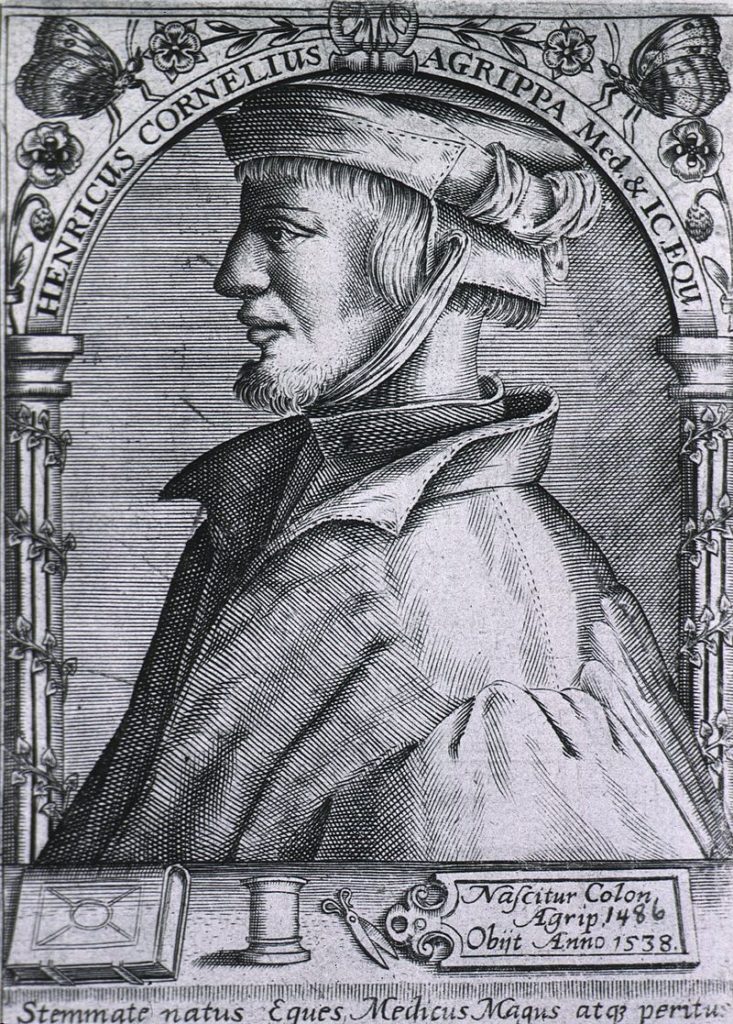
One of the most epochal textbooks on magic theory ever published was the three-volume De Occulta Philosophia, by the 15th-16th-century German Kabbalist and Neoplatonist Heinrich Cornelius Agrippa.
We showcased Agrippa twice already. First, he appeared in our video “Top 10 Occultists of All Time,”
…and then again in “10 Occultists Who Were Accused Spies.”
Agrippa was born and received his early education in the German city of Cologne.
This is significant because Cologne had been a stronghold of Medieval Scholasticism, a composite philosophical-theological system expounding Christianity using the logical apparatus of Aristotle.
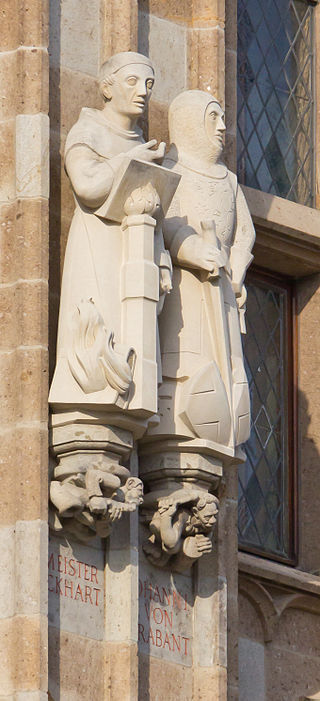
Within that context, debates still broke out. At Cologne, the majority of the faculty followed the teachings of St. Thomas Aquinas, known as “Thomism.” But a minority of school men opted instead for “Albertism,” a competing system drawn from Aquinas’s most distinguished teacher, Albert the Great (also known by the Latinized version of his name, Albertus Magnus).[17]
Although Albertism is little-mentioned today, it was (for a time) preserved in Cologne – where Albert had spent time lecturing – by a coterie of scholars devoted to his outlook. A key point, here, is that Albert was regarded as having been sympathetic to both alchemy and astrology.
As for the latter, in his Speculum Astronomiæ (“The Mirror of Astronomy”), published circa 1260, Albertus Magnus had argued that astrological investigations were compatible with Christianity. Much later, Agrippa read this work and cited it as instrumental on his thinking.
In the 14th century, Albertism was combined with Neoplatonism by the largely unknown Dominican Berthold of Moosburg (ca. 1300-1361). Thus, Agrippa would have been trained in what is now referred to as the “Cologne Tradition of Neoplatonism.”
Simultaneously, Agrippa mastered – and would also lecture on – humanist-Catholic thinker Johann Reuchlin’s seminal Kabbalistic treatise, De Verbo Mirifico, printed in 1494.[19] Incidentally, that title roughly translates to “About the Miraculous Word” and is a sustained explication of the alleged magical power of the name “Jesus.”[20]
Reuchlin had been introduced to Jewish mysticism by the found of so-called “Christian Cabala,” the Italian Renaissance innovator, Pico della Mirandola, whom we will discuss further in a bit.[21]
It is difficult to overstate Agrippa’s significance. Occult Philosophy was, in effect, the first attempt at a comprehensive encyclopedia of esotericism and magic.[22] His thesis? “…[T]hat the hermetic texts …and the Kabbalistic writings… were the gateway to true wisdom” and would restore the control of nature to humanity, who had lost it due to the sin of Adam.[23]
Early 20th-century English historian Frances Yates relates the opinions of two specialists who believed that Agrippa “and his associates formed some kind of secret society…”.[24] Incredibly, “[s]ome historians of the origins of Protestantism in Geneva have regarded Agrippa and his circle … ‘as the seed-bed of the reformed faith’.” Of course, “Reformed Christianity” is merely another name for Calvinism, or the branch of Protestantism owing to 16th-century French theologian John Calvin.
Not only was Agrippa at ground zero for what developed into Calvinism, but he was also operating in humanist circles in England.[25] This would have placed him in the orbit of the unfortunately named “Oxford Reformers”:[26] provocative New-Testament translator Desiderius Erasmus, English statesman and Catholic martyr Sir Thomas More, and – particularly – Renaissance standard bearer, John Colet.
And once again, behind Agrippa – the figure who was apparently so pivotal for preparing the ground for momentous religious changes on the continent and the British Isles[27] – we find a more obscure intriguer lurking in the shadows.
For, before writing his magnum opus, “[i]n 1509-10, Agrippa was in Germany, visiting the learned [Benedictine] abbot [Johannes] Trithemius,” to whom De Occulta Philosophia would be dedicated.[28]
4. The Man Behind Trithemius: Pelagius of Majorca
19th-century French occultist Éliphas Lévi, on whom see “Top 10 Occultists of All Time,” …
…praised Trithemius as having been the most accomplished magician of his era.
Besides Agrippa, Trithemius had at least one other illustrious student. The revolutionary alchemist and medical reformer Paracelsus (born Theophrastus von Hohenheim) – regarded as the Martin “Luther of the Physicians” – “…identified… the famous Cabalist Johannes Trithemius… [as] among his tutors.”[29]
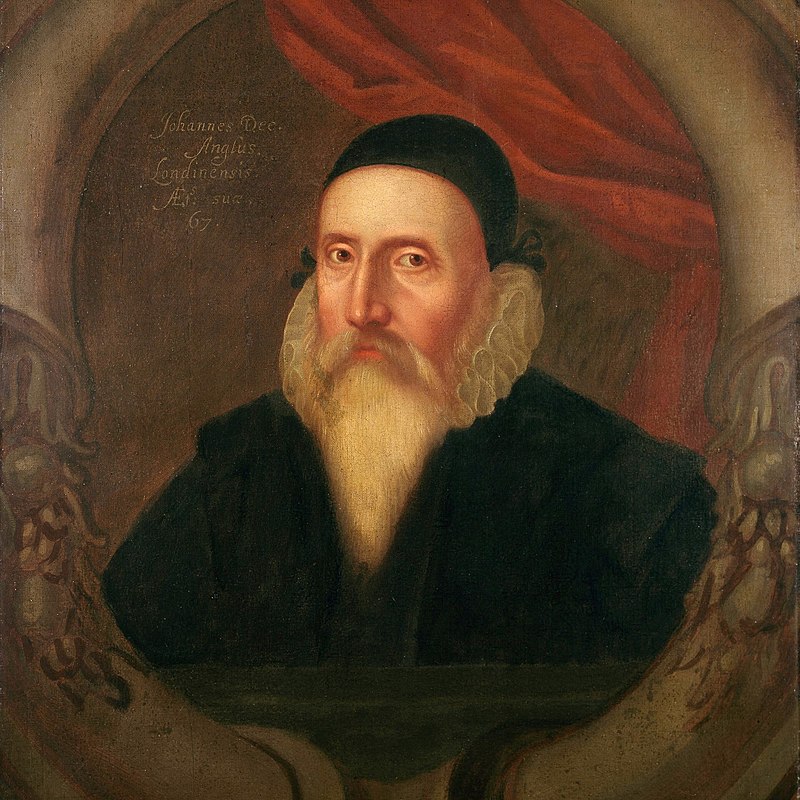
Additionally, Dr. John Dee, Queen Elizabeth I’s astrologer royal, whom we also ranked one of the occult practitioners with the most enduring legacies.
Dee’s extensive library, one of the world’s largest of his time, contained several of Trithemius’s books on its shelves. This included Trithemius’s the Steganographia (written ca. 1500),[30] which “contained many numerological and astrological calculations connected with angels as well as instructions on how to summon them, to gain knowledge, and how to send messages over long distances by means of angelic agency.”[31]
Because of these alleged angelological dealings, Trithemius garnered a reputation as “a demonic magician,”[32] necromancer, and “sorcerer.”[33]
Like the mysterious abbot himself, Dee developed a reputation as a sorcerer.
and De Septem Secundeis (1508), a treatise on astrology and Kabbalistic magic;
And, as we noted in “10 Occultists Who Were Accused Spies,” Dee may have exploited Trithemian ciphers to send coded messages for the English crown.
Along with his students, Agrippa and Paracelsus, Johannes Trithemius would be cited by the previously named Lévi in his influential Histoire de la magie (1860).
Confidence in his monumental importance for later streams of occultism is inversely proportional to relative uncertainty about the details of his early life and intellectual formation. In various biographical “snippets” readily available online, one finds unfailingly repeated a fairy-tale-like anecdote about Trithemius’s unlikely – and inexplicably swift – ascent. A twenty-year-old Trithemius was supposedly returning home from university when he was caught in a snowstorm. The ferocity of the storm was such that he sought refuge in a Benedictine Abbey. The story goes that he decided to stay there, and – within a year – he was made “Abbot,” or head monk.
Trithemius himself claimed that he had been schooled in various esoteric arts by one “Libanius Gallus,” an otherwise unknown adept. But the autobiographical questions ramify when we learn that Libanius Gallus himself was said – again, by the precocious abbot himself – to merely have been an intermediary between Trithemius and an even more secretive mage.
Allegedly named “Pelagius of Majorca,” after Mallorca, the Spanish island that is one of the top-ten largest in the Mediterranean Sea.
Stay tuned for more on these sorts of crypto-politically magnetic areas.
Some historians, such as Paola Zambelli, have concluded that “both Pelagius and Libanius were fictions invented by our abbot.”[34]
Another possibility is that they are veiled acknowledgements of real people. One thinks, for instance, of the 13th-century “proto-Cabalist” Ramon Llull who happened to be from Mallorca.
Still, as Michael Hoffman remarks, due to Trithemius’s preposterous account of his own rise and influence, we must assume that the abbot was assisted by a person (or persons) unknown.[35]
Along a similar line, writer Rosemary Guiley states that, early in his own intellectual formation, Trithemius went to Heidelberg – a center of alchemy and occultism – where he became the student of an unknown teacher.”[36]
5. The Man Behind ‘Christian Cabala’: Flavius Mithridates
Speaking of Kabbalists, the short-lived Renaissance syncretist, Giovanni Pico della Mirandola, exercised an outsized influence on subsequent esotericism – especially in its Neoplatonic incarnations.
His main contributions were twofold. Firstly, particularly via his captivating Oration on the Dignity of Man,[37] Pico gave expression to his “…magical view of man as master of the created world.”[38]
Later interpreters understood Pico to have been asserting “…that man is set apart from the rest of creation, and is completely free to form his own nature.”[39]
This arguably becomes a major component of later philosophies – such as those of Arthur Schopenhauer and Friedrich Nietzsche – which place an emphasis upon will.
But, it also forms the part of the foundation for various occult currents, such as those involving figures like Éliphas Lévi – according to whom the Pentagram symbolized “[t]he sovereignty of the will…”[40] – and Aleister Crowley, both of whom we surveyed in “Top 10 Occultists.”
Secondly, Pico is credited with introducing the Jewish mystical Kabbalah into Western occultism. This would have a monumental impact. In the first place, it created – right away – the curious amalgam known as “Christian Cabala.”
Of course, predictably, it seems that Pico wasn’t acting on his own hook. Standing behind him were several figures about whom little else is known – beyond their tutelage of the young Italian.
One of them was the noteworthy Jewish Averroist, Elijah Delmedigo. Among other effects, Delmedigo seems to have primed Pico for his interest in an Aristotelianism that was separate from the usual Catholic framework set in place by the great Dominican theologian St. Thomas Aquinas.
Another was Rabbi Yohanan Alemanno, from whom Pico learned the rudiments of Hebrew. Alemanno was also known for his view “…that natural magic was inferior to the Kabbalah, which provides the keys to a ‘divine’ magic.”[41]
But, it was from one Samuel ben Nassim Bulfarag, alias Guglielmo Raimondo de Moncada, alias Flavius Mithridates, Pico’s tutor in Aramaic, that Pico would learn the most about Kabbalistic secrets.
British Renaissance historian Frances Yates reports that, “[c]hief among …[the Spanish Jews who instructed Pico] was the mysterious character known as Flavius Mithridates who provided Pico with Cabalist manuscripts.”[42]
In the words of University of California, Los Angeles Professor Brian Copenhaver, “Flavius Mithridates …[was] his [Pico’s] most prolific Jewish informant, [who] translated (and mistranslated) thousands of pages of Kabbalah into Latin for him.”[43]
Copenhaver’s aside raises questions about Flavius’s honesty. A commentator (of unknown reliability) introduces a record of one of Flavius’s speeches, delivered on Good Friday in front of the pope no less, by saying that – although he “dazzled the clerics” with his linguistic abilities – he fabricated evidence in the manner of “[a] clever charlatan.”[44]
As an added layer of intrigue, the Encyclopædia Judaica observes that, in Rome, Flavius had once been “…under the patronage of Giovanni Battista Cibo, bishop of Molfetta, [who] later [became] Pope Innocent VIII.”[45]
Yates draws attention to the high strangeness of the relationship between Pico and Flavius,[46] stating that the latter “…encouraged Pico in the Christian interpretation of Cabala, even to the point of inserting into the texts interpolations of his own pointing in a Christian direction.”[47]
Yates candidly confesses her own astonishment, asking: “What can have been Flavius’s motive in thus encouraging and directing Pico towards his momentous adoption of Cabala into Christianity…[?]”[48]
6. The Man Behind Renaissance Neoplatonism: Elissæus
Similar weirdness also surrounds the earlier, 14th-15th-c. Constantinopolitan scholar Gemistos Pletho (circa 1355-1452). He was a well-connected, Byzantine Greek who rejected Eastern Orthodoxy and advocated a return to paganism – ostensibly combined with a Neoplatonic form of Christianity.
Pletho – sometimes alternatively called Plethon – was a major catalyst for Italian Renaissance interest in Plato.[49] First of all, he was a celebrated participant in the Council of Ferrara-Florence – held over almost a twenty-year period from 1431 to 1449. The council was called to try to undo the Great Schism of 1054. Also called the “East-West Schism,” you’ll recall that this separated Christianity into Eastern Orthodoxy, on the one hand, and Roman Catholicism, on the other.
Secondly, Pletho gave numerous, well-attended lectures “On the Difference Between Aristotle and Plato,” some of which were apparently heard by Florentine banker Cosimo de’Medici.
De’Medici proceeded to establish a Platonic Academy in Florence. Subsequently, he funded the research-and-translation projects of Italian priest-scholar Marsilio Ficino. Ficino, along with the previously mentioned Pico della Mirandola, would basically open wide the doors for mysticism, magic, and revived Neoplatonism in the Catholic Church.
In fact, Pletho arguably paved the way for Pico.
And, wouldn’t you know it? According to Pletho’s dogged ideological adversary, Georgios Scholarios (ca. 1400-1473), a man who would later become Patriarch of Constantinople under the name Gennadios II, some of Pletho’s ideas had been suggested to him by a Kabbalist named Elissæus.[50]
Of course, the allegations, while provocative, are far from historically certain. Nevertheless, if true, they would mean that two major esoterically oriented streams – Kabbalism and Neoplatonism – were introduced into Western Christianity partially under Rabbinic superintendence.
7. The Men Behind Cagliostro (I): Altotas
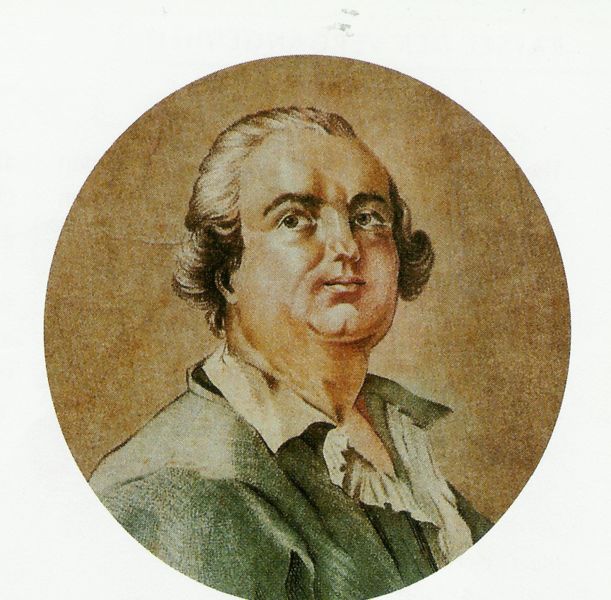
Fast-forwarding to the Enlightenment, Count Alessandro di Cagliostro, allegedly born with the more modest name Giuseppe Balsamo was an 18th-century Sicilian-Jewish adventurer and Hermeticist.
We covered Cagliostro, who was recently incorporated into the Dr. Strange story line in the Marvel Cinematic Universe, in our video titled “Top 10 Occultists of All Time,” where we noted his institution of a so-called “Egyptian” variety of Freemasonry with Kabbalistic-sorcerous overtones.
“Some accounts suggest that Cagliostro” – who was allegedly trained in sex magic by an adept whose identity will be disclosed in a few minutes – “forced his wife to sell sexual favors in order to augment his income.”[51]
According to his critics, he was a swindler who gallivanted about Europe engaging in confidence scams and evading his creditors. That is… until he ran afoul of the Roman Inquisition – allegedly trying to found a lodge of the “Brotherhood” right in the Vatican’s backyard – and, for his efforts, was imprisoned in the Castel Sant’Angelo.
Viewers of Ron Howard’s 2006 film, Angels and Demons – Dan Brown’s sequel to the wildly successful The Da Vinci Code – will recognize the imposing, cylindrical mausoleum from an exciting scene as the movie builds toward its climax.
In any case, some say that Cagliostro was eventually moved to the Fortress of San Leo, where he died.
But legends suggest that Cagliostro possessed coveted secrets for the attainment of limitless wealth and miraculously long life – if not immortality.
For more information on these fabled goals of alchemy, see “Top 10 GOLD-MAKING Alchemists.”
No prison could hold a man so supernaturally empowered as Cagliostro. Or… so some say. Therefore, rumors of his magical escape and subsequent reappearances gained currency in esoteric circles.
From where – or who – had he acquired his arcane knowledge?
According to one persistent account, young Guiseppe Balsamo had served as famulus to a mysterious Greek adept named Altotas.[52]
Versions of the story differ slightly. Either the future Count Cagliostro had apprenticed with Altotas on the Island of Malta, or, to advance their learning, the two had journeyed to Malta together.
Malta, of course, was the headquarters for one of the Catholic Church’s oldest military-religious orders. Originally founded as the Knights of Saint John of Jerusalem, otherwise known as the Hospitallers, a string of defeats prompted their periodic relocation. First they ended up on the island of Cyprus, then Rhodes, and – finally – Malta.
Supposedly, Altotas was so connected that he was able to effect Cagliostro’s introduction to the Grand Master of that august organization, into which our mysterious count claimed to have been initiated.
What happened to Altotas after this, no one seems to have discovered. He simply receded into the background while his pupil proceeded to revolutionize the ritualism of Masonry. Unless, well… hold that thought.
8. The Men Behind Cagliostro (II): Comte de Saint-Germain
Cagliostro is perhaps the best-known of a number of 18th-century adventurers who were able – at least for a short time – to capitalize on the venality of European nobles.
Among this group, also, were the prodigious “lover” Giacomo Casanova, and the curious Comte de Saint-Germain.
In fact, Saint-Germain is often said to have initiated Cagliostro into some form of Illuminism. “Illuminism” is a somewhat opaque synonym for Enlightenment. During the heyday of the intellectual movement by that name, which occurred roughly in late-17th and 18th centuries, there was an exaltation of the powers of the human mind. This illumination could take the form of a Gnostic-like “awakening” precipitated by contact with some tantalizing bits of “hidden knowledge” – …
…as we have covered in out several videos on Gnosticism.
Or, Illuminism could depend, instead, on an exaggerated confidence in human brain power and ingenuity. This “rationalism” in a broad sense was typical of philosophers of the period, regardless of whether they favored a priori argumentation, as was pioneered by René Descartes and carried on by such thinkers as Baruch Spinoza and Gottfried Wilhelm Leibniz,
…or whether they leaned more heavily on a posteriori, empirical methodology, as did John Locke, George Berkeley and David Hume.[53]
The difficulty with a figure like the Comte is situating him along this continuum. In the words of Antoine Faivre, men like Saint-Germain were “expert in exploiting the taste for the marvelous…” that prevailed in their age.[54] The consensus Ivory-Tower view seems to be something like this: Saint-Germain used early developments in science, to dazzle the mob and pretend spiritual Enlightenment.[55]
Were we previously to have catalogued the top eleven occultists, instead of ten, he would have contended for extra spot.
And, given rumors that he was an agent in the service of Prussian ruler Frederick the Great, we could have featured him in “10 Occultists who Were Accused Spies.”
Saint-Germain’s pedigree is as debated as other aspects of his life. At various times, and by diverse observers, he has been labeled a Hungarian prince or the fabled “Wandering Jew” – and quite a few things in between.
A preposterous array of “past lives” have been assigned to Saint-Germain – whether by popular acclaim or by retelling of his own autobiographical declarations. These include: Joseph, the human father or (depending on the source) step-father of Jesus Christ; the 13th-century proto-scientist Roger Bacon; and the 16th-17th-century English essayist and statesman, Sir Francis Bacon…
…who we have mentioned before.
Saint-Germain was a reputed Rosicrucian and, like Cagliostro, maintained numerous connexions to Freemasonry.
Perhaps more than his contemporaries, Saint-Germain seemed to become larger than life in the years following his alleged death around 1784 or 1785. I say “alleged death” since stories of “sightings” of the miracle-worker pile up in a manner similar to those about Elvis Presley.
A year after his reported demise, Saint-Germain was supposedly elected by Masons – including the groundbreaking hypnotist, Franz Anton Mesmer – to represent their order at an upcoming convention.
Subsequently, he was also supposedly seen retiring to Tibet, which seems to have given rise to – or at least encouraged – the belief that Saint-Germain had joined the ranks of an exalted class of mystics variously designated “Ascended Masters” or Mahatmas.
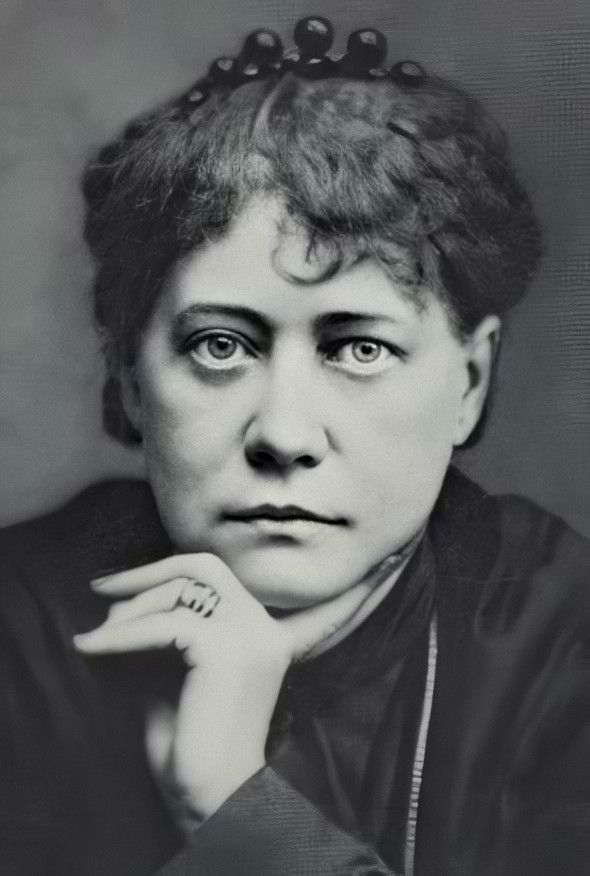
Indeed, Helena P. Blavatsky, whom we covered in “Top 10 Occultists,” …
…principal founder (in 1875) of the Theosophical Society, which we discussed in “10 Arcane Words,” …
…references Saint-Germain along with other supposed Masters – Morya and Koothoomi – as collectively directing earth’s affairs behind the scenes as the “Great White Brotherhood.”
Madame Blavatsky’s intellectual and spiritual heirs, including Annie Besant and Charles Webster Leadbeater, claimed to have had dealings with the Count.
Saint-Germain’s influence extends even further. Several key “New Agers” professed the Comte’s involvement in their enterprises. For instance, Guy and Edna Ballard established the I AM Movement under the auspices of the Saint Germain Foundation.
Elizabeth Clare Prophet, matron of the Church Universal and Triumphant, articulated a complicated lore surrounding “Saint Germaine,” including the belief that he somehow “inspired” the Constitution of the United States. Throughout her tenure as “Guru Ma,” Prophet claimed continual – or periodic – contact with various Ascended Masters, especially Saint-Germain.
These tales have cemented Saint-Germain’s legacy as one of the most powerful and proficient adepts of all time.
Runner Up: The Man Behind Éliphas Lévi
Let me momentarily interrupt the Cagliostro saga, with all the various behind-the-scenes operators. For there is one aspect of it that is probably best introduced by way of example.
For the illustration, we’ll turn to the man who, for all intents and purposes, kickstarted the so-called “Occult Revival” in the 19th-century – which we highlighted in the video “10 Arcane Words.”
Born Alphonse Louis Constant, he is far better known under his assumed (and “Hebræcized”[56]) name, Éliphas Lévi.
Of course, Lévi was a major name in “Top 10 Occultists of All Time.”
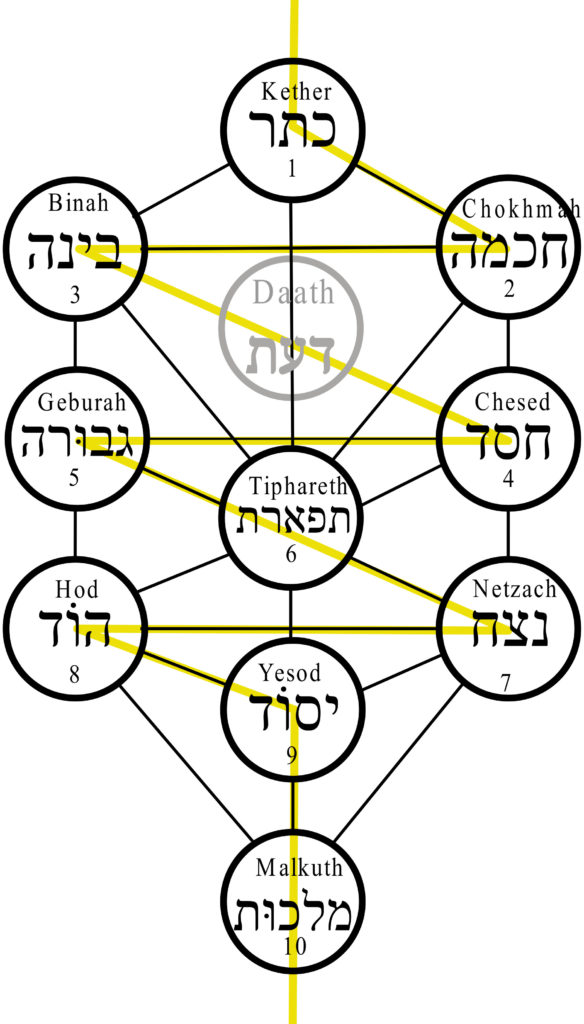
His chief contribution to occultism was his suggestion that there were “…esoteric correspondences between the twenty-two paths on the Kabbalistic Tree of Life and the twenty-two major trumps in the Tarot pack of cards.”[57]
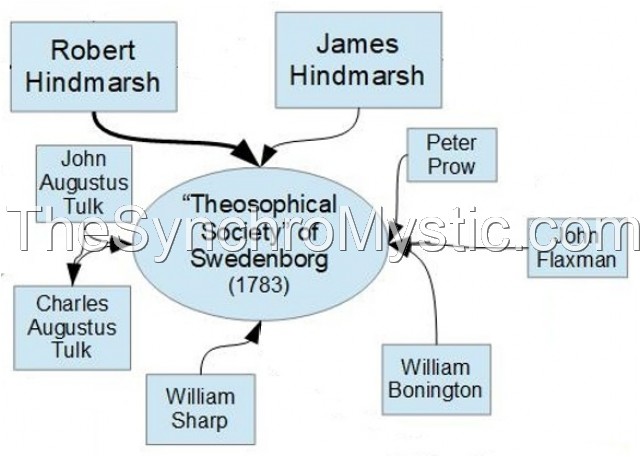
>Lévi’s synthesized a “transcendental” magic out of material gleaned from a wide variety of sources. These included: idiosyncratic 16th-17th-century German mystic Jakob Böhme, 17th-18th-century Swedish theosopher[58] Emanuel Swedenborg, 18th-century Freemason and Tarot enthusiast Antoine Court de Gébelin, 18th-19th-century German “animal-magnetism” theorist and hypnotist, Franz Anton Mesmer; 18th-19th-century French poet Antoine Fabre d’Olivet; and 18th-19th-century French esoteric Louis-Claude de Saint-Martin, founder of Martinism.
These were centered around the Jewish-mystical Kabbalah, which we have repeatedly encountered. What was additionally unique about Lévi, however, was that he seems to have fused two Kabbalistic streams together.
On the one hand, Lévi was acquainted with “Christian Cabala,” as it had originated with Pico and filtered down to the 17th-century German Hebraist Christian Knorr von Rosenroth. In 1684, Rosenroth had published the influential compendium Kabbala Denudata, or “Kabbalah Uncovered.”[59]
On the other hand, there were several separate strands of Kabbalah originating in Poland. One of these owed to Jacob Frank, a follower of the curious, 17th-century Messianic pretender, Sabbatai Zevi.[60]
We touched on both Zevi and Frank in “10 ‘Sex-Magic’ Cults.”
Another Polish current came from Hasidism. Fittingly for the present topic, its history is complex and obscure. But it seems to have been introduced into Poland from Prague, during its so-called “Golden Age” in the 17th century. At that time, the community presumably was in custody of the teachings of the 16th-century Rabbi Judah Loew ben Bezalel, known as the Maharal of Prague. He is still remembered for his supposed magical creation of a Frankenstein-like monster called a “Golem.”
From the Bohemian capital of Prague, Kabbalistic teachings passed to a line of practitioners known as “Baal Shem.” Literally signifying “Lord of the Name,” the specific reference is to the Tetragrammaton, or the four letters making up the name Yahweh – which is regarded as the ultimate magical formula.
Various Baal Shem are reputed to be adept at such things as manufacturing magical amulets and talismans, casting – and averting – the “evil eye,” summoning and controlling demons, and so on.
In any case, the Hasidic movement was founded in the 18th century Poland by one Israel ben Eliezer, better known as the Baal Shem Tov. In the words of the late historian James Webb, the Baal Shem Tov fashioned “…Hassidism [sic] …[into] a mass movement” by “placing …emphasis on an interpretation of the popular elements in the Cabala…”.[61]
As a consequence, “…the often abstruse doctrines of the Jewish mystical philosophers …[were] rendered …more intelligible to …Gentile[s]. Judæo-Christian sects sprang up throughout Poland and Russia, with rituals based on [these] esoteric doctrines…”.[62]
Our magus – Éliphas Lévi – was initiated into this form of Kabbalism by the 18th-19th-century Polish-born French émigré Józef Maria Hoëne-Wroński.
Among other things, Wroński was a mathematician. He therefore brought a dose of Neo-Pythagoreanism into his metaphysician speculations, which he also communicated to Lévi.
Similarly to his star pupil (Lévi), Wroński himself “was well versed in Kabbalah, Boehme, and Gnosticism.”[63]
No word on what would have become of Alphonse Louis Constant without his fateful encounter with his obscure Polish master. But it may well be that just as it was Lévi’s “work [which] formed ‘the narrow channel through which the whole Western tradition of magic flowed to the modern era’,”[64] it was Wroński’s work through which important aspects of that tradition were communicated to Lévi.
9. The Men Behind Cagliostro (III): Baal Shem of London
With those, later historical developments in place, let’s return to Cagliostro. You see, among the mysterious count’s teachers was yet another rabbinical “Shem Tov.”
In this case, we’re referring to Rabbi Ḥayyim Samuel Jacob Falk,[65] otherwise called the “Baal Shem of London.”
Apparently, Londoners referred to him as “Doctor Falken”[66] – which creates a curious “synch” with the reclusive computer genius by the same name from the 1983 movie War Games.
Rabbi Falk emerged out of “Shabbateanism,”[68] that is, a modified, messianic form of Judaism.
Shabbateanism sought to preserve the legacy of Sabbatai Zevi, whom we mentioned in passing moments ago, and whom we sketched in “Top 10 ‘Sex-Magic’ Cults.”
Like several entrants on this list, Falk “became known early as a magician…”.[69] And like Cagliostro and Saint-Germain, specifically, Falk had numerous run-ins with civil authorities. Apparently, he was almost executed in Germany for practicing sorcery and witchcraft.
In one dark episode, for example, Falk supposedly “sacrifice[d]… [a] black calf” in the presence of several noblemen,[70] one of whom saw his valet suffer a fatal injury to his spine.[71] According to the report, the unnamed “young man” had his neck so “twisted” that, “had he lived after the accident that [in fact] took his life, could have only seen backward.”[72]
Falk decamped for England where, initially, he was on the “outs” with the Jewish community in London,[73] perhaps because he was laboring under suspicion of “fraud” and heresy – accusations that had been thrown at him by influential German Talmudist Jacob Emden, who had ties to the city.[74]
However, again as with Cagliostro and Saint-Germain – as well as with numerous other occultists, such as Jacob Frank – Falk managed to secure financial assistance from a wealthy family.[75] When he died, Falk was “in relatively affluent circumstances…”.[76]
Falk’s relationship with the broader community improved when he reportedly “saved the Great Synagogue from destruction by fire by means of a magical inscription” – presumably, representation of the Tetragrammaton – “which he [applied] to the doorposts.”[77]
Doctor Falken supposedly had an unnatural-seeming silver candelabrum that illuminated his study without visible use of conventional oil or wax. And – like Saint-Germain – it was said of him that he could subsist for long periods of time without eating or drinking.[78]
By feats such as these, “…he achieved notoriety in both Jewish and non-Jewish circles for his Kabbalistic practices based on the used of the mysterious Name of God, hence becoming known as a Ba’al Shem (‘Master of the [Divine] Name’).”[79]
Among other things, Falk was believed to be able to effect cures by manufacturing and using “Kabbalistic talismans”.[80] By wielding a magic wand constructed from a “rolled-up scroll,”[81] the Baal Shem of London seemed to exert “control over angelic spirits”.[82]
According to the esteemed British Jewish historian Cecil Roth, Falk maintained some sort of “kabbalistic laboratory on” the symbolically charged London Bridge.[83]
It may have been Saint-Germain who “personally initiated” Cagliostro “into the Lodge of Illuminists at his castle in Holstein,”[84] but it was “[t]he Rabbi Jacob Falk [who] taught [him] sex magic…”.[85]
10. The Man Behind the ‘Illuminati’: Kolmer
Perhaps no word provokes as many strong reactions – whether out of curiosity, derision, or enthusiasm – as “Illuminati” (and its cognates).
The term has so many colloquial and technical variations that it would be best if I saved its exploration for a dedicated study. Still, I can’t help but to introduce it, here, on account of its relevance for this particular investigation.
Often imagined representing the upper echelon of an all-encompassing, global, economic-and sociopolitical control apparatus, it was established in Bavaria, in what is now Germany – as a bona fide, quasi-Masonic organization.
It was founded in 1776, no less (which, you’ll probably agree, was a pretty important year as far as world-historic events go).
The key player was a twenty-something year old law professor named Adam Weishaupt.
The story of the Illuminati is extraordinarily tangled and it is frequently difficult to separate fact from fiction. The “official record” – if there is such a thing – associates the group with some minor characters such as the German writer Adolph Knigge.
Its goals were said to be furtherance of the sort of anti-clerical and anti-monarchical program that one would expect from an Enlightenment-era movement.
And, according to the surface-level narrative, the Bavarian Order of the Illuminati was outlawed – along with other secret societies – and disbanded sometime between 1784 and 1787.
There is, however, no shortage of dissenting opinions on these – and other – pertinent matters. But, more interesting for us, at present, is the observation that the Order of the Illuminati was linked with more prominent individuals: for example, the 18th-19th-century German “animal-magnetism” theorist, Franz Anton Mesmer, and the previously named Count Cagliostro. That, and (of course) the further fact of the claimed influence of yet another “mystery man.”
Nesta Webster wrote of him: “Kolmer remains the most mysterious of all the mystery men of his day…”.[86]
That such a man may have been behind Weishaupt is extraordinary. For consider that Weishaupt has been linked both to the Jesuits[87] and to the Rothschild banking powerhouse.[88]
We intend to probe these topics more fully in upcoming videos. For example, stay tuned for “10 Precursors to the Bavarian Illuminati.”
Copyright 2023, TheSynchroMystic. All rights reserved.
[1] The term “Gnosticism” was said to have been coined by Cambridge Neoplatonist Henry More. See Michael Williams, “Gnosticism,” Encyclopedia Britannica, <https://www.britannica.com/topic/gnosticism>.
[2] Such as “Esotericism,” “Hermeticism,” “Mysticism,” and “Neoplatonism.”
[3] It fed into various streams of philosophy as well and, along with other currents (such as Aristotelianism, Cynicism, and Stoicism), resulted in so-called “Middle Platonism.” Middle Platonism, in turn, combined with Neo-Pythagoreanism and issued in Neoplatonism which, confusingly enough, “back fed” into Gnosticism.
[4] It derives from even older forms, such as those of Media and Persia. It shows up in references such as to the “Magi” who paid tribute to the Christ child in the New Testament.
[6] Rosemary Ellen Guiley, The Encyclopedia of Magic and Alchemy, New York: Infobase; Checkmark Books, 2006, p. 294.
[7] Alternately spelled “Dositheus.” His Wiki article (“Dositheos (Samaritan),” Jun. 25, 2022, <https://en.wikipedia.org/wiki/Dositheos_(Samaritan)>) gives “Nathanael” as an alias, justifying the variant by remarking that both names mean “gift of god.”
[8] Samaritans have an interesting history. You’ll recall that King David had ruled over a united kingdom (ca. 11th – 10th centuries, B.C.) – as did David’s son, Solomon (10th c. B.C.). But when Solomon died (a typical date given is 930 B.C.), the kingdom split into Northern and Southern halves, both of which were eventually conquered. The Southern Kingdom, called Judah, is usually said to have survived until around 587 or 586 B.C., when it was taken over by Neo-Babylonian ruler Nebuchadnezzar II. But the Northern Kingdom of Israel didn’t last as long. It fell to Neo-Assyria; the Northern Kingdom’s capital, Samaria, was overrun circa 722 / 721 B.C. So, the story goes that the “Samaritans” were (and, I suppose, still are) a remnant that claims descent from the original inhabitants of the Northern Kingdom who managed to remain in Samaria after the arrival of the Assyrian invaders. The history is complicated by the “return” of exiled Jews from Babylon after the Neo-Babylonian Empire was displaced by the Persian. A number of factions arose within the religion of Judaism, with the Pharisees and Sadducees being prominent representatives. Main differences lie in the facts that the former maintained bases of operation in small assembly houses (called “synagogues”) and insisted on adherence to a so-called “Oral Law” in addition to the written books of (what we would commonly know as) the Old Testament; Pharisaic Judaism morphed into Rabbinic Judaism. The latter Sadducees – as high priests – were headquartered in the Temple. Both the Sadducees and the Samaritans rejected the “Oral Torah,” but had other differences (including ethnic / racial). These were exacerbated by military conflicts (especially the campaign of John Hyrcanus, circa 128 B.C.). By the time of Jesus of Nazareth, the Samaritans held to their pre-rabbinical form of Judaism and were considered “outsiders” from the viewpoint of mainline Judaism.
[13] Richard Wilhelm, “Introduction,” The I Ching, or Book of Changes,” [Princeton, N.J.: Princeton Univ. Press, 1967, n.p.,] qtd. by Mitch Horowitz, Occult America, New York: Bantam, 2010, p. 8. Wilhelm is writing on the views of Confucius and Lao-tse, but could just as easily be discoursing on Platonism.
[14] Antoine Faivre, Western Esotericism: A Concise History, Christine Rhone, transl., Albany, N.Y.: SUNY Press, 2010, p. 26.
[15] He may also have once been a student of the Alexandrian Christian theologian, Origen.
[16] Elizabeth DePalma Digeser, A Threat to Public Piety: Christians, Platonists, and the Great Persecution, Ithaca, N.Y.: Cornell Univ. Press, 2012, <https://books.google.com/books?id=K_2tDwAAQBAJ&pg=PA74>; citing Porphyry, Plotinus, 3.16.
[17] See Nicholas Goodrick-Clarke, The Western Esoteric Traditions: A Historical Introduction, New York & Oxford: Oxford Univ. Press, 2008, p. 55.
[18] Some alchemical – or, at least, pro-chemical – opinions presented in Albert’s De mineralibus (ca. 1248-1262). However, more overtly alchemical-magical texts – preëminently, the grimoire known variously as the Grand Albert or the Secreta Alberti – are now believed to have been falsely attributed to Albertus Magnus (and, thus, belong to what is called the pseudo-Albertine literature).
[19] Reuchlin’s mature thought, including Neo-Pythagorean elements, is on full display in De Arte Cabalistica (“On the Art of the Cabala”), published in 1516.
[20] “Jesus” is rendered as an expansion of the holy Tetragrammaton, or the “Four Letters” – YHWH or JHVH – which signify Yahweh or Jehovah. In the Christian-Cabalist analysis, the name of Jesus (IESU) is Kabbalistically equivalent to (or may be rendered as) the Pentagrammaton: “Five Letters,” given as YHSWH or IESVE, and yielding (something like) “Yeshua,” which is a Hebrew name translating to “Joshua” …or Jesus.
[21] Though, Agrippa also knew the brothers Agostino and Paolo Ricci, the latter responsible for translating (1515) a major Kabbalistic work titled (in Latin) Portæ Lucis, and (in Hebrew) Sha’arei Ora, both meaning “Gates of Light,” written by the 13th-century Rabbi Joseph Gikatilla. Giktilla had studied under Abraham Abulafia.
[22] Book 1 dealt with “natural magic,” such as the use of herbs and stones, as pertained to the terrestrial elements. Book 2 concerned itself with “mathematical magic,” including “magic squares” and numerology, imported from Neo-Pythagoreanism (via Reuchlin), and linked with the “celestial” spheres. Finally, Book 3 focused on “angel magic” – invocations, summonings, and the like – associated with what Agrippa termed the “super-celestial” realm. This book, in particular, earned him a reputation as a black magician who made pacts with demons. A “Fourth Book of Occult Philosophy” – pertaining to ceremonial magic and geomancy – was published several decades after Agrippa’s death. However, Agrippa’s student Johann Weyer maintained that it was falsely attributed to his former master.
[24] Or, even, that Agrippa “…may have been the centre of [several] secret societies,” all according to Frances Amelia Yates, The Occult Philosophy in the Elizabethan Age, London and New York: Routledge, 1999, p. 44.
[25] Additionally, of course, Agrippa influenced later occultists such as Éliphas Lévi, Francis Barrett, and the members of the Hermetic Order of the Golden Dawn, among others.
[26] “It is usual to speak of Colet, Erasmus and More as the ‘Oxford Reformers,’ but the title is misleading. If they advocated reforms, they did not undertake any. Although they had all three been in Oxford, London was the real centre of their influence.” H. Maynard Smith, “The Catholic Reformers,” chapt. 11, Pre-Reformation England, London: Palgrave Macmillan, 1963, <https://doi.org/10.1007/978-1-349-00406-5_12>; <https://link.springer.com/chapter/10.1007/978-1-349-00406-5_12>.
[27] Agrippa was convinced that Roman Catholicism has lost the true faith – as, he believed, was evidenced in the inability of Churchmen to perform miracles. See Goodrick-Clarke, op. cit., p. 59.
[34] See P. Zambelli, “Chapter Three. Magic, Pseudepigraphy, Prophecies and Forgeries in Trithemius’ Manuscripts. From Cusanus to Bovelles?” in the volume White Magic, Black Magic in the European Renaissance, Leiden: Brill, 2007, pp. 73-100, <https://doi.org/10.1163/ej.9789004160989.i-282.11> and <https://brill.com/display/book/9789047421382/Bej.9789004160989.i-282_008.xml>. Trithemius refers to a mysterious, “now lost” text, “attributed to Pelagius of Majorca,” for whom our “only witness is Trithemius”, ibid. Cf. Michael >Hoffman, The Occult Renaissance Church of Rome, Coeur d’Alene, Id.: Independent History and Researc, 2017, p. 243, who calls both Labanius and Pelagius “imaginary sages,” as well as “Frater Acher,” who refers to Pelagius as an “invented persona” in “Paracelsus & Trithemius – Musings on a Bewitched Relationship,” Theo Magica [weblog], Feb. 1, 2022, <https://theomagica.com/blog/paracelsus-and-trithemius>.
[35] See Hoffman, op. cit., pp. 238ff, where he repeatedly refers to Trithemius’s unnamed “handlers.”
[39] E. J. Ashworth, “Pico della Mirandola, Giovanni,” p. 619. Significantly, Ashworth demurs on almost all the standard summaries of Pico. Pico “…hoped to write a Concord of Plato and Aristotle”; so, he shouldn’t be considered a “Neoplatonist” in an unqualified sense. Pico “is often described as a syncretist” – as I have done – “but in fact he made it clear that the truth of Christianity has priority over the prisca theologia or ancient wisdom found in the hermetic corpus and the cabala.” Finally, Ashworth thinks that the interpretation of Pico as announcing an almost unrestricted capacity for individual liberty has to be checked by the facts that: firstly, in his Heptaplus (1489), Pico downplays human freedom. Secondly, Ashworth insists that Pico’s anthropology interprets mankind “as a microcosm” of the universe and “thus firmly within the hierarchy of nature…”. (All quotations, ibid.) It seems to me, however, that the stated aim of reconciling Aristotle and Plato belies Ashworth’s rejection of Pico’s syncretism. Furthermore, that Pico gave “Christianity …priority” over Hermeticism must be assessed in light of the Pico’s overall Neoplatonizing tendencies and his “Christian Cabalism.” In other words, it would be a colossal mistake to read Pico’s supposed ranking of “Christianity” over Hermeticism as a preservation of Medieval Scholasticism or Thomism. The caveats about Pico’s endorsement of the notion of alchemical correspondence between humans (as microcosm) and the universe (as macrocosm) are well taken. But, maybe the point is that, divested of his Hermeticism (as occurred during the Enlightenment), Pico’s praise of human freedom takes on larger proportions.
[40] Goodrick-Clarke, op. cit., p. 193. In Lévi’s conception, “…the primary function of magic was to enable the magician to focus and direct his will.” Ibid.
[42] Frances Amelia Yates, The Occult Philosophy in the Elizabethan Age, London and New York: Routledge, 1999, p. 22.
[43] Brian Copenhaver, “Giovanni Pico della Mirandola,” Edward N. Zalta, ed., Stanford Encyclopedia of Philosophy, Summer 2020 ed., <https://plato.stanford.edu/archives/sum2020/entries/pico-della-mirandola/>. Copenhaver elsewhere remarked: “Kabbalah, which Pico saw as the holier Hebrew analog of the gentile ‘ancient theology’ revealed by Marsilio Ficino, is provocatively on display in the 900 Conclusions: 119 of them, including the final and culminating 72, are Kabbalist theses—outlandishly Kabbalist from a Christian point of view. …Because of its Mosaic origin, Kabbalah was holier to Pico than the pagan wisdom that Ficino had traced to Zoroaster and Hermes Trismegistus, in ancient Chaldaea and Egypt, where Ficino found the beginnings of Platonic philosophy.” Ibid. At the same time, Pico wrote subtly. Again, Copenhaver: “Large portions of the Oration, drawing on these texts, are also informed by Kabbalah in ways that no contemporary Christian could have detected—least of all a Christian who lacked the clues provided by the Conclusions.” Ibid.
[45] Menachem E. Arton, updated by Nadia Zeldes, “Mithridates, Flavius,” Fred Skolnik and Michael Berenbaum, eds., Encyclopedia Judaica, 2nd ed., vol. 14, Detroit: Thomson Gale; Jerusalem: Keter Publ. House, 2007, p. 370.
[46] Arton and Zeldes (ibid.) state that “…in his writings, Mithridates in very explicit about his homosexuality…”. This is suggestive, since Pico is also alleged to have had male lovers. “Quattrocento humanists, based largely in Florence and including such notable figures as Marsilio Ficino and Pico della Mirandola, vigorously explored a Neo-Platonism with …inherent homosexual overtones. … See Leonard Barkin’s Transuming Passion: Ganymede and the Erotics of Humanism (Stanford: Stanford University Press, 1991) and James Saslow’s Ganymede in the Renaissance: Homosexuality in Art and Society (New Haven: Yale University Press, 1986). Marsilio Ficino (1443-99), whose influential commentary on Plato’s Symposium, 1469, questioned (in the form of a dialogue) the inclusion of “desire” in [“?]friendship.” Pico della Mirandola (1463-94) and the poet Girolamo Benivieni “wrote passionate sonnets to each other and were buried in the same tomb in San Marco, like husband and wife,” although the poet died 40 years after Pico. Saslow admits that there is “little concrete evidence to suggest that Ficino’s deep love for Giovanni Cavalcanti—whom he enthroned as the hero of his annual symposium commemorating the death of Plato on November 7—was anything other than chaste.” Likewise, there are no explicit accounts of sexual activity between the Pico and Benivieni. (Saslow, Ganymede, 29).” From Robert Diamond, A Gay Neoclassical Movement, thesis, master of arts, Stony Brook, N.Y.: Stony Brook Univ., May 2012, p. 6, footnote 14, <https://ir.stonybrook.edu/xmlui/bitstream/handle/11401/76793/Diamond_grad.sunysb_0771M_10949.pdf>.
[50] See George Karamanolis, “George Gemistus Plethon,” Henrik Lagerlund, ed., Encyclopedia of Medieval Philosophy: Philosophy Between 500 and 1500, Dordrecht & New York: Springer, 2011, p. 390, <https://books.google.com/books?id=x5FiMR3kd_8C&pg=PA390>. Alternative spellings are: Elisaeus and Eliseus.
[51]Mysteries of the Unknown: Secrets of the Alchemists, vol. 21, Time-Life, p. 102.
[53] We would also want to situate many important French thinkers – e.g., Denis Diderot, Montesquieu, Jean-Jacques Rousseau, and Voltaire – in the vicinity. And, of course, we would need to deal with Immanuel Kant.
[55] To put it another way, Saint-Germain, and – perhaps – his students (such as Cagliostro), essentially utilized the results of Illuminism in sense number two (rational-empirical investigation and the primitive – by our lights – technology that it produced) to fake possession of Illuminism in sense number one (i.e., “Gnosis”)!
[56] That is, the alleged attempt to transliterate “Alphonse Louis” into Hebrew letters.
[58] “Theosophy” merely designates the “wisdom of God.” I write “theosopher” in order to distinguish Swedenborg from the disciples (and offshoots) of H. P. Blavatsky’s Theosophical Society (founded 1875), who are generally called theosophists.
[64] Goodrick-Clarke, op. cit., p. 195; quoting Ronald Decker, Thierry Depaulis, and Michael Dummett, A Wicked Pack of Cards: The Origins of the Occult Tarot, London: Duckworth, 1996, p. 168.
[67] Raphael Patai, The Jewish Alchemists, Princeton, N.J.: Princeton Univ. Press, 1994, p. 456.
[68] Again, alternatively spelled “Sabbatæanism,” “Sabbateanism,” “Sabbatianism,” etc.
[69] Cecil Roth, “Falk, Samuel Jacob Ḥayyim,” Encyclopædia Judaica, vol. 6, Jerusalem: Keter, 1972, p. 1159. Cf. Patai, op. cit., p. 455: “early” in his “career” he was “primarily a magician and conjurer…”.
[70] Patai records the testimony as referring to the “Comte de Westerloh” and the “Duc de Richelieu,” p. 460. The latter appears to have been Louis François Armand de Vignerot du Plessis. I have so far been unable to ascertain the identify of the former personage. “Westerloh” could be Westerloo/Westerlo; if so, Jean Philippe Eugène de Merode might have been a candidate, except he seems to have died too soon. (Patai wrote that Rantzow recorded his impressions between 1736 and 1739; Jean Philippe Eugène de Merode died in 1732. Of course, it is possible that Rantzow’s observations were recorded some years after the events they purport to describe.) Jean Philippe’s son, Philippe-Maximilien, was born in 1729, which suggests that he would have been far too young to have been a perceptive or reliable observer.
[71] Patai, op. cit., p. 460; quoting George Louis Albert de Rantzow.
[72] Patai, op. cit., p. 457; quoting George Louis Albert de Rantzow
[73] Though, Joseph Jacobs and Herman Adler report that Falk was “[r]eceived in London with hospitality” and that “Falk rapidly gained fame as a cabalist and worker of miracles, and many stories of his powers were current.” Joseph Jacobs and Herman Adler, “Falk, Ḥayyim Samuel Jacob (Also Known as De Falk, Dr. Falk, or Falkon),” Jewish Encyclopedia, 1906, <https://www.jewishencyclopedia.com/articles/5992-falk-hayyim-samuel-jacob>.
[74] For example, Jacob Emden’s son, Israel Emden (known as Meshullam Zalman, or Meshullam Solomon) was Chief Rabbi of the United Kingdom from about 1765 to 1780. See “Emden, Jacob,” Wikipedia, Nov. 22, 2022, <https://en.wikipedia.org/wiki/Jacob_Emden>; citing Jacob Emden, Megilat Sefer: The Autobiography of Rabbi Jacob Emden (1697–1776), PublishYourSefer.com, p. 353, <https://books.google.com/books?id=dOfOc56BFdkC&pg=PA353>.
[75] In Falk’s case, the Goldsmids: “Falk’s principal friends were the London bankers Aaron Goldsmid and his son.” Jacobs and Adler, loc. cit.
[83] At least, according to Roth! (Op. cit., p. 1159; emphasis supplied.) Falk also operated “a private synagogue in his house in Wellclose Square…,” ibid.
[88] See the comments from Joseph “Doc” Marquis, in Christian J. Pinto, Eye of the Phoenix, dvd, N.p.: Antiquities Research Films, 2008; <https://www.worldcat.org/title/430836014>.
In 1961, President John Fitzgerald Kennedy spoke to the American Newspaper Publishers Association, remarking, in part: “The very word ‘secrecy’ is repugnant in a free and open society; and we are as a people inherently and historically opposed to secret societies, to secret oaths, and to secret proceedings.”[1]
That these comments issued from JFK is interesting for several reasons. A main one is that his life would be publicly and violently snuffed out two and a half years later in what the United States House of Representatives Select Committee on Assassinations concluded was “probably” the “result of a conspiracy.”[2]
For more, see “10 Reasons to Believe JFK Was Killed by Conspiracy.”
That JFK would direct this message to newspaper men is also intriguing, not least because of post-Watergate-scandal revelations, reported by journalist Carl Bernstein, of collusion between the intelligence community and the press. More on these disquieting disclosures in a future video.
I take these – and myriad other – tidbits as indications of just how often the American people are kept in the proverbial “dark” about the inner workings of their own government.
This can be quickly – albeit roughly and even playfully – illustrated by surveying some of the ostensible “public servants” who were devotees of various organizations that, well… let’s just say aren’t entirely forthcoming about the goings on at their meetings. In this presentation we’ll do just that, by looking at the top ten Presidents of the United States alleged to have been card-carrying members of secret societies.
Caveats
This is intended for educational or entertainment purposes only. No allegations of wrongdoing, on the part of any individual or organization, are expressed or implied. The information supplied herein has been gleaned from public records. Its factuality is assumed. Referenced rankings and statistics are for comparison or illustration and have not been calculated with scientific rigor.
Introduction
According to authors Craig Heimbichner and Adam Parfrey, at “…the beginning of the twentieth century, …as many as one-third of all Americans belonged to a secret society…” of some kind.[3]
Without a doubt, the largest and best-known of these groups is Freemasonry.
Freemasonry, or the “Ancient Free and Accepted Masons,” are bundle of traditionally fraternal – that is, male-member-only – associations. The complicated origin story is not without interest and has been the subject of endless debate and speculation. To do it justice, it should probably have its own devoted presentation. But a few brief comments are in order, here.
Some historians trace Freemasonry, sometimes called the “Craft,” back to various societies of artisans, called collegia, that existed in Roman times. These may – or may not – have segued into Medieval trade guilds, specifically ones organized for stonemasons. These are craftsmen who have been trained to build, cut, and otherwise work with stone.
Allowing for technological developments and stylistic innovations, stonemasons have been credited with construction projects ranging from Europe’s great cathedrals, all the way back to the pyramids of Egypt and even the Biblical Tower of Babel.
At some point, approximately during the 17th century, groups of work-a-day masons began to fellowship with select men who did not have anything to do with stone, professionally. These first “non-operative” inductees were likely nobility or other wealthy patrons and their admission into the “order” launched so-called “speculative freemasonry.”
This is a fitting name since much has been conjectured about possible links between Freemasonry and streams of bona fide esotericism, such as alchemy, Kabbalah, and Rosicrucianism.
And many colorful connexions are asserted – with varying degrees of credibility – with all manner of predecessors from Gnostic-heretical groups like Catharism and Manichæanism, …
…military-religious orders such as the Knights of Malta and the Knights Templar, and other things besides.
The official emergence of institutional Freemasonry, as it’s known today, dates to the founding of what was then called the Grand Lodge of London but is today – after various growth and mergers – the United Grand Lodge of England. Masonic assemblies are termed “lodges.”
For various socio-political reasons, the order experienced explosive growth and even migrated across the ocean to America where many of the United States’s Founding Fathers, including Benjamin Franklin,[4] eagerly joined.
We highlighted Franklin in the video “10 Occultists Who Were Accused SPIES.” In that place we get into the possibility that was decidedly more satanic than the usual portrayals of him let on.
Ignoring, presently, the several U.S. Presidents who were members of multiple secret societies, we may name at least nine who almost certainly belonged to the Freemasons.
These include our first head of state, the Revolutionary War hero, George Washington;[5] …
…James Monroe, whose “Monroe Doctrine” arguably became the foundation of U.S. Imperialism; …
…Andrew Jackson, the hero of the War of 1812…
…whose opposition to the Second Bank of the United States is largely forgotten, but which loosened the grip of private interests over the nation for 80 years (until the creation of the Federal Reserve System); …
…James Polk, who spearheaded the country’s expansion into the south and west; …
…James Buchanan, whose legacy was, in part, the disastrous fratricidal conflict known as the “Civil War”; …
…Andrew Johnson, reportedly so inebriated at his vice-presidential inauguration he was nearly unable to recite his oath of office,[6] who became president after the assassination of Abraham Lincoln; …
…James Garfield, one of four “commanders in chief” to have been assassinated, and the only White-House occupant to have created a unique proof of the Pythagorean Theorem; …
For more information on the esoteric importance of Pythagoras, see our dedicated video.
…Lyndon Baines Johnson, Kennedy’s successor – allegedly implicated in the assassination by former Central Intelligence Agency asset E. Howard Hunt – whose “Great Society” program ushered in the Civil Rights Act and Medicare; …
…and Gerald Ford, birth name “Leslie Lynch King, Jr.,” remembered mainly for his participation in the Warren-Commission whitewash and for “pardoning” Richard Nixon who, you’ll recall, had been charged with abusing presidential power and obstructing justice to cover up the Watergate burglary.[7]
There are also a few others with possible masonic affiliations. Depending on the prejudices of the source, these possibilities may be leveraged into affirmations (as with some anti-Masonic authors) or are vociferously denied (as is the standard line from Masonic apologists).
Prominent, here are Thomas Jefferson, drafter of many of the nation’s important foundational documents (including the Declaration of Independence), and James Madison, who (alongside Alexander Hamilton and John Jay) helped write the Federalist Papers; …
…as well as Ulysses S. Grant and Rutherford B. Hayes, both of whom presided over the so-called “Reconstruction” era.
If we expand our list slightly, we might include William Jefferson “Bill” Clinton, born William Blythe III, to bring our count to fourteen.
You see, “Slick Willie” is touted as perhaps the most famous past member of the Order of DeMolay (now “DeMolay International”).
This group, which is basically Freemasonry for boys, was founded in 1919 and named after Jacques de Molay, a 14th-century of Knight Templar whose tenure as head (or “Grand Master”) of that military order coincided with its dissolution at the hands of King Philip IV of France and Pope Clement V. High-ranking Templars were accused of assorted crimes – such as desecrating Christian icons and sodomy – and many, including de Molay himself, were burned at the stake.
The junior masonry named in de Molay’s honor claims to instill values such as fierce loyalty, even in the face of death. It seems to have helped form our 42nd President, perhaps priming him for his instruction, under Georgetown University Professor Carroll Quigley, …
…in the history of the shadowy Round Table Group, a consortium of “think tanks” that were ostensibly the brainchild of 19th-century British colonialist and diamond magnate, Cecil Rhodes.
So far, we’ve limited ourselves to men who supposedly confined their fraternal horizons to Freemasonry. And we’re already knee deep in cryptopolitical intrigue!
The ‘Top-10’
But there are eleven others who apparently took to oaths and secret handshakes with more enthusiasm. These fellows were connoisseurs of confidential information and the societies that purport to guard it. I’ve loosely arranged the names as a “top-ten” list, where the entrants are ranked in descending order according to the number of societies they belonged to.
Admittedly, though, this list is a bit awkward.
Firstly, there are only five numerical positions represented. This is because there are so many “ties” – that is, occasions where a president has the same number of fraternal affiliations as one or more of his confrères.
Secondly, I’m not pretending to have plumbed the depths of each president’s membership profile. To put it another way, I may have neglected a few connexions.
I wasn’t especially concerned with thoroughness because, thirdly, this list is intended to be on the lighthearted side and doesn’t give any consideration to the possible cryptopolitical “weight” of any of the organizations included.
Finally, for expedience, I have only counted ten (or so) secret societies. While the inclusions are, I think, justifiable and representative of the field of options, they are not exhaustive.
In other words, the entire list is open to question. So, don’t take it too seriously!
Number 8
All that said, coming in at “number eight” (or, #s 8, 9, 10, and 11), we have a four-way tie among William Howard Taft, John Fitzgerald Kennedy, Richard Milhouse Nixon, and George W. Bush who each belonged to at least two, publicly identifiable secret societies.
Infamous for his Watergate shenanigans – which we got into in “10 Occultist Spies” – …
…Nixon is routinely found on lists of the most hated or worst U.S. presidents.
One story has it that Nixon – who was supposedly self-conscious of his humble origins – was launched into power by the secretive “Committee of 100.” Not to be confused with the contemporary association of Chinese-American businessmen, the earlier incarnation was allegedly a consortium of rich California Republicans looking to unseat a popular “New Deal” Democrat named “Jerry” Voorhis.
As he rose to prominence, Nixon made his way onto the ticket with Dwight Eisenhower. However, revelations that Texas oil men had established a slush fund for him worth about $18,000 threatened to stop his career in its tracks.
He went on “air,” as it were, and delivered his now famous “Checkers speech.” Among other things, Nixon admitted receiving a cute puppy as a political gift but stated that, due to his family’s newfound affection for it, he resolved to keep it regardless of the consequences. The comments saved him and ultimately paved the way to the presidency over a decade later.
An interesting side note is that ol’ Tricky Dick himself “just happened” to be in Dallas, Texas on November 22, 1963. Officially, he was there in his capacity as legal counsel for the Pepsi Corporation.
Unofficially, well… there’s a video presentation that gets into the topic, if you’re interested.
Speaking of JFK, his inclusion on this list may seem odd given our opening quotation.
Then again, politicians have a generally poor reputation for consistency. As the 15th-16th-century Italian Renaissance philosopher Niccolò Machiavelli argued, political rhetoric is “…power-oriented in the sense that the orator’s mission was to mold his listeners’ responses and work on their wills.”[8]
It has long been rumored that JFK was, well… let’s say… given a “boost” on election day from certain “fixers” in the Chicago mob. Word on the street once was that JFK’s dad, Joseph Kennedy, made a deal with mafioso Sam Giancana to help get “Jack” into the White House. Apparently, someone either forgot to tell JFK, or he and his family decided to double cross La Cosa Nostra.
For, when JFK leveled up, his brother “Bobby” Kennedy continued his longstanding crusade against the “Outfit.” Usually pooh-poohed by academic types, this theory has been advanced to explain the spate of high-profile assassinations that seemed to disproportionately affect the Kennedys in the 1960s.
Perhaps, however, one may be tempted to give JFK a “pass.” For besides his membership in a group (to be discussed in a few minutes) that, by most accounts, was simply a drinking club, his primary affiliation seems to have been with the Fraternal Order of Eagles.
This group, initially formed in 1898 by a half dozen theater proprietors, subsequently became more politically active. It claims to be staunchly anti-Communist and claims credit for the institution of the Mother’s Day holiday as well as for campaigning in support of Franklin Roosevelt’s “New Deal” policies, including Social Security. In other words, the Fraternal Order of Eagles seems to operate fairly transparently – by secret-society standards, anyway.
Things are a bit different, however, the Yale-University-based order called “Skull and Bones,” which was introduced in the aforementioned “10 Occultists Who Were Accused SPIES.”
Founded by Connecticut businessman and politician William Huntington Russell, …
…it conducts its secretive rituals inside a windowless stone building cheerfully named the “Tomb.”
Sometimes referred to as “Chapter 322,” speculation abounds that this Ivy-League frat house functions as an American arm of the legendary New-World-Order architects known as the “Illuminati.”
In fact, according to a recent edition of Heart’s Biography magazine: “It is speculated that the number refers to the year 322 BCE, when Athens transformed from democracy to plutocracy following the death of the Greek orator Demosthenes.”[9]
Be that as it may, it is exceedingly interesting that Skull and Bones, with all its bizarre and – reportedly, sexualized – initiations, “just happened” to spring up in the aftermath of the William Morgan Affair that precipitated organized anti-Masonry in the United States.
The sordid scene unfolded in the town of Batavia, New York in 1826. One William Morgan – either a disgruntled ex-Mason or a lodge crasher, depending on the account you read – was arrested on a flimsy pretext. He was subsequently kidnapped by a posse of Freemasons who apparently gained access to him by posting his bail. Like that of Teamster boss James Riddle “Jimmy” Hoffa, Morgan’s fate is often said to be “unknown.” But the presumption, partially informed from a deathbed confession of one of the alleged perpetrators, was that Morgan was murdered.[10]
The motive was Freemasonic resentment toward Morgan because of a book-length exposé he wrote disclosing the secrets of their order.
In any event, the first “Third” political party in the U.S. was the short-lived Anti-Masonic Party, established in 1828. So it was, in 1832, during the ensuing anti-Freemasonic furor, that Skull and Bones cropped up in New Haven.
Its membership roster is a “Who’s Who” of American finance, industry, and politics. So-called “Bonesmen” have included Central Intelligence Agency “counter-intel” chieftain, James Jesus Angleton, Time-Life publisher Henry Luce, and Stephen Allen Schwarzman, the founder of the private-equity powerhouse Blackstone.
Numerous other names could be added to the list. But, for our purposes, we draw attention back to two. Number one, there’s William H. Taft, the only U.S. President to also have been a Chief Justice of the Supreme Court.
William Taft’s father, Alphonso Taft, helped get Skull and Bones going.
Number two, we have George W. Bush. Of course, “Dubya” was the son of George Herbert Walker Bush, …
…who we’ll get to shortly.
Both Bushes followed in the footsteps of Bush I’s father, Prescott, who – in 1917[11] or 1918[12] – allegedly used him time as a “Yalie Bonesman” to dig up the skull of the famous Apache Indian Geronimo and whisk it back to New Haven as an ornament.
The 2004 presidential election pitted Bonesman John Kerry against Bonesman George W. Bush.
Number 5
At number five,[13] we have a three-way tie. This triad is distinguished for the trio of secret fraternal organizations that make up its curriculum vitæ. And it is comprised of William McKinley, Ronald Reagan, and the previously named George Herbert Walker Bush. There are a few highlights – or lowlights – from this group.
For one thing, we have yet another president (McKinley) who was outright assassinated; …
…one president (Reagan) who was almost assassinated; …
…and a third (Bush I) who – at one time – was the director of a government agency that specializes in spycraft, covet action, and so-called “black ops,” including assassination.
All three were Republicans.
By way of a little background, we may turn to the History Channel which, in 2012, aired a series titled The Men Who Built America.
Over eight installments,[14] the “docudrama” staged fictionalized reenactments – purportedly based on real events – of portions of the lives of some of America’s “robber barons.”
The individuals spotlighted were 19th-century shipping and railroad tycoon Cornelius Vanderbilt; …
…19th-20th-century oilman John D. Rockefeller; …
…19th-20th-century industrialist Andrew Carnegie; …
…financier and Rothschild-banking asset J.P. Morgan; …
…and pioneering automobile manufacturer Henry Ford.
Episode #7, titled “Taking the White House,” centers on the attempt, by “Vanderbilt, Rockefeller, Carnegie and Morgan” to “unite in a bid to buy the White House by striking a lucrative deal with Ohio Governor, William McKinley.”[15]
According to the History Channel, this “bid” consisted at least partially of a “donation” of $30 million to McKinley courtesy of the above-named money trust.[16]
McKinley’s close ties to finance and industry, and his opposition by populist-Democrat and master orator William Jennings Bryan created – or, at least, cemented – the idea that Republicans are the “party of the rich.”
Further reinforcing this notion has been the tendency of Republican presidents – including Nixon,[17] Reagan and Bush I – to belong to yet another cryptic and private group. In this case, it is one that annually meets in Sonoma County, California, in the shady surrounds of imposing redwood trees.
Called the “Bohemian Club,” it hosts a summer retreat at the eponymous “Bohemian Grove” in Monte Rio, some 70-odd miles north of San Francisco.
Originally founded in 1872 by a cadre of newspaper men, it morphed into a clique for economic heavy-hitters and kingmakers. The “Grove” is an interesting symbol in its own right – one which I hope to explore in a future installment.
But as a literal forest hideaway, it appears to date from around 1901.
This was the era of President Theodore “Teddy” Roosevelt, among whose claims to fame is launching the “conservationist movement,” which reclassified massive tracts of the country’s land as “National Parks,” making them off limits to developers.
…Unless, that is, you’re among the privileged class. Then you can go ahead and build your magnificent woodland haven in the middle of the John Muir Woods and have the grounds cared for by the National Park Service.[18]
As Mel Brooks’ character repeatedly exclaims in The History of World, Part 1: “It’s good to be the king.”
By some accounts, until Donald Trump took office, “[e]very Republican president since Herbert Hoover [had] belonged to the club.”[19]
A centerpiece of the “Summer High Jinks” spectacle performed at the Grove every year is a psychodrama titled the “Cremation of Care.” It features the supposedly mock-sacrificial immolation of a figure – designated “Dull Care” – below a humongous wooden owl (whose character, at one time, was voiced by a recording of longtime Columbia Broadcasting System anchorman Walter Cronkite).
For more on this conscience-banishing ritual, see “10 Occultists Who Were Accused SPIES.”
Number 3
In third place,[20] we have a two-way tie of those who belonged to no fewer than four secret societies.
Here, we’ll recall “Rough Rider” Teddy Roosevelt, whose corporate “monopoly-busting” is reputed to have struck a blow for the little guy, …
…but which resulted in John D. Rockefeller’s net worth skyrocketing to levels it hadn’t hit previously. I won’t hazard any guesses about whether this outcome was foreseen or unforeseen, intended or not intended. It is routinely asserted that Roosevelt took a turn to the left.
Indeed, he eventually opposed his former protégé, Bonesman William Howard Taft, in the 1912 election.
When the Trust Buster failed to obtain the Republican nomination, in the contest that wound up in the favor of Democratic Woodrow Wilson, he created his own third party.
Officially named the “Progressive Party,” it was popularly nicknamed the “Bull Moose Party,” after a bombastic comment from Roosevelt who defiantly claimed that he remained “strong as a bull moose” after being thrown over for Taft at the Republican Convention.
The bombastic phrase was typical for Roosevelt. But it’s noteworthy that he was a member of the Loyal Order of Moose.
The secret society, now known as Moose International, follows the overarching pattern – for initiations, advancement, and meetings – long established by Freemasonry.
Like numerous other groups, however, it appears to have been primarily catered to men who wished periodically to blow off steam and get loaded. In this vein, it is usually depicted as a rival to another, similar drinking club called the Order of Elks.
In the mold of social organizations with quirky beginnings, the Elks is said to have begun life in 1868 as a get-together of a minstrel troupe that called itself the “Jolly Corks.”
Once upon a time, justifiably or not, the group had a reputation for ribaldry. It was thought that their meetings were occasions – or even pretexts – for drunkenness, indecency, and even orgies.
This description hearkens to tales of the 18th-century “Hell-Fire Club,” one incarnation of which boasted Benjamin Franklin as a member.
We got into this in a little more detail in “10 Occultists Who Were Accused SPIES” and we mentioned it in passing in “10 ‘Sex-Magic’ Cults.”
After the passage of some time, and a dash of remedial “P.R.,” the modern association “rebranded” itself as benefit society, under the expanded named “Benevolent and Protective Order of Elks.”
Minimally, that means insurance sales.
One of the Elk’s members, at some stage of its evolution, was 33rd U.S. President, and 33rd-Degree Freemason, Harry S. Truman – who, …
…some say, had his early governmental ambitions bankrolled by fraudster “political boss” Tom “T. J.” Pendergast.
As Michael Hoffman once noted, “Give ‘Em Hell Harry” – true to his nickname – “did just that” by authorizing the vaporization of several hundred thousand Japanese at Hiroshima and Nagasaki when the United States of America became the first and (so far!) only country in world history to use atomic weapons in war.
Perhaps it’s meaningful that Truman was also a prominent member of Ancient Arabic Order of the Nobles of the Mystic Shrine, colloquially called the “Shriners.”[21] Their presumably once-secret vow, the alleged text of which is now widely available from online and print sources, reads like a blood oath invoking “…Allah, the God of Arab, Muslim and Mohammed…”.[22]
In any case, their characteristic headgear, a tasseled conical red hat called a “fez” is often adorned with Islamic-esque symbols like the curved sword (called a “scimitar”) and the crescent moon. Some anti-Masons, Protestant Fundamentalists, and others of a generally paranoid bent sometimes fret about the deep color of the hat. Occasionally, it is suggested that it is blood red – in commemoration of some past, but difficult to precisely identify, Muslim-instigated slaughter of Christians.
Nowadays, the name “Shriner” is perhaps more frequently conjoined with the word “hospital” than with anything else.
Though, to be fair, this talk sometimes invites “Moolah clowns” – and they can be horrifying enough.
Who said secret societies were only for Republicans? Right, just ask Kennedy or Truman!
Sidelight: Royal Order of Jesters
Some secret organizations contain even more reclusive societies within the larger society. In at least one case, these are nested several layers deep – like “Russian dolls.”
Take, for example, the fact that the Shriners only accept “master masons” in good standing. These are men who have attained the Third Degree within basic, Blue Lodge (or “Craft”) freemasonry.
But – by invitation only – a select few Shriners may be asked to join the more obscure Royal Order of Jesters which, by its own admission, is dedicated to enjoyment and merrymaking.
The Jesters were reportedly founded in 1911, adopting for themselves a vaguely sinister totem called the “Billikin” …
…– among other symbols, some of which evince an apparent fascination with death (one apparently shared by other orders, such as the previously named Skull & Bones).
Weirdly, the Billiken isn’t unique to the Jesters. In fact, earlier claim to it may have been made by the Catholic, Jesuit-controlled Saint Louis University, which refers to the Buddha-looking sigil – and stylized variations, thereof – as its “good-luck charm” and mascot.
Once prosecuted back east on charges of prostitution and human trafficking (with hints of deadlier antics), the Royal Order of Jesters has been investigated for its – shall we say? excessive partying – by now-absentee researcher Sandy Frost.
However, as of this recording, an eye-opening piece is readily available at Medium.com, the “blogging” website started by Twitter cofounder Evan Williams. No fewer than two U.S. Presidents are said to have had connexions with these exclusive fun-seekers.
The first was Missourian Harry S. Truman.
The second? Gerald R. Ford – whose wife, Betty Ford, became something of a byword for alcoholism – not least through her own struggles and via her eponymous “substance-abuse” clinic.
Number 2
Now we’re really “up there,” as it were, on our list. One, two, …even four secret-society affiliations is small potatoes for our next president who, according to the record, maintained at least six such memberships.
We’re speaking of 29th President, Warren Gamaliel Harding – who popularity at the time of his election quickly eroded in the face of numerous, unflattering posthumous disclosures.
Among minor accomplishments, Harding is remembered for the creation of the Veteran’s Bureau which, through various twists and turns, has become the United States Department of Veterans Affairs.
Though, it is arguable that the most distinctive things about him were the strangeness of his death and the brevity of his presidency that, nonetheless, was riddled with scandal.
In one writer’s bitingly sarcastic appraisal, Harding was “[a] newspaper publisher who became president of the U.S. And gave dirty politics a bad name by surrounding himself with some of the most dishonest and corrupt chiselers of all time.”[23]
He wasn’t even close to having occupied his office for the absolute shortest amount of time – that dubious “award” goes to 9th President, William Henry Harrison.
Still, he’s one of ten presidents to have served less than a single full term, for one reason or other.
In the case of Warren G. Harding, accounts vary slightly. The cause of death has various been attributed to any, or some combination, of the following: cardiac arrest, cerebral hemorrhage, food poisoning, and pneumonia. I plan to spend just a tad more time with this curious story in a forthcoming video.
But, for now, suffice it to say that Harding’s peculiar demise punctuated a presidency the climax of which was, at least retrospectively, the bribery fiasco known as “Teapot Dome.” The upshot of the affair was that Harding’s Secretary of the Interior, Albert Fall, was convicted of accepting money from oil men – including Harry Ford Sinclair – to secretly transfer land rights from the Navy to private business interests.
Well, to be precise, Harding gave Fall control of Teapot Dome by executive order. Then Fall handed it over to Big Oil. I suppose that provides a veneer of “deniability.”
Maybe that would be giving Harding too much credit. One source alleged that he spent more time playing poker than governing the nation. Harding hosted regular poker games attended by a fair few of his “Ohio Gang,” including “…Fall, Attorney General Harry Daughtery, [gofer] Jesse Smith, and Veterans Bureau head Charles R. Forbes. After the Teapot Dome scandal, Fall and Forbes went to jail, Daugherty got two hung juries, and Smith committed suicide.”[24]
Or…was it murder?
Anyway, Harding loved his secrets. Like McKinley before him, he was a member of the Independent Order of Odd Fellows, a group whose origins are as mythologized as those of Freemasonry – from which it may have emerged.
Ignoring the surely fantastical claims of 11th-century beginnings, the Odd Fellows can be documented in 18th-century England, where it attracted such members as dissident journalist and politician, John Wilkes.
Wilkes was also a member of the previously mentioned Hell-Fire Club, which we covered in greater depth in “Top 10 Occult Spies.”
The Odd Fellows was subsequently associated with the rakish British monarch George IV. In turn, King George had dealings with portrait artist Richard Cosway.
Cosway was connected to an erotic-mystical circle via English Romantic artist, poet, and Emanuel-Swedenborg enthusiast William Blake…
…whom we discussed in “Top 10 ‘Sex-Magic’ Cults.”
The Odd Fellows crossed the Atlantic with Thomas Wildey, who founded a lodge in Baltimore.
This North American progenitor initially catered more to the blue-collar set than had its ancestor from London. This explains Harding’s involvement, since he started off as a “working man,”[25] selling insurance and doing other odd jobs in his youth.[26]
Like the exclusive Skull-and-Bones fraternity, the Odd Fellows has – or had – a fascination with death symbolism. According to the Washington Post, human “…skeletons …reside in closets, drawers, attics and crawl spaces in Odd Fellows lodges nationwide.”
Reportedly, these remains are invoked as emblems “of mortality” during initiation ceremonies. According to one member, the skeletons are hidden and only make their appearances when a prospective candidate actually goes through the secret admission ritual.
The Odd Fellows appear to have derived these practices from the Freemasons – at least, those of the higher-degree Scottish Rite. In Masonic ritual materials, one can find innumerable references to coffins, “death’s head” skulls, skeletons, and other ritual paraphernalia.
Commentators as far flung as the 19th-century Presbyterian preacher Charles Finney and 21st-century writer John “Ed” Decker have asserted that members of the “Brotherhood” go so far as to drink wine from a human skull during the 30th-degree ceremony.
Predictably, this is denied by Masonic apologists, like S. Brent Morris.
But, the macabre spectacle was given credence by novelist Dan Brown, whose book The Lost Symbol – which Morris admitted “showed Masons in a pretty good light” – incorporates the scene into its opening pages.
Similarly to the Elks, the Odd Fellows were believed to incline toward the Bacchanalian.
One aspect of this suspicion was the fact that it was the Odd Fellows, rather than the Masons per se, who were accused of incorporating goats into their outrageous ritualism.
This would be an amusing irrelevance were it not for curiously recurring links between goat symbolism and devil worship. Notable mentions include: Aleister Crowley’s rendition of the #15 “Devil” card in the Tarot deck as well as Éliphas Lévi’s drawing of Baphomet, …
We can’t neglect the related, so-called “Goat of Mendes” or “Baphomet sigil” originally published – if not drawn by – occultist Stanislas de Guaita.
Reportedly, there’s also an obscure reference, in Masonry, to a “God of All Things” that later morphed into a “Grand Architect Of The Universe.” Those initials are awfully GOAT-like.[27]
Number 1
But even Warren G. Harding, with his half-dozen affiliations, can’t hold a candle to Theodore Roosevelt’s fifth cousin, Franklin Delano Roosevelt. By my (admittedly rough and unscientific) count, F.D.R. was a veritable aficionado of secret societies, having been actively involved with no fewer than seven of them over his lifetime.
A Democrat – in fact, theultimateDemocrat in the minds of his many admirers – F.D.R. was famously elected for a whopping four presidential terms. Of course, he only served three of them since he died a few months into 1945.
Officially, he is said to have died from an “intracerebral hemorrhage.”
He also suffered from diseases of his arteries and heart, and recent medical revisionists have suggested that, perhaps due to his longtime tobacco smoking, he may have died of cancer.[28] We may have an additional possibility to float in a follow-up presentation. Stay tuned.
In any case, and justifiably or not, F.D.R. is credited with helping to bring the United States out of the Great Depression. His so-called “New Deal” policies enlarged the federal government in the name of economic recovery and future stability.
He instituted the Federal Deposit Insurance Corporation, or FDIC, ostensibly to safeguard bank accounts.[29]
Though… according to financial advisor and writer Fredric Mark “Ric” Edelman, writing in his The Truth About Money (originally published in 1997): Nowadays, “…FDIC …has only $1.25 per $100.”[30]
FDR created the Social Security Administration as a sort of “social-insurance” program, including various old-age benefits.[31]
Not all these achievements were universally acclaimed. Some have proved more lastingly controversial than others.
For example, FDR is remembered for confiscating most privately held gold under the guise of rebooting the economy.
Meanwhile, some wealthy gold bugs – especially (one presumes) those within FDR’s Blue-Blood circle – were at least partially exempted from complying with the Executive Order 6102. You see, some holdings were treated as collector’s (or “numismatic”) pieces, rather than as circulating coin.
The Great Depression itself was a suspiciously selective catastrophe. Noble-Prize-winning economist Milton Friedman was among the more prominent people to call attention to the rôle of the Federal Reserve in crashing the America economy – despite the uncomfortable fact that the “Fed’s” whole reason for existing was ostensibly to prevent such misery.
All this led to the charge, from many of the “right side” of the politic spectrum, that Franklin Roosevelt was either an out-and-out Communist or, at the least, a sympathizer.
In fact, it seems that some American industrialists and money men became so fed up, that they attempted to orchestrate a coup d’état to remove Roosevelt from power.
In the basic narrative, which I hope to expound in a follow-up presentation, a highly decorated marine-corps officer, General Smedley Darlington Butler, was approached to lead the American Legion to facilitate this “regime change.”
[Video clip of Butler]
That F.D.R. came through the event unscathed testifies to the diligence of his attendant angel. The entire story – sometimes referred to as the “Business Plot” or the “Capitol Hill Coup” – is a fascinating chapter of American history. It seems to be a part of the complicated crypto-political backdrop for the so-called “January 6th Riot,” the symbolism surrounding which we sketched in a dedicated video.
Although we intend to tug on some conspiratorial threads in this tangled yarn in future installments, for now, we return to the fact that FDR maintained numerous secret-society connexions.
One of these was with the Knights of Pythias,[32] which organization Roosevelt is said to have joined during his long presidential tenure.
The Knights of Pythias, instituted during the fratricidal waste that is euphemistically termed the “civil war,” was apparently “chartered” – whatever that comes down to – by the federal government (either Abraham Lincoln or, more likely, Congress).
Its ritualism is based on the so-called Pythagorean ideal of friendship, as exemplified in the myth of Damon and Pythias.[33] This is just a single example of the abiding fascination with Pythagoras one discovers in esotericism. For examples, & for the reasons, see “Top 10 Occultists of All Time” …
…as well as the dedicated “Pythagoras.”
The Knights were founded in 1864 by a U.S. Treasury Department clerk named Justus Henry Rathbone. Rathbone was also a member of the so-called Improved Order of Red Men…
…which F.D.R., some years later, would also join.
The society adopted some of the symbols and vocabulary of Amerindians in a manner similar to the embrace of the trappings of Islam by the Masonic Shriners or – for that matter – like the Knights of Pythias’s own Knights of Khorassan.
The word “Khorassan” is interesting. It supposedly signifies the “east” or “sunrise.”[34] One author has it that “Khorassan signifies, in the old Persian language, Province or Region of the Sun.”[35]
It crops up in the romantic lore of St. Louis’s “Veiled Prophet Parade.”
And, more recently, we’re told there’s an offshoot (or upper echelon) of the dangerous al-Qaeda organization: an “ISIS”-like operation supposedly calling itself the Khorasan Group.
The name is explained as an obscure reference to the same general area that has been the key geo-political node and espionage epicenter for over a hundred years – and which you can discover more about in the video “10 Occultist Spies.” It was of great interest to mason and novelist Rudyard Kipling.
And this leads us back to F.D.R. for whom, arguably, a major preoccupation was Freemasonry.
The most flamboyant attestation of this is the fact that it was during Roosevelt’s presidential incumbency that the all-seeing eye symbol was placed on the U.S. dollar bill.
Well in advance of its implementation in the design of the dollar, eminent 19th-century Harvard art professor, Charles Eliot Norton, labeled eye-and-pyramid amalgam a “dull emblem of a masonic fraternity.”[36]
There are a few other key players in that drama, including FDR’s third-term vice president and mystic, Henry Agard Wallace; Wallace’s one-time personal, spiritual “guru,” the Russian Theosophist Nicholas Roerich…
…to whom we devoted a segment in the previously named “…Occultist …SPIES…” video…
…and hearkening back to the Knights of Pythias, FDR’s treasury secretary, Henry Morgenthau Jr. (You’ll recall that the Knights get their start in the imagination of a treasury clerk.)
According to Dr. Robert Hieronymus, a specialist on the United States Great Seal, Roerich likely suggested placing the all-seeing-eye symbol on the dollar. And then Wallace brought the idea to FDR, who simply instructed Morgenthau to use it.
The upshot is that presidential secret-society affiliations literally stare us in the face whenever we pay with cash – an occurrence that (admittedly) happens less and less often with each passing day. And, of course, it’s far from the only association between our currency and occultism. See “Top 10 Gold-Making Alchemists” for the magical origins of the serpentine “dollar sign.”
Conclusion
Did we miss – or miscount – anyone? What order would you have preferred? Feel free to drop us a comment, below.
But if you found something of interest, please be sure to “Like” the video and, if you’re not already subscribed to the channel, consider doing so in order to see more content similar to this.
If you think others might appreciate this content, do us a favor and share the link. And if you have video ideas or suggestions, don’t hesitate to let us know!
Copyright 2023, TheSynchroMystic. All applicable rights reserved.
[2]House Select Committee on Assassinations, Investigation of the Assassination of President John F. Kennedy: Hearings Before the Select Committee on Assassinations of the U.S. House of Representatives, United States Congress, Ninety-Fifth Congress, Second Session, Washington, D.C.: U.S. Govt. Printing Office, 1978-1979; online at <https://www.archives.gov/research/jfk/select-committee-report>.
[3]Adam Parfrey and Craig Heimbichner, Ritual America: Secret Brotherhoods and Their Influence on America, Port Townsend, Wash.: Feral House, p. xviii.
[4]For his part, Franklin presided over Masonic assemblies both in America and in Europe.
[5] According to the official website of the Thomas Jefferson Foundation, Inc., the third U.S. president “is frequently, yet falsely, linked to the Freemasons.” (“Fraternal Organizations,” Monticello.org, n.d., <https://www.monticello.org/research-education/thomas-jefferson-encyclopedia/fraternal-organizations/>.) No initiation records are extant that would be evidence of the contrary, as is usually pointed out by Masonic apologists (such as S. Brent Morris). Despite these protests, Jefferson is sometimes found on rosters of Masonic presidents. (See, e.g., “Masonic Presidents of the United States,” Harry S. Truman Library and Museum, National Archives, <https://www.trumanlibrary.gov/photograph-records/58-11>. Notice that James Madison is also depicted on the image.)
[6] Amy Wallace, David Wallechinsky, and Irving Wallace, The Book of Lists #3, New York: Bantam, 1983, p. 28.
[7] Jimmy Carter is sometimes listed as a Freemason. However, supposedly, this is based upon a misreading of the significance of that fact that he was sworn into office using George Washington’s Inaugural Bible, which was in the custody of a Masonic Lodge (St. Johns No. 1, New York). Carter is best remembered for brokering a peace deal between Egypt and Israel that concluded three decades of hostility – but also served as the catalyst for the creation of Baptist minister Jerry Falwell’s “Moral Majority,” which signaled a new partnership between Protestant Christians and the Republican political party. Fundamentalists were professedly dissatisfied with what they interpreted as a betrayal of the Israeli state.
[9] “Skull and Bones, Yale University,” Biography Presents Secret Societies, New York: Hearst Specials, 2023, p. 43.
[10]The confession is from Henry L. Valance, as published in Charles G. Finney, The Character, Claims, and Practical Workings of Freemasonry, Cincinnati: Western Tract & Book Society, ca. 1869, <https://www.gospeltruth.net/1869Freemasonry/freem_chap2.htm>.
[16]See, e.g., the episode summary available at the Internet Movie Database, “Taking the White House,” History Channel, season 1, episode 7; “Storyline” at IMDB, <https://www.imdb.com/title/tt18298200/>. Cf. The 1913 Pujo Committee Report, details about which can be found at “Money Trust,” Wikipedia, Feb. 3, 2023, <https://en.wikipedia.org/wiki/Money_trust>.
[17] According to Wikipedia’s summary of the “historical drama” Secret Honor, “…Nixon admits that he has been the willing tool of a political network he alternately calls ‘the Bohemian Grove’ and ‘The Committee of 100’.” “Secret Honor,” Wikipedia, Aug. 27, 2022, <https://en.wikipedia.org/wiki/Secret_Honor>; see Donald Freed and Arnold M. Stone, Secret Honor, Robert Altman, dir., New York: Cinecom, 1984, film.
[21]Cofounding credits are given to surgeon Walter Millard Fleming, allegedly a Masonic-degree collector almost as enthusiastic as John Yarker, and playwright William J. Florence (born William Jermyn Conlin).
[30] Ric Edelman, The Truth About Money, 3rd ed., New York: HarperBusiness; Rodale, 2004-2005, p. 63. (Earlier editions read: “…$1.22 per $100,” ibid.) The figure may have been updated for the 4th edition, published in 2010.
[32]Established in 1864 by a school teacher named Justus Henry Rathbone.
[33]The story goes that Pythias was sentenced by a tyrant to death for treason. Pythias accepts his punishment, but asked only for the latitude to conclude his personal business. The tyrant only agreed on the condition that Pythias’s bosom companion, the innocent Damon, submit to arrest to guarantee Pythias’s return. The tyrant is initially surprised that both men agree to this condition. The tyrant, expecting Pythias to simply disappear, anticipates Damon’s execution. But Pythias does come back. The astounded tyrant frees both men in admiration of their friendship.
10 Quick Reasons to Believe There Really WAS a Conspiracy
Read along as you watch the video!
According to press reports, the majority of Americans believe that thirty-fifth United States President John Fitzgerald Kennedy was murdered as part of some sort of conspiracy.
However, there’s always that one holdout: a colleague, friend, or other acquaintance who insists that accused assassin, Lee Harvey Oswald acted alone.
In this video, in commemoration of the 59th anniversary of JFK’s untimely death, I’ll sketch ten (10) reasons to believe that there is more to the tale than one, Communist-sympathizing “lone nut.” The aim, here, is certainly not to break new ground or to favor one particular hypothesis over another. Rather, the points to be surveyed are merely intended as candidate “opening moves,” as it were. They may be used in circumstances – such as over holiday dinners – where partisans of the “official story” ask for justification for the skeptic’s position.
The first point could well be that it’s rational in this case to be in the majority. And although there are important, burden-of-proof-style considerations that probably ought to be raised, let’s begin with the following instead.
10. Oswald was never tried – let alone convicted.
Legend has it that there is a presumption of innocence in the legal system of United States of America. At a minimum, this is supposed to mean that a person is considered to be innocent until proven guilty in a court of law.
According to the Sixth Amendment of the U.S. Constitution, this is to play out via a “speedy …public trial” in front of “an impartial jury” in the relevant jurisdiction. The accused is to have the opportunity to address the evidence and testimony against him, with the help of a competent lawyer.
Of course, as now-deceased attorney Mark Lane vociferously pointed out, Lee Harvey Oswald received no such trial, was never afforded a robust legal defense, and – since he was essentially summarily executed while under the “protection” of the Dallas Police Department – never had the opportunity to confront or answer any of his accusers.
While these facts, by themselves, may not suffice to show that JFK was assassinated as part of a conspiracy, they persuade me that Oswald’s guilt was never established according to this country’s historical canons of judicial fairness.
9. The Warren Report didn’t satisfy everyone.
What about “The President’s Commission on the Assassination of President Kennedy”?
Better known as the Warren Commission, this was the body empowered to “investigate” the assassination.
As JFK’s immediate successor, Lyndon Baines Johnson would – in an impartial and sane world – surely have rated more than a passing glance as an accomplice or suspect himself.
Indeed, he would later be implicated by career CIA man, E. Howard Hunt in what has become known as Hunt’s deathbed confession.
Even setting aside the fact that Kennedy’s death catapulted Johnson into the highest office in the land, the new President’s “commission” initially resisted any attempt to allow Oswald, posthumously, to receive a fair hearing.[1]
That including an actual defense for the recently deceased defendant was (at best) an afterthought must surely cast doubt on the pretense that the Warren Commission approximated anything like a “fair trial.”
Furthermore, the commission was populated by at least one of JFK’s presumed enemies – namely, Allen Dulles.
Recall that Kennedy had fired Dulles from the über-secretive Central Intelligence Agency.
When one reflects on this fact, one can easily sympathize with then-influential columnist and television personality Dorothy Kilgallen who publicly ridiculed the Warren Commission’s Report as “laughable.”
Dorothy decided to bring her considerable investigative talents to bear on the matter. Unfortunately, on November 8, 1965, she turned up dead – in highly suspicious circumstances – before her potentially history-altering conclusions could see the light of day.
Or again, consider JFK’s brother, Robert F. “Bobby” Kennedy. According to Robert F. Kennedy, Jr., RFK believed that the supposedly exhaustive report was a “shoddy piece of craftsmanship.”
Of course, RFK was short dead in June of 1968, when was – potentially – close to being nominated as the Democratic candidate for the office of the presidency.
The story goes that Bobby’s assassination led the U.S. Secret Service to offer to safeguard high-level political candidates.
A lot of good that does, seeing that JFK ostensibly enjoyed the same “protections” when he became the fourth president to be murdered in office – by official count, anyway – and the first to be assassinated since the Secret Service began shielding the commander in chief.
8. Even Warren Commission members didn’t believe it.
As if it weren’t bad enough to have prominent members of the public rejecting the Warren Commission’s authoritative-sounding pronouncements, the word is some of its own members may not have believed it, either.
For instance, according to various documents belonging to the late Richard B. Russell, a former Democratic senator from Georgia, Russell “was troubled by the Warren Commission’s conclusion that a single bullet killed President John F. Kennedy and wounded former Texas Gov. John Connally, even though he signed the commission’s report…”.[2]
Supposedly, however, Russell had been one of three commission members who at first refused to lend their names to the final report.[3]
The others were Senator John Cooper and Congressman Hale Boggs.
Although Hale Boggs would waffle and make contradictory claims – before his own mysterious disappearance (and presumed death) in an airplane crash in late 1972…
– at one time he disclosed his “strong doubts” about magic-bullet theory.
7. The Commission’s self-doubt engenders skepticism.
When nearly half of commission members had grave misgivings about signing their own “findings,”…
…it’s not surprising that upwards of half of the American public can’t bring themselves to believe it either.
Prominent people who have, in one capacity or other, expressed some measure of disbelief, include numerous celebrities – from Kevin Costner and Tommy Lee Jones to Oliver Stone and Bruce Willis – have made no bones about their incredulity.
In the political sphere, the quirky, left-leaning “independent” former professional wrestler and ex-governor of Minnesota, Jesse Ventura is a professed doubter of the System-approved account,…
…as are occasional presidential hopefuls John Forbes Kerry and Gary Warren Hartpence.
The latter, better known as “Gary Hart,” went so far as point out the (obvious) failure of mainstream “American journalism” to do any real “follow up” on the myriad indicators of widespread treachery.
In fact, this dereliction of press responsibility is so grievous and, on its face, so inexplicable that it deserves its own treatment – which I hope to provide. For now, suffice it to say that, at least since World War II, the relationship between the media and the intelligence services has been a little, well… murky.
6. The media seems long ago to have sacrificed any semblance of objectivity.
Let’s try to make this point more vividly. Case in point, consider a then-youthful CBS news correspondent Dan Rather speaking about his viewing of the film of the assassination captured by Ukrainian-born American clothier Abraham Zapruder.[4] Rather misrepresents the result of the second shot to hit Kennedy[5] – which he calls “the third total shot” – falsely claiming that it caused the president’s “head …to move violently forward”.[6]
[play]
In fact, Kennedy’s head was savagely blown back and to the left, in the memorable phraseology of director Oliver Stone’s film, JFK.[7] [play]
You’ll note that, in 1963, the Zapruder Film was purchased by Time-Life and essentially put on ice.
It’s an interesting story – and it involves a now seldom mentioned former O.S.S. operative, army psychological-warfare mastermind, and Eisenhower speechwriter named Charles Douglas “C. D.” Jackson.
But that will have to wait. For the time being, I’ll simply note that, except for the publication of odd still frames – several of which were reproduced out of their proper sequence – Dan Rather’s claims could not readily be exposed as fabrications.
In 2022, when Zapruder’s footage is easily discovered by anyone with a web browser, widely available references such as Wikipedia casually admit that there were “inaccuracies in his [Dan Rather’s] description” of the content of the film.[8]That’s an understatement.
5. Despite the disinformation, scattered admissions are intriguing.
Rather was far from unique. And the relentless Oswald-alone agitprop continues to be pushed by soulless apparatchiks like Peter Jennings well into the 21st century. But, occasional interesting tidbits can be found.
For example, consider comments made by Lyndon Johnson to Walter Cronkite in 1969. LBJ stated that he couldn’t rule out the assassination involving “international connexions.”[9]
For some reason, Cronkite – billed as “the most trusted man in America” – was inexplicably standing by a news wire machine at around noon (Dallas time) when the JFK-assassination dispatch came thru.
4. Newsman admits the obvious: ‘there had to be a conspiracy.’
As we hope to excavate in a future video, even a partial accounting of the worrying interrelationships between major newspapers and television networks on the one hand, and the Central Intelligence Agency on the other, shows that among the worst offenders were some of the biggest names in the business: for example, CBS and the New York Times.
So, perhaps it isn’t all that surprising that this particular comment owes to a man who was a fixture of public broadcasting instead.[10]
In an interview with Diane Rehm, Jim Lehrer remarked:
“I went at my reporting or the idea that there had to be a conspiracy. The only issue was, what kind of conspiracy?”[11]
I would say that this is extraordinary. But, on the contrary, it seems to me that nothing could be more ordinary. Perhaps we should take it as an attestation of the adage (apparently falsely attributed to George Orwell) that “In a time of universal deceit, telling the truth is a revolutionary act.”[12]
3. Even a pathological liar occasionally lets the truth slip.
Former President Richard M. Nixon isn’t exactly remembered for his honestly. The only president ever forced to resign his office, he – or someone in his administration – ran an espionage and sabotage campaign against his political enemies.
This culminated in the Watergate debacle, in which a group of burglars – including several central intelligence agents such as E. Howard Hunt – were arrested trying to bug the headquarters of the Democratic National Committee.
“Coincidentally” (quote, unquote), Hunt was also likely front and center in the JFK assassination – at least according to his own alleged deathbed confession, as told to his son Saint John Hunt.
Even some possible (and famous) photographic evidence exists.
It has long been suspected that E. Howard Hunt was one of the three so-called “hobos” or “tramps” present at ground zero on November 22, 1963.
In his secret audio tapes, Nixon made repeated references to his fear that the Watergate investigations would uncover the “whole Bay of Pigs thing.” To hear Nixon’s former White House chief of staff, H. R. Haldeman, tell it, this was a code phrase for Kennedy’s assassination.
At one point, Nixon appeals for cover-up help to then-Director of Central Intelligence, Richard Helms. In his usual halted, rambling style, Nixon is heard to bring up: “The ‘who shot John?’ angle,” asking: “Is Eisenhower to blame? Is Kennedy to blame? Is Johnson to blame? Is Nixon to blame? Etc., etc. It may become, not by me, a very vigorous issue. But if it does, I need to know what is necessary to protect – frankly – the intelligence-gathering and the dirty-tricks department. And I will protect it. I have done more than my fair share of lying to protect you. And I believe it’s totally right to do it.”
So, here is the sitting U.S. President – Tricky Dick, himself – asking the head of the CIA for information on “who shot John” Kennedy. And of course, quite interestingly, Helms did not say: of course, it was Lee Harvey Oswald.
2. Some of the files are still sealed.
Which brings up another curiosity: After 59 years, some of the JFK-associated records are still off limits. This naturally brings a few questions to mind, such as: what are they still hiding?
At this point, establishment pundits typically scoff – as if the only reason to fret about secret archival information is the chimerical quest for a “smoking-gun” document. But such thoughts are wrongheaded – in two equal and opposite directions.
For one thing, the fact that some records remain hidden – even at this historical distance – displays the bad faith of certain government archivists. It’s already beyond question that there has been a cover up. That the same players still resist – or outright refuse – oversight is, frankly, insulting.
This leads to a second, and perhaps more important, point – one which moves in a diametrically different direction. Namely, it’s reasonable to think that the sealed files are an emblem of a pathological lack of volition on the part of the American people. We don’t need to wait for some smoking gun. The evidence already available is more than sufficient to show that President John F. Kennedy was murdered by conspirators – some of whom (or some of whose heirs) are yet in power. The problem isn’t sealed files; the problem is collective paralysis.
1. The government’s own most recent investigation concluded conspiracy!
As a final attestation to the fact that overwhelming evidence for conspiracy is widely available, we need look no further than the House Select Committee on Assassinations. Established in 1976, it looked into the JFK murder, among other things. It’s conclusions?
One was this: “The committee believes, on the basis of the evidence available to it, that President John F. Kennedy was probably assassinated as a result of a conspiracy.”
A second was that there is a “high probability” of a second gunman. – meaning… whatever conspiracy you favor, Lee Harvey Oswald did not act alone.
A second was that there was a “high probability” of a second gunmen – meaning, of course, that (regardless of what conspiracy you favor) Lee Harvey Oswald did not act alone.
Copyright 2023. All applicable rights reserved.
[1] It only reluctantly appointed Walter E. Craig, then head of the American Bar Association, to the task when called out on the “oversight” by the previously named Mark Lane.
[3] Charles J. Sanders and Mark S. Zaid, “Disclosure Law at Last May Help to Clarify the Facts of the Kennedy Assassination,” South Texas Law Review, vol. 34, p. 412; reproduced in Hearing Before the Legislation and National Security Subcommittee of the Committee on Government Operations, The Effectiveness of Public Law 102-526, The President John F. Kennedy Assassination Records, U.S. House of Representatives, 103rd Congress, 1st Session, Nov. 17, 1993, Washington, D.C.: U.S. Government Printing Office, 1994, p. 141; archived online at <https://books.google.com/books?id=j6Z_LOsTRi8C&pg=PA141>.
[9] “Lyndon Johnson interview with Walter Cronkite, September 1969,” Michael Courtenay (channel), YouTube, posted Nov 23, 2013, <https://www.youtube.com/watch?v=h5psrZmT0tY>. The interview excerpt, though recorded in September 1969, was originally part of a CBS Nightly News broadcast dated April 24, 1975.
[10] Tho, PBS had its share of odd characters. For instance, former White House Press Secretary – and ex-Council on Foreign Relations member – Bill Moyers deserves a careful look.
[11] Jim Lehrer, interviewed by Diane Rehm, “Jim Lehrer: ‘Top Down: A Novel Of The Kennedy Assassination’,” Diane Rehm Show, Oct. 7 2013, <https://dianerehm.org/shows/2013-10-07/jim-lehrer-top-down-novel-kennedy-assassination>. Continuing, he said: “So I checked out every one of them, as did everybody else. And it was all said and done, I came away with a conclusion after several years, after a few years that there may have been a conspiracy,” ibid.
Historically, it has involved actors in sub–rosa activities, prompted the adoption of pseudonyms, and – depending upon how unfavorably ruling powers would react to discovery – resulted in the creation of clandestine networks.
All this is made to order for another area that might, at first glance, appear to be totally unrelated to these mystical or sorcerous undercurrents: namely, the world of spy craft.
But, in fact, the two arenas may overlap surprisingly frequently.
In this video, we’ll examine some of the junctures by looking primarily at ten (10) well-known occultists who have been accused of espionage.[1]
However, there is an almost unbelievably dramatic aspect to our entire saga. We will get to this in our final and climactic consideration of that much honored American Founding father who held a key to a kite string, for a Luciferian personal lightning strike. Of course, we’re referring to the man so well portrayed on the $100 bill, and who needs no further introduction now.
10. Aleister Crowley
We’ll start things off – as we have done before – with the man who styled himself “The Great Beast, 666,” Edward Alexander “Aleister” Crowley.
Perhaps no one has a higher profile in 20th-century occultism than he.
If the usual biographical sketches are credible, at one time or other, Crowley dabbled in nearly every “alternative” form of religion, and joined every esoteric group, that existed. He had connexions to both English and French Freemasonry. He was initiated into the magical system of the Hermetic Order of the Golden Dawn. He made a study of Theravāda Buddhism and Tantra. He became the head of the Ordo Templi Orientis (O.T.O.).
For more on some of these currents, see “10 ‘Sex-Magic’ Cults.”
When he was dissatisfied with the status quo, he either set about reforming preëxisting institutions in his own image, or simply formed his own associations. For example, he started the A∴A∴ (usually said to abbreviate the Latin phrase Argentium Astrum, or “Silver Star”)[2] – a magical society not to be confused with Alcoholics Anonymous.
Crowley modified the high-grade masonic degrees of John Yarker. He rewrote the rituals for the Gnostic Church and the O.T.O.
Effectively, he established his own quasi-religion called Thelema.
Not to be confused with the London-based hedge fund, …
…Crowley’s Thelema was based on precepts (such as “Do what thou wilt”) that were articulated by the Renaissance writer François Rabelais.
But these interests placed Crowley in numerous, out-of-the way places on the earth. And he associated with many strange people.
These facts, together with Crowley’s own (often exaggerated) bravado, led to allegations that Crowley was a spy.[3]
For example, for two years, Crowley worked as a columnist for German-born American political agitator and accused spy George Sylvester Viereck.[4] In the lead up to both world wars, Viereck was outspokenly pro-German. He published two periodicals, The Fatherland and The International, for which Crowley both edited and wrote articles ostensibly championing Germany over against his native Britain.
In his autobiography, Confessions, Crowley maintained that he had been doing “undercover” fact-finding for British Intelligence.[5]
He also associated with Gerald Hamilton,[6] a man who, for a brief interval, was reputedly as notoriously “wicked” as Crowley himself.
Also like Crowley, Hamilton seemed prone to aggrandize himself; so biographical details are a bit sketchy. But Hamilton appears occasionally to have operated as an information broker or a police informant.[7]
According to biographer Tobias Churton, Crowley met with Guy Burgess in 1942.[8]
Burgess was a principal member of the ring of British double agents known as the “Cambridge Five.” Under the direction of Harold “Kim” Philby, and from the era of World War II right through the early stages of the “Cold War,” the five spies secretly assisted the Soviet Union – to which Burgess defected in 1951.
Crowley also had dealings – some of them potentially sexual in nature – with journalist and Parliamentarian Thomas “Tom” Driberg.
Driberg may (or may not) himself have worked with the Soviet KGB or the British MI5.[9]
Finally, Crowley was acquainted with, and influenced, German-born doctor and occultist Arnold Krumm-Heller.
Krumm-Heller was the neo-gnostic founder of the South American-based Fraternitas Rosicruciana Antiqua – a blend of Martinism, Rosicrucianism, Spiritism, Thelema, and Theosophy.
He was a personal physician to Francisco Madero, the 37th president of Mexico (until the latter’s deposition and assassination in 1913).
And, of course, Krumm-Heller was an operative in both the German and Mexican secret services.
Krumm-Heller appears to have reported to German diplomat and intelligence agent Felix Sommerfeld.
The two may have been attempting to engineer a war between Mexico and the United States. To that end, Krumm-Heller and Sommerfeld possibly engineering the bloody attack on Columbus, New Mexico by Mexican revolutionary Pancho Villa on March 9, 1916.
9. Michael Sendivogius
During the sixteenth and seventeenth centuries, it was still uncommon for non-nobility to be widely traveled. Exceptions included certain craftsmen (for example, stone masons) as well as self-styled adventurers and …occultists!
On the other hand, you have noblemen who were also esotericists. An obvious case is that of Michael Sendivogius, …
Sendivogius shuttled amongst various European courts, including those of Emperors Rudolf II and Ferdinand II …and Polish[11] King Sigismund III, from the House of Vasa –…
…for whom (allegedly) he was “a double agent.”[12]
Among other things, Sendivogius seems somehow to have been mixed up[13] in the Russian affair of the “False Dmitry,” during that country’s so-called “Time of Troubles.”[14]
The gist was that a succession of various imposters – referred to as “Pseudo Dmitries” –…
…claimed to have been the youngest son of Tsar Ivan the Terrible,
…who was apparently assassinated at the age of eight.
The first of these pretenders actually managed for a time to assume rulership of the country.[15]
Espionage-related shenanigans concerning royal succession would later afflict other countries, including England – as we will see further on. And other European nations would give rise to interesting espionage-occultism interrelations.
8. Emanuel Swedenborg
And this brings us to Sweden, and to the late-17th to early 18th-century scientist turned philosopher-theologian, Emanuel Swedenborg.
Initially, Swedenborg studied physical science and became a knowledgeable mineralogist. His mechanical inventions, including one enabling ships to be transported on land, brought him to the attention – and into the favor – of government officials.
Following a series of mystical experiences in the 1740s, Swedenborg devoted himself to spiritual pursuits.
Essentially, he became convinced that he had a divine mission to reinterpret the Bible and Christianity, effectively being the conduit for a new gospel. But, he denied that he was acting on his own hook. Instead, Swedenborg claimed that he was merely delivering information obtained by “visiting” heaven and hell and conversing with angels and with God.
Swedenborg was preoccupied with the hermetic notion of “correspondence” between human beings and the cosmos – an idea we sketch in the video “10 Arcane Words.”
Several of his doctrines arguably had a neo-gnostic complexion. Some of them revolve around marital – and even sexual – concepts, as discussed in “Top 10 ‘Sex-Magic’ Cults.”
For all that, the influence of his Protestant-Lutheran background was still evident.
After his death, a few of his disciples – referred to as “Swedenborgians” – founded the Church of the New Jerusalem, or the “New Church.”
Swedenborgianism, in one form or other, attracted notables such as John Chapman, better known as “Johnny Appleseed”; Swedish entomologist Leonard Gyllenhaal, progenitor of actors Jake and Maggie Gyllenhaal; Henry James, Sr., father of important writers Henry and William James; and popular health commentator Mehmet Cengiz Öz, who is, in 2022, a senatorial candidate in Pennsylvania and who’s known professionally as “Dr. Oz”[16]
But, Swedenborg also inspired a group of French esoterics, called the Illuminés of Avignon. This was an assembly of Freemasons, led by “Dom” Antoine-Joseph Pernety and Count Thaddeus Grabianka, who introduced the so-called “Swedenborg Rite” into their masonic rituals.[17]
As to whether Swedenborg the man had himself been a member of “the Brotherhood,” the matter is hotly disputed.
In her book Emanuel Swedenborg, Secret Agent on Earth and in Heaven,[18] author Marsha Keith Schuchard has argued not only that Swedenborg was a Freemason, but also that he was a Jacobite spy in the employ of the Swedish government, during the rise of parliamentarianism.
According to her, Swedenborg was valued, in part, because of his access to “secret Masonic networks” which functioned as confidential message-relaying systems.
Schuchard places Swedenborg, an inveterate traveler, at the epicenter of prominent British Prime Minister Robert Walpole’s intelligence apparatus in Hanover, Germany.
If true, this would place Swedenborg in a class of adventurers and businessmen, operating during the heyday of mercantilism, that also veered over into spy craft. This would include Swiss-English agent John Coustos and Prussian antiquarian Philipp von Stosch – both of whom were Freemasons.
It also includes the even more mysterious Count of St. Germain,[19] who was suspected of participating in Jacobite machinations during the 1740s.[20] He claimed to have been one of the last surviving members of the Hungarian royal House of Rákóczi.[21] “…[T]here is some evidence that Saint-Germain had worked for …[Frederick the Great] as a secret diplomat (i.e. a spy) in France…”.[22]
The so-called Grand Constitutions of 1786, one of the important documents in the formation of the Scottish Rite, name Frederick as the head of that order. Masonic orders play a recurring part in state intrigues.
7. Robert Moray
Recall that, as part of the far-flung occult connexions he maintained, Aleister Crowley was a high-degree Freemason. This is suggestive – not to say instructive – not least because (as we have seen) several other historically important members of the “Craft” also spent time as spies.
For example, consider the case of Sir Robert Moray. Moray was in on the ground floor of what is termed “speculative” masonry – as opposed to the “operative” variety in which bona fide builders and stone workers would have engaged.[23]
Although the official inception of the Grand of Lodge of England wouldn’t occur until June 24, 1717,[24] Moray is recognized as having been among the men “raised” to masons as part of “[t]he first recorded initiation in England” circa 1641.[25]
Prior to that, Moray was part of a secretive coterie of Scottish military and statesmen who had some connexion to France. In fact, Moray supposedly had close contact with the distinguished Duke Armand Jean du Plessis, better known as Cardinal Richelieu.
Richelieu was a shrewd political operator and managed to attain high offices in both the Catholic Church and in the government of France, where he was King Louis XIII’s chief minister.
Among his accomplishments was that he catapulted France above Spain as the most powerful nation in Continental Europe.
He did this, in part, by negotiating tactical alliances with numerous Protestant countries (including the Dutch Republic, England, and Sweden) to oppose the Hapsburgs, who controlled both the Iberian Peninsula and the Holy Roman Empire.
To advance this master plan, Richelieu maintained a network of spies – among whom was Robert Moray. And among Moray’s tasks seems to have been that of ingratiating himself with a militant group of lowland Presbyterian Scots called the “Covenanters.”
Making short shrift of portions of Scottish history, we may summarize the situation. The Covenanters opposed Kings James VI (i.e., James I of England), and his son Charles I – at least, insofar as these rulers followed the precedent set by Henry VIII – and assumed control of the church in Scotland.
However, even though the Covenanters resented monarchial intrusions into church governance and theology, they recoiled in horror when Charles I was deposed and executed.
So, the Covenanters extended an olive branch to Charles’s son. “Moray helped to persuade the Prince of Wales, the future Charles II, to visit Scotland for his coronation as King of Scots at Scone on 1 January 1651.”[26]
Charles II was reigning when a group of twelve men, including Robert Moray, met at Gresham College in 1660 and founded The Royal Society of London for Improving Natural Knowledge. Moray was apparently instrumental in procuring the royal charter from the king.
As discussed in a previous video, the Royal Society’s initial membership included Sir Robert Boyle, the alchemist who helped launch the modern science of chemistry.[27]
In 1688, Boyle’s advocacy helped persuade Parliament to overturn a law forbidding the practice of alchemy. This paved the road for the incorporation of the Bank of England just a few years later, in 1694.
So, it’s tempting to say that part of Sir Robert Moray’s legacy was the London-based money-power apparatus that, to a certain degree, supplanted the British monarchy starting in the 17th century.[28]
But, Sir Moray was not the only “brother mason” to have entered into intelligence work. Another notable was the ponderously named individual (Charles-Geneviève-Louis-Auguste-André-Timothée d’Éon de Beaumont) later known as the Chevalier D’Eon.
We had occasion to name d’Eon in “Top 10 ‘Sex-Magic’ Cults” owing to his alleged affiliation with English poet, and Emanuel-Swedenborg discipline William Blake.[29] In that place, we noted the chevalier’s reputation as a “cross-dresser” – an usual pastime for an 18th-century gentleman.
It turns out, however, that this fact – irrespective of its possible sexual connotations and implications – figures in at least one persistent tale of international intrigue.
According to the story, recounted in the chevalier’s memoirs, the French King Louis XV wished to open a secret channel of communication with Elizabeth Romanov, then the Empress of Russia. The trouble – according to d’Eon – was that England was using its influence to prevent French emissaries (on pain of death) from entering Russia.
In order to circumvent English security, the Chevalier d’Eon claimed that he impersonated a woman and inveigled himself into “service as a maid of honour to the Empress.”
D’Eon was closely aligned with the House de Broglie, which eventually produced famed quantum physicist Louis de Broglie, who postulated the particle-wave duality of subatomic parts like electrons.
For example, he and Charles-François de Broglie, also known as the Marquis de Ruffec, were both operatives in Louis XV’s clandestine “King’s Secret” group. Among other things, the marquis worked with playwright and spy Pierre Beaumarchais, composer of The Barber of Seville and The Marriage of Figaro.
Together de Broglie and Beaumarchais lobbied the French government in support of the American Revolution. In fact, the duo was instrumental in convincing Gilbert du Motier, the Marquis de Lafayette, to intervene on behalf of the Americans to the point where he assumed command of his own troops in the Continental Army.
6. Nicholas Roerich
Nicholas Roerich was a late-19th to early 20th-century Russian painter and occultist. He achieved early public acclaim both for his Symbolist oil compositions as well as for stage-costume designs – for example, in Igor Stravinsky’s 1913 The Rite of Spring.
He and his wife, Helena, became students of Buddhism, Hinduism, mythology, and Theosophy – which, of course, owed its formulation in large measure to Russian esoteric H. P. Blavatsky.
Similarly to Blavatsky, the Roerichs claimed to be in contact with Himalayan-based “Ascended Masters.”
These “Mahatmas” prompted them to create their own, mystical system known as “Agni Yoga.”
Eventually, the pair traveled to United States by way of Finland and Great Britain. In America, the Roerichs impressed Freemason and financier Louis L. Horch, who – in 1928 – paid for the construction of the Roerich Museum in New York City.
Among those who frequented the museum, then called the “Master Building,” was masonic philosopher Manly Palmer Hall.
Nicholas Roerich also became a spiritual advisor to politician Henry A. Wallace. At the time, Wallace served as President Franklin Delano Roosevelt’s secretary of agriculture. But he would become FDR’s third-term vice president. Had he not been edged out by Harry S. Truman during the 1944 election cycle, Wallace might have become president of the United States when F.D.R. died in office in 1945.
Because of his contacts, history, and mobility, Roerich was commissioned by Wallace to search southeast Asia in search of drought-resistant grasses to offset the negative effects of the “Dust Bowl.”
But, what he may really have been doing was attempting to secure local support for an Asian union – possibly around Eastern-messianic expectations.
Roerich is now counted among the ranks of that motley assortment of characters who took up the reigns of what has been called the “Great Game” after the British Empire went into eclipse. The phrase the “Great Game” – a 19th-century coinage – was popularized by Freemason and novelist Rudyard Kipling, especially in his 1901 classic, Kim.
The degree to which masonry interconnected with political intrigue was vividly, if fancifully, showcased in Kipling’s 1888 short story, The Man Who Would Be King, which was adapted for film in 1975 by John Huston and featured actors Michael Caine, Sean Connery, and Christopher Plummer.
Also termed the “Tournament of Shadows,” the overarching power struggle between the British and Russian empires revolved around the geopolitical significance of portions of Asia, including Afghanistan, India, and Tibet.
“…[T]o many theorists [this is the]…heartland of the world, and [it is] riddled with symbolism.”
Pursuant to his mythological interests, Roerich appears to have been on the hunt for legendary locations supposedly imbued with magical powers.
For one thing, beneath the surface of Tibet – quite literally – was said to lie the mythical subterranean city of Agartha, supposed home to the Lord of the World.
Or, again, the “hidden paradise called Shambala” has long been rumored to be in the vicinity. Some claim that it is an “undiscovered city” somewhere in the Himalayas “in northern Tibet.” Others – including Roerich – seem to have searched for it in the Altai Mountains, in an area sometimes referred to as the “Russian Tibet.”
Interestingly, F.D.R. wasn’t the only world leader to fix his attentions on Tibet. Under Soviet “Chairman” Vladimir Lenin,[30] the cryptographer, spy, and Tantric Buddhist Gleb Ivanovich Bokii also attempted to locate Shambala.
Almost incredibly, one of the stated aims was to “merge” the sex-magical oriented “Kalachakra-tantra and ideas of Communism”.[31] For more on Tantra, see “10 ‘Sex-Magic’ Cults.”
Until his summary execution during Joseph Stalin’s “Great Purge,” Bokii was active in the U.S.S.R.’s numerous pre-KGB-era secret-police outfits, including the Cheka, NKVD, and OGPU.
In the next decade, then-German Führer Adolf Hitler sent his own exploratory party to the Tibetan region under zoologist Ernst Schäfer. The expedition was operated under the auspices of SS-Reichsführer Heinrich Himmler’s Ahnenerbe,[32] which basically investigated what might be termed “esoteric genealogy.” The explorers sought to establish that “….Tibet …[was] the cradle of the Aryan race…”.
Also operating in the Indian subcontinent was the eccentric, French-born Greek and occultist Maximiani Julia Portas. Portas later converted to Hinduism and changed her name to Savitri Devi.
Her Hindu sympathies stemmed from an interpretation of the history and etymology of the word “Aryan.” Devi perceived a connexion between the ancient, Indo-Iranian people group of that name and the racial identification embraced by National Socialist Germany, by way of French ethnologist Arthur de Gobineau and British philosopher Houston Stewart Chamberlain.
5. J. G. Bennett
Another interesting figure in the vicinity was John Godolphin Bennett. “J. G.” Bennett was apparently a linguistic savant who was connected, in some fashion, to British intelligence.
After mastering Turkish, he was stationed in Constantinople (Istanbul) toward the tail end of World War One.
Perhaps significantly, later American Central Intelligence chief Allen Dulles was also in the same vicinity.
“In 1916 Dulles joined the U.S. Foreign Service. …He was assigned to Constantinople (later Istanbul) from October 1920 to April 1922, and then went to Washington, D.C., to become the State Department’s specialist on the Near East.”[33]
While in Turkey, Dulles was mixed up in the hoopla surrounding the so-called Protocols of the Learned Elders of Zion. Specifically, he was among the first opinionators to label the document spurious.[34]
The Protocols are a whole other story. One commonly repeated theory holds that they are the creation of one Mathieu Golovinski, a Russian writer in France who acted as an agent for Pyotr Rachkovsky, head of the Tsar’s “secret police,” the Department for Protecting the Public Security and Order (abbreviated “Okhrana”).
Like Dulles’s experience, Bennett’s time in Turkey resulted in his own promotion under General Edmund Allenby. (Allenby had commanded Colonel Thomas Edward “T. E.” Lawrence, who became famous as “Lawrence of Arabia.”) Bennett “…was recruited to be the head of Military Intelligence ‘B’ Division, with responsibility for the entire Middle Eastern region.”[35]
Following the European war and the Bolshevik revolution, Bennett was assigned to surveil Russian émigrés and expatriates. This put him in contact with occultist G. I. Gurdjieff, and Gurdjieff’s principal disciple, P. D. Ouspensky. Apparently, the trio were introduced to one another through Prince Sabahaddin de Neuchâtel. Sabahaddin was simultaneously the scion of the House of Osman, the then-ruling Ottoman dynasty, as well as a supposed anti-dynasty agitator and proponent of democracy.
As an aside, the “Osman” name is intriguing. One recalls the following tidbit related to the terrorist attacks of September 11, 2001. “A member of a prominent Saudi Arabian family with links to the Texas Bush clan, Osama (Usama) bin Laden was known to the CIA in the 1980s as Colonel Tim Osman, a successful leader of the Mujahiddeen.”[36]
Nevertheless, these associations – and an alleged near-death, out-of-body experience – warmed Bennett up to all things esoteric. He ended up delving into Gurdjieff’s Fourth Way, Rudolf Steiner’s Anthroposophy, H. P. Blavatsky’s Theosophy, and even becoming a missionary for Indonesian guru Muhammad Subuh Sumohadiwidjojo, bringing the “Subud” movement to Britain.[37]
4. Theodor Reuss
Turning to police spies, we ought to mention Theodor Reuss.
Along with Carl Kellner, Reuss was one of the initial founders of the Ordo temple Orientis, or O.T.O.[38] We mentioned this organization in connexion with Aleister Crowley, who ratcheted its sex obsessions into the stratosphere.
But beyond their common interest in magia sexualis and Tantra, Crowley and Reuss shared another thing in common: supposed ties to intelligence work.
In the case of Reuss, this amounted to alleged involvement with the Prussian secret police.
As writer (and former Blondie drummer) Gary Lachman notes, this put Reuss in the orbit of anarchists and socialists. In fact, Reuss was expelled from “…the English Socialist League for spying on Karl Marx’s daughter Eleanor for the Germans…”.[39]
Bear in mind that the Prussian secret police are identified by contemporary writers as having been the motivating force behind the infamous – and previously mentioned – document known as the Protocols of the Learned Elders of Zion.
Almost universally – and variously – denounced as a “forgery” or a “hoax,” the Protocols are part of a spate of nineteenth-century, socio-politically supercharged manuscripts with questionable provenances.
Interlude 1: William Thetford
We hope to be able to enumerate ten of the most salient of these in a future video. But, for the time being, we observe that the nexus of intelligence with quasi-religious texts isn’t confined to previous centuries.
Consider, as just a single example, the ponderous tome titled A Course in Miracles.
After the works of Alice Bailey and Edgar Cayce, the writings of Marilyn Ferguson[40] and James Redfield,[41] and alongside other supposedly “channeled” treatises,[42] such as those of Judy Zebra “J. Z.” Knight[43] and Dorothy Jane Roberts,[44]A Course in Miracles has been hugely influential for “New Agers.”
The “course” contains material supposedly “channeled” by a psychologist named Helen Shucman[45] from an entity elsewhere identified as “Jesus.”
However, Shucman merely dictated the words of a perceived “inner voice” to at least one other collaborator. According to the story, this person was her colleague, William Newton Thetford.
And this is where things take a strange turn. For, consulting Thetford’s autobiographical sketch, as presented on A Course in Miracles’s website, we find that he was trained by Carl Rogers at the University of Chicago. Rogers – widely regarded was a board member for the Central-Intelligence-Agency-connected Human Ecology Fund, which appears to have been an MK-Ultra cover operation.
In a testimony to the interconnectivity of the tangled web of characters we’ve been surveying, we note – in passing – that the Cornell University-based Human Ecology Fund was also the institutional base for Louis Jolyon West. Dr. West engaged in public shadow boxing with L. Ron Hubbard’s Church of Scientology and was also consulted as a “brain-washing expert” in the trial of Patricia Campbell Hearst. Better known as “Patty Heart,” she is the granddaughter of publishing tycoon William Randolph Hearst, and become notorious when she was arrested for numerous crimes – including bank robberies – committed in connexion with a strange, leftist terror organization called the “Symbionese Liberation Army.” Heart’s defense claimed that she had been mind-controlled through rape and other forms of coercion. Dr. West successfully petitioned then-President Jimmy Carter for commutation of her prison sentence and she was later pardoned by Bill Clinton.
Back to Thetford: the psychologist further disclosed that he himself was recruited into the C.I.A. during the 1950s. According to Thetford’s account, as retold via an interview with “transpersonal” psychotherapist Frances Vaughan, the C.I.A. was expanding a battery of personality assessments that had originally been conceived by Harvard University Professor Henry Murray.
During World War II, Murray worked for William “Wild Bill” Donovan’s Office of Strategic Services, or the O.S.S. Murrary is infamous for conducting a series of barbaric human “experiments” on Harvard students – including the now-infamous so-called “Unabo(b)mer,” Theodore “Ted” Kaczynski.
During Murrary’s “research project,” an untold number of individuals were given mind-altering drugs, including LSD, or lysergic acid diethylamide, as well as psilocybin.[46] Others were – essentially – emotionally traumatized. It is entirely possible that a few hapless “volunteers” were subjected to both pharmacological and psychological abuses.
As journalist Alexander Cockburn wrote in one Los Angeles Times article in 1999: “What did Murray give Kaczynski? Did the experiment’s long-term effects help tilt him into the Unabomber’s homicidal rampages? The CIA’s mind experiment program was vast. How many other human time bombs were thus primed? How many of them have exploded?”[47]
According to an article in Psychology Today, “Murray …supervised psychoactive drug experiments, including …[those of psychedelic-drug advocate Timothy Leary].”[48] Leary once publicly stated that he had long “…been an admirer of Aleister Crowley” and believed that he had “…carried on much of the work that he started over a hundred years ago…”.[49]
In any case, Murray’s legacy was continued (in part) by John Gittinger, best known for developing a “Personality Assessment System” that C.I.A. used for creating and exploiting psychological weaknesses in targets of espionage or in recruitment scenarios.
Thetford states: The P.A.S. “…was so accurate that I began working with …[Gittinger] and others to further develop and refine it.”
As a final point, recall Helen Shucman’s claim to have heard a disembodied voice in her head. It is interesting to consider this alongside a further datum known as the “microwave auditory effect,” whereby “communications are generated directly inside the human head without the need of any receiving electronic device.”
This was described in 1961 by biologist Allan H. Frey. At the time Frey published a paper on the phenomenon – now sometimes called the “Frey Effect – he was employed by General Electric’s Advanced Electronics Center at the MK-Ultra-connected Cornell University in Ithaca, New York.[50]
The power to induce the effect in controllable and predictable ways was supposedly harnessed by Joseph C. Sharp, a neuropsychiatrist working at the Walter Reed Army Institute of Research.
In other words, we have an ostensible C.I.A. operative named William N. Thetford who, by his own testimony, was a participant in MK-Ultra psychological experiments. He’s working closely to “record,” edit, and publicize what would – partially through the promotion of media gurus like Oprah Winfrey – become hugely influential text of New-Age spirituality. And this text was allegedly obtained through a process oddly reminiscent of the “Frey Effect” – a radar-induced sensation of “inner communication” that had just been identified prior to Helen Shucman’s adventures in “inner dictation.”[51]
The case is hardly the only curious interstice between “intelligence” and contemporary culture.
As mentioned before on this channel, consider (in this vein) a man who may have inspired the fictional, Marvel Comics character Howard Stark, father of Tony Stark, billionaire playboy and tech savant …and the real-life identity for the superhero known as Iron Man.
3. Jack Parsons
Of course, I have in mind the American, California Institute of Technology-associated rocket scientist John Whiteside Parsons, better known as “Jack.”
Given his possible inspirational rôle for the movie representation of Howard Stark, I’m sure it’s just an extraordinary coinkydink that his given name, at birth, was “Marvel.”
He was also a principal member, and later head, of the so-called “Agape Lodge,” a United States branch of Aleister Crowley’s Ordo Templi Orientis.
By day, he made numerous discoveries pertinent to the manufacture of both liquid-fueled and solid-state aeronautical engines. Parsons was one of the founders of Caltech’s Jet Propulsion Lab. One important series of test explosions was fired off on Halloween (no less) in 1936. The event, which was photographed for posterity, is known as the “Nativity” and is annually recreated, in memoriam.[52]
Many of Parsons’ engineering projects were conducted under the directorship of Hungarian-born American mathematician and physicist Theodore von Kármán.
According to an article published by Britain’s august Royal Society – which we mentioned throughout “Top 10 Gold-Making Alchemists” – “…the most famous of [von Kármán’s] ancestors is Yehuda Loew ben Bezalel, the ‘Exalted’ Rabbi of Prague, a famous sixteenth-century scholar… who is …credited by legend with the creation of the Golem of Prague…”.[53]
By night, Parsons accentuated these tantalizing biographical details by performing “sex-magickal” (sic) rituals, some of which were aimed at summoning elemental spirits. The culmination of his efforts was the “Bablon Working,” the stated goal of which was the incarnation of a quasi-demonic being on earth.
Eventually, and perhaps inevitably, Parsons’ path crossed with the Hughes Aircraft Company, originally founded by eccentric engineer and entrepreneur Howard Hughes. Parsons obtained a Hughes chemical-manufacturing contract. While under Hughes’s employ, he was accused of document theft. This led to charges of corporate espionage and allegations that he was spying for the newly created nation of Israel.
To complicate matters further, Parsons was – for a time – romantically involved with one Sara Northrup. Sara was the sister of Parsons’ first wife, Helen Northrup. Sara eventually broke things off with Jack and eloped with then-fellow thelemite, and later Church of Scientology founder, Lafayette Ronald Hubbard, better known as L. Ron Hubbard.
As if the love triangles weren’t bewildering enough, a tapestry of espionage intrigue was superimposed on the situation. Firstly, Hubbard denounced Sara as a Communist spy. Though, Hubbard’s allegations have largely been dismissed – and appear to have been rejected by Federal Bureau of Investigation agents – as sour grapes.
Secondly, Hubbard himself was connected to U.S. Naval Intelligence. He would later claim that his membership, along with Parsons and Northrup, in the Agape Lodge had merely been part of a covert sting operation geared toward eradicating “black-magic” cults in California.[54]
Although officially exonerated of wrongdoing himself, Parsons’ reputation – and acquaintances – resulted in the permanent revocation of his all-important security clearances. He was compelled into ancillary fields (such as pyrotechnics) to continue exercising his peculiar skill sets.
Ultimately, Parsons lost his life conducting some (obviously perilous) experiment in his home. Explanations ranged from the pedestrian – such as hastiness due to the pressures of meeting shipment demand for an order of fireworks from a Hollywood movie studio – to the exotic – such as the speculation that Parsons was attempting to animate a Frankenstein-like creature called a homunculus.
Of course, there were also those who believed Parsons had been murdered. Hypotheses included that there was some anti-Zionist conspiracy motivated by Parsons’ cooperation with Israel; that various industrial tycoons – including Hughes – might have been looking to rid themselves of their competition; or even that the Los Angeles Police Department may have sought vengeance for Parsons’ rôle in the conviction of Captain Earle E. Kynette, who had been charged with conspiracy in an attempted car bombing directed against a former detective (Harry J. Raymond) who had blown the whistle on law-enforcement corruption.[55]
This subplot “thickens,” as it were, when one discovers that Captain Kynette didn’t simply preside over beat cops. He was the head of the L.A.P.D.’s “intelligence unit.”[56] He and his officers were themselves referred to in press clippings as “police spies.”[57]
2. John Dee
John Dee already had a reputation as a skilled astrologer, cartographer, and mathematician when he acquired a curious book that may have assisted – or even inspired – him in a more covert path.
The book, titled Steganographia,[58] had been written circa 1500 by the mysterious Benedictine monk Johannes Trithemius.[59]
The contents – and significance – of the book are still being debated (some 500 years later). But it’s clear that it uses ostensiblymagical emblems and formulæ to convey groundbreaking techniques in cryptography.
In fact, the word “steganography” (albeit uncommon in conversation around the water cooler) has entered English, where it refers to “the practice of concealing messages or information within other nonsecret text or data.”[60]
And this appears to be precisely how John Dee applied the procedure. 17th-century English polymath Robert Hooke,[61] writing at the turn of the 18th century, “suggested, in the chapter Of Dr. Dee’s Book of Spirits, that John Dee made use of Trithemian steganography to conceal his communication with Queen Elizabeth I.”[62]
In this way, Dee – if I may be forgiven the expression – took a page out of the book of yet another Renaissance “magus” who had been influenced by Trithemius, the German polymath Heinrich Cornelius Agrippa. Like Dee, whom he inspired, Agrippa was fascinated by codes and by all things esoteric, on which he wrote the seminal Three Books of Occult Philosophy.
And like his later, English counterpart (Dee), Agrippa also seems to have been connected to the world of espionage, and may have functioned as a “diplomatic spy” for Holy Roman Emperor Maximilian I.[63]
Likewise, Dee seems to have at one time operated as an “intelligencer” for the English Crown. Reportedly, when Sir Francis Walsingham was appointed chief spy Queen Elizabeth, the rôle for which he is principally remembered, “he found it necessary to consult with the only man in England who understood encryption ciphers and who (legend has it) had long since served as the queen’s spy: John Dee.”[64]
There is an “idea of Dee as a roving James Bond of Tudor times” which, though it is “far-fetched” in certain respects – for example, Dee was certainly not regarded as a lady’s man – nevertheless has a “basis” in fact and history.[65]
For example, and remarkably, according to author Richard Deacon,[66] “…twentieth-century author” Ian Fleming “unconsciously [borrowed] as a code name for his hero the very signature used by Bond’s Elizabethan counterpart – 007.”[67]
Though Deacon admits that, overall, “despite his signature of 007, …[Dee] can better be compared to Admiral Sir Reginald Hall, Director of Naval Intelligence in World War I, than to James Bond.”[68]
“Unlike Bond, he was not directly involved in the maritime defence (sic) of the nation, but he was able to lend his technical and navigational know-how to sailors at the court of Elizabeth.”[69] To extend the analogy to Fleming-inspired characters, “[m]aybe he was a little more like Q than Bond…”.[70]
Interlude 2: Francis Bacon
We might as well continue this Elizabethan saga by speaking of the courtier to whom, according to Masonic philosopher Manly Palmer Hall, John Dee might have passed his torch of occult knowledge.
Francis Bacon[71] was a late-16th to early 17th-century English lawyer, philosopher, and politician. Intellectually, he was a trailblazing British empiricist. He articulated a method of reasoning that is still referred to a “Baconian induction” and was a forerunner of what evolved into the “scientific method.”
At his high point under King James I, Bacon became Lord High Chancellor. But his career as a member of court ended on a sour note. Bacon’s longtime enemy, the famed jurist Sir Edward Coke, brought numerous “corruption” charges – including accepting brides – against him.
Beyond his duties as a statesman, and seemingly apart from his rôle in the development of experimental science, Bacon may also have been an esoteric adept. As noted, Freemasonic writer Manly Hall, possibly drawing upon a tradition that was transmitted to him via Max Heindel’s[72] Rosicrucian Fellowship, represents Bacon as the inheritor of an occult gnosis that was transmitted to him by John Dee.
This is a story for another time. But, what is interesting from the standpoint of the current topic, is that Lord Bacon’s younger brother, Anthony, was undeniably a member of the Elizabethan-era spy network headed by the previously mentioned Sir Francis Walsingham.[73]
The Bacon family was a powerful force in England at the time. And it raises the question of how much sharing of information – and vision – might have occurred between the brothers.
In this respect, the Bacon family bears some similarity to the Dulles family.
In twentieth-century America, of course, Allen Welsh Dulles – having been instrumental in the wartime Office of Strategic Services and its successor, the Central Intelligence Agency – was indisputably one of the United States’s highest-ranking spies.
At the same time, his older brother, John Foster Dulles, was an attorney and high-level political insider. He was the Secretary of State under President Dwight D. Eisenhower, worked closely with Republican party boss Thomas E. Dewey, and was a key player in the U.S.’s early participation in the United Nations.
The Dulles brothers coordinated in at least two covert actions, both considered by Masonic President Harry S. Truman but ultimately authorized and implemented by President Dwight D. Eisenhower.
The first was Operation Ajax, by which the C.I.A. and Britain’s MI6 – in 1953 – overthrew the democratically elected Iranian leader Mohammad Mosaddegh and installed Shah Mohammad Reza Pahlavi in his place. The second was Operation PBSuccess which, the following year, ousted democratically elected Guatemalan President Jacobo Árbenz and installed a military junta.
1. Benjamin Franklin
Speaking of coups and rebellions, and as we teased in our introduction, we would be remiss if we didn’t say something about one of America’s homegrown revolutionaries.
And that brings us (at last) to number one. Benjamin Franklin, of course, was an 18th-century polymath who is most famous for his rôle in securing the United States as its own nation, independent of England.
As one of the country’s preëminent statesmen, he was a cosigner for each of three, über-important, formative documents: the Declaration of Independence, the U.S Constitution, and the Treaty of Paris.
It’s worth mentioning that Franklin arguably displays numerous similarities to Francis Bacon.
For example, along with his Italian contemporary, Galileo, Bacon is regarded as a father of modern experimental science.
Similarly, having made contributions to the studies of electricity and oceanography, Benjamin Franklin was also at the forefront of investigation during his era. Several of his inventions, including bifocal lenses and the lightning rod, are still in use.
Moreover, according to Baconian legend, the man known variously as Lord Verulam and the Viscount St. Alban, figures in Rosicrucianism and the beginning of Freemasonry.
Likewise, Franklin not only became a mason, but he was elevated to the position of master at lodges both in Philadelphia, Pennsylvania as well as in Paris, France.
There, in the “Lodge of the Nine Sisters”[74] – which (coincidentally or not) later became an important center for the bloody French Revolution[75] – he was initiated by Court de Gebelin, fountainhead of Western-occult fascination with the Tarot deck.
Franklin later personally initiated François-Marie Arouet, better known as the satirist Voltaire.
In truth, freemasonry may have just been the tip of the iceberg of Franklin’s occult involvement. Though, a word of caution is in order. The word “occult” has a range of meanings.[76] We discussed some of these in “10 Arcane Words.” For a more detailed survey, see that presentation.
But, somewhere along the “occult spectrum” lies the Bavarian Illuminati, to which Franklin can be connected through pamphleteer Thomas Paine.[77]
Paine was on intimate terms with one Nicolas Bonneville (and, incidentally, with Bonneville’s wife). Prior to the order’s office dissolution in 1787, Bonneville had been converted to Illuminism by Adam Weishaupt’s chief lieutenant, Christian Bode.[78]
At the same time, allegedly, the seeming sober-minded politician and printer was himself a member of a quasi-Satanic group known colloquially as the “Hell-Fire Club.”
Technically, the order to which Franklin is said to have belonged alternately called itself the “Brotherhood” or “Knights of St. Francis of Wycombe” and the “Monks of Medmenham” – both phrases intended as parodies of Christian (especially Catholic) religiosity. But the label “Hell-Fire Club” is the one that has stuck.
It turns out that there was a predecessor club by that exact name. This original incarnation goes back to a curious, 18th-century English duke and playboy named Philip Wharton.
At various times, and somewhat like the later Frenchman who called himself “Léo Taxil” (for the details, see “Top 10 Gold-Making Alchemists of All Time”), the paradoxical Wharton posed as both friend and enemy of Freemasonry. Supposedly, he once presided over the Premiere Grand Lodge of England as well as the Grande Loge de France.[79] However, after his alleged expulsion, he founded an even more secret society. Wharton ran this supposedly “anti-Masonic” organization – called the Gormogons – along with Andrew Michael Ramsay, a Scotsman known by the French title Chevalier, that is, “Knight.”
In a famous speech delivered in 1736, Ramsay connected Freemasonry to a group of Catholic crusaders. Later typically identified as the Knights Templar, the military order to which Ramsay referred was said to have passed its mysteries on to those men who founded masonry.
This idea, called “Templarism,” is detectable in esoteric degrees of “appendant” societies, such as the York Rite which offers a set of “Knights Templar” degrees. But even within the Ancient and Accepted Scottish Rite[80] – which, in an apparent nod to our Scottish Chevalier, is sometimes designated by the French word Écossais – one finds shades of Templarism, for example in the so-called Knight Rose Croix.
Politically, Ramsay was also a Jacobite. This group, whose name comes from the Latin Jacobus, lent its support to James II, the Catholic king of England who was deposed by Parliament during the “Glorious Revolution” and replaced by the Protestant William of Orange.
There has long been speculation that certain Jacobites, like the Chevalier Ramsay – with the possible assistance of French Jesuits – attempted to rewrite various Freemasonic rituals. Their presumed intention was to introduce these reformulations back to England to increase public support for the ousted House of Stuart and possibly for Catholicism.
At least, this line – that Freemasonry had been coopted by agents within the Vatican’s militant Society of Jesus – was pushed by the likes of Bode, Bonneville, and Weishaupt. These men billed the Illuminati as the anti-dote. Its anti-authoritarianism was pro-revolution and equally opposed to kings and popes.
Philip Wharton himself had Jacobite sympathies for much of his life. And Wharton was friends with James II’s son, James Francis Edward Stuart, known variously as the “Old Pretender” or as the rightful King James III – depending on the side one favored.
Late in his short life, Wharton seems to have abandoned the Jacobite cause and (like Emanuel Swedenborg) may have been a spy for English Prime Minister Robert Walpole. Walpole was a stalwart advocate for the Georgian Kings of the German House of Hanover, and he employed numerous covert agents, including the ostensible anti-Jacobite George Dodington, 1st Baron Melcombe.
Supposedly, George Dodington also happened to be a member of Francis Dashwood’s circle. When Dashwood rebooted Wharton’s Hell-Fire Club, beginning at London’s George and Vulture tavern, Dodington reportedly signed up, along with other influential persons – including Benjamin Franklin.
This is interesting for many reasons, not least of which is writer Richard Deacon’s contention that the club served as a “cover” for “British Intelligence” and, in effect, became a “…centre of English espionage.”[81]
And Benjamin Franklin was right in the thick of things. In fact, according to one researcher, Franklin came to England in 1758 expressly “…to discuss the future of the American colonies with Dashwood.”[82]
Additionally, Franklin had close dealings in Paris with Edward Bancroft, who was later unmasked as a double agent. It is disputed whether Franklin knew of Bancroft’s intrigues or not.[83]
As if that weren’t enough, Franklin appears to have known and corresponded with the Chevalier d’Eon, who we covered earlier. According to Deacon: “The Philadelphia philosopher and the chevalier became friendly in the 1770s when the French master spy was assigned to London and promptly joined the Hell-Fire Club.”
All this doesn’t necessarily mean that Franklin was a spy himself, that he had treasonous designs, or that he was working for the British. Tho, historian Cecil B. Currey raises this precise possibility in his 1972 study, Code Number 72 / Ben Franklin: Patriot or Spy?[84]
Admittedly, Franklin was cunning. It could be that he was hedging his bets if the Colonists were defeated.
Alternatively, Franklin may have been conspiring with a group of supporters inside George III’s own government. In this regard it’s worth recalling that Freemasonry extended throughout Britain and its colonies. American lodges frequently obtained their “charters,” or their authority to operate, from either the Grand Lodge of England.[85] So, that there existed some transatlantic, supranational confederation is not outside the realm of possibility.
One does wonder, however, just what Franklin was doing cavorting with the “Hell-Fire” group, if not simply using their meeting place as a convenient locale for hatching political schemes.
It should be remembered that Franklin was something of a ladies’ man. He himself, in his Autobiography, admitted his weakness for the opposite sex, writing that he was “…hurried …frequently into intrigues with low women that fell in [his] way.”[86]
And his womanizing ways continued well beyond his youth. As one crude, 18th-century poem put it: “Franklin, tho plagued with fumbling age / Needs nothing to excite him. / But is too ready to engage / When younger arms invite him.”[87]
The received, and sanitized, view of the club is that it was characterized by “ritual comedy, …banqueting and drinking, …and …wenching …”.[88]
Though, to read Daniel Mannix’s account, “…the Black Mass was celebrated and a solemn sacrifice [was] made to the devil of the virginity of the young girls lured into the cave system”[89] – a reference to the chalk caves directly beneath St. Lawrence Church, in West Wycombe, Southeast England, where Dashwood hosted Hell-Fire revels.
This darker complexion to the story might be dismissed as so much scandalmongering against the esteemed author of the Poor Richard’s Almanack were it not for an odd discovery made in 1998 by workmen renovating Franklin’s old digs at #36 Craven Street in London.
“…[O]ver 1200 pieces of [human] bone were retrieved… [f]rom a one metre wide, one metre deep pit…”.[90]
One of the builders who made the grisly discovery exclaimed: “It was like a horror movie”![91]
According to the London Times: “Most of the bones show signs of having been dissected, sawn or cut. One skull has been drilled with several holes.”[92]
At the time, “Paul Knapman, the Westminster coroner,” said in an official statement: “I cannot totally discount the possibility of a crime.”[93]
However, this angle was never investigated. According to the Benjamin Franklin House website: Since it was “determined that the bones were more than 100 years old …an inquest was not required.”[94]
Instead, is casually asserted that the bones are the “remnants of an anatomy school run from the House by William Hewson, son-in-law of Franklin’s landlady, Margaret Stevenson.”[95]
Even if this nonchalant reply is accepted at face value, one might worry that it glosses over several important points. For instance, there’s the issue of just where the bodies were obtained.
The further worry about why the remains of fellow human beings were so callously discarded is usually “answered” with the observation that the basement pit was “probably” used “to hide [the bones] because grave robbing was illegal.”[96] But, this solves nothing – unless, that is, learning about a Founding Father’s complicity in criminal grave robbery and evidence tampering is only worth an insouciant shrug.
That Hewson lived at the house for two years is mentioned in the usual retelling. But why Franklin shared quarters with him is evidently a question that is not interesting enough to answer. Likewise, the obvious follow-up query – namely, why Franklin would permit his home to be converted into a makeshift “anatomy school” – is apparently also of little to no consequence.
While one wrestles with these lacunae, commentators on the “Craven Street Bones” are busying themselves displaying an inexplicable omniscience in virtue of their (typically solemn) assurances that our American hero had nothing to do with the unsanctioned surgeries, themselves. Perish the thought!
Though, how Franklin’s aloofness and innocence could be ascertained without an investigation is anyone’s guess. Doubtless it is an inference from axioms such as that “he that would live in peace & at ease, must not speak all he knows or judge all he sees.”[97]
Nevertheless, on pain of being labeled gadflies, we must press this inquiry a bit further. After all, William Hewson was said to have been trained by anatomist William Hunter. In an article published in 2010 by the Journal of the Royal Society of Medicine, one may read a “prima facie case” that Hunter, along with accomplice William Smellie, “were responsible for a series of 18th-century …murders of pregnant women, with a death total greater than the combined murders committed by the famous 19th-century murderers, Burke and Hare, and Jack the Ripper.”[98]
Not only this, but – as mentioned in “Top 10 Gold-Making Alchemists of All Time” – Freemasonic reference materials ritualize the word “autopsy.” This implies that, in a bizarre – and arguably twisted – way, some Masons (perhaps like Franklin) may view this procedure both medically and esoterically. But, surely, there’s nothing to see, here!
Conclusion
Lest viewers conclude that these odd – and frankly alarming – connexions are relics of the past, we have only to ponder the career of New-World-Order booster George Herbert Walker Bush.[99]
Bush had moved in upper-level political orbits since at least the early 1950s, when he worked to support the presidential campaign of Dwight D. Eisenhower.
But he was introduced (in earnest) into federal positions by Richard M. Nixon, who appointed him the U.S. ambassador to the United Nations and chair of the Republican National Committee.
Coincidentally or not, Bush’s tenure corresponded to revelations about a sensational (and apparently bungled) burglary attempt – and ensuing coverup – at the RNC’s counterpart Democratic National Committee’s headquarters at the Watergate complex in Washington, D.C. The whole sordid business involved key personnel in Nixon’s Whitehouse and resulted in the president’s unprecedented resignation in 1974.
Reportedly, Bush’s profile was high enough throughout this period that he was considered for the vice presidency by Both Nixon and Gerald R. Ford.[100] It’s well known that Bush eventually did become V.P. under Ronald Reagan. And he nearly became president on March 30, 1981, when a would-be assassin’s bullets crippled White House Press Secretary James Brady and nearly claimed Reagan’s life.
It’s less well known that the Bushes had ties to the family of accused shooter, John Hinckley Jr. According to a New York Times article, dated April Fool’s Day, 1981: “The eldest Hinckley child, Scott, … is …a friend of Neil Bush, the son of Vice President Bush.”[101]
Neil Bush and Scott Hinckley were such close friends that the two had planned to attend a dinner together “…at the young Bushes’ home …but,” we’re told, “the dinner was canceled after the shooting.”
The “elder” Bush, who would in 1989 succeed Ronald Reagan and become the 41st president of the United States, had been tapped in 1976 by then-President Gerald Ford to assume headship of the Central Intelligence Agency.
You’ll recall that Gerald Rudolph Ford – whose birth name had been “Leslie Lynch King Jr.” – had also been a member of the President’s Commission on the Assassination of President Kennedy, better known as the “Warren Commission.”
Interestingly, although Bush denied having had any intelligence experience prior to his becoming chief spook, a provocative memo from longtime Federal Bureau of Investigation Director, J. Edgar Hoover, suggests otherwise. “Hoover reported that, on the day after JFK’s murder, the bureau had provided two individuals with briefings. One was ‘Captain William Edwards of the Defense Intelligence Agency.’ The other: ‘Mr. George Bush of the Central Intelligence Agency.’”[102]
Just a year prior to Bush’s appointment as DCI, Ford was himself the target of two assassination attempts, just a few weeks apart. The first, on September 5, 1975, involved Manson-family member Lynette “Squeaky” Fromme and occurred in Sacramento, California.
The second assassination attempt, September 22, 1975, took place in San Francisco in front of the St. Francis Hotel. This public attention on the name “Saint Francis” reminded synchromystic extraordinaire, James Shelby Downard, of the Hell-Fire Club which – as we discussed – jokingly called its members monks of “Saint Francis.”
One Sara Jane Moore was arrested and served thirty-two years for the crime, until she was paroled in 2007 – during the presidency of George W. Bush. Moore, who was at one point an informant for the Federal Bureau of Investigation, had peculiar ties to William Randolph Hearst’s organization “People In Need” and to the Patty Hearst case. According to Time Magazine, Moore made national headlines “in the early 1950s by collapsing …in front of the White House …suffering from amnesia”.[103]
That’s probably not worth looking into. Nor, I suppose, is it newsworthy that George Herbert Walker Bush had connexions to so many high-level political killings – or attempts.
As stated, and following the bizarre pair of failed assassinations on Ford, Bush, “Sr.” served as director of central intelligence. His assumption of that title came fast on the heels of previous DCI William Colby’s surprisingly cooperative testimony during Congressional investigations into C.I.A. activities.[104]
Colby himself was found dead under suspicious circumstances in 1996. Oh! I almost forgot to mention the occult angle.
Along with his son, and 43rd President, George Walker, as well as numerous other policy-making heavy hitters (like “Dubya’s” opponent in the 2004 presidential election, John Forbes Kerry), George Herbert Walker Bush was a member of the ultra-exclusive, and spookily named, secret society “Skull and Bones” operating at Yale University.
They meet in a walled-off building affectionately referred to as the “Tomb.” Supposedly, the Bonesmen have a collection of human skulls – including those previously resting on the shoulders of famous Apache elder Geronimo and of the previously mentioned Mexican revolutionary born José Doroteo Arango, but better known as “Pancho Villa.”
But that establishment-recruitment mechanism, which masquerades as a college fraternity, will have to be the subject of future study.
If you found something of interest in this presentation, please “Like” the video. If you would care to see additional content, don’t forget to “Subscribe” and turn on “Notifications.”
Copyright 2023; all rights reserved.
[1] Some figures appear to have been accused as part of character-assassination campaigns. This is the current line taken, for example, on the late-19th-to-20th-c. Russian monk and mystic Grigori Efimovich Rasputin. He had a strange and multifarious reputation that included accusations of espionage, sexual deviancy, and an almost supernatural (though plainly not inexhaustible) ability resist death. However, these claims are now usually explained as having been defamatory attacks launched by Tsarist enemies during the tumultuous year 1917, which saw two successive revolutions. See, e.g., Albinko Hasic, “5 Myths and Truths About Rasputin,” Time Magazine, Dec. 29, 2016, <https://time.com/4606775/5-myths-rasputin/>. Be that as it may, Rasputin does seem to have been involved in political intrigues. Additionally, there are those who still advocate for there having been some connexion to intelligence. According to press reports, Rasputin may even have been killed by British agent Oswald Rayner. See Karyn Miller, “British spy ‘fired the shot that finished off Rasputin’,” Telegraph (U.K.), Sept. 19, 2004, <https://www.telegraph.co.uk/education/3344528/British-spy-fired-the-shot-that-finished-off-Rasputin.html>.
[2] This is far from uncontroversial. Wikipedia (“A∴A∴,” Apr. 2, 2022, <https://en.wikipedia.org/wiki/A%E2%88%B4A%E2%88%B4>) provides a useful summary of the options. One possibility is that the phrase is actually Greek, rather than Latin. On this view, A∴A∴ stands for Άστρον Αργόν (Astron Argon or Aster Argos), which still translate to “Silver Star.”
This proposal is credited to James Eshelman, who gives an explanation based upon Jewish numerology (the Gematria of Kabbalah).
A variant on this Kabbalistic theme has it that A∴A∴ is a reference to the semitic phrase Arikh Anpin, sometimes referred to as the “Macroprosopus” (as in the Christian Cabalist Christian Knorr von Rosenroth) or the “Long Face.” This is an obscure concept in the emanationist cosmology of Jewish mysticism, and derivative systems. For more insight into the basics of both – emanation and Kabbalah – see my video “10 Arcane Words.”
A further option is that A∴A∴ represents the chimeric notion of a sublime, Acanum Arcanorum, that is, a “secret of secrets.” Indeed, Crowley appeared much taken with this sort of concept. Specifically, O.T.O. founders Carl Kellner and Theodor Reuss both professed to have discovered such an, ahem… penetrating mystery in the complicated subject of “sex magic,” to which I devoted an entire presentation. (See “Top 10 ‘Sex-Magic’ Cults.”)
Alternatively, one sees the phrase “Angel and Abyss” crop up periodically. Crowley certainly placed heavy emphasis both on the notion of a “Holy Guardian Angel” as well as of the indispensable significance of “crossing the Abyss” on one’s journey toward gnosis.
The Wiki authors also state that 20th-c. American novelist Lyon Sprague de Camp floated “Atlantean Adepts” as a candidate in his 1980 book, The Ragged Edge of Science (Philadelphia: Owlswick Press).
To round things out, Robert Anton Wilson and Robert Shea asserted (in their The Illuminatus! Trilogy, New York: Dell, 1975) that A∴A∴ doesn’t represent anything. To hear them tell it, anyone who presumes to decode the name gives himself away as a pretender.
[3] Theosophical Society (co-)foundress, Helena Blavatsky, has also been suspected of being an intelligence agent. She was interviewed by the British-based Society for Psychical Research. At the end of 1885, its highly critical was report was circulated. In it, principal investigator Richard Hodgson (who was an associate of both William James and Henry Sidgwick) denounced her as a fraud and “…accused Blavatsky of being a spy for the Russian government…”, according to “Helena Blavatsky,” Wikipedia, Aug. 31, 2022, <https://en.wikipedia.org/wiki/Helena_Blavatsky>; citing Bruce F. Campbell, Ancient Wisdom Revived: A History of the Theosophical Movement, Berkeley, Cal.: Univ. of Cal. Press, 1980, pp. 92–93; Nicholas Goodrick-Clarke, Helena Blavatsky, Berkeley, Cal.: North Atlantic Books, 2004, p. 13; Gary Lachman, Madame Blavatsky: The Mother of Modern Spirituality, New York: Jeremy P. Tarcher; Penguin, 2012, pp. 228–230 and 236–237; and Peter Washington, Madame Blavatsky’s Baboon: Theosophy and the Emergence of the Western Guru, London: Secker & Warburg, 1993, pp. 82–83. On Hodgson’s associations, see Nevill Drury, “Hodgson, Richard,” The Dictionary of the Esoteric, Delhi, India: Motilal Banarsidass Publ., 2004, p. 144. Hodgson’s conclusions were questioned by Vernon Harrison. See Goodrick-Clark, op. cit., p. 14.
[4] E.g., Crowley’s main Wikipedia article – “Aleister Crowley” – refers to Viereck as a “German spy.” At least, in the version available as of Sept. 24, 2022, <https://en.wikipedia.org/wiki/Aleister_Crowley>. Though, Viereck’s own article contains no such reference, and merely calls him a “pro-German propagandist.” See “George Sylvester Viereck,” Wikipedia, Aug. 8, 2022, <https://en.wikipedia.org/wiki/George_Sylvester_Viereck>.
[5] Gary Lachman, Aleister Crowley: Magick, Rock and Roll, and the Wickedest Man in the World, p. 196.
[14] No fewer than three, and perhaps four. They were: False Dmitry I (fl. 1582-1606), False Dmitry II (fl. 1607-1610), and False Dmitry III (fl. 1611-1612). If there were a fourth (False Dmitry IV), he would have been active circa 1611-1612.
[15] Of course, Ivan the Terrible, was married to Anastasia Romanovna, through whom proceeded the House of Romanov. This dynasty would end with the abdication, and eventual murder, of Tsar Nicholas II of Russia by the Bolsheviks. As an aside, Tsar Nicholas II bore an uncanny resemblance to his cousin, King George V of Britain, as can be seen from a famous 1913 photograph depicting the two side by side. See <https://commons.wikimedia.org/wiki/File:Tsar_Nicholas_II_%26_King_George_V.JPG>.
[16] Mehmet Oz supposedly also is an adherent of Sufism.
[17] Elsewhere, it is referred to as the Rite hermétique (“Hermetic Rite”).
[18] Marsha Keith Schuchard, Emanuel Swedenborg, Secret Agent on Earth and in Heaven: Jacobites, Jews and Freemasons in Early Modern Sweden, Leiden: Brill, 2011.
[19] Also written: Comte de Saint Germain. He is also said to have used a panoply of other titles, including: Comte Bellamarre, Marquis de Montferrat, Prince Ragoczy, Chevalier Schoening, Comte Soltikoff, Graf Tzarogy, and Chevalier / Count Weldon. See Isabella Cooper-Oakley, The Comte De Saint Germain, 2nd ed., London: Whitefriars Press, 1912, passim.
[20] See, Horace Walpole, “The Rebel Army Has Retreated From Derby…,” letter to Horace Mann, Dec. 9, 1745, Letters of Horace Walpole, vol. 1, Charles Duke Yonge, ed., London: T. Fisher Unwin; New York: G. P. Putnam’s Sons, 1890; online by Ted Garvin and Linda Cantoni, eds., Project Gutenberg, <https://www.gutenberg.org/files/12073/12073.txt>.
[22] Colin Wilson, The Occult: A History, New York: Random House, 1971, p. 360.
[23] There is a rough – and perhaps prototypical – distinction between “practical” and “speculative” aspects of many occult disciplines, chief examples are alchemy and Jewish Kabbalah.
[24] This coincides with “St. John’s Day,” that is, the Nativity of John the Baptist. Whether deliberately or not, it’s celebrated on what was apparently referred to as “Midsummer Day” in certain pagan contexts. “St. John’s Day,” Wikipedia, Mar. 28, 2022, <https://en.wikipedia.org/wiki/St._John%27s_Day>.
[25] See the article by that title: “The First Recorded Initiation in England,” Grand Lodge of British Columbia and Yukon, Dec. 1, 2010, <https://freemasonry.bcy.ca/texts/moray_r.html>; a reproduction of, and citing, Dudley Wright, The Builder, 1921.
[26] “Robert Moray,” Wikipedia, May 13, 2022, <https://en.wikipedia.org/wiki/Robert_Moray>. Before his restoration, Charles II was spied upon by agents of Oliver Cromwell. One such spy, Henry Manning (not to be confused with the 19th-c. Anglican-turned-Catholic Cardinal Henry Edward Manning), reported to spymaster John Thurloe before he was discovered and executed. See John P. Kenyon, The Stuarts: A Study in English Kingship, Glasgow: Fontana Collins, 1979 [London: B.T. Batsford, 1958], p. 103; archived on Google Books, <https://books.google.com/books?id=vdA_AAAAYAAJ>. Relatedly, Cromwell was interfacing with Jewish spies – or “intelligencers” – such as Antonio Fernandez Carvajal (who may have been an agent of Manasseh ben Israel). See Joseph Jacobs, “Carvajal, Antonio Fernandez,” Jewish Encyclopedia, 1906, online, <https://www.jewishencyclopedia.com/articles/4089-carvajal-antonio-fernandez>.
[27] Moray was also friends with alchemist Thomas Vaughan.
[28] Of course, William of Orange came from the Netherlands (the Dutch Republic). The predecessor of the Bank of England (and, for that matter, the bank of Sweden, est. 1668) was the Bank of Amsterdam (1609).
[29] Portrait artist Richard Cosway also figured in the same Masonic-Swedenborgian circle. Among other subjects, Cosway painted George Augustus Frederick, then the Prince of Wales and the future King George IV. George Augustus Frederick’s father, of course, was King George III, against whom the American Revolutionaries successfully revolted and for whom the Prince of Wales served as regent during George III’s extended periods of mental incapacity. Cosway’s wife, Maria, was also alleged involved with French “Illuminism” and is said to have had a romantic entanglement with American Thomas Jefferson when he was an ambassador to France. See, e.g., “Maria Cosway,” Wikipedia, Sept 22, 2022, <https://en.wikipedia.org/wiki/Maria_Cosway> and “Richard Cosway,” Wikipedia, Jul. 19, 2022, <https://en.wikipedia.org/wiki/Richard_Cosway>.
[38] Others associated with the group’s earliest period include Franz Hartmann and Heinrich Klein.
[39] Gary Lachman, Aleister Crowley: Magick, Rock and Roll, and the Wickedest Man in the World, p. 175. As Lachman later observed, the comingling of occultism and sex (in a European context) had been prefigured by the curious Moravian Nicolas Zinzendorf and the Swedish mystic Emanuel Swedenborg.
[46] Suspiciously, Louis Jolyon West was also active at the Haight Ashbury Free Medical Clinic in San Francisco, California during the height of the 1960s “hippie-countercultural revolution” – at least, as it was depicted by mainstream media outlets like Time-Life. Military psychologist James Sanford Ketchum was also in attendance.
[51] Another participant in the creative process was a neo-gnostically inclined psychologist named Kenneth Wapnick.
[52] John Carter, Sex and Rockets: The Occult World of Jack Parsons, Port Townsend, Wa.: Feral House, 2005, p. 15; online at <https://books.google.com/books?id=TIWoTlHT4xYC>. Another character in the mix was Brooklyn, N.Y.-native Martin Summerfield (1916-1996). Perhaps apropos of nothing, the German intel chief Felix Sommerfeld – whose surname is merely “summer field,” auf Deutsch – has no recorded date of death on his Wikipedia page. The ultimate paragraph of the article on Sommerfeld reads: “In June 1918, Sommerfeld was interned in Fort Oglethorpe, GA as an enemy alien.[19] He was released in 1919. A few trips back and forth to Mexico have been recorded in the 1920s and 30s. However, the German agent disappeared in the 1930s, though he does show up in 1942 at age 63 residing at 117 West 17th Street in New York City,[20] after which his whereabouts remain unknown. …[19] The Washington Post, June 21, 1918, “Held as Enemy Alien.” [20] Ancestry.com. U.S., World War II Draft Registration Cards, 1942 [database on-line]. Lehi, UT, USA: Ancestry.com Operations, Inc., 2010.” All online at: “Felix A. Sommerfeld,” Wikipedia, May 7, 2022, <https://en.wikipedia.org/wiki/Felix_A._Sommerfeld>.
[54] “Hubbard broke up black magic in America …L. Ron Hubbard was still an officer of the U.S. Navy, because he was well known as a writer and a philosopher and had friends amongst the physicists, he was sent in to handle the situation. He went to live at the house and investigated the black magic rites and the general situation and found them very bad… Hubbard’s mission was successful far beyond anyone’s expectations. The house was torn down. Hubbard rescued a girl they were using. The black magic group was dispersed and destroyed and has never recovered.” Source: “L. Ron Hubbard,” Wikipedia, Oct. 3, 2022, <https://en.wikipedia.org/wiki/L._Ron_Hubbard#cite_note-355>; citing “Scientology: New Light on Crowley,” The Sunday Times (U.K.), Dec. 28, 1969, n.p.
[55] See, e.g., “Police Captain Earle E. Kynette sits in court after being charged with conspiracy to commit murder, Los Angeles, 1938,” archived photograph, Los Angeles Daily News, February 1938; Univ. of Cal., Los Angeles, <https://digital.library.ucla.edu/catalog/ark:/21198/zz0027z90w>. Two others implicated were Fred Browne (ultimately acquitted) and Roy J. Allen (eventually convicted along with Kynette). The name “Allen” is an interesting study in its own right. For example, Ethan Allen Hitchcock was a major general during the American Civil War. He was also interested in – and wrote on the topic of – alchemy. His mother, Lucy Caroline Hitchcock (née Allen), was the daughter of famed militiaman, Ethan Allen, founder of the Green Mountain Boys. The name “Ethan Allen” recurs in the lore surrounding the “Zodiac” killer(s), in that it is the name of the father of suspect Arthur Leigh Allen. According to the dossier on ZodiacKiller.com, “Ethan was a retired, highly decorated naval commander.” “The Arthur Leigh Allen File,” Zodiac Killer, <https://www.zodiackiller.com/AllenFile.html>. Leigh Allen himself had enlisted in the U.S. Navy in 1957. Though, again according to the posted biographical data, the official record indicates that “…in 1958 he [Leigh] was less-than-honorably discharged from the Navy after two years of service.” Ibid. Investigators in the Zodiac case pursued leads (specifically, the “wing-walker” shoe prints discovered at the Lake Berryessa crime scene where Cecelia Shepard was murdered, Sept. 27, 1969) suggesting that their killer (or killers) might have had a connexion to the military in general, or the navy in particular.
[61] Hooke was an architect, biologist, geometrician, paleontologist, and member of the Royal Society. Some of his scientific apparatuses helped innovate inventions like microscopes and vacuum pumps. And he assisted and collaborated with the great chemist Sir Robert Boyle, about whom we spoke in the presentation “Top 10 Gold-Making Alchemists of All Time.” The Frenchman Denis Papin also associated with Boyle.
[62] “Johannes Trithemius,” Wikipedia, Jun. 6, 2022; citing Robert Hooke, The Posthumous Works of Robert Hooke, London: Richard Waller, 1705, p. 203. Hooke was inclined toward naturalistic explanations. For example, Hooke is credited with prefiguring later theories of biological and geological evolution and with opposing Biblical-literalist calculations for the age of the Earth.
[63] Donald Tyson, ed., ann., Three Books of Occult Philosophy Written by Henry Cornelius Agrippa of Nettesheim, James Freake, transl., Llewellyn’s Sourcebook Series, St. Paul, Minn.: Llewellyn Worldwide, 2004 [1993], p. xvi. <https://books.google.com/books?id=5YjXnoAaYowC&pg=PR16>.
[64] Aaron Leitch, The Essential Enochian Grimoire: An Introduction to Angel Magick from Dr. John Dee to the Golden Dawn, Woodbury, Minn.: Llewellyn Publ., 2014, p. 35. Tho, the two would eventually have something of a falling out. Walsingham assigned agents to tail Dee, and his shady companion Edward Kelley, alias Edward Talbot. (The name is sometimes spelled “Kelly.”) For his part, Dee was frequently able to evade his pursuers. Ibid., p. 36.
[70]Ibid.; quoting history researcher Jenny Rampling.
[71] In “Top 10 ‘Sex-Magic’ Cults,” I introduced the curious concept of “Nick”-names. On that wavelength, it is interesting that our statesman’s father’s name was Nicholas Bacon. The elder Sir Bacon was Queen Elizabeth I’s Lord Keeper of the Great Seal.
[73] Anthony Bacon was stationed in France until he became embroiled in a scandal stemming from allegations that he was a homosexual.
[74]La Loge des Neuf Sœurs, also referred to as the “Lodge of the Nine Muses.”
[75] The lodge was, at one time or other, associated with people such as Jean Sylvain Bailly, Jean Pierre Brissot, Nicolas Chamfort, Marquis Nicolas de Condorcet, Georges Danton, Camille Desmoulins, and Joseph-Ignace Guillotin. Franklin was also friends with the likes of Count Mirabeau.
[76] Suffice it here to say that we may distinguish forms of “mysticism” from Enlightenment rationalism, the latter being “occultic” at least in virtue of its political and religious subversiveness.
[77] To trace some of the complex currents of this novel political radicalism, former Librarian of Congress James Billington follows the word “Philadelphia,” meaning brotherly love. Manifestly, the city by that name was Ben Franklin’s American base of operations and became the first capital following the Revolutionary War. According to Billington, “Philadelphia” was also a code word. E.g., various orders sprang up with that label. One stream extended from the 16th-17th-c. German mystic Jakob Böhme, to English Hermeticist and minister John Pordage, whose “Behmenists” would create the “Philadelphian Society” under Jane Leade. See “Philadelphians,” McClintock and Strong Biblical Cyclopedia; archived online at: <https://www.biblicalcyclopedia.com/P/philadelphians.html>. The previously named Chevalier Ramsay was influenced by these Philadelphians prior to his conversion to Catholicism. See: Martin I. McGregor, “A Biographical Sketch of Chevalier Andrew Michael Ramsay Including a Full Transcript of his Oration of 1737,” Pietre-Stone’s Review of Freemasonry, Feb. 18, 2008, <http://www.freemasons-freemasonry.com/ramsay_biography_oration.html>. A second current likewise arose out of Germany, in connexion with (and possible opposition to) Baron Gotthelf von Hund’s “Rite of Strict Observance.” This strand surfaced in Narbonne as the “Primitive Rite of Philadelphians” and led to the formation, in Paris, of the Lodge of the Nine Sisters. See James H. Billington, Fire in the Minds of Men: Origins of the Revolutionary Faith, London: Routledge, 2017, pp. 108f.
[80] By the way, the then early Scottish Rite met (ca. 1733) in the City of London at the Devil Tavern. Was this locale the setting for the planning stages of use of the key Kabbalistic number “13” in the curious deployment of England’s otherwise ill-fitting New World “thirteen colonies”? The political activism associated with the Devil Tavern goes back at least to the late 17th-c., when “…some 150 members of the House of Lords, including Sir Thomas Clarges, Heneage Finch …, Sir Robert Sawyer, and Sir Christopher Musgrave, met at the Devil Tavern Club in the City of London… pp. 197, <https://books.google.com/books?id=OWFnAAAAMAAJ>. Among other things, when Parliament passed the “Act of Toleration” in 1688-1689 (which was dutifully signed by William of Orange): “The Devil Tavern Club group was in accord, and William [III] gave his consent on May 24,” ibid., p. 202. There’s this also this tantalizing factoid: “In [the revolutionary year!] 1776 some young lawyers founded there a Pandemonium Club; and after that there is no further record of the ‘Devil’ till it was pulled down and annexed by the neighbouring bankers,” Walter Thornbury, “Fleet Street: General Introduction,” Old and New London: A Narrative of Its History, Its People, and Its Places, vol. 1, London: Cassell, Petter and Galpin, 1878, pp. 32-53; online at British History Online, <http://www.british-history.ac.uk/old-new-london/vol1/pp32-53>. It was evidently the meeting place of choice for numerous, powerful persons – not all whose actions are matters of public record. And there is a literary tie-in as well. “As well as [Ben] Jonson, members of the club are said to have included William Shakespeare, Jonathan Swift, Alexander Pope and Dr. Samuel Johnson. Samuel Pepys is also said to have frequented the tavern,” “Lost London – The Devil Tavern…,” Exploring London, Oct. 17, 2014, <https://exploring-london.com/2014/10/17/lost-london-the-devil-tavern/>.
[82] Christian J. Pinto, Secret Mysteries of America’s Beginnings, Volume 1: The New Atlantis, dvd, N.p.: Antiquities Research Films, 2005; citing Michael Howard, The Occult Conspiracy: Secret Societies, Their Influence and Power in World History, Rochester, Vt.: Destiny Books, 1989.
[83] The Americans did have an acknowledged espionage apparatus as seen, for instance, in the Culper Spy Ring which was organized in reaction to intelligence failures (such as the capture and execution of Nathan Hale). Benjamin Tallmadge ran operations for George Washington. Agents included Robert Townsend and Abraham Woodhull – and, possibly Bancroft, Silas Deane, and James Rivington.
[84] Cecil B. Currey, Code Number 72 / Ben Franklin: Patriot or Spy? Englewood Cliffs, N.J.: Prentice-Hall, 1972.
[85] Or …from the Grand Lodge of Scotland. Allegedly, several prominent American families – including the Standishes – had descended from Jacobites who decamped for the “New World” after a series of unsuccessful revolts failed to restore the Stuarts to the throne in the Kingdom of Great Britain.
[86] Benjamin Franklin, The Autobiography of Benjamin Franklin, reprint ed., Bedford, mass.: Applewood Books, n.d. [orig.: Chicago: Lakeside Press; R. R. Donnelley & Sons, Co., 1903], p. 103, <https://books.google.com/books?id=Y32wOLkDz1oC&pg=pa103>.
Is there a magical powder or “stone” with the power of turning lead into gold? Is there a potion capable of prolonging life indefinitely?
In the wake of pandemics and rising prices, these questions are perhaps more pressing now than ever before. Surely the answer to both is… no. Right?!?
But… dotting the timeline of history, like gold ore embedded in gravel, are a minority of dissenters who not only answer a resounding “yes!” – but who also claim to have developed repeatable techniques for accomplishing these (and other) fabulous ends.
Of course, we’re speaking, here, about the diverse cluster of men and women who engaged in a storied discipline known as alchemy.
Working alone and in secret, these alchemists communicated with one another in code, and they took pains to shroud their beliefs – and, more importantly, their methods – under a veil of elaborate and even grotesque symbolism.
The received view is that these practitioners were largely deluded and superstitious failures who misspent their lives on chimeric quests but who managed, with their fledgling efforts, to pave the way for the advent of Science, which has now cleared the field of these ill-educated dilettantes.
And yet… whispers remain about a select group who may have achieved the impossible.
Introduction:
The term “alchemy” is one striking example of a fascinating family of still-current words whose origins – and primary meanings – are shrouded in mystery.
Among the etymological candidates is the root, khemia,[1] which may have been an ancient reference to Egypt.[2]
Sometimes provocatively labeled the “gay science,” alchemy – which is conspicuously preoccupied with quasi-miraculous changes known as “transmutations” – is commonly represented as divine chemistry.[3]
Alchemical formulæ purport to provide something like a “recipe” for elemental transformation.
And these lofty pretensions are not for nothing. You see, the art and science of alchemy was said to have been primordially and supernaturally communicated to humankind by otherworldly beings.
The legendary Hermes Trismegistus is one of the earliest initiates, if not the source, of this tradition.[4]
In the first place, Hermes is a reference to the Greek god of communication.[5] Hermes – and his Roman counterpart, Mercury – are frequently further identified with the Egyptian Thoth.[6] In this sense, Hermes was believed to have been the fountainhead of all the esoterica associated with Egypt.
But, Hermes Trismegistus – via “many mythical and contradictory genealogies”[7] – is also said to have been a contemporary (and possible teacher) of the Biblical patriarch Moses. He therefore leads a kind of double life, here being identified with a (presumably human) initiate who became a proficient sorcerer.
By the way, “Trismegistus,” means “three times great” and celebrates Hermes’ alleged mastery over a trio of disciplines – alchemy, astrology, and magic – that make up a system known as “hermeticism.”
(For an introduction, see “10 Arcane Words.”)
While the last two of these disciplines will have to occupy us another time, we note that the first, alchemy, influenced the development of numerous fields that now function as self-contained sciences.
Among the most important of these is modern physics[8] which, before the era of Albert Einstein, was dominated by the theories of the 17th– to 18th-c. English polymath, Sir Isaac Newton. According to researchers at Cambridge University in Britain where, once upon a time, Newton himself held a prestigious position as head of the mathematics department, of Newton’s surviving writings, no fewer than one million words – or 10% of his voluminous output – were devoted to his study of alchemy.
Chemistry is another of the so-called “hard sciences” that owes a huge debt to alchemy.[9] Here, we’ll name 17th-c. figures like Belgian physician Jan-Baptiste van Helmont and, again in England, Sir Robert Boyle. Boyle was one of the founders[10] of England’s Royal Society[11] and is sometimes regarded as the father of modern chemistry.[12]
Perhaps most surprisingly, alchemy also informed the investigations of pioneering thinkers operating in sciences that are often considered to be “softer.”[13] For example, the 19th– to 20th-c. Swiss psychiatrist Carl Gustav Jung created a strand of depth psychology that notably diverged from that of his teacher, the Austrian-Jewish founder of “psychoanalysis,” Sigmund Freud. Among the elements that differentiated this Jungian, “analytic” approach from its Freudian parent, was its originator’s fascination with, and use of, the symbolism of medieval alchemy. Jung was inspired by the writings of the 3rd– to 4th-c. Greco-Egyptian alchemist Zosimus of Panopolis who employed “chemical symbols and analogies” to describe a process of “psychological transformation”.[14]
What is it about this subject that so captivated these, and other, undisputed geniuses?
In this video, we’ll lay some historical groundwork for an answer by looking at ten people with enduring reputations for having been able to command nature itself by becoming adepts of alchemy.
1. Nicholas Flamel
Among people who are most famous for their connexions to alchemy, perhaps none has achieved the renown enjoyed by the remarkable, 14th– to 15th– c. Frenchman Nicolas Flamel.
As a sidenote, in the video titled “10 ‘Sex-Magic’ Cults,” we introduced viewers to the possibility that the name “Nicholas” (and its cognates) is a preëminent “name of power.” As a first pass, this means that you may expect it to appear – like in the present context – as a landmark for high strangeness.
Most historians will attest that Nicolas Flamel was indisputably a real person. The burning question, however, is whether the flesh-and-blood man managed to realize two of the main alchemical goals: (1) the creation limitless wealth by means of the fabled “Philosopher’s Stone”; and (2) the attainment of immortality through the so-called “Elixir of Life” – both of which are the result of a glamorous but hazy process termed the Magnum Opus, or “Great Work.”
On the prevailing scholarly view, the historical Flamel was a run-of-the-mill manuscript salesman who had his life story fancifully embellished by 17th-c. chroniclers.
But, legend has it that in 1357 Flamel acquired a copy of an enigmatic spell book, or grimoire, known as the Book of Abramelin the Mage.
Among myriad curious “magical squares,” the book[15] specified rituals which would later become part of the erotically suffused system of notorious 20th-c. British esotericist Aleister Crowley, whom we highlighted both in our “Top 10 Occultists” and “10 ‘Sex-Magic’ Cults” videos.[16]
Flamel reportedly spent two fruitless decades attempting to decipher the seemingly impenetrable text with his wife, Perenelle, before deciding, circa 1378, to travel in search of a knowledgeable interpreter.
Spain was the logical place to seek such a venerable sage since, until the tail end of the 15th century, it had the distinction of being one of the very few feasible European destinations where adherents of the “Big Three” religions – Christianity, Judaism, and Islam – coexisted.
And, indeed, Flamel supposedly cracked Abramelin’s secrets with the help of a Jewish converso (that is, a Jew who had converted to Catholicism) during a chance encounter while on his Iberian tour.
By 1382, the Flamel was supposedly capable of producing silver and gold using his decrypted formulæ.
20th-c. Masonic philosopher Manly Palmer Hall provides a threefold taxonomy of alchemical enlightenment. The lowest rung on Hall’s “Hermetic ladder”[17] are the Initiates – those people who know of the true secret. Slightly higher are the Illuminates, who have had their propositional knowledge bolstered by witnessing a live transmutation. Finally, the Adepts are the ones who have the know how to create the Philosopher’s Stone. Chief among them is Flamel. (Diagram: Imitates [Knowers]; Illuminated Ones [Seers]; Adepts [Doers])
Beyond his significance for fellow occult practitioners, Nicolas Flamel’s impact has been most noticeable in the arenas of arts, entertainment, and literature, where he has several noteworthy mentions.
For one thing, in his masterful 1831 novel Notre-Dame de Paris, better known as The Hunchback of Notre-Dame, French Romantic novelist Victor Hugo gives his villain, Monseigneur Claude Frollo, an insatiable lust for knowledge. This leads Frollo to pore over various hermetic insignia attributed to Flamel and carved throughout Paris’s Holy Innocents’ Cemetery.
Hugo’s American contemporary, the Confederate general and high-ranking freemason Albert Pike, connected Nicholas Flamel with famed 13th– to 14th-c. Italian poet Dante Alighieri.[18] For more on Pike, who, in his capacity as Sovereign Grand Commander of the order, rewrote the rituals for the Scottish Rite’s so-called Southern Jurisdiction, see our “Top 10 Occultists” presentation.
Finally, on the current scene, Nicholas Flamel is mentioned throughout J. K. Rowling’s first installment in what would later become the wildly successful Harry Potter franchise. In the United States, her debut novel was labeled Harry Potter and the Sorcerer’s Stone.[19] But, in the United Kingdom, it bore the unmistakably alchemical title Harry Potter and the Philosopher’s Stone.[20]
Flamel is introduced into Rowling’s story as a 665-year-old “French wizard …who was the only known maker of the Philosopher’s Stone.”[21]
2. Maria the Jewess
Alchemical histories are interlaced with fable to such an extent that it is difficult to disentangle the strands. Be that as it may, some names crop up repeatedly.[22]
One such, and a possible candidate for the founder of the entire enterprise (at least, as we think of it), is the Greco-Egyptian woman remembered as Maria the Jewess.
Her appellation is exceedingly interesting, not least because a principal stream of Western occultism – the Kabbalah – coalesced partially out of Jewish-mystical currents.
In any case, competing accounts place Maria variously in Memphis during the 5th century, B.C.,[23] or in Alexandria in the 3rd century, B.C.
She is credited with the invention of alchemical paraphernalia, for example, the Bain-Marie. The phrase, which translates as “Mary’s Bath,” denotes a double boiler that is still used in industry and cooking.
Her distillation vessel, called a kerotakis, incorporated “copper foil” which, at a point in the alchemical process “…change[d] colors – giving the impression that it was taking on the spirit of gold.”[24]
You should realize that, early on, hermetists such as Zosimus of Panopolis began to syncretize alchemy with other mystical doctrines, such as Gnosticism (for an introduction, see “10 Arcane Words”).
The idea that an overarching entity, called the “world soul,” or anima mundi, pervaded all reality became part of the emerging alchemical gnosis. Consequently, one aim of various “spagyric” operations, was to harness the individual latent pneuma that was trapped both in inorganic and organic matter.
In fact, liquor distillers (among others) retain some of the alchemical lingo, and routinely refer to various alcoholic preparations as… “spirits.” Moreover, cosmeticians, herbalists, and perfumers also must familiarize themselves with a variety of usually plant-based “essential oils.” These “natural oil[s are] typically obtained by” processes of “distillation” that hearken back to those of the ancient alchemists.
Suffice it to say that Maria’s legacy of devices and reputed knowledge resulted in her commemoration as one of the few alchemists who had managed to create the Philosopher’s Stone.
3. Jabir / Geber (Al-Sufi)
The so-called “Dark Ages” – spanning roughly from the 5th to 11th centuries – began with the fall of the Roman Empire and the cessation of the study of the Greek language. This period is characterized by a marked decline of learning in general.
For example, the two giants of Greek philosophy had been Plato and his pupil, Aristotle. Whereas the former would enjoy continued influence, at least in the spiritualized form of “Neoplatonism,” the latter went into almost total eclipse for over 500 years.[25]
One of the chief contributions of the Islamic civilization to the world is its preservation of Greek philosophy through this Western downturn.[26] Therefore, it is unsurprising to find that alchemy next surfaces in an Arabic context.
A principal figure, here, is sometimes designated Al-Sufi, but whose given name was Jābir ibn Ḥayyān.[27]
Jābir expanded Aristotle’s doctrine, taken up from “pre-Socratic” philosophers like Empedocles, that the cosmos is composed of various arrangements of four basic “elements” – earth, air, water, and fire – along with two pairs of complementary “qualities” – dryness and moistness, along with coldness and hotness.[28]
This basic, Aristotelian theoretical framework served to underwrite the procedures of alchemy – not to mention Galenic medicine which centered on the closely related concept of the four “humors.”[29] The idea was that, if things (such as metals) are what they are in virtue of their peculiar ratios of elements and qualities, then knowledgeable artisans could change one thing into another by manipulating these (sometimes hidden) natures.
Jābir is, however, somewhat critical of these explanations, and began to move toward an alternative theory. On this new view, which would be developed in terms of “Three Principles” (or Tria Prima): salt, sulfur (or sulphur), and mercury.[30] At least part of the material description for reality would have to invoke this triplet.
The Arabic adept professed that two transmutations into gold were possible: a temporary one, which only modified the superficial, or “accidental properties” of a base metal, and a permanent one, which – to borrow Catholic Eucharistic lingo – managed to transubstantiate, or permanently change, the underlying the essence.
Like many historical characters, Jābir’s identity was later assumed by at least one anonymous author, presumably in the hope that readers would take him more seriously. To this unknown writer, termed “Pseudo-Geber,” is owed an alchemical treatise in Latin, the title of which is variously translated “The Height of Perfect Mastery,” “The Sum of Perfection,” or “The Perfect Magistery.”[31]
Much of the Jabirian corpus is written usually a strategy known as the “dispersion of knowledge”[32] technique, whereby passages are reproduced out of their proper order – like cooking directions that have been scrambled. Thus, possession of an alchemical text – by itself, without the proper key – does little good (even if a reader can decode individual symbols).
In fact, our English word “gibberish,” which means “unintelligible or meaningless speech or writing,” literally comes from the Latinized spelling (“Geber”) of Jābir.
This paranoid secrecy – which resulted in impenetrable texts – was partly due to the fact that alchemical knowledge was frequently considered heterodox – even heretical[33] – by mainstream adherents of the three major, monotheistic religions.
But, it was also because of the fear that the gold-making and life-extending potential of the Philosopher’s Stone, were it to be too widely known, would undermine the proper order of society. We’ll get back to this in a moment.
4. George Ripley
Fear of being labeled a heretic may have been off-putting for most would-be alchemists. But… not for everyone. Among those who sought this recondite information was the 15th-c. English Augustinian canon, George Ripley.
Ripley is one of a handful of people that allegedly achieved alchemical adeptness – at least, according to Freemasonic scholar Manly Palmer Hall. According to Hall, Ripley’s wonderworking was confirmed by the fact that he “…contributed one hundred thousand pounds [of gold] to the Knights of Rhodes,” who later became the Knights of Malta, “so that they could continue their war against the Turks.”[34]
In his important poetic volume The Compound of Alchemy, “Ripley adopted an allegorical approach to” his titular subject. He compared an adept’s completion of the Magnum Opus to passage through “Twelve Gates.”[35] This metaphor, which treats the Great Work as “a kind of spiritual obstacle course,”[36] became the basis for a division of the alchemical process into “twelve stages,”[37] usually enumerated:[38] 1. Calcination; 2. Solution (or Dissolution); 3. Separation; 4. Conjunction; 5. Putrefaction; 6. Congelation; 7. Cibation; 8. Sublimation; 9. Fermentation; 10. Exaltation; 11. Multiplication; and 12. Projection.
The fact that Ripley was an Augustinian hints at what you might call a “Catholic connexion” to alchemy that goes back at least to the 12th century.[39] For example, scholastic theologian and Catholic bishop of Lincoln, Robert Grosseteste, is sometimes named on rosters of alchemists – as was his most illustrious student, the 13th-c. Franciscan friar, and “proto-empiricist,” Roger Bacon.[40]
Also from the 13th century, German-born Dominican St. Albert the Great[41] was associated with the city of Cologne, where his system of thought, a blend of Aristotelianism and Neoplatonism[42] (sometimes called “Albertism”)[43] would influence the mystic Meister Eckhart as well as polymath and out-and-out occultist, Heinrich Cornelius Agrippa, in the 14th and 16th centuries, respectively.[44]
This is especially noteworthy since, according to 20th-c. British historian Frances Amelia Yates, it “is with Cornelius Agrippa” that alchemy “…very decidedly …enter[s]” the Hermetic-Cabalist tradition[45] as it came to expression during the Renaissance.[46]
Albert – or, according to the strictures of contemporary textual criticism, Pseudo–Albert[47] – is said to have codified eight preconditions for would-be creators of the Philosopher’s Stone – including the ability to, well… keep your mouth shut![48] (display 9th Gate “silence is golden”)
Additionally, Albert the Great was rumored to have been in possession of the Philosopher’s Stone. He is said to have passed its secrets to his best-known student, the precocious Dominican St. Thomas Aquinas, whose Summa Theologiæ (or “Comprehensive Summary of Theology”) revolutionized Catholic philosophical instruction and became the foundation for later publications including the important Catechism of the Catholic Church. An alchemical treatise called the Aurora Consurgens (“Rising Dawn”) is sometimes attributed to St. Thomas,[49] leading to his occasional classification as a hermetic initiate.
5. Salomon Trismosin
Not that Catholics corner the market on this sort of endeavor. As we have seen, there was no shortage of Arabic-Muslim influence, and it is arguable (for example, from the case of Maria the Jewess) that the whole enterprise was at least partially informed by Hebraic mystical currents as well.
And this influence continued unabated until – or, was at least renewed during – the Renaissance. One of the principal figures credited with tuning Europe onto a Hermetic wavelength was the legendary Salomon Trismosin.
Trismosin, which name is suspected of being a pseudonym, is said to have had his alchemical curiosities piqued after a chance meeting with an otherwise unknown alchemist named “Flocker.” After witnessing the metamorphosis of lead into gold, but being unable to wrest the secret from Flocker, Trismosin threw himself into a lifelong investigation for the formula for the Philosopher’s Stone.
His travels took him to Venice, Italy, where he apprenticed to an itinerate German master named “Tauler”[50] and finally learned the key to transmutation.
As an aside, Venice, home of the 15th– 16th-c. Franciscan Cabalist Francesco Giorgi, formed the backdrop for some of the action in Dan Brown’s 2013 mystery novel, Inferno,[51] which was adapted into a film in 2016 by director Ron Howard.
According to Franz Hartmann, the 19th– to 20th-c. German occultist and cofounder, with Carl Kellner and Theodor Reuss, of the Ordo Templi Orientis, Trismosin also managed to discover the Elixir of Everlasting Life. At least, Hartmann makes use of this hypothesis to explain allegedly sightings of Trisomosin throughout the 17th century.
One of Trismosin’s lasting contributions was the gorgeous, illuminated manuscript titled Splendor Solis (“The Sun’s Splendor”), which was first printed around 1532. The illustrations are some of the most recognizable representations of alchemy extant.
It’s worth remarking that such works – whether handwritten or typeset – left tremendous impressions, sometimes changing European history for good, …or ill.
Consider the works of the (possibly fictional) alchemist Bernard of Treviso.[52] They were rumored to have exerted a formative influence upon Joan of Arc’s 15th-c. companion and later diabolist, Gilles de Rais. According to the 20th-c. English Catholic scholar and priest Montague Summers,[53] the highly influential 19th-c. French occultist Éliphas Lévi said “…that Gilles de Rais ‘sought the Philosophical Stone in the blood of murdered children…”.[54]
Recall that the elusive Philosopher’s Stone is oftentimes described as a “red powder that transmutes base metal into purest gold.”[55]
Summers then proceeds to quote Lévi’s further assertion that Gilles de Rais “…had doubtless derived his [alchemical] recipe from …old Hebrew Grimoires…”.[56]
As the book collector Victor Fargas puts it in Roman Polansky’s 1999 film, The Ninth Gate, “Some books are dangerous, not to be opened with impunity.”
6. Paracelsus
One of Salomon Trismosin’s proverbial “claims to fame” was undoubtedly the power he exerted over that man who has been dubbed the “Martin Luther of medicine.”[57] In fact, “the scientific debates of the late sixteenth century were centered more frequently on …[this man’s] innovations …than they were on the heliocentric astronomy of Copernicus.”[58]
I’m speaking now of the pioneering anti-Galenic physician born Theophrastus von Hohenheim, but better known as Paracelsus.[59]
In the ancient world, “Western alchemy [was] based on the Hermetic tradition,” and consisted of “a syncretism of Egyptian metallurgy” and magic, along with Greek Neoplatonism and Jewish-Christian Gnosticism.[60] But, under Paracelsus’s influence, European Renaissance alchemy started to assume the characteristics of (what we’d today think of as) chemistry, homeopathy, pharmacology, and surgery.[61]
Although he rejected medical explanations framed in terms of the “four humors,” he was by no means anti-alchemical. On the contrary, according to Paracelsus, “…chemically prepared medicines …would work only if the physician first understood the relationship between the patient, the cosmos, and God. An essential key to that understanding lay in the study of alchemy…”.[62]
From a Hermetic perspective, alchemy is merely a set of procedures for speeding up natural processes of physical and spiritual evolution whereby “metals evolve toward gold …[j]ust as all life evolves toward Divine Perfection.”[63]
The Hermetic philosopher holds that human beings are miniature versions – or “microcosms” – of the entire universe – or macrocosm. Consequently, there are meaning (albeit hidden) correspondences between lower-level and higher-level realities. This is the significance of the famous alchemical maxim “as above, so below,” which is expressed in the so-called Emerald Tablet.
For his part, “…Paracelsus …claimed to have received the final secrets of the Great Work in Constantinople…”.[64]
A famous drawing of Paracelsus shows him grasping an upside-down sword by its hilt, with the word “Azoth” (/AZ-oth/) engraved on the pommel.
The well-known 19th-c. French occultist Éliphas Lévi likened the Azoth – also called the panacea or the “universal medicine”[65] – to a mysterious, fabled “fifth element” called the quintessence. According to Lévi, the Azoth “is a combination of gold and light.” (onscreen quote: (Ignis et Azoth tibi sufficiunt. [“Fire and Azoth are enough for you.”])
Enthusiasts have considered these dense and obscure claims worthy of reflection, since – according to Paracelsus – therein lies the “key to creating spiritual gold.”[66]
Who can say whether Paracelsus cracked the ultimate code? But upon his alleged death in 1541, “…a few suggested that the alchemist …had found the elixir of life and given himself a dose of immortality.”[67]
Paracelsus had a number of intellectual successors, including Gérard Dorn (who exerted a powerful influence on Carl Jung), Oswald Croll (who had contact with John Dee’s collaborator, Edward Kelley), Jan Baptiste van Helmont, and Valentin Weigel. They all, in one way or other, came to believe that the “Book of Nature” could be just as illuminating as the Holy Bible – and held just as many secrets.
7. Basil Valentine
Like Maria the Jewess, Salomon Trismosin, and several others on this list, Basil Valentine[68] is the subject of many stories.
Depending upon the report, he is said to have lived anywhere between the 12th and 15th centuries – or even beyond. This either means that his precise origins are unknown, or else that he is suspected – similarly to Counts Cagliostro and St. Germain, as well as to the 16th– to 17th-c. English barrister, philosopher, and one-time Lord High Chancellor of England, Francis Bacon – of having unlocked the secret of eternal life.[69]
As an aside, Cagliostro claimed affiliation with the same Catholic military order – though, under their new name, the Knights of Malta – that had been funded been George Ripley. “The famous and elusive Saint-Germain convinced many European aristocrats he could create gold.”[70] And Francis Bacon included a “section on the making of gold” in his Sylva Sylvarum, or a Naturall Historie in ten Centuries,” published posthumously in London in 1627, and which he had intended to form “part of …[his] unfinished Instauratio Magna.”[71]
According to one persistent legend, Basil Valentine was a Benedictine monk;[72] though, revisionist biographers have begun identifying him with a German salt miner named Johann Thölde.[73] In any event, he cultivated a “reputation for obscure learning.”[74]
Like Paracelsus, Valentine was an early medical experimenter and critic of the establishment. Also like Paracelsus, he certainly picked up on the “Azoth” current. This is evident from one of the most recognizable alchemical diagrams that is owed to Basil Valentine.
It is a prominent illustration in the work titled “Azoth of the Philosophers.” According to writer Dennis William Hauck, “Azoth” is an alpha-omega symbol, and hints obliquely at “the chaotic First Matter at the beginning of the [alchemical] Work and the perfected Stone at its conclusion.”[75]
“The Azoth is believed to be the animating energy (spiritus animatus) of the body…”[76] – and its crucial in the gold-making endeavor, as occultist Franz Hartmann explains. “This [spirit, the ‘prime mover’[77]] is the great alchemical agent, and in it are contained all productive and generative powers. If this spirit is extracted from gold or silver and united with some other metal it transforms the latter into gold, respectively silver.”[78]
Much of the symbolism of alchemy was subsequently imported into the 17th-c. Rosicrucianism movement. Special mention should be made of the possible authors of the “manifestos” published between 1614 and 1617, namely, Johannes Valentinus Andreæ, Christopher Besoldus, and Tobias Hess.
But, among the Rosicrucian apologists we must also count English Paracelsan doctor Robert Fludd, German Hermeticist Heinrich Khunrath, and Michael Maier[79] whose alchemical epigrams were famously printed in the volume titled “Atalanta Fleeing,” alongside gorgeous illustrations by Matthias Merian.[80]
Not quite a relic of bygone eras, a handful of quirky personalities have also philaappeared to continue Basil Valentine’s legacy. One of these was the French adept known only as “Fulcanelli.”[81]
The name – ostensibly a mashup of Vulcan, god of the forge in classical Roman mythology, and El, a semitic word for “god” – appeared as the byline of a book titled “The Mystery of the Cathedrals,”[82] arguing that medieval stone masons preserved the formula for the Magnum Opus through decorations in the great churches of Europe.[83]
According to Fulcanelli’s protégé, Eugène Léon Canseliet, Fulcanelli’s (theoretical) teacher – whether through books or via some miraculous attainment of old age – had been none other than… Basil Valentine.
8. Alexander Seton
Alexander Seton[84] stands near the top of a short list of those “…very few alchemists, reportedly, who succeeded in the great experiment of the transmutation of metals.”[85] It is for this reason that Seton’s story also serves as a cautionary tale for would-be gold makers.
The story begins in 1601 when a Dutch boat shipwrecked off the coast of Scotland. By chance, the ill-fated vessel had crashed near Seton’s home. At personal risk, Seton rescued many of the sailors and nursed them back to health.
One of the survivors, a pilot named James Haussen, was thankful to the point of offering to host Seton for a vacation in his native Holland.
During the trip, Seton disclosed to Haussen “that he was a master of alchemy …and proved his words by performing several transmutations.”[86]
Apparently, Seton continued to tour continental Europe – and he continued, also, injudiciously displaying his much-coveted talents along the way. Some of these alleged exhibitions – if the stories are true – are among the most remarkable accounts of their kinds.
Unlike scores of seeming charlatans, such as the miserable 18th-c. British chemist James Price who, when challenged to repeat a carefully choreographed lead-into-gold demonstration in front of a scrutinous, scientific audience, opted instead to commit suicide, Alexander Seton invited crowd participation.
Spectators brought their own lead. Chemical equipment was brought by disinterested third parties – such as town apothecaries and smithies. Seton himself purportedly touched nothing – he merely directed the action, as it were. And the results of the process were immediately available to contributors for close inspection.
All this was most impressive to Seton’s audiences. Unfortunately, word of these spectacular feats reached the avaricious Christian II, who held the title “Elector of Saxony” from 1591 to 1611, until he died at the age of 27. But, while he drew breath, he summoned Seton to his court.
After trying to evade the sham “invitation” by sending an emissary[87] in his stead, Seton was at last sufficiently pressured to appear personally. Satisfying that request was Seton’s final and most grievous error – in a long sequence of mistakes.
Ultimately, he ended up in Christian’s prison tower. According to Manly Palmer Hall, Seton: “was pierced with pointed iron, scorched with molten lead, burned with fire, beaten with rods, and racked from head to foot; yet …he refused to betray his God-given knowledge.”[88]
Enter Michael Sendivogius.
9. Michael Sendivogius (knew John Dee;[89] went to Prague)
Sendivogius was born into a family of means. The official account has it that he was moved by the plight of the hapless Seton and used his influence to gain access to the prisoner.[90]
During their tête-à-tête, Sendivogius supposedly proposed staging a jailbreak in exchange for the Seton’s alchemical secret. This plan was then put into place with the help of strategic bribes and, after plying the guards with food and drink, Seton was freed.
However, Seton refused to divulge his gold-making recipe and soon died from the trauma of abuse sustained during his imprisonment.
Before he expired, Seton entrusted to Sendivogius his stock of the so-called “projection” catalyst, that scarce red powder which is also called the “Philosopher’s Stone.”
It is said that Sendivogius used his magic powder to effect numerous, genuine transmutations.
But, without the all-important formula, he was operating on borrowed time. Desperate to unearth the preparation instructions, he accosted Seton’s widow – on the assumption that she knew something of her husband’s techniques.
Being unsuccessful at that interrogation, Sendivogius absconded with a manuscript in Seton’s hand, bearing the title The New Light of Alchemy. “In its pages, he thought he saw a method for increasing the powder, but he only succeeded in lessening it.”[91]
Doubtless bitter, and perhaps desperate for money, Sendivogius published New Light under his own name, and died among the ranks of pretenders.
At least, such is the tale as “[m]ost biographers have assumed”.[92]
George Starkey has the distinction of being the only American on our list.
Like Paracelsus, Jan van Helmont,[94] and numerous others, he was a physician by training. In fact, Starkey received his medical instruction at Harvard during the 1640s, just a few years after its founding in 1636.
He decamped from Boston to London to find an intellectually stimulating environment more congenial to his esoteric interests.
Starkey associated with the great chemist Robert Boyle,[95] from whom we know of the existence of the so-called “Invisible College.” That institution deserves its own treatment. Suffice it here to say that it was a precursor to the Royal Society.
As a token of good will, and likely to impress his European collaborators, Starkey produced manuscripts bearing the name Eirenæus Philalethes, which is Greek for “Peaceful Lover of Truth.”[96]
“The authorship of the Philalethes manuscripts has never been firmly established, but most scholars are of the opinion that George Starkey wrote the books himself.”
Starkey bankrupted himself and alienated his English colleagues. For a time, he was reduced to performing experiments in the cell of a debtor’s prison.[97]
He managed to secure a release but died shortly after an “outbreak of bubonic plague” in London. In 1665, he and physician George Thomson offered to dissect a corpse to gain insight into the mechanisms behind the affliction. His proposal was scornfully rejected by the medical establishment. When Starkey passed following the attempt, which the pair proceeded with anyway, naysayers told exaggerated stories about how his death had come “within minutes” of the idiotic procedure.
Weirdly, Freemasonry also includes a ritual referred to by the same word – autopsy – which is in common use to designate the very operation Starkey had proposed.[98]
Starkey has a generally poor reputation – even among esoteric writers. Freemasonic scholar Manly Palmer Hall described him as “of unsound character.”[99] Still, he is important for at least two reasons.
Firstly, it was arguably the work of Boyle and Starkey that sparked the alchemical interests of the young Isaac Newton whose Hermetic library eventually grew to one of the largest in the world.[100]
Secondly, he is of interest because of his possible connexion to the shadowy figure of Thomas Vaughan.
According to the usual retelling, Thomas Vaughan[101] was born in Wales in 1621. He studied to become a physician, but “never practiced” that profession – preferring, instead, to devote himself to alchemy.
Vaughan seems to have adopted “the pseudonym Eugenius Philalethes,” under which he published several Hermetic treatises.[102]
Supposedly, Vaughan killed himself (accidentally, one presumes) while engaging in an obviously dangerous chemical experiment.[103]
According to Theosophist H. P. Blavatsky, the aforementioned Count Saint-Germain: “belonged to the Martinist-related Masonic Rite of the Philalethes, ‘whose members made a special study of the Occult Sciences’.”[104]
The Freemasonic connexion crops up repeatedly. For one thing, Masonry has adopted numerous alchemical emblems. For another, some of the earliest English Freemasons had Hermetic interests. This includes Elias Ashmole who, in 1652 published a compilation of alchemical texts under the title Theatrum Chemicum Britannicum;[105] as well as Sir Robert Moray, who was one of Vaughan’s patrons.
Conclusion:
It makes sense that states would have a mercenary interest in bottomless coffers. Regents like James IV of Scotland and Holy Roman Emperor Rudolf II were among the array of monarchs with more than passing interests in funding gold-making. And then there’s the interest of private parties and corporations.
But, would you believe that alchemy also influenced… modern finance?!
Consider, as a first pass, Hungarian-born American financier, George Soros.[106] Provocatively, he titled his 1987 book, The Alchemy of Finance![107]
Soros became world famous in 1992 when he made one billion dollars by using an investment tactic called “short selling” to profit off the Bank of England.[108]
The Bank of England is the British ancestor of the United States’s Federal Reserve, and it “…was formed in 1694 to institutionalize” a money-lending procedure called “fractional-reserve banking.”[109]
Without getting too technical, the “fractional-reserve” system allows money changers to lend out more than they actually have in their vaults. In other words, through the “magic” of fractional reserves, bankers are literally authorized to create money out of thin air.
If this were not a modern form of gold-making alchemy, then why did agents of the Invisible College, including Sir Robert Boyle,[110] agitate for the passage of the Mines Royal Act of 1688?[111]
The answer is: The Mines Royal Act repealed the 1404 Act Against Multipliers in which then-King Henry IV “…had made it a felony to create gold and silver by means of alchemy.”[112]
With the anti-alchemy law off the books and out of the way, private banking interests were free to charter the Bank of England, which they did around five years later.
With this in mind, consider the possible Hermetic interests of economist John Maynard Keynes. You see, Keynes was one of the principal purchasers (through the famed auction house, Sotheby’s) of Sir Isaac Newton’s treatises on alchemy.[113]
Perhaps all this is not so strange. After all, recall that alchemy was said to have descended from Hermes. And among Hermes’ grandiose titles was …the god of commerce.
(Onscreen quote: Thomas Norton: “This art must ever secret be. / The cause whereof is this, as ye may see: / If one evil man had thereof all his will, / All Christian peace he might easily spill, / And with his pride he might pull down / Rightful kings and princes of renown.”[114])
“False alchemists seek only to make gold; true philosophers desire only knowledge.”[115]
Copyright 2023, TheSynchroMystic. All rights reserved.
[1] It is sometimes rendered “land of black earth.” See Douglas Harper, “Alchemy,” Online Etymology Dictionary, Oct. 13, 2021, <https://www.etymonline.com/word/alchemy>.
[2] With only slight variations, the word was subsequently imported into Arabic, Greek, and Latin, from which it has come to us in English. As one source (“Egypt, Chemi, Kham,” Esoteric Philosopher: Study of the Endless Path of Wisdom, <>.) notes: “…‘The Land of Ham’ or chem, Greek (chemi),” is mentioned in “Psalm cv. 23”: “Then Israel entered Egypt; Jacob resided as a foreigner in the land of Ham.” (Psalm 105:23, New Intl. Vers.)
[4] Sometimes, “Tubal-Cain, who lived before the Flood, was considered the father of alchemy since it was said of him that he was ‘the forger of every cutting instrument of brass and iron’ (Gen. 4:22),” J. E. Grennen, “Alchemy,” New Catholic Encyclopedia, Jun. 11, 2018, <https://www.encyclopedia.com/philosophy-and-religion/other-religious-beliefs-and-general-terms/miscellaneous-religion/alchemy>. “The fire chemist is descended from the mighty smithy, Tubal-cain (sic), the iron worker…”, Hall, op. cit., p. 27.
[5] In fact, the word “hermeneutics” is still current in specialized circles that are engaged in the interpretation of literary works, such as the Holy Bible.
[7] Antoine Faivre, Western Esotericism, Christine Rhone, transl., New York: SUNY Press, 2010, p. 25.
[8] The “hard sciences” include: astronomy (“father of modern astronomy” was Nicolaus Copernicus, 1473-1543); chemistry (if it’s not Boyle, then the “father” was probably Antoine Lavoisier, 1743-1794); and physics (Galileo Galilei, 1564-1642). If one had to name a single “father” for the entire enterprise of modern science, the honor could also go to Galileo. Though, Francis Bacon, 1561-1626, could be called the “father of modern empiricism.”
[9] Allied disciplines didn’t surface until the 16th c. or later – at least, not in any form resembling what we think of as “modern science.” For example, minerology was comparatively early; the “Father of Mineralogy” was the German humanist Georgius Agricola (born Georg Bauer; 1494-1555). On the other hand, geology proper came about later: the “father” of that area of study usually being credited as the Scottish naturalist James Hutton (1726-1797). Especially up to a certain point in history, it’s almost impossible to draw a sharp line between alchemy and other disciplines. For example, part of the “alchemy” of 13th-c. Spanish thinker Ramon Llull was his project of reimagining Christian apologetics and theology along the lines of a grand synthesis that recognized similarities Christianity had with Islam and Judaism. In this way, he both combined opposing principles along alchemical lines, as well as anticipated the later “Christian Cabala” of people like Pico della Mirandola and Johannes Reuchlin. See Yates, loc. cit.
[10] The fascinating history is complicated and cannot be told without reference to the curious “Invisible College.” But, the proximate founders were notables from a group, operating out of London’s Gresham College, known as the “Oxonian Society.” In the year 1660, some of these met in what is called the “Committee of Twelve,” and formed the Royal College as we know it. They were: William Ball, Robert Boyle, William Brouncker, Alexander Bruce, Jonathan Goddard, Abraham Hill, Sir Robert Moray, Paul Neile, William Petty, Lawrence Rooke, John Wilkins, and Christopher Wren.
[11] Originally known as “The Royal Society of London for Improving Natural Knowledge.”
[12] But, see previous footnote on the “hard sciences.” It is conceivable that once chemistry really “got going,” there was a renewed interest in alchemy (in some circles) in virtue of the hope that newly discovered information, or recently developed technology, might equip practitioners to at last realize the fabled, ancient goals.
[13] The “soft sciences” are, for the most part, even later still. They are frequently adumbrated as: anthropology (“father of physical anthropology” was Johann Friedrich Blumenbach, 1752-1840; the “father of cultural anthropology” was Sir Edward Burnett Tylor, 1832-1917; while the “father of American cultural anthropology” was Franz Boas, 1858-1942; the “father of social anthropology” was Bronisław Kasper Malinowski, 1884-1942; but precursors included Sir James George Frazer, 1854-1941, and Sir Edward Evan “E. E.” Evans-Pritchard, 1902-1973), economics (“father of economics” should probably be credited to Scottish philosopher Adam Smith, 1723-1790), psychology (“father of modern experimental psychology” was Wilhelm Maximilian Wundt, 1832-1920); and sociology (“father” was Auguste Comte, 1798-1857; or, sometimes, it is given as David Émile Durkheim, 1858-1917; “father of sociology of religion” could be thought of as Maximilian K. E. “Max” Weber, 1864-1920). Though, some incarnations of these were a bit earlier: economics (some of the earliest modern writers on economic theory were Jesuits – e.g., Luis de Molina, 1535-1600 – from the Spanish School of Salamanca); political science (“father of modern political science” may have been Niccolò Machiavelli, 1469-1527; of course, political philosophy goes back to Aristotle); psychology (“father of modern psychology” was arguably Juan Luis Vives, 1493-1540).
[14] Zosimos of Panopolis, The Book of Pictures, Theodore Abt, ed., transl., Zurich, Switzerland: Living Human Heritage Publ., 2007, p. 33.
[15] Crowley availed himself of a then-recent translation produced by his erstwhile colleague Samuel Liddell “MacGregor” Mathers: The Book of the Sacred Magic of Abra-Melin the Mage, As Delivered by Abraham the Jew Unto His Son Lamech, A.D. 1458, London: J.M. Watkins, 1898.
[16] Reportedly, some of these were conducted in conjunction with George Cecil Jones, Jr., who was a fellow member of the Hermetic Order of the Golden Dawn and co-founder, with Crowley, of the magical order designated the “A∴A∴” – which is sometimes said to stand for Argentium Astrum (“Silver Star”), but may have any of a number of alternate interpretations (including Arcanum Arcanorum, or “Secret of Secrets”). See, “A∴A∴,” Wikipedia, Apr. 2, 2022, <https://en.wikipedia.org/wiki/Aleister_Crowley>; “Aleister Crowley,” Wikipedia, Aug. 22, 2022, <https://en.wikipedia.org/wiki/Aleister_Crowley>; and “George Cecil Jones,” Wikipedia, Mar. 30, 2021, https://en.wikipedia.org/wiki/George_Cecil_Jones>.
[22] Another early – if not seminal – 3rd-c. (B.C.) figure was Bolos (or Bolus) of Panopolis. The place name is also intriguing. Geopgraphically, Panopolis was an Egyptian city now called Akhmin. The principal deity worshipped at this location was supposed to have been Min, sometimes understood as an alter ego of Horus. In any event, Min is routinely depicted ithyphallically, and (presumably for this reason) was associated with the ever-amorous, rustic Greco-Roman deity Pan. Connexions abound. Fortean anomalist Jim Brandon formulated an entire study – his 1983 volume, The Rebirth of Pan: Hidden Faces of the American Earth Spirit (Firebird Press, Dunlap, Ill.) – around the theme. For my part, I’ve had opportunity to mention Pan in the past (for one example, see “Omicron”). A dedicated presentation may be forthcoming.
[23] According to some legends, she taught the late 5th-c. to early-4th-c. “pre-Socratic” philosopher Democritus, one of the earliest expositors of atomism, the idea that reality is explicable in virtue of the interplay of irreducible, microscopic pieces of matter (“a-toms” – which word literally means “un-cuttable”) and the in-between spaces (the “void”). To confuse matters, there is a secondary character, one Democritus of Alexandria, who enters the picture – though, frequently, he is said to have been a student of another alchemical master named Ostanes.
[24] Janet Cave and Robert A. Doyle, et al., eds., Mysteries of the Unknown: Secrets of the Alchemists, Alexandria, Va.: Time-Life Books, 1990, p. 24.
[25] From St. Augustine onward, Aristotle would only be known indirectly, through his quotation by previous generations of scholars, or through scattered translations, such as Boethius’s version of the Organon.
[26] Streams of ancient Greek tradition were also preserved in the Byzantine Empire. Alchemically speaking, the Neoplatonist Olympiodorus the Younger (or an unknown author that we may call “Pseudo-Olympiodorus”) penned Περί τῆς ἱερᾶς τέχνης τῆς φιλοσοφικῆς λίθου (“On the Divine and Sacred Art of the Philosophical Stone,” in Latin: De arte sacra lapidis philosophorum).
[28] These dovetail in a surprisingly compelling and intuitive way. As rehearsed on the relevant Wikipedia page: “…fire was both hot and dry, earth, cold and dry, water cold and moist, and air, hot and moist.” “Jabir Ibn Hayyan,” Wikipedia, Aug. 24, 2022, <https://en.wikipedia.org/wiki/Jabir_ibn_Hayyan>.
[29] The four are: blood (associated with a sanguine temperament), “yellow bile” (resulting in a choleric personality), black bile (melancholic), and phlegm (phlegmatic). This schema was assumed for centuries, but began to be challenged around the 10th century, e.g., by the Arabic physician Al-Rāzī (Rhazes).
[30] On the usual picture, “all things” are inherently “hermaphroditic,” Guiley, op. cit., p. 9. (For more insight, see “Top 10 ‘Sex-Magic’ Cults.”) This is to say that they are, in some sense, mercurial-sulfurous composites. “Sulfur,” here, is not an anachronistic gesture toward the periodic table of elements (where it has the symbol “S” and an atomic number of 16). Rather, it is an emblem of “soul” (anima), the fiery, masculine energy of thought, symbolized by the sun. “Mercury,” on the other hand, is “spirit” (spiritus), the watery, feminine energy of emotion, represented by the moon. And salt – added later – is an oblique reference to sensations and the “body” (corpus), in which the “fiery water” is incarnated. See, e.g., ibid. and Hauck, loc. cit. “The adept is the child of the sun and the moon,” Hall, op. cit., p. 29. But, on the subject of the periodic table, it’s worth noting that the search for foundational chemical “elements” as the building blocks of matter was arguably given impetus by the hermetic philosophizing of people like Gottfried Wilhelm Leibniz (see his concept of “monads”) and Robert Boyle (via his idea of “corpuscles”).
[37] One thinks, also, of various “twelve-step” programs – such as Alcoholics Anonymous (“AA”) – which fit into a broader tapestry of “Mind Cure,” “Positive Thinking,” and “self-help” literature.
[39] One obscure personality of the period is John Dastin (or John Daustin). He was a 14th-c. alchemist, living in England, who apparently achieved prominence enough to correspond with the Pope (then John XXII). According to his Wikipedia article, Dastin was known to Elias Ashmole, Hermannus Condeesyanus, and Arthur Dee. “John Dastin,” Wikipedia, Aug. 23, 2022, <https://en.wikipedia.org/wiki/John_Dastin>.
[40] In the midst of his treatment of Bacon, Manly Hall makes a point of criticizing medieval education. Growing frustration with “sterile scholasticism” is a point of commonality amongst Roger Bacon, Paracelsus, Francis Bacon, the Rosicrucians, and other Renaissance figures. The usual summary has it that the apriorism of the Catholic Middle Ages was based on axioms that were uncritically assumed solely in virtue of appeals to authority: whether the Church’s or that of antiquity (e.g., Aristotle was esteemed so highly that he was simply referred to as “The Philosopher”). Nothing was subjected to experiential testing – which became a rallying cry for malcontents and hallmark of later empirical science. Leonardo Da Vinci, another product of the period, referred to himself as “a disciple of experience,” quoted by Bill Gates, “Walter Isaacson’s Terrific New Biography Sheds Light on Every Facet of the Artist’s Life,” GatesNotes (weblog), May 21, 2018, <https://www.gatesnotes.com/books/leonardo-da-vinci>. Practical disciplines, like medicine, weren’t the only ones affected by the new patterns of thinking. The whole ad fontes (“back to the sources”) movement undergirding humanism, and priming the pump for theological change vis-à-vis the Protestant Reformation, must also be factored in. Moreover, intellectual discontent would engender political discontent, as the 18th century (and later centuries) of revolution would demonstrate. It’s not for nothing that Manly Hall refers to part of the pertinent period (specifically, the years between 1590 and 1630) as the “Universal Reformation,” op. cit., pp. 62-63. See, also, James H. Billington, Fire in the Minds of Men: Origins of the Revolutionary Faith, New Brunswick, N.J.: Transaction Publ., 1999. Incidentally, Roger Bacon was called “Doctor Mirabilis,” meaning “Miraculous Doctor,” or one who is “amazing, wondrous, remarkable,” see: “Roger Bacon,” Wikipedia, Aug. 14, 2022, <https://en.wikipedia.org/wiki/Roger_Bacon> and “Mirabilis,” Wikipedia, Aug. 31, 2020, <https://en.wikipedia.org/wiki/Mirabilis>.
[41] A.k.a., “Doctor Universalis,” or “Universal Doctor.”
[42] At the time, Neoplatonism had a respectable veneer among learned Catholics, since one of its key expositors, now referred to as Pseudo-Dionysius (late 5th– to early-6th– c.), was believed to have been the genuine, 1st-c. Dionysius the Areopagite, an Athenian converted by St. Paul as told in the Holy Bible (the Book of the Acts of the Apostles, chapter 17, verse 34).
[43] Albertism differed from competing systems, such as those of St. Thomas Aquinas (“Thomism”), Duns Scotus (“Scotism”), and William of Ockham (“Nominalism”), as well as of the revived Augustinian Neoplatonism of St. Bonaventure and the Franciscans. It arguably faded into oblivion because: (1) Albertism wasn’t as thoroughgoing a philosophical system as, say, Thomism or Augustinianism; (2) unless you count its inspiration of occultists or members of secret societies supposedly founded by Agrippa (see Frances A. Yates, The Occult Philosophy in the Elizabethan Age, London: Routledge & K. Paul, 1979), Albertism was never (per se) embraced by any religious order (as Thomism had been by the Dominicans, Augustinianism by the Franciscans, etc.); and (3) Albertism was anti-nominalist (and nominalism became philosophical orthodoxy along with the rise of mechanistic science).
[44] Other “Albertists” included Heymericus de Campo, Johannes Hulshout of Mechelen, Gerardus de Harderwijck, Arnoldus Luyde de Tongeris, and others associated with the “Gymnasium Laurentianum.” See Maarten J. F. M. Hoenen, “Albertism,” Henrik Lagerlund, ed., Encyclopedia of Medieval Philosophy: Philosophy Between 500 and 1500, Dordrecht, Netherlands: Springer, Jan., 2011, pp. 44-51; online at: <https://www.researchgate.net/publication/302883424_Albertism>. Albert also influenced Dietrich of Freiberg, Berthold of Moosburg, and John of Freiburg, as well as Ulrich of Strasbourg. See: Irene Zavattero, “Ulrich of Strasbourg,” Henrik Lagerlund, ed., Encyclopedia of Medieval Philosophy: Philosophy Between 500 and 1500, Dordrecht, Netherlands: Springer, 2020, pp. 1351-1353; online at <https://link.springer.com/referenceworkentry/10.1007/978-1-4020-9729-4_509>.
[45] Due primarily to difficulties transliterating Hebrew, the word “Kabbalah” sometimes displays spelling variations. Some of these variations should be treated synonymously, across certain contexts. However, in my lexicon, “Cabala” is reserved the sort of “Christianized,” Neoplatonized variety that flowed from Pico and Reuchlin. On the other hand, “Qabalah” (not employed as such in this text) is the peculiar version that is often blended with Tarot (courtesy of Éliphas Lévi) and was widely adopted by esotericists (such as Hermetic Order of the Golden Dawn members) after the Nineteenth-Century “Occult Revival.” Kabbalah is reserved for specifically Jewish varieties; though, even here, we must allow for development. See “10 Arcane Words” for a very basic introduction.
[47] “Among these works [that are now considered ‘Pseudo-Albertine’] are many treatises relating to chemistry. The titles of some of them will serve to show how explicit was Albert in his consideration of various chemical subjects. He has treatises concerning Metals and Minerals; concerning Alchemy; A Treatise on the Secret of Chemistry; A Concordance, that is a Collection of observations from many sources with regard to the Philosopher’s Stone; A brief Compend on the Origin of the Metals; A Treatse on Compounds; most of these are to be found in his works under the general heading ‘Theatrum Chemicum’,” James Joseph Walsh, The Thirteenth: Greatest of Centuries, New York: Catholic Summer School Press, 1907, p. 46; online at <https://books.google.com/books?id=_rofAAAAIAAJ&pg=RA2-PA46> and <https://books.google.com/books?id=kvQRAAAAYAAJ&pg=PA46>. N.B.: The quoted author seems to have thought that the listed works were penned by the historical Albert the Great. It was only later, it seems, that they were relegated to the knockoff.
[49] It is now more commonly ascribed to “Pseudo-Aquinas.”
[50] One remembers that a main disciple of Meister Eckhart was Johannes Tauler. Tho, this Tauler likely died in Germany (Strasbourg) over 100 years (1361) before Trismosin’s sojourn to Italy (ca. 1473).
[52] A.k.a. Bernard Trévisan; see Hall, op. cit., p. 32.
[53] Scholars have begun questioning Montague Summers’ priestly bona fides. As the relevant Wikipedia article states, Summers was apparently never connected to any parish or religious order. One possibility, mentioned (but not developed), would be that Summers was ordained by an irregular, or “Wandering” bishop (or episcopus vagans) named Ulric Vernon Herford – which would be another story and, therefore, cannot be taken up, here.
[54] Montague Summers, Witchcraft and Black Magic, Detroit: Grand River Books, 1971 (orig. London & New York: Rider, 1945/6), p. 151.
[57]Lutherus medicorum (“the Luther of physicians”), see Cave and Doyle, eds., op. cit., p. 63. Other of Paracelsus’s important instructors were Ulrich Poysel and – especially – the Abbot Trithemius, about whom (the latter) I hope to say more in a subsequent video.
[58] According to Allen G. Debus, “Paracelsus and the Medical Revolution of the Renaissance,” Paracelsus, Five Hundred Years: Three American Exhibits, St. Louis, Mo.: Washington Univ. School of Medicine Library, 1994; blurb online at <https://www.nlm.nih.gov/exhibition/paracelsus/index.html>. Whereas Copernicus overthrew Ptolemy, Paracelsus displaced Hippocrates, Galen, and Avicenna. Paracelsus’s decision to favor the German language over academic Latin (which was also characteristic of Reformers like Martin Luther) was, at least in part, a declaration of war against received medical opinion.
[59] The name, para-Celsus is meant to signify that von Hohenheim was moving “… ‘beyond Celsus,’ …the celebrated first-century Roman physician…,” Cave and Doyle, eds., op. cit., p. 63.
[60] See, e.g., Rosemary Guiley, The Encyclopedia of Magic and Alchemy, New York: Facts on File, 2006, p. 8.
[61] “Paracelsus is credited with starting to build the science of chemistry on the footings of alchemy,” simultaneously “…establish[ing the] …basis …of pharmacy,” Cave and Doyle, eds., op. cit., p. 63. He had received the standard university education for the time but was dissatisfied with state of medical knowledge. So, he took to interviewing “…wives, gypsies, sorcerers, wandering tribes, old robbers, and such outlaws …tak[ing] lessons from them,” Cave and Doyle, op. cit., p. 63. Again, we see that Paracelsus anticipates the emergence of experimental science by simply going out and asking everyday people with experience one simple question: “What works?” This hearkens back to Roger Bacon who, as Manly Hall reports, “[broke] with the rigid scholastic pattern” not only by conducting his own “experiments” which “contributed much to the profession of medicine,” but also by gleaning “some of his …ideas from lesser-known contemporaries,” op. cit., p. 41. Although alchemical knowledge is a sort of “gnosis,” it is a “…religious gnosis [that] demands direct personal experience rather than pedestrian faith,” Caezza, loc. cit.
[64] Hall, op. cit., p. 33. Perennially, Constantinople has been the setting for various intrigues – both fictional and genuine. Examples of this include Graham Greene’s 1932 novel, Stamboul Train (London: William Heinemann), and Agatha Christie’s 1934 mystery, Murder on the Orient Express (Glasgow, Scotland: William Collins). Or consider Allen Welsh Dulles, who was named director of the Central Intelligence Agency in 1953 by then-President Dwight Eisenhower, and who served in that capacity until being fired in 1961 by John F. Kennedy, after the botched “Bay of Pigs” operation. Before his tenure as CIA chief – before, even, his involvement with William “Wild Bill” Dononvan’s Office of Strategic Services (OSS) – “…Dulles joined the U.S. Foreign Service” in 1916 and “was assigned to Constantinople (later Istanbul) from October 1920 to April 1922.” “Dulles, Allen Welsh,” Encyclopedia.com, May 17, 2018, <https://www.encyclopedia.com/people/history/us-history-biographies/allen-welsh-dulles>.
[65] At least, “the universal remedy” is how Paracelsus used the term, “Azoth,” Dictionary.com, 2022, <https://www.dictionary.com/browse/azoth>. For other alchemists, “azoth” designated “quicksilver” or “mercury, …the assumed first principle of all metals,” ibid. About this “Universal Medicine,” Paracelsus remarked that it “consumed all diseases …like an invisible fire,” Guiley, op. cit., p. 245. The aim of the Paracelsian physician, like later practitioners such as Robert Fludd, was to restore a patient’s place in the delicate cosmic balance.
[68] Manly Hall speculates that his name – Basil Valentine – means (something like) “the strong or mighty king,” op. cit., p. 57. It may have been the nom de plume for “a circle of Hermetic initiates,” ibid., pp. 57-58. This is an intriguing possibility. One thinks, also, of (one version of) the so-called “Baconian hypothesis” for Shakespearean authorship. Somewhat sophisticated Baconians frequently hold that Francis Bacon may have been the “principal” author or editor of a literary society (the “Knights of the Helmet”) in a way analogous to how “a typical Renaissance studio” painter may have had a whole “studio of pupils.” According to Peter Dawkins, interviewed in Christian J. Pinto, Secret Mysteries of America’s Beginnings: Volume 1, The New Atlantis, DVD, Los Angeles: Antiquities Research Films, 2005. Cf. Peter Dawkins, The Shakespeare Enigma, London: Polair, 2004.
[69] Saint-Germain is sometimes considered a part of H. P. Blavatsky’s “Great White Brotherhood.” Other times, Francis Bacon and Saint-Germain are said to have been one and the same person. To borrow a phrase from Manly Hall (though, he wrote it in a different context): “It is all very difficult…”! Hall, op. cit., p. 94.
[72] Hall admits: “Substantially, nothing is known of Brother Valentine except such stray and fugitive information as appear on the title page of various editions of his supposed writings or in the introductions affixed thereto by editors and translators equally obscure,” op. cit., p. 59.
[75] Dennis William Hauck, “Azoth of the Philosophers,” Alchemy Lab, n.d., <https://www.alchemylab.com/azoth.htm>; excerpted from Dennis William Hauck, The Emerald Tablet: Alchemy for Personal Transformation, New York: Arkana (Penguin), 1999.
[76] “Azoth,” Wikipedia, Jun. 25, 2022, <https://en.wikipedia.org/wiki/Azoth>. This recalls Parcelsus’s claim that the fabled First Matter – or prima materia – out of which all actualized, particular substances were formed, “is the essence of the world soul,” or anima mundi. See Guiley, op. cit., p. 245.
[78] Franz Hartmann, In the Pronaos of the Temple of Wisdom, London: Theosophical Publ. Society; Boston: Occult Publ. Co., 1890, p. 38.
[79] There was a tendency in some writers – for example, Michael Maier and the previously mentioned psychoanalyst, Carl Jung – to interpret classical mythology as alchemy allegory. This would also include “Dom Pernety,” Antoine-Joseph Pernèty, an 18th-c. French-born supposed Benedictine monk who, with Polish Count Tadeusz Grabianka, created a Masonic society colloquially termed the “Illuminati of Avignon” (ca. 1760). The Avignon Illuminism entered around the so-called Rite hermétique, which was informed by the (sometimes sexual) mysticism of Emanuel Swedenborg. For all three men, see: Nicholas Goodricke-Clark, The Western Esoteric Traditions: A Historical Introduction, Oxford Univ. Press, Oxford, 2008, pp. 121, 146, and 245ff.
[80]Atalanta Fugiens, Oppenheim: Johann Theodor de Bry, 1617. Another, lesser-known figure was the 18th-c., German-born illustrator and physician Sigismund Bacstrom who was a prolific translator of alchemical and Rosicrucian manuscripts. Contemporary alchemical writer Adam McLean relates that Bacstrom claimed to have been initiated into various arcana by one “Comte Louis du Chazal,” on the Island of Mauritius. Chazal supposedly had attained unnaturally long life for the time, having reached ninety-six years. McLean supposes that “Chazal” was none other than the Comte de St. Germain. See: Adam McLean, “Bacstrom’s Rosicrucian Society,” Hermetic Journal, no. 6, 1979; reproduced online at: <https://www.alchemywebsite.com/bacstrm1.html>.
[82]Le Mystère des Cathédrales, Paris: Jean Schemit, 1926.
[83] This line of thought inspired Jay Weidner and Vincent Bridges’s volume The Mysteries of the Great Cross of Hendaye: Alchemy and the End of Time, Rochester, Vt.: Destiny Books, 2003, as well as Weidner’s subsequent follow-up video, Secrets of Alchemy: The Great Cross and the End of Time, DVD, Seattle: Wash.: Sacred Mysteries Productions, 2004.
[89] Another alchemist of the period, and John Dee’s contemporary, was Thomas Charnock. He is mentioned by Elias Ashmole in the latter’s Theatrum Chemicum Britannicum (“Chemical Theatre of Britain,” Lond: Brooke, 1652).
[90] Accounts that I have read do not seem to countenance that Sendivogius was part of a Mutt-and-Jeff routine where Christian’s sentinels were “bad cops” and Sendivogius played the part of the savior / “good cop” in order to learn Seton knew.
[105] Among the alchemical writers represented are some that we have not had occasion here to mention, such as: D.D.W. Bedman, William Bloomefield, Geoffrey Chaucer, John Dastin, John Gower, John Lydgate, Thomas Norton, and Thomas Robinson.
[110] Boyle was “intellectual heir to Francis Bacon, …the Rosicrucians”, and alchemists like Jan Baptista van Helmont. See Cave and Doyle, eds., op. cit., p. 95. On the Rosicrucians, see Christopher McIntosh, The Rosicrucians: The History, Mythology, and Rituals of an Esoteric Order, Newburyport, Mass.: Weiser, 1998. Van Helmont made numerous advances – such as articulating a model of digestion and identifying various gases. As Time-Life Books put it: “These contributions now belong to the realm of science, but they were made in the name of alchemy,” Cave and Doyle, eds., op. cit., p. 92.
[112]Ibid. “The Act Against Multipliers was signed into law by King Henry IV of England on 13th January 1404. It ordered that ‘None from hereafter shall use to multiply gold or silver, or use the craft of multiplication; and if any the same do, they incur the pain of felony’,” John Welford, “The Act Against Multipliers, 1404,” Medium, Apr. 4, 2022, <https://medium.com/@johnwelford15/the-act-against-multipliers-1404-dd01d63ca86f>. This had followed a condemnation of alchemy (in the decree Spondent quas non exhibent; a.k.a. Spondent partier, 1317) by Pope John XXII.
[113] Possibly related is the fact that former Microsoft chieftain, Bill Gates, bid on and won one of the working notebooks (variously called Codex Hammer or Codex Leicester) from Renaissance genius Leonardo Da Vinci. According to Gates: “…it doesn’t contain codes protecting age-old secrets,” Gates, loc. cit. On the other hand, what would you expect him to say if it did?
[114] Qtd. Janet Cave and Robert A. Doyle, et al., eds., op. cit., p. 45. See, also, “10 Arcane Words” and “Top 10 ‘Sex-Magic’ Cults.”
For the necessarily age-restricted video version of this presentation, see our YouTube channel.
Introduction
Top 10 Groups That Practiced ‘Sex Magic’
Sex magic?[1] Yes, really! So what is one to make of this salacious, risqué and frankly vulgar phrase that has attained currency among contemporary cognoscente?
…Even as STDs (sexually transmitted diseases) supposedly spiral out of sight in Euro-American public health.
One gathers that this is, to some extent, from the baleful renown of a certain Edward Alexander “Aleister” Crowley. Being featured on the cover of the Beatles’ 1967 Sgt Pepper’s record album – and even possibly as the real identity of the eponymous Sgt. –seems to have clinched (or validated) the idea of psychoneurotic sexuality for credulous millions.
The self-styled “Great Beast 666” Crowley – the “wickedest man in the world” – was the personification of demented eros, even though he himself, for all his supposed powers, ended his days an impoverished terminal heroin addict in December 1947. We will meet “Mr. Crowley” again, shortly.
All right: down to particulars. “Sex” I suppose needs no special explication, except that – more precisely – it is the adjectival form, sexual, that is implied here. Magic (or magick, Crowley style) is much more historically reverberating, as we will see throughout this presentation. A definition supposedly popularized by Crowley and repeated by an admiring Wikipedia is: “a technique for bringing about change in the physical world through the force of one’s will.”[2]
But with this basic groundwork in place, in this video, we will look at ten groups (and some of the often-notorious people associated with them) for whom sacred rituals have revolved around sexual intercourse, or what is sometimes given the lofty sounding title magia sexualis – that is, “sex magic.”
Caveats and Disclaimers
Just a few words of caution: As usual, no claim is being made for completeness. In other words, this presentation will merely be a survey, rather than an exhaustive exploration. Additionally, nothing herein should be construed as an allegation of wrongdoing on the part of any individual or organization. This isn’t a legal brief; it’s a video! And it’s for entertainment purposes, only! We will be looking at some of the racier characterizations that have been made of various institutions. But we leave it to viewers to decide whether these accounts are exaggerations, fabrications, or reliable histories.
Stanley Kubrick’s ‘Eyes Wide Shut’ contains depictions of what — at least on the surface — appear to be the inner workings of a modern-day sex-magic cult. (Obtained from Wikipedia; By The poster art can or could be obtained from Warner Bros.., Fair use, https://en.wikipedia.org/w/index.php?curid=56814432; https://upload.wikimedia.org/wikipedia/en/7/73/Eyes_Wide_Shut_%281999%29.png)
20th & 21st Centuries
The phrase “sex cult” may immediately recall images from the ritual-orgy sequence in the blockbuster erotic tour de force, Eyes Wide Shut.[3] In the film, the late, inimitable Hollywood director Stanley Kubrick has main character Dr. Bill Harford, played by Tom Cruise, unwittingly infiltrate a group of wealthy debauchees. Harford observes masked participants in flagrante delicto. Ultimately, he himself is unmasked and threatened for his deception.
It is standard to hear movie analysts and critics (whether System-approved or self-proclaimed) issue blanket denials that Kubrick intended to lend his considerable weight to the opinion that such secret societies actually exist.[4]
It would be presumptuous of me to suppose that I could settle the question of what was on the famed movie-maker’s mind. However, recent developments must surely call into question dismissals that are pronounced in the usual, all-too cavalier manner.[5]
After all, in 2018, major media outlets disclosed the arrest of one Keith Raniere. Raniere was ostensibly the head of a successful marketing company called NXIVM (“nexium”) that provided “personal-development” seminars to white-collar, executive types.
But, according to stories, underneath this sleek veneer, Raniere billed himself “Master of Slave Women”[6] and operated a sex-trafficking network with the help of a coterie of female accomplices, including actress Allison Mack and Seagram’s-liquor heiress Clare Bronfman.
This was followed, one year later, by the re-arrest of sex-offender and former financier, Jeffrey Epstein. Epstein also appears to have had some kind of interaction or relationship with high-profile persons such as former U.S. presidents Bill Clinton and Donald Trump, Microsoft mogul Bill Gates, Britain’s Prince Andrew, and numerous others. And he also supposedly utilized the “fairer sex” to entice fresh meat into his predatory (and sex-obsessed) orbit.[7]
Or, consider the earlier Children of God group, also sometimes referred to as the Family International. Once upon a time, the group enticed the parents of notables such as actress Rose McGowan as well as of the “Phoenix” siblings – Joaquin, Liberty, Rain, River, and Summer.
River Phoenix, you may remember, reportedly overdosed on drugs inside of Johnny Depp’s Viper Room nightclub, along the Sunset Strip in West Hollywood in 1993. He was transported to the Cedars-Sinai Medical Center, but died on Halloween night at the age of 23. According to an article that appeared in Esquire Magazine two years before his death, River supposedly called the Children of God “disgusting” and claimed that it was “ruining people’s lives.”[8]
Apparently, the Children of God’s sex-obsessed “…leader, David Brant Berg” recruited new members through seduction – “proudly refer[ring]” to his sexual missionaries “…as hookers for Jesus.”[9]
Of course, this smacks of Charles Manson’s notorious – and, ultimately, murderous – collection of hippie youths, who also referred to themselves as a “family.”[10] It’s not uncommon to see the Manson Family referred to as a sex cult. And it’s worth point out that Manson himself seemed inexplicably well-connected with California movie-and-music-scene personalities like actress Doris Day’s son Terrence “Terry” Melcher,[11] actress Angela Lansbury’s teenage daughter Didi,[12] Rat-Pack member Dean Martin’s daughter Deana,[13] and – most famously – Beach Boys’ co-founder Dennis Wilson.[14]
For his part, Manson may have been (partially) influenced by the London-based, and oddly named, Process Church of the Final Judgment. The brainchild of a pair of British occultists named Robert and Mary Anne De Grimston, the “Process” was described in media reports as “an offshoot of” Lafayette Ronald Hubbard’s Church of Scientology – the outfit that has attracted Hollywood “A-listers” like Tom Cruise and John Travolta, as well as other big names like Kirstie Alley, Stanley Kubrick’s daughter Vivian, Giovanni Ribisi, and others.
But, as an offshoot, the Process was a more sinister variant – one “…which practice[d] black magic and glorif[ied] sexual excess.”[15]
According to Ed Sanders, some Process members were decidedly Luciferian,[16] and – to help ourselves to Sanders’ euphemism – “celebrated… sensuality”[17] by participating in what the pornographic-movie industry routinely calls “gangbangs.”[18]
Given all these cultish and sexual shenanigans, it seems fair to ask: What might some of these groups have been up to? Borrowing a phrase from Baroness Kessler (in Roman Polanski’s 1999 film, The Ninth Gate), we may ask: are these just “social club[s] for bored” degenerates “…who use …meetings as …excuse[s] to indulge their jaded sexual appetites”? Or is there a deep secret, or arcanum arcanorum, lurking in the background?
‘Spermo-Gnosticism’: Salvation Thru Sex?
In the West, no study of sex magic would be complete without some mention of ancient Gnosticism. So, we may as well start with that.
I dealt with what you might call the “main lines” of Gnosticism in a video titled “10 Arcane Words.”[19] So, for a sober-minded account of foundational philosophical-religious terms such as “dualism” and “gnosis,” with no hanky-panky, see that presentation.
Here, we’ll only be concerned with the more sensational possibility that some rivulets of Gnosticism involved members in risqué ritualism. Many of these offshoots would (sometime later) be described as “spermo-gnostics,” in order to differentiate them from their milder-mannered cousins.[20]
The ‘Gospel of Judas’ is reputed to be a Sethian-Gnostic text and it illustrates a common Gnostic fascination — not to say rehabilitation — of Biblical villains.
Cainism, Ophism, Sethianism: Revolt Against Jehovah?
But, to kick things off slowly, in a three-way tie at number ten, we’ll look at some sects that have one conspicuous thing in common: their heroes come off as villains in the Bible.
For instance, consider the Cainites. In the Old Testament Book of Genesis, chapter 4, Cain is the firstborn son of Adam and Eve. When God favors the sacrifice of his younger brother, Abel, Cain also becomes the first murderer.
And then there’s the Ophites. The Greek root word – ophis – means “snake.” The reference, of course, is to the serpent that tempted Eve in the Garden of Eden, just two chapters before Cain and Abel.
The significance of serpentine references was perhaps uncovered by Thomas Inman. As George Ryley Scott summarizes: “The power of erection possessed by certain snakes” – and, here, he names “[t]he Egyptian asp and the Indian cobra” – “was likened to the same power exhibited by the male organ of generation.”[21]
The case of the Sethians is more complex.[22] But we can zero-in on a highly relevant detail by noting that they are widely believed to have been the composers of the Gospel of Judas, the first English translation of which was published to great media acclaim by the National Geographic Society in 2006.
In the canonical Gospels (according to Matthew, Mark, Luke, and John), Judas is portrayed as the wretched betrayer of Jesus; whereas, in the Gospel of Judas, he is the beau idéal of the enlightened Gnostic and the sole Apostolic custodian of the “true teaching” that the crucifixion was necessary to liberate the Christ from his bodily prison.[23]
Why did the Gnostics have this predilection for inverting the Biblical narratives? Firstly, they sought to learn and possess, hidden doctrines, or “Gnosis,” lying beneath the literal storylines.
But, secondly, they also viewed the Old Testament God, variously transliterated Yahweh or Jehovah, as a fool or as an evil entity.[24] And they associated him with Plato’s Demiurge[25] – the being responsible for the physical world of privation and suffering.[26]
This led to the Gnostic conviction that the only appropriate reaction was to “[revolt] against” the Hebrew and Christian God.[27]
In the words of agnostic New Testament critic Bart Ehrman: “Anything that [the Old Testament] God commanded, [Gnostics] opposed, and anything that God opposed, they supported.”[28]
The 19th-c. French occultist Éliphas Lévi would later connect this mentality of revolt – which included “profanation of Christian mysteries” – with “black magic” that would arise “in the Middle Ages.”[29]
With this backdrop, we’re positioned to appreciate why many occult commentators have stated the “true God,” represented by the subversive serpent and Judas Iscariot, was in fact Lucifer.
Something of this is echoed by 19th-century Freemasonic majordomo Albert Pike, who put it starkly in his monumental, if largely unreadable, tome Morals and Dogma. “LUCIFER, the Light-bearer! Strange and mysterious name to give to the Spirit of Darkness! Lucifer, the Son of the Morning! Is it he who bears the Light…? Doubt it not!”[30]
Likewise, 20th-century Masonic philosopher Manly Palmer Hall states: “When the Mason …has learned the mystery of his Craft… [t]he seething energies of Lucifer are in his hands…”.[31]
How does one carry out this revolutionary and Luciferian project against Yahweh? In the words of the 18th-century French essayist Jean-Pierre-Louis de Luchet: You “destroy the works of God and …commit every kind of infamy.”[32]
This shows up in Elizabethan playwright Christopher Marlowe’s The Tragical History of the Life and Death of Doctor Faustus, where Lucifer’s servant-angel, Mephistophilis, tells the titular character:
“Therefore the shortest cut for conjuring “Is stoutly to abjure all godliness, “And pray devoutly to the prince of hell.”[33]
If this magical connexion seems farfetched, recall that the founder of Gnosticism was reputed to be the sorcerer Simon Magus, who appears in the Acts of the Apostles attempting to bribe Jesus’s apostles for the knowledge of how to “receive the Holy Spirit.”[34]
Apparently, Simon traveled with a Phoenician prostitute and encouraged his disciples to “…[follow] their own pleasure as though free…”.[35] It seems that, in these conditions, any Jehovian revolt would spill over into sexual deviancy.
Pretty salacious. But, you say: the case is merely inferential.
Okay, but what may be merely implicit for the Cainites, Ophites, and Sethians, becomes more obvious later, starting with a system called Valentinianism, which comes in at number nine.[36]
Dan Brown’s ‘The Da Vinci Code,’ and the movie by the same name, makes references to ‘sex rituals’ as well as a purported romantic entanglement between Jesus Christ and Mary Magdalene. (Movie poster obtained from Wikipedia; Fair use, https://en.wikipedia.org/w/index.php?curid=5024537; https://upload.wikimedia.org/wikipedia/en/e/e9/The_da_vinci_code_final.jpg.)
Valentinianism Introduces the ‘Hieros Gamos’
For instance, the Valentinian-Gnostic Gospel of Philip uses “sexual imagery” to describe a “sacral rite” provocatively called the “bridal chamber.”[37] “[S]ome scholars [understand] the text as promoting sacred intercourse among group members…”.[38]
This same Gnostic “gospel” is mentioned both by author Dan Brown, in his 2003 novel The Da Vinci Code,[39] as well as in director Ron Howard’s 2006 movie adaption featuring famed American actor Tom Hanks and French actress Audrey Tautou.
The frenetic plot centers around the adventures of Harvard symbologist named Robert Langdon (Hanks), and French police cryptographer, Sophie Neveu (Tautou). In an attempt to solve the murder of Sophie’s grandfather, and lift suspicion from Langdon, the pair are pulled into the shadowy world of secret societies, and the search for the fabled Holy Grail.
In the course of the narrative, it is revealed that Brown’s heroine[40] “witnessed a sex rite” in her youth.[41]
The character Langdon explains that this ritual – which he refers to as a Hieros Gamos, or “Sacred Marriage”[42] – was meant to “achieve gnosis”.[43]
Saying #114 in the Gnostic ‘Gospel of Thomas’ — ‘Every female who makes herself male will enter the kingdom of heaven’ — illustrates a preoccupation with androgyny and ‘gender-changing’ that pervades some streams of sex magic. (Source: https://d28hgpri8am2if.cloudfront.net/book_images/onix/cvr9781594770463/the-gospel-of-thomas-9781594770463_hr.jpg.)
Proponents of this sex-for-knowledge idea frequently attribute it to Jesus himself who, in the Gnostic Gospel of Thomas, allegedly endorsed it with cryptic remarks about “[making] the two one”.[44]
Viewers will also remember that Dan Brown has the character Sir Leigh Teabing assert that Jesus was “married” to Mary Magdalene, as implied in the Gospel of Philip. If you’re catching the drift, it’s implied that Mary Magdalene would have been Jesus’s sex-magic partner.
Of course, in context of The Da Vinci Code story, the Hieros-Gamos participants – including Sophie’s murdered grandfather, former Louvre museum curator Jacques Saunière – were members of a mysterious, and possibly fictitious, 20th-c. order called the Priory of Sion.
Priory of Sion Legend: Jesus’s Sacred Marriage Begat Royalty
The received view of the Prieuré de Sion is that it is a product of the fevered imagination of Frenchman Pierre Plantard de Saint-Clair. Plantard claimed descent from an apparently long-extinguished line of kings known as the Merovingians.
Prevailing opinion has it that later writers, such as Anglo-Americans Michael Baigent, Richard Leigh, and Henry Lincoln,[45] notably in their bestselling 1982 volume, Holy Blood, Holy Grail,[46] provided Plantard’s delusions of grandeur with a backstory. So it goes that, in the expanded legend, the Priory – via its enforcement arm, the Knights Templar – were the protectors of a supposedly royal bloodline going back to Jesus of Nazareth and Mary Magdalene.
Brown’s fiction has a similar spirit. Or, at least, so it seemed to Baigent and Leigh, who brought an ultimately fruitless legal action against the Da-Vinci-Code creator for copyright infringement.[47]
Be that as it may, in his book, Brown has his lead male protagonist declare: “Sophie Neveu had unwittingly witnessed a two-thousand-year-old sacred ceremony.”[48] And that claimed pedigree, of course, situates Brown’s imaginary Hieros Gamos in the context of the birth of ancient Gnosticism.
The Most Noble Order of the Garter is a British fraternal society — and possible heir of Neo-Carpocratian principles — to which some members of the royal family (including the now-disgraced Duke of York, Prince Andrew) belong. (Source: By This W3C-unspecified vector image was created with Inkscape. – Own work, CC BY-SA 3.0, https://commons.wikimedia.org/w/index.php?curid= 10967471; https://upload.wikimedia.org/wikipedia/commons/thumb/a/aa/Arms_of_the_Most_Noble_Order_ of_the_Garter.svg/800px-Arms_of_the_Most_Noble_Order_of_the_Garter.svg.png)
Carpocratianism Taught ‘Deconditioning’ Thru Sex Rites
Another early variant of Gnosticism, Carpocratianism, takes us to number eight.[49]
The Carpocratians took up Plato’s idea that human beings have preexisting souls that reincarnate after death.[50] But…with a twist.
Essentially, they maintained that, in order to facilitate the purification (and ultimate release) of the soul over its many cycles of reincarnation: “One must try everything, experience everything, unveil everything…”.[51] In order to grasp this, you must lay a lot of stress upon the word everything.
“Thus bad deeds as well and good deeds were …wrought in pursuance of this idea.”[52] Get the picture?
The late 20th-c. French classicist Jacques Lacarrière calls this “deconditioning.” It is something similar to “sensitizing,” and it involved breaking down, through repeated exposure, a subject’s resistance to something viewed as objectionable.
An allied concept surfaces in alchemy, where the Latin maxim solve et coagula refers (roughly) to a process whereby something – for example, the consciousness of the alchemist – is first “dissolved” and the resultant residue is “rejoined” in a novel way.
In later traditions, this would come to be expressed as the thought that, in order to advance spiritually, a person needs to destroy or otherwise “transcend” his or her “ego.”
And one way to do this, or so it is sometimes held, is to engage in activities that, although they may be morally or physically repugnant, facilitate “[t]he terror, agony and despair” that tamp down the ego.[53]
A kind of neo-Carpocratianism recurs in European movements beginning around the 14th century.[54] One core notion held in common by these groups could be expressed, in English, as the thought that “[t]here is nothing evil in nature except as men think it.”[55]
William Shakespeare appears to echo this sentiment when he has his Danish prince, Hamlet, exclaim: “There is nothing either good or bad, but thinking makes it so.”[56]
In France, where many of the medieval revivals originated, it might have been phrased: “Honi soit qui mal y pense,” or (roughly) “Evil to him who evil thinks.”[57]
The French phrase is all the more curious since it is the motto of the Most Noble Order of the Garter, a chivalric association to which numerous members of the British Royal Family belong.[58] (There’s that royal connexion, again!)
The concept of “subjectivizing” evil – or reducing morality to a matter of human convention – is, in this context, often related to something called “antinomianism.” And this, it turns out, is an overt part of another variety of ancient Gnosticism.[59]
Painting depicting an ‘Agape,’ or Christian ‘love feast’ — a revel interpreted more carnally by Nicolaites, among others.
Nicolaism: ‘Antinomianism’
Tradition holds that this system, Nicolaism, our number seven, also had a checkered past.
It may have originated with Nicholas, one of the first seven deacons in the Christian faith.
Interestingly, Fortean thinker Jim Brandon, in his 1983 study, The Rebirth of Pan: Hidden Faces of the American Earth Spirit,[60] touches upon the relationship of particular “names of power” with anomalism.[61]
Nicolaism was condemned outright in the New Testament Book of Revelation, where Jesus states to the church at Ephesus: “You hate the practices of the Nicolaitans, which I also hate.”[63]
The antipathy of the mainstream ancient church for Nicolaism stemmed, partially, from the suspicion that Nicholas had taught the aforementioned antinomian heresy. The word, coined in the 1530s by seminal Protestant Reformer Martin Luther, literally means being “opposed to the law.”
Luther had argued with fellow reformer Johannes Agricola, because the guy taught not only that Christians could disregard the Mosaic Law, but also that they could set aside all moral constraints.
Agricola’s basic idea was that if, as even Luther maintained, doing good works isn’t going to help your chances of getting to heaven, then it’s hard to see why doing evil would hurt your chances!
But Agricola’s view was arguably a restatement of a belief that went back to the early days of Christendom. Specifically, it arose within various branches of Gnosticism.[64]
The basic rationale was this: your soul is “fallen” just because you’re trapped in a dirty, physical body. It doesn’t matter what you do with your body. You can’t make things worse than they are already!
This, or something like it, may help to explain why the Nicolaites were known for leaning toward libertinism and “…lead[ing] lives of unrestrained indulgence”[65],[66]
The Nicolaites were notorious for defiling an early Christian ceremony tantalizingly known as an Agape, which – in the present context – roughly translates into “love feast.”[67]
Apparently, the Nicolaites may have drawn too close a parallel between erotic “human love,” on the one hand, and “heavenly love…,” on the other.[68] And this is where the story takes a decidedly darker turn, with the inception of a group of Gnostics with an even more sordid reputation for sexual immorality during these “love feasts.”
Satanist Anton S. Lavey’s daughter, Zeena Schreck, with her co-author and husband Nikolas, report on the significance of the consumption of sexual fluids during sex-magical rituals: namely, the act is variously believed to rescue imprisoned subtle energies and imbue the sex magician with spiritual powers.
Borborite’s Secret Technique for Absorption of Magical Energies
This deeply shadowy sect is perhaps best known by the disparaging term “Borborites,” which means – provocatively – “filthy ones,”[69] and brings us to number six.
Similarly to the Sethians, the Borborites may have venerated an obscure entity known as “Barbelo.” A religious text called the Secret Book of John calls “Barbelo”: “…the Mother-Father, the first man, …the thrice-named androgynous one…”.[70]
“Androgyny,” of course, refers to the property of being sexually ambiguous in virtue of possessing both feminine and masculine properties. One of the prime symbols of alchemy has long been the androgyne – or “man-woman,” depicted here as the so-called Rebis, Latin for “dual thing.”
Dan Brown mentioned “androgyny” numerous times in The Da Vinci Code. For example, he claimed that the sex of Da Vinci’s Mona Lisa is ambiguous. He had participants in his fictional hieros-gamos sport “androgynous masks.” And, drawing from a Kabbalistic tradition that we will expound in a few minutes, he relates the belief that “[t]he Jewish tetragrammaton YHWH – the sacred name of God – in fact derived from Jehovah, an androgynous physical union between the masculine Jah and the pre-Hebraic name for Eve, Havah.”[71] The theme of androgyny will come up again.
For the moment turning aside from esoteric bisexuality, and toward claims of the 4th-c. Catholic heresiologist St. Epiphanius, the Borborites treated the previously mentioned Agape meals as occasions for orgies and wife swapping.[72]
Not only this, but – if Epiphanius’s lurid retelling is credible – they also took semen,[73] as well as “the unclean menstrual blood” of the woman, when it was available, and consumed these as …get ready for it: the “body” and “blood of Christ.”[74]
Church of Satan founder Anton LaVey’s daughter, Zeena Schreck, comments on “[t]he practice of ritualized copulation” and the “consumption of the sexual fluids,” saying: “…the celebrants …swallow the sexual elixir …to devour magical energies…”.[75]
Though Zeena herself reportedly renounced her father’s beliefs in favor of Tantric Buddhism, her heritafe is interesting since the Borborites are routinely cited as precursors to the establishment, in ostensibly Satanic circles, of the so-called “Black Mass.”[76] This dark ritual, it is alleged, is essentially an “inversion,” or mockery, of certain elements of the Catholic Mass.[77]
When Satanism or other forms of supposed “devil worship” recurred in France, beginning in the 17th century, certain features of those tales – such as abortion, child sacrifice, and cannibalism – hearken back to early accounts of the Borborites.
Of course, the socio-religious context is important. During the heyday of Christendom, it was believed that “…magic …[was] taught by the Devil …and the practices were …more effective the more obscenely they were performed.”[78]
Unsurprisingly, this seems to have raised some hackles. Epiphanius, who was regarded as a defender of Christian orthodoxy, was especially incensed, since he understood these activities simultaneously as affronts to natural law as well as parodies and perversions of the Catholic Eucharist, also known as the “Lord’s Supper” or “Holy Communion.”[79]
Although initially a Persian (Parthian) movement, Manichæanism swept through the ancient world and influenced the development of later Gnostic ‘heretical’ cults, such as the Albigensians (Cathars). (Source: By Aldan-2 – File:Relief_map_of_Eurasia.png, CC BY-SA 4.0, https://commons.wikimedia.org/w/index.php?curid=73877040; https://upload.wikimedia.org/wikipedia/commons/thumb/0/0c/Spread_of_Manicheanism.png/1920px-Spread_of_Manicheanism.png.)
Manichæans Reserve Secrets for the ‘Elect’
A similar charge (of defiling the Catholic Eucharistic host) was leveled against the next group that we’ll consider – number five – the Manichæans, a group that exerted a powerful influence over various Church-proclaimed “heretics” for at least one thousand years of European history.
Manichæanism has been described as a blend of Persian Zoroastrianism and Gnostic Christianity.[80],[81]
A chief Manichæan innovation was its two-tiered initiation system. At the entry level were the “auditors” (or “hearers”) and, at the top, was a group of élites known as the “Elect” or “Perfect.”
St. Augustine, the towering 4th-5th-c. “doctor” of the Catholic Church, accused this upper echelon of engaging in “secret vices,”[82] including ritual nudism and – like the Borborites – consumption of “…a kind of eucharist including human sperm.”[83]
Presumably, Augustine would’ve known; he was a member of the group for several years![84]
In typical Gnostic fashion, Manichæans viewed the ingestion of human sexual fluids as means of freeing the latent “divine substances” that had been trapped inside.[85]
In fact, some Manichæans called themselves “…Catharists,” meaning “purifiers”. And they believed that they were redeeming or “purify[ing]…part of God” by eating sexual discharges.[86]
Interestingly, a kind of neo-Manichæanism surfaced in Europe during the twelfth and thirteenth centuries. Its name? Catharism![87]
Cathars / Albigensians
These Cathari,[88] more commonly termed “Albigensians,” flourished in the south of France.
At the time, the region was geopolitically removed from the orbit of the French king, who was headquartered in Paris. And it was also free from direct control of the Roman Church, which operated out of Italy. Consequently, a form of anti-Catholic, Manichæan religion appealed to the people in this area.
Albigensianism included the Manichæan system of initiation: an upper level of “…a ‘pure’ élite …(perfecti, parfaits, bonshommes or hérétiques)…” and a “…mass of simple believers (credentes).”[89]
Like the Borborites: “They were said to consume the ashes of dead babies and indulge in incestuous orgies.”[90]
Troubadours
According to Freemasonic scholar Manly Palmer Hall, Albigensianism “descended from the same source” as the tradition communicated by traveling minstrels called troubadours.[91]
According to Hall, these medieval singers (and, later, the celebrated Italian writer Dante) transmitted features of the Manichæan gnosis through poems dealing with chivalry and “courtly love.”
Writer Donald McCormick adds that “…the Troubadours …had [a tremendous] influence in creating the [modern] idea of love…”.[92] Tho, Shakespeare’s Romeo and Juliet must surely also be mentioned in this regard.
These balladist and lyrists created a repository of folklore that would furnish the materials for the stories of Excalibur, the Holy Grail, and the Knights of the Round Table.
Recall that a principal plot point in the Arthurian Cycle revolves around the adulterous romance between King Arthur’s bravest and most illustrious knight, Lancelot, and Queen Guinevere, retold – in a lighthearted fashion – to modern audiences in various performances (and revisions) of Alan Jay Lerner and Frederick Loewe’s 1960 musical, Camelot.
Suffice it to say, one or more of these Gnostic streams feed into later sex-magical currents. So much for one of the primary western roots of magia sexualis. Now, let’s shift our attention to a different tradition with roots that stretch further East.
The Kabbalistic symbol known as the ‘Tree of Life’ simultaneously represents ideas of esoteric anatomy, cosmology, and mysticism. (Source: By Alan James Garner – Own work, CC BY-SA 3.0, https://commons.wikimedia.org/w/index.php?curid=8542830; https://upload.wikimedia.org/wikipedia/commons/1/19/Tree_of_Life_2009_large.png.)
Kabbalah: The Tree of Life
A second root comes from Jewish mysticism.[93] Scholar Hugh Urban puts it this way: “[O]ne of the most influential forces in the rise of modern sexual magic was the complex body of texts and traditions that make up Jewish Kabbalah. …Erotic symbolism is pervasive throughout Kabbalistic literature…”.[94]
Rabbi Moses de Léon, probable author of the major Kabbalistic text known as the Sefer Zohar (or, “Book of Splendor”) was “…a disciple of …‘Gnostic’ kabbalists…” who were preoccupied “…the world of the demonic …[and] with the sexual mysteries… [the alchemical] mysterium coniunctionis …[that] lies at the very heart of the Zoharic teaching.”[95]
A kabbalistic variation on the sacred-marriage theme was further developed in the anonymous, but highly influential, treatise titled Iggeret Ha-Kodesh (or, the “Holy Epistle”).[96]
The word Kabbalah itself signifies “tradition.” Specifically, we’re talking about a mystical tradition in which “[s]exual relations between a husband and wife were seen to replicate the union between [the] Shekinah and God.”[97] In Kabbalistic sex, “…the woman represents and to some extent becomesShekhinah [sic],” while her male partner identifies with masculine aspects of divinity.[98]
The dictionary definition of “Shekinah” is the “glory of the divine presence.”[99] In Kabbalistic circles, it is linked with another concept, Malkhut, and it is construed as the “feminine aspect of God” – something like the Jewish version of the “goddess.”[100]
Of course, this recalls the “sacred marriage” – or hieros gamos – that we encountered with Valentinian Gnosticism.[101] Though, in this case, it has a Jewish complexion.
The topic of Kabbalah (and its origins) is, predictably, huge and multifarious. Once again, for its most basic – and non-sexual – contours, see “10 Arcane Words.”
However, since knowledge of the Bible and history is instructive, for now, I’ll simply lay it down that the Kabbalah appears to be an amalgamation of Hebrew and other traditions,[102] some of which – like Gnosticism and Neoplatonism – we’ve touched on both here and in our other videos.[103]
But, it’s arguable that some influence came by way of the ancient Akkadian empire of Babylonia, which enforced a system of “sacred prostitution.” In the words of the ancient historian Herodotus: “The foulest Babylonian custom is that which compels every woman of the land to sit in the temple of Aphrodite and have intercourse with some stranger at least once in her life.”[104]
The influence that the Babylon sojourn exerted upon later Jewish religion is a complex and oft-debated matter. “Some Biblical scholars… have interpreted the story of Judah and Tamar [in the Book of Genesis, chapter 38] as a case of sacred prostitution.”[105]
Hargrave Jennings puts it directly when he asserts that ancient “Hebrew grove worship was …Phallic worship.”[106]
The case is hotly disputed, but we can get an intuitive “fix” on the overall, complicated situation another way. Subsequent Jewish religion would be importantly centered around a library of texts known as the Talmud. Although there are two versions of this encyclopedia-length corpus, arguably the most important of them is called the BabylonianTalmud.[107]
Whatever the extent of the comingling – and occultists sometimes go so far as to maintain that Moses encoded secret, ancient-pagan teachings into the Pentateuch, that is, the first five books of the Old Testament in the Bible – the fact is, Jewish interpretive tradition displays signs of syncretism.[108]
On a lighthearted note, the phrase mazel tov – commonly used to express congratulations and for joyous occasions – literally means “good star,” and invokes concepts of pagan astrology.
Chief among sex-magical ‘secrets’ is the notion that humanity was originally androgynous. Concurrently, a main aim of some contemporary occultists is the application of the ‘gay science’ (i.e., alchemy) to recreate, resurrect, or otherwise restore this primordial state.
More centrally and seriously, the 5th-c. commentary[109] known as Bereshith Rabba explains that when the Book of Genesis says that “God created man in His image …male and female He created them,” the text doesn’t refer to Adam and Eve, as readers may assume. Instead, according to the commentator, Genesis is saying that the “first man” was androgynous.[110]
In the occult imagination, this original human (sometimes called “Adam Kadmon”) was supposed to have been a composite entity – similar to the previously mentioned Barbēlo. In other words, the male Adam and the female Eve were formed from the preexisting, and hermaphroditic, “Adam Kadmon.”[111]
Some analysts connect this legendary Jewish character to “Baphomet,” the diabolical idol of the Knights Templar (according to some accounts), also known as “the Sabbatic Goat.” Baphomet was drawn in its now widely recognized form – and embellished with the alchemical maxim solve et coagula – by Éliphas Lévi as an illustration in his 1856 book, Dogma and Ritual of High Magic.
The correct recombination of “sacred” male and female energies is believed by some occultists to issue in the creation of the “divine child.” This conjunction of opposites[112] is sometimes said to be the mystical significance of symbols such as the right triangle in Freemasonry as well as the so-called “Star of David” hexagram in Judaism. Whether in Jewish-Masonic or Eastern lore, “[t]he downward-pointing and upward-pointing triangles …symbolize the sexual union of the female and male principles…”.[113]
Far from having been specifically a symbol of Jewishness from time immemorial, the Magen David (or “Shield of David”) hexagram appears to have come from medieval grimoires, of spell books. This magical use was then funneled through the work of idiosyncratic and highly influential Kabbalist Isaac Luria. Ultimately, the so-called “Star of David” was adopted as a Jewish flag, first in 14th-century Prague. Prague was a hotbed for alchemy, astrology, and other occult arts.
Either way, and “…ever since” this primordial sex-change operation, human beings have sought their “soul mates” to restore the complete perfection of this supposedly original androgyny.[114]
Notice that these musings hearken back to the Gnostic-Kabbalistic interpretation of the Tetragrammaton: namely, that it is a symbol of a quasi-sexual combination of male and female divine energies.
This principle also motivates some sexual magic since, as Kabbalists put it: “humanity left Eden as a couple, …as a couple they must return.”[115] Therefore, practitioners operating on this wavelength view hieros–gamos-type rituals as part of an elaborate program of “repairing the world,”[116] resulting either in the creation of souls for ourselves or the restoration of our latent divinity (or perhaps both).[117]
This necessitates gaining self-knowledge; or, as the Delphic Oracle put it: “Know[ing] Thyself.”[118]
For example, in esoteric anatomy, the Kabbalistic “Tree of Life” is identified with the human spinal column. Said to contain the Freemasonically significant number of thirty-three vertebræ, the spinal column, also associated with the rod of Moses, is rooted in the sexual organs. The knowledgeable sexual Kabbalist will understand that the fiery, creative energy of Moses’ brazen serpent (see Numbers 21:8) is generated during sex.
Incidentally, in Eastern traditions this business is sometimes called “raising the Kundalini” and it connects back, in the minds of some authors (such as the 19th-c. British Freemason and Rosicrucian Hargrave Jennings) with Gnostic snake worship – which, we mentioned before.[119]
Kabbalists view themselves as custodians of hidden knowledge such as this. As we saw previously, in Greek, these secrets would be termed “Gnosis.” In Hebrew, the word is Da’ath.[120]
Both in the Bible and in other spiritual literature, the word Da’ath is sometimes used as a euphemism for sexual intercourse.[121]
For example, in The Book of Genesis, chapter four, verse 1, when it says that “Adam knew his wife,” the plausible interpretation is that he and Eve had sex.[122]
Craft Freemasonry is said to be fascinated with some of these Gnostic-Kabbalistic concepts, as are depicted in what is perhaps the most recognizable masonic emblem. As it is typically presented, the compass and square – which, if completed, would represent the interlaced triangles of the Star of David[123] – surrounds the letter “G,” often supposed to be shorthand for “Gnosticism.”
Also remember that another major set of Kabbalistic-Masonic symbols revolve around the fabled Temple of Solomon. In occult lore, Solomon was a powerful sorcerer who could summon and control demonic entities and other aethereal forces. But, he also had “700 wives and 300 concubines” – who, collectively, led him into apostasy.[124] This fact prompts some observers – like the previously named Rosicrucian Hargrave Jennings – to imagine that Solomon was a prodigious sex magician.
Apart from Freemasonry, another mysterious sect emerged from the syncretistic backdrop just sketched. These people, called “Frankists,” carry us to number 4 on our list of sex-captivated cultists.
Jacob Frank, an 18th-c. follower of the self-proclaimed ‘messiah’ Shabbetai Zevi, advocated ceremonially reversing moral prescriptions, in a Jewish version of Carpocratian & Tantric ‘deconditioning.’
‘Frankists’ Invert Judaism
First, we need a little historical context. In the inauspicious-sounding 1666, the same year as the Great Fire of London, Jewish theologian Nathan of Gaza proclaimed that the Messiah had come.[125] Nathan was the principal follower and promoter of the offbeat, 17th-c. Sephardic Kabbalist Sabbatai Zevi.[126]
Sabbatai Zevi had long garnered a reputation for having a “‘Luciferan’ [sic] side” that issued in “strange acts.”[127] For instance, he once busted in on a synagogue service and, wielding an axe, “forced [worshippers] to pronounce the sacred, always unspoken, four-letter Name of God”[128] – the previously mentioned Tetragrammaton. Or, another time, he “publicly [married] himself to a Torah scroll.”[129] One wonders whether that “marriage” was ever consummated.
Nevertheless, for a host of socio-political and other reasons, the pair initially won over a considerable number of followers, who became known as Sabbateans.[130]
Many of these disciples became disillusioned, however, when Sabbatai Zevi converted to Islam after being apprehended in Turkey.
Curiously, some of the Sabbateans remained faithful to their founder – and even converted with him, in solidarity. For example, to this day, in Turkey, one may still find a group called the Dönmeh, who endorse what, as a first pass, could be glossed as a blend of Islam and Judaism.
According to the Jewish Encyclopedia, and like the varieties of Gnosticism that we previously surveyed: “The mystical cult of the [Sabbateans]”[131] was a mixed bag. Some genuinely embraced asceticism, while others “gave themselves over to licentiousness.”[132]
“The Polish rabbis attempted the extermination of the ‘Shabbethaian heresy’…, but” – as is evidenced by the existence of the Dönmeh – “could not fully succeed, as it was kept alive mostly in secret circles which had something akin to a Masonic organization.”[133]
Enter Jacob Frank. In 1726, he was born into a family of Sabbateans in what we would today know as Ukraine.[134] Frank was raised to be a merchant, and he supposedly traveled back and forth between Podolia and Turkey, where the Sabbatean Dönmeh were headquartered.
By 1755, Frank had somehow managed to attract his own congregation, which he turned on to his idiosyncratic version of Sabbateanism. His activities – and popularity – provoked the wrath of the local Rabbis, and the Frankists (as they began to be known) were dragged in front of rabbinical courts.
As the Jewish Encyclopedia puts it: “…[M]any of the sectarians confessed to having broken the fundamental laws of morality; and women confessed to having violated their marriage vows, and told of the sexual looseness which reigned in the sect under the guise of mystical symbolism.”[135]
For example, the “…bet din (Jewish court) …found [the Frankists] guilty of breaking numerous halakhic prohibitions …[including] adultery, …wife swapping, stud[ying] banned Sabbatian books, and profess[ing] the faith of Shabetai Tsevi.”[136]
Eventually, Frank claimed to be Sabbatai Zevi’s successor. The form of religion that he evidently preached called for his followers to invert (or ritually break) the Jewish law.
And similarly to Sabbatai Zevi, who apparently converted to Islam, Frank and his Frankists converted en masse to Christianity and were collectively baptized in what is now Lviv, Ukraine[137] in 1759.
Rabbi Marvin Antelman would link the Frankists with all manner of subversive movements, including the Illuminati.[138]
Frank himself went on the lam, as it were. He ended up in Germany and lived the remainder of his life in apparent luxury, assuming the title “Baron of Offenbach.”[139]
Some of “Count” Nicolaus Zinzendorf’s Pietistic Moravians believed that Christian men would eventually change genders in order to fulfill their quasi-sexual functions in the church, which is often called the ‘Bride of Christ.’
The Moravian Connexion
Allegedly, he had contact with – and may have been partially funded by – a group of Protestants known as Moravians. The original Moravian Brethren go back at least to the 15th century.
In the 18th century, a Lutheran-Pietist[140] named Nicolaus Zinzendorf – and known more commonly as “Count Zinzendorf” – resurrected the label “Moravian,” though “there is no real historical association between the two” movements.[141]
Dusting off a teaching reminiscent of Nicolaism, Zinzendorf made “…sex into such an important act that Moravians referred to it as a ‘sacrament.’”[142]
Zinzendorf also borrowed from the language of some “[m]edieval mystics …[and] held that sex …both symbolized and reenacted the unification of Christ and his bride, the church…”.[143]
Married Moravians were – somewhat unbelievably – supposed to have sex “…while focusing on their union with Christ.”[144]
But, if this imaginative effort alone made the difference between base and sacred sex, then it was hard to see why unmarried people couldn’t, well… get in on the action, too – provided only that they achieved the proper mental state.
Zinzendorf appears also to have believed and taught that, since males are part of the church, and the church is the “Bride of Christ,” males must somehow eventually become female. This queer notion initially issued in “homoerotic …liturgical language.”[145]
Ultimately, Zinzendorf’s son, Christian Renatus, and a group of likeminded brethren got the idea that they could effect this end state in the here and now. They did this by “[performing] a gender-changing ceremony,” after which they began calling themselves a “choir of sisters.”[146]
Predictably, nowadays, enthusiasts insist that “[t]he practice of sex magic does not require sex organs, male-female polarity, or a partner”![147]
Swedish mystic Emanuel Swedenborg imagined that permissible sexual intercourse (or, divine ‘Conjugial Love’) was not so much a matter of legal formalities (e.g., earthly marriage), but of having a proper mental disposition.
The ‘Swedenborgian Church’
Speaking of redefining marital relations, 18th-c. Swedish mystic Emanuel Swedenborg came to believe that Conjugal Love (the title of his 1768 book) bordered on the liturgical. It seems relevant that, while he lived in London, Swedenborg associated with a group of English Moravians.[148]
However, to bring things around full circle, we note that it has long been assumed that Swedenborg was influenced by erotic Kabbalism. Though, this hypothesis has seen scholarly challenges, lately.
But Marsha Keith Schuchard has argued forcefully that that Swedenborg was trained in Hebrew by one Johan Kemper, formerly known as Rabbi Moses Aaron of Krakow. Additionally, Swedenborg was almost certainly acquainted with Rabbi Hayyim Samuel Jacob Falk, better known as the “Baal Shem of London.” In the first place, for a while, the Baal Shem – which is Hebrew for “lord of the (divine) name” – was practically Swedenborg’s next-door neighbor while he lived in England. But, also importantly for our purposes, both Kemper and Rabbi Falk were suspected of Sabbateanism!
Count Cagliostro figures in this broader picture. For an introduction, see “Top 10 Occultists.”
In any case, Swedenborg exerted an influence on numerous, subsequent celebrities – for example, 18th-19th-c. English Romantic artist and poet William Blake.
By some accounts, Blake, and a circle of associates – including engraver John Flaxman, portrait painter Richard Cosway, and the curious, androgynous, cross-dressing Freemason and spy known as the Chevalier d’Eon – may have participated in nudism and orgies.[149] Both of which were uncharacteristic for respectable Englishmen of the period.
Some of Swedenborg’s followers would proceed to start congregations based upon his teachings, loosely designated “Swedenborgianism.” This “New Church,” as it came to be called, has arms in Europe and North America where, according to Wikipedia, “[i]t is …liberal on social issues and sexual ethics, such as the ordination of women, homosexuality, and abortion.”[150]
In this, it is faithful to Swedenborg, who advanced a “view of sexual relationships outside marriage” that was “startling at the time”. “Unlike modern Christian fundamentalists, he did not condemn all sexual activity outside marriage, but saw that there were degrees of behaviour. …Just as subversive, …was his teaching that truly conjugial love is enjoyed in heaven.”[151]
American occultist Paschal Beverly Randolph, and the erotic Rosicrucianism of his ‘Brotherhood of Eulis,’ was a crucial link in the belt of transmission for ‘hieros-gamos’ ritualism.
Erotic Rosicrucianism
Still on the subject of revolutionary marriage-modifying movements, let’s move to number three, and call it “erotic Rosicrucianism.”
Circa 1856, an American spiritualist named Paschal Beverly Randolph founded the Fraternitas Rosæ Crucis, first in San Francisco, and then in Boston and Philadelphia. This is the order for which he is primarily remembered – though, his heirs disclaim any connexion to sex magic.
Though, according to Manly Palmer Hall, phallic and sexual symbolism was the original significance of the rose and cross, Rosicrucian emblems going back at least to the 17th century.[152]
Bear in mind that Randolph conducted paid lectures and published numerous handbooks and novels[153] in which he advertised a mysterious set of privately printed manuscripts[154] that – he claimed – taught secret techniques of sex magic.
Randolph thus initiated select groups of customers during sub rosa meetings of his Brotherhood of Eulis – presumably introducing attendees our old notion of hieros gamos. His innovation was to place special attention on the idea that mutual climax – especially simultaneous orgasm of male and female partners – was especially powerful and can “[open] a momentary pathway to the cosmos” which, in turn, activates latent clairvoyant and psychic abilities.[155]
Randolph was interesting for several reasons, not least that he was of blended African-Caucasian extraction – which may have warmed him up to the alchemical-Rosicrucian notion known as coniunctio oppositorum, or the “union of opposites.”[156]
According to an apologetic offered in Hugh Urban’s volume Magia Sexualis,[157] Randolph would supposedly been horrified by any notion that a “sacred” sexual union could occur anywhere other than on a marriage bed.
However, according to Lara Langer Cohen, Randolph endorsed something close to Swedenborg’s view that “celestial marriage” is not to be confused with anything as base as an exchange of legal formalities in front of a justice of the peace. Professor Cohen contends that, in Randolph’s view, if mutual orgasm between two people is good, then the “best sex” involves “more than two participants.”[158]
In a CliffsNotes version, Randolph held that “true Sex-power is God-power.”[159]
Randolph’s influence extended far beyond his initial, possibly restricted circle. Numerous later practitioners, for example, the Russian-born artist, mystic, and (according to some commentators) Satanist Madame Maria de Naglowska, would take his insights in a variety of directions – such as in the rituals of Naglowska’s Parisian Brotherhood of the Golden Arrow. It is noteworthy that Naglowska claims to have translated – but may, in fact, have written – the volume Magia Sexualis that was published in Paris in 1931 with Paschal Beverley Randolph’s name on it.[160]
In their book, Demons of the Flesh, Nikolas and Zeena Schreck conclude that Randolph’s system has much in common with one final stream of sex-magical tradition,[161] which we will now take up.
Indian Tantra may represent the earliest form — and ultimate source — of sexual magic in the world. Alternatively, it may simply be the far-Eastern variant of traditions that also show up in Gnosticism and Kabbalah. (Source: By Joe Mabel, CC BY-SA 3.0, https://commons.wikimedia.org/w/index.php?curid=24774105; https://upload.wikimedia.org/wikipedia/commons/thumb/c/cb/Vajradhara_L2012.81_03.jpg/800px-Vajradhara_L2012.81_03.jpg.)
Tantra
In fact, we’ll cheat a little and count this third important strand (in toto) as our top-two “sex-magical” cult. Of course, it’s the one that derives from the far-eastern mystical tradition known as “Tantra.”
Let me give a few prefatory words of caution, however.
At least since famed British explorer Sir Richard Francis Burton published the first English translation of the Kama Sutra,[162] there has been a tendency to sexualize wide swaths of Eastern philosophy. Although the Kama Sutra does contain portions that deal with sexual positions, which is the content it’s famous for, it is overall a treatise on how to live well – and not generally classified as “Tantra.”
Additionally, there are Eastern-religious practices that, for all their sexual appearance, are also distinguishable from Tantra, properly so-called. For instance, there is a maxim that, “[t]o prove one’s aloofness[,] one should lie with beautiful naked women in order to show self-control. Gandhi is said to have done this in the belief that it increased spiritual powers.”[163]
According to Donald McCormick: “The Tertiaries of the Catholic Order of St. Francis …[also] slept by the side of naked women” – and for similar reasons: supposedly “to test their powers of resisting temptation.”[164] Our attention will be focused elsewhere.[165]
Tantra, or Tantrism, is something of a blend of its parent traditions of Hinduism and Buddhism.
Preëminently, it is concerned with ritualized sex that purports to approximate – or identify with – the union of the god and goddess, in this case, Hindu deities such as Shiva and Shakti.
Some resources suggest that Tantrics, or practitioners of Tantra, may follow either of two “paths,” designated the “right hand”[166] and the “left hand.”[167] As a first pass, and although practitioners would bristle at the notion, you could think of this distinction as something like that between “white” and “black” magic in western occultism.[168]
So, the next set of sex-magic enthusiasts we’ll consider are those who adhere to this sinister track. (The word “sinister,” of course, comes from Latin, where it originally meant “left.”)
Left-Hand Tantrics: Taboo-Breaking
Left-hand Tantra,[169] or Vāmamārga,[170] ties back in with the concept of “deconditioning” that we mentioned, earlier. In Left-Hand Tantra, this deconditioning – or “destruction of the ego” – is frequently associated with the “breaking of ethical or social taboos” for the power that is believed to issue therefrom.
An entire procedure is prescribed, called (in English) the “Five Ms,” or Panchatattva.[171]
On the surface, the first four of the “M”-words uncontroversially represent substances that are generally taboo in Indian culture: madya (liquor), māṃsa (animal meat), matsya (fish), and mudrā (roasted grain).
However, the fifth word, maithuna, is of primary interest to us, here. Often translated “sexual intercourse,” maithuna provides us with an opportunity to take a peek under the surface, as it were.
Exoterically, it might appear that maithuna, the culminating taboo, is an action. On this superficial interpretation, which is also a common assumption for Western observers, sexual intercourse itself is seen as “taboo.” Therefore, having sex – at all; or, at least outside carefully circumscribed societal rôles – is tantamount to “taboo breaking.”[172]
But, seemingly more knowledgeable students of Tantra, such as Indologist David Gordon White,[173] disclose the explanation held by insiders: namely, that maithuna actually involves the ritual consumption of some combination of male and female sexual discharges or fluids.[174]
Ritual “consumption” or “reabsorption” may either be through oral ingestion (e.g., via cunnilingus) or through “…the drawing of the mixed essence …back into [the] still erect penis,”[175] in an alleged “flow reversal” that is bound up with various semen- and urine-retention techniques collectively known as amaroli, or the vajroli seal.[176]
We have seen ritual fluid ingestion before, with some forms of Gnosticism. Whether Tantra is, in some way now lost to history, the source of the Gnostic belief, or whether it is merely an allied system of thought, the fact is that later Western sex-magic practitioners recognized the similarities and began to look for ways to combine or syncretize the two.
This is sometimes put aphoristically to the effect that the way up is down or the adept must first descend in order to ascend.
So, for instance, some commentators reinterpret the Christian doctrine of “Original Sin” through this sort of lens, yielding the conviction that, with Gnostic-Tantric practices, “…the Fall into the body is reversed and human consciousness is able to escape its entrapment in matter.”[177]
On this view, Tantric sex is not simply an emblem for so-called “social liberation” – but it is literally a vehicle for spiritual liberation. In some streams of Tantra, for example, where “loss of semen is loss of soul,” having sex the “wrong way” may be spiritually deadly. Therefore, would-be yogis are either told to abstain totally, or else they are compelled to learn complicated breathing and meditative practices aimed at mastering the “correct” way to have sexual intercourse. There are competing theories, here.
‘Samael Aun Weor’
One suggestion comes from the South American apostate Catholic and neo-Gnostic Víctor Manuel Gómez Rodríguez, better known under the Hebraic-sounding appellation “Samael Aun Weor.” According to him, the aim is to have sex without achieving climax.[178] The rationale is that the orgasm is a wasteful expulsion of life energy and seed.[179]
In his 1961 book, The Perfect Marriage,[180] Aun Weor describes “Sexual Yoga” as divisible into three subsorts: white, gray, and black. In “white Tantra,” ejaculation is forbidden;[181] in “gray” and “black” varieties, on the other hand, it is allowed – to one degree or other.[182]
The movement of Tantra into the Anglo-American world is probably best understood against the backdrop of the so-called “19th-c. Occult Revival,” part of which included the creation of the Theosophical Society – which was partially characterized by a syncretism that sought to fuse Eastern and Western forms of esotericism. For the basics, see (again!) my video titled “10 Arcane Words.”
Ida C. Craddock
One illustration of the Theosophical Society’s influence can be seen in the curious figure of Ida C. Craddock. Craddock was born into a Quaker household in Philadelphia, Pennsylvania in 1857. After a brief stint as a Unitarian, and ostensibly following some sort of contact with the Theosophical Society, Craddock founded a “Church of Yoga,” and declared herself its head. She devoted her life to teaching and promoting eroticism and mystical sexuality, before committing suicide at the age of 45, due (according to some commentators) to despair over the constant barrage of obscenity charges that were leveled against her.
Craddock’s case might be thought an insignificant footnote – even for a study as specialized as this one – were it not that her posthumously published volume, Heavenly Bridegrooms,[183] caught the attention of no less an occultist than Aleister Crowley who reportedly wrote: “No Magick [sic] library is complete without it.”[184]
Crowley himself was influenced by both Buddhism and Tantra. He was an inveterate connoisseur of erotic occultism. At one time or other, he became a member of Freemasonry as well as the Hermetic Order of the Golden Dawn.[185] And this brings us to our final sex-associated organization.
Of course, this study only hits highlights (or lowlights, depending on how you look at things). A more comprehensive treatment of sex magic would have to excavate traditions such as alchemy, Tarot, and Wicca, and would require in-depth study of groups such as the Knights Templar and ‘Palladian’ Freemasonry.
Honorable Mentions
But… before that, let me name a few “runners up” for this list. Mainly, these systems (or associations) were – for one reason or other – simply too complicated to tackle, here. Each of them deserves fuller treatments – which I hope to provide in forthcoming videos.
The first notable – which we have mentioned in passing – is the esoteric discipline of alchemy, one ancient name for which was the “Gay Science.”
Alternatively called the “science of god,”[186] its central theme is transformation. Many of the vivid images associated with alchemy contain sexual symbolism. Indeed, the mysterious process of alchemical transmutation itself is frequently likened to sexual intercourse.
Secondly, we have the Knights Templar. This Catholic military order, founded in the 12th century – partly due to the fervent support of mystic and saint Bernard of Clairvaux, attained then-undreamed-of heights of power and wealth following the Crusades. However, as many people know, the order was disbanded in the 14th century by French King Philip IV and Pope Clement V, and many – though possibly not all – of its knights were jailed and executed. The pretext? The Templars were first of all accused of blasphemy and idolatry – specifically, the worship of the previously named goat-headed entity “Baphomet.” They were also charged with sexual immorality – especially homosexuality – in conjunction with their infernal rites.
As writer Donald Michael Kraig helpfully summarizes: “The accepted history is that the Templars learned sex magic from the Sufis of the Middle East, who had learned it from the Tantrics of India. The Medieval alchemists received this information from the Templars and encoded it into some of their works.”[187]
Sufism, in brief, is a mystical tradition within Islam that has “many features of Gnostic doctrine”. In fact, “…at various times, Sufis were …called Gnostics,” that is, “knowers.”[188]
Thirdly, I wish I had time to dive into the divining cards known as the Tarot deck. Several of the face or “Trump” cards allegedly have sexual interpretations. And, in any case, no study of the 19th-c. “Occult Revival” – which gave birth to modern sex magic – would be complete without considering the Tarot.
But if the Hell-Fire Club’s Luciferianism is sometimes dismissed as irreverent mischief, it is worth noting that there were allegations – arising in late-19th-c. France, to the effect that serious devil-worshipping cults and even rogue Freemasons were engaging in sex magic. I have in mind the circle of the defrocked Abbé Boullan, Henri Antoine Jules-Bois, and the so-called “Order of the Palladium.” Whereas the former were accused of out-and-out black magic, the latter participants – called “Palladists” in some chronicles – were supposed to have been involved in a kinky variation on “co-masonry” (that is, a form of masonry that allowed the admission and initiation of women as well as men). However, since much of this is derided as a fraud perpetrated by a habitual double-dealer, operating under an assumed name, the affair is often dismissed as the “Léo Taxil Hoax.” Probably, given all attendant difficulties, a more responsible treatment of it would be in line. At any rate, it would take up more space than I could afford, presently. So…call it a runner-up.
Finally, a major – if not seminal – branch of contemporary neopaganism and witchcraft is Wicca. There are several varieties to consider – not least is “Gardnerian Wicca,” principally established by Gerald Gardner, whom we mentioned in our “Top 10 Occultists” presentation. But, a few acknowledge a ritual, frequently termed the “Great Rite,” which is a take-off from the hieros-gamos ceremonies that we have already examined.
But, without further ado… my pick for the number one “sex-magic” cult, is a mashup of the Ordo Templi Orientis (“O.T.O.”), and an associated sex-suffused, Thelemic brand of “Gnostic Catholicism.” Lemme try to explain.
The ‘O.T.O.,’ short for ‘Ordo Templi Orientis’ (which phrase is variously translated ‘Order of Oriental Templars’ or ‘Order of the Eastern Temple’) — originally founded by German occultists Carl Kellner and Theodor Reuss, and later infused by Aleister Crowley’s with the religious philosophy of ‘Thelema’ — represents the attempted fusion all previous forms of erotic spirituality into one, ‘sex-magick’ (Crowley’s spelling) tradition.
Ordo Templi Orientis
Crowley joined the O.T.O. in 1912. But, it had reportedly been founded more than a decade earlier (circa 1897) by a professed German Rosicrucian named Carl Kellner, and his associate Theodor Reuss.
At a high level of generality, the O.T.O. may be describable as a composite of magic and Masonic Templarism – both of which were largely focused through a lens of mystical sexuality.
Specifically, “Kellner and Reuss had in mind that they would form a new esoteric order that would fuse craft Masonry, Rosicrucianism, and Hindu Tantra.”[189]
Kellner’s organization was downstream, and partially derived, from the 19th-c. American occultist and spiritualist Paschal Beverly Randolph, whose sex-magical system we mentioned, above.
But Randolph’s admirers in the O.T.O. were also instructed and motivated by other currents.[190] One of the most important was the sex-infused teachings of the Kabbalistic Hermetic Brotherhood of Luxor.[191]
Hermetic Brotherhood of Luxor
Allegedly founded by Louis-Maximilian Bimstein, who operated under the pseudonym “Max Théon,” The Hermetic Brotherhood of Luxor may – or may not – have exercised a formative influence on theosophist H. P. Blavatsky. But, in any case, its teachings were transmitted to the United States by the Scottish astrologer and psychic, Thomas Henry Burgoyne.[192]
According to Joscelyn Godwin, “…the primary result of the Order was to introduce occultists to the practical methods of P. B. Randolph.”[193] This was especially important, since “…[Randolph’s] detailed instructions in self-training were not easy to come by.”[194]
It’s not clear whether Kellner’s sex magic came from Randolph. For his part, Kellner claimed that he had been initiated into erotic mysticism directly by Sufi and Tantric masters.[195]
You’ll recall that, rightly or wrongly, widespread popular Western interest in Tantra was – ahem! – aroused (mistakenly, as we have said) in part by the aforementioned British scholar Sir Richard F. Burton, through his privately published (in 1883) early English version of the Kama Sutra. The Indian text is, of course, best-known for it’s explicit, illustrated representations of myriad sexual positions.
The ‘Magnificent Oom’
But another, lesser-known, belt of transmission came by way of the mysterious American Pierre Arnold Bernard,[196] who was known by the colorful – if nonsensical – nickname “The Great Oom.”[197]
Bernard’s family includes individuals with connexions both to Buddhism and Sufism.
He founded “the Tantrik Order of America in 1905” and “[promoted] self-hypnosis and yoga.”[198]
In press reports, Bernard was depicted as a sex-obsessed philanderer who may have utilized hypnotism to debauch numerous women – and even young girls.
Enter Mr. Crowley
Enter “Mr. Crowley.” There’s no question but that the main sex-magical practitioner of the 20th century – and possibly of all time – was British occultist Aleister Crowley.
Presently, we’ll start in 1909, with Crowley and his Jewish-English acolyte, Victor Neuberg, a poetry student who, incidentally, is credited as an early publisher of 20th-c. Welsh poet Dylan Thomas.
Venturing into the desert of Algiers, Crowley suddenly had the urge to have homosexual sex.[199] As author Rosemary Guiley puts it: “The ritual marked a turning point …in [Crowley’s] view of the importance of sex in magic.”[200]
This rite, which Crowley claimed put him in contact with a demon – “Choronzon” – that had been known to Elizabethan sorcerer John Dee, led him to seek out other sex-magic adherents.
Crowley, who was by all accounts fairly sex-obsessed in any case (having had numerous partners of both sexes), would go on to found the Abbey of Thelema in Cefalu, Italy, on the Island of Sicily. The name was taken from a bawdy work of fiction titled The Life of Gargantua and of Pantagruel, written in the 16th century by the Renaissance humanist and supposed Catholic monk, François Rabelais.
In 1923, Crowley’s “Thelemic” commune – with its sex-and-drugs experimentation[201] – was closed, and he himself was expelled from the country, by order of Benito Mussolini no less.
The proverbial “last straw” had been the death of a young Oxford literature student, Frederick “Raoul” Loveday, allegedly following a depraved black-magical ritual involving the ingestion of cat blood.[202]
Ecclesia Gnostica Catholica
Crowley drew upon these – and myriad other[203] – ceremonies to rewrite the O.T.O.’s ceremonials to include “the ritual consumption of semen and vaginal fluids,” masturbation, as well as heterosexual and homosexual intercourse.
Crowley also influenced the Gnostic Catholic Church.[204] In fact, Crowley’s “Gnostic Mass” would become its principal rite.
One of the mainstays of this Mass is the consumption of a “Cake of Light.” A useful summary of the ingredients is easily discovered by a visit to the pertinent Wikipedia page: flour, honey, oils, and …sexual fluids.[205]
Crowley used the phrase “Elixir of Life,” or the word Amrita, as euphemisms for these sexual secretions. Thus, he resuscitated themes found in ancient Gnosticism and Tantra.[206]
Not only these, but Kabbalism, too, is a huge part of Crowley’s magical system.[207]
One legendary – and widely fictionalized[208] – facet of Kabbalistic lore, generally, is the so-called Golem.[209]
Not unlike Frankenstein’s Monster, the creature of 19th-century gothic novelist Mary Shelley,[210] the Golem is a subhuman entity that is animated by rabbinic magic – specifically, various, math-like manipulations of the Hebrew alphabet.[211]
On this wavelength, would you believe that various Crowleyan sex rituals may have been geared toward the magical generation of a similarly soulless entity known as an homunculus?[212] And with this, we arrive at what is (if true) perhaps the darkest of the secrets of this current of magia sexualis.
The Homunculus
To start with, following particular strands of occult speculation, a fetus is held to be soulless until “…the third month of gestation.”[213]
In fact, Strong’s Condordance, a widely consulted Bible-reference book, defines “golem” as “embryo.”[214]
In Crowley’s imagination, this opens the door for the possibility that a rite of conception, properly performed according to formulæ derived from the Gnostic-Kabbalistic-Tantric tradition earlier rehearsed, will issue in the creation of an apparently living humanoid that is actually some incarnated “elemental or planetary spirit.”[215] The purpose of this operation is to create a minion – one variety of which Crowley termed a “Moonchild”[216] – that will carry out the magician’s bidding.[217]
Crowley intimates that this rarely succeeds.[218] Though, it’s a bit unclear just what “success” is supposed to look like. Consider the case of American occultist and “Thelemite” rocket scientist John “Jack” Parsons,[219] possible inspiration for Marvel Comic character Howard Stark – father of the Iron Man superhero, Tony Stark.[220]
Parsons was initiated into a California-based branch of the O.T.O. The outfit’s name – the Agape Lodge – recalls the ancient Christian “love feast” mentioned in conjunction with Gnosticism. Originally founded in Hollywood by one of Aleister Crowley’s acolytes, an esotericist named Wilfred Talbot Smith, the Agape Lodge came under Parsons’ control when it moved to Pasadena.
Parsons was said to have attempted (on several occasions, and failed in) the creation of homunculi with his then-wife Marjorie Cameron.[221]
At least one of their sex-magical ceremonies, the “Babalon Working,” supposedly had this aim.
There has also been speculation that Parsons was attempting some dangerous version of the homunculus rite when he died in a fiery explosion in his Pasadena home.
According to author John Carter, “…Cameron later claimed to have been impregnated by Parsons during their first two weeks together… She said she had an …abortion[222] with Parsons’ consent (and another abortion later on), then just a few days later they were performing another working.”[223]
Was the human fetus supposed to have been the “clay” out of which a flesh-and-blood homunculus was produced? Or was the sexual act merely intended to generate (or summon) some sort of “astral” or ethereal entity? At the end of the day, we’re left to guess whether the physiological pregnancies were the unintended byproducts of the rite, or whether the abortions were, so to speak, magical sacrifices.[224]
In any event, in Aleister Crowley, we have something of the Mount Everest of sex magic – a long and perilous climb to a mythical peak from which some, in attempted ascent have plunged headlong into inhospitable depths. Perhaps this is a fitting metaphor since Crowley was, in his youth, a mountaineer.
Concluding Thoughts
As a coda, Crowley’s O.T.O. brings us back, full circle, to some of the groups touched on in the introduction.
For the “Solar Lodge of the Ordo Templ[i] Orientis” has been characterized as a “magical cult specializing in blood-drinking [and] sado-sodo sex magic” – and that has ties to none other than Charles Manson.[225]
The upshot is that, even with Aleister Crowley’s death in 1947, Thelemic “magick” – including, one presumes, its sexual varieties – apparently lives on, probably in one or more of the myriad groups that dovetail (or identify themselves) with it.
Scattered reports even suggest that heirs of Crowleyite sex magic may even have wormed their ways into unlikely places – such as the Roman Catholic Church. But, that will have to be a study for another time!
In summary, though, magia sexualis preexisted Crowley, and it will certainly survive him.
If you have found something of interest in this presentation, please “Like” the video, subscribe to the channel, and turn on “notifications” for immediate access to forthcoming content. If you would like to assist with future production efforts, please consider sponsoring us via Patreon. Your one-time or ongoing gifts are much appreciated and make possible programs like this.
End Notes:
[1] I first became aware of “sex magic” through various presentations, such as: James Shelby Downard’s King Kill 33 (1998), Michael Hoffman’s Judaism’s Strange Gods (2000) and Hoffman’s Judaism Discovered: From Its Own Texts (2008) – all publications of Independent History and Research (operating out of Coeur d’Alene, Idaho) – as well as Jim Brandon’s audio recording Sirius Rising (privately circulated; ca. 1970s). Subsequently, I discovered that the topic had been taken up, to one degree or other (or, at the very least, touched upon), by numerous others, including (without limitation): Bob Dobbs, Phatic Communion With (Toronto: Perfect Pitch Eds., 1992); Francis King, Sexuality, Magic and Perversion (Port Townsend, Wash.: Feral House, 2002); Nikolas Schreck and Zeena Schreck, Demons of the Flesh: The Complete Guide to Left-Hand Path Sex Magic (London: Creation, 2002); John Carter, Sex and Rockets: The Occult World of Jack Parsons (Los Angeles, Cal.: Feral House, 2005); Peter Levenda, in his trilogy titled Sinister Forces: A Grimoire of American Political Witchcraft: Book One: The Nine (Walterville, Ore.: Trine Day, 2005), Book Two: A Warm Gun (Walterville, Ore.: Trine Day, 2005), and Book Three: The Manson Secret (Springfield, Ore.: Trine Day, 2006); former “Blondie” bassist, Gary Lachman, e.g., in his Swedenborg: An Introduction to His Life and Ideas (New York: Penguin, 2012); S. K. Bain, The Most Dangerous Book in the World: 9/11 as Mass Ritual (Walterville, Ore.: Trine Day, 2012); Sherwood Kent, Most Dangerous: A True Story (Walterville, Ore.: Trine Day, 2015); and Allen H. Greenfield, Dr. Randolph’s Magical Elixir: The Story of the 19th Century Genius Who Created WESTERN Sexual Magic (Martinez, Cal.: Paranoia Publ., 2020). Recently, the topic has been undertaken by academics as well, for example, in: Joscelyn Godwin, Christian Chanel, and John Patrick Deveney, The Hermetic Brotherhood of Luxor: Initiatic and Historical Documents of an Order of Practical Occultism (York Beach, Me.: Samuel Weiser, 1995); John P. Deveney, Paschal Beverly Randolph: A Nineteenth-Century Black American Spiritualist, Rosicrucian, and Sex Magician (Albany, N.Y.: State Univ. of New York Press, 1997); and Hugh B. Urban, Magia Sexualis: Sex, Magic, and Liberation in Modern Western Esotericism (Berkeley, Cal.: Univ. of Cal. Press, 2006).
[4] For one example, see Rob Ager, “Are satanic societies really depicted in EYES WIDE SHUT?” Collative Learning (channel), YouTube, Apr. 27, 2018, <https://www.youtube.com/watch?v=22UjKH-yrQw>.
[5] Not that I am accusing Ager, specifically, of being “cavalier,” necessarily. Though, in his brief (publicly available) analysis, he states that he has consulted the Kubrick Archives, and he evidences familiarity with Peter Brookesmith’s Cult and Occult (London: Guild Publ., 1985) – some claims of which he dismisses as “downright wacky.” It’s not obvious to me that this is a cogent counterargument. However, confessedly, I do not currently possess a copy of the book. Ager also references Francis King’s The Secret Rituals of the O.T.O. (originally published: London: Daniel, 1973), which – in a scanned copy of the American edition – I will have occasion to quote later, myself.
[6]The pseudo-Latin phrase that crops up repeatedly, here, is Dominus Obsequious Sororium (or “D.O.S.”).
[7] This included Epstein’s private island – Little St. James – which contained one odd, temple-looking structure (said to have been “a music pavilion” and which seems to have been the scene of innumerable crimes of molestation and rape in the synchromystically significant “U.S. Virgin Island” chain. See Mary K. Jacob, “Jeffrey Epstein ‘pedophile island’ gets price cut after two months for sale,” N.Y. Post, Jun. 9, 2022, <https://nypost.com/2022/06/09/jeffrey-epsteins-virgin-islands-properties-undergo-price-cut/>.
[9]Ibid. Berg allegedly called the “tactic …‘flirty fishing’,” ibid. Continuing, the article took a darker tone: “Berg also advocated incest and sex with toddlers, and mailed circulars with graphic pictures of molestation,” ibid. The cult was in the news as recently as 2020, when a former Family International “missionary,” Derek Lincoln, was apprehended after a five-year manhunt, charged, and convicted of sex crimes going back several decades. (Lincoln is also a curious name, synchromystically speaking.) See, e.g., Paul O’Hare, “Children of God cult rapist jailed for ‘horrific’ offences,” BBC Scotland, Aug. 7, 2020, <https://www.bbc.com/news/uk-scotland-glasgow-west-53448774>.
[10] A forerunner, at least in name, seems to have been “Familism,” associated with the Familia Caritatis, or the “Family of Love.” This sect had been founded in 1539 by Henry Nicholis (see further on for a few remarks about “Nick” names), a native of Germany who was alleged to have had taken part in a political uprising known as the “Münster Rebellion.” Following this, he seems to have moved about – from various cities in Germany (including Cologne and Emden) to England and the Netherlands. Nicholis was inexplicably well-connected. His compatriots included humanist printer Christophe Plantin, artist Pieter Brueghel the Elder, and the cartographer Abraham Ortelius, who was in John Dee’s circle. John Dee, whom we highlighted in our video “Top 10 Occultists,” was best remembered as Queen Elizabeth I’s “astrologer royal.” Presumably exploiting some political connexions, the Familists requested religious toleration around 1604, during the reign of Scottish King James I. But the petition was rejected. Subsequently, they were lampooned in the anonymous play “The Family of Love,” possibly written by Thomas Middleton and Thomas Dekker and published in 1608. As Wikipedia’s summary puts it: “The play satirises the sect’s reputation for sexual lasciviousness…”. See “The Family of Love (Play),” Wikipedia, Jan. 22, 2022, <https://en.wikipedia.org/wiki/The_Family_of_Love_(play)>. As a coda, Jakob Böhme’s foremost English apologist, John Pordage (who established “Behmenism” on the British Isles), might have been operating on the periphery of the Familist movement. “Possibly, Pordage’s opinions owed something to furtive influence of the Familia Caritatis, followers of the sectarian prophet Henry Nicholis (alias H. N.). In 1637, Pordage’s brother-in-law, Henry Faldo, was accused of Familism.” According to “John Pordage,” Wikipedia, Aug. 28, 2020, <https://en.wikipedia.org/wiki/John_Pordage>; citing David Como, “The Family of Love and the Making of English Revolutionary Religion: The Confession and ‘Conversions’ of Giles Creech,” Journal of Medieval and Early Modern Studies, vol. 48, 2018, pp. 562-65.
[11]This connexion is well-known. But, for a sample, see: Tommy Udo, Charles Manson: Music Mayhem Murder, London: Bobcat Books, 2012, passim.
[12]See, e.g., Jeff Guinn, Manson: The Life and Times of Charles Manson, New York: Simon & Schuster, 2013, p. 134. Supposedly, Manson may also have been in contact with actress Candice Bergen, via Terry Melcher. See: James Buddy Day, Hippie Cult Leader: The Last Words of Charles Manson, Toronto: Optimum Publ., 2019, back matter, <https://books.google.com/books/about/Hippie_Cult_Leader.html?id=IdtAxQEACAAJ>.
[14]Again, this has been widely commented upon and reported. But, see: William McKeen, Everybody Had an Ocean: Music and Mayhem in 1960s Los Angeles, Chicago: Chicago Review Press, 2017, esp. pp. 317f.
[18]To be sure, Sanders admits, “…in the early phases of …[Process] initiation sexual celibacy is practiced. Further on, however, in the trek toward higher ranks, all sorts of bunch-punchings take place,” Ibid., p. 84. Sanders’ prose can be nearly equal parts colorful and opaque. For those unfamiliar with the lingo, “bunch punch” is slang term for: “A sexual encounter between one woman and multiple men.”[18] See “Bunch Punch,” The Free Dictionary, citing Farlex Dictionary of Idioms, <https://idioms.thefreedictionary.com/bunch+punches>. On the porno-flick term, see “Gangbang,” UrbanDictionary, Sept. 21, 2004, <https://www.urbandictionary.com/define.php?term=gangbang>.
[20] See, e.g., Peter-Robert Koenig, “Ordo Templi Orientis: Spermo-Gnosis, Carl Kellner, Theodor Reuss, Aleister Crowley,” lecture, ParaReligion, 1994 / Mar. 2000 [these are the dates that appear at the following URL], <https://www.parareligion.ch/spermo.htm>.
[21] George Ryley Scott, Phallic Worship, reprint ed., London: Random House, 1996 [London: Luxor Press, 1966], pp. 68-69; citing Thomas Inman, Ancient Faiths Embodied in Ancient Names, Liverpool: privately printed, 1868, n.p.
[22] The name “Seth” seems to have been a reference to Adam and Eve’s third son by that name. The Gnostics appear to have read the Book of Genesis as if it were presenting a mythological cosmogony in disguise. In other words, as in certain pagan world-formation narratives, where one reads that Marduk slew Taimat or Cronus castrated Uranus, and it is perhaps not taken to have been literal, so too when Cain killed Abel, this was presumably understood as allegorical.
[24] “In general, Gnostics held that the …demiurge …was a fool (‘saklas’)… [and they identified this entity with the] god of the Old Testament,” according to Bart D. Ehrman, “Christianity Turned on Its Head: The Alternative Vision of the Gospel of Judas,” Rodophe Kasser, Marvin Meyer, and Gregor Wurst, eds., The Gospel of Judas, Washington, D.C.: National Geographic, 2006, p. 90.
[25] For the cosmos is “…the product of rational, purposive, and beneficent agency,” ibid.
[26] “In the [dialog titled] Timæus Plato …proposes …[that the universe] …is …the handiwork of a divine Craftsman ([also known as the] “Demiurge,” [or the] dêmiourgos… [citing Plato, Timæus, 28a6.])…,” Donald Zeyl and Barbara Sattler, “Plato’s Timaeus,” Stanford Encyclopedia of Philosophy, Summer 2022 Ed., Edward N. Zalta, ed., <https://plato.stanford.edu/archives/sum2022/entries/plato-timaeus/>. Continuing: The Demiurge “imitate[es] an unchanging and eternal model, [and] imposes mathematical order on a preexistent chaos to generate the ordered universe (kosmos). The governing explanatory principle of the account is teleological: the universe as a whole as well as its various parts are so arranged as to produce a vast array of good effects. For Plato this arrangement is not fortuitous, but the outcome of the deliberate intent of Intellect (nous), anthropomorphically represented by the figure of the Craftsman who plans and constructs a world that is as excellent as its nature permits it to be,” ibid.
[27] Nesta Helen Webster, Secret Societies and Subversive Movements, London: Boswell Printing & Publ. Co., 1924. According to Webster: “…to whom they referred under the Cabalistic term of the ‘demiurgus’,” Nesta Helen Webster, Secret Societies and Subversive Movements, reprint ed., Escondido, Cal.: The Book Tree, 2000, p. 30.
[28] Ehrman, loc. cit. “…all the figures in Jewish and Christian history who stood against [the Old Testament] God” – like the Serpent in Eden and the fallen angel, Lucifer, as well as “Cain, the men of Sodom and Gomorrah, and eventually Judas Iscariot – were the ones who had seen the truth and understood the secrets necessary for salvation,” ibid.
[29] According to Webster’s summary of Lévi in Secret Societies…, 2000, p. 30.
[30] Albert Pike, Morals and Dogma of the Ancient and Accepted Scottish Rite of Freemasonry, Richmond, Va.: L. H. Jenkins, 1947, p. 321; capitalization in original. Besides Pike’s Scottish Rite, this Gnostic-Luciferianism arguably surfaces in other esoteric such as Helena Blavatsky’s Theosophical Society. Further evidence for this will have to be the preoccupation of a forthcoming video. But, for now, see, “Are the Pyramid and All-Seeing Eye Symbols ‘Masonic’?” Bell Curve [weblog], Jun. 6, 2015, <http://curveofbell.blogspot.com/2015/06/are-pyramid-and-all-seeing-eye-symbols.html>.
[31] Manly P. Hall, The Lost Keys of Freemasonry, Mineola, N.Y.: Dover Publ., 2009, p. 48.
[32] Again, Webster quoting, op. cit., p. 30; citing De Luchet, Essai sur la Secte des Illuminés, Paris & Londres [London]: 1789, p. 6. Webster: “…The glorification of evil …[also] constituted the creed of the Ophites, who worshipped the Serpent because he had revolted against Jehovah… and …of the Cainites,” ibid.
[33] Christopher Marlowe, The Tragical History of the Life and Death of Doctor Faustus, ca. 1588 / 1592; archived online at <http://www.lem.seed.pr.gov.br/arquivos/File/livrosliteraturaingles/faustus.pdf>. Marlowe’s work is understood as an adaptation of a preexisting folk legend regarding the life of the (ostensibly) real, 15th-16th-c. German Renaissance alchemist and sorcerer, Johann Georg Faust (sometimes called John Faustus). Later, famed German Romantic writer Johann Wolfgang von Goethe would also pen his own version (Faust, ca. 1780 / 1806). In 1947, Nobel Prize-winning author Thomas Mann published Doktor Faustus: Das Leben des deutschen Tonsetzers Adrian Leverkühn (Berlin: Surkamp), which was a retelling of the basic “Doctor Faustus” story as it pertained to the imaginary “…Life of the German Composer Adrian Leverkühn…”. Additionally, there are innumerable film and stage performances – based on one of the underlying traditions – including Richard Burton and Nevill Coghill’s Doctor Faustus (Columbia Pictures, 1967).
[34]The Books of Acts, chapt. 8, verses 18-19, New International Version.
[35] Irenæus, Against Heresies, book I, chapter 23, paragraphs 2 & 3; as quoted by the 19th-20th-c. Gnostic and Theosophist G. R. S. Mead, in Simon Magus: An Essay on the Founder of Simonianism Based on the Ancient Sources With a Re-Evaluation of His Philosophy and Teachings, London: The Theosophical Society, 1892, electronic version, online at <http://gnosis.org/library/grs-mead/grsm_simon_magus.htm>. Mead’s citation reads: “Irenæus (Contra Hæreses, I. xxiii. 1-4). Text: Opera (edidit Adolphus Stieren); Lipsiæ, 1848,” ibid.
[36] For some Gnostics, such as the Valentinians, even cosmic emanation was reinterpreted sexually. The various syzygies were construed as “sexually complementary pairs,” “Valentinus,” New World Encyclopedia, <https://www.newworldencyclopedia.org/entry/Valentinus>.
[37]Paul Foster, The Apocryphal Gospels: A Very Short Introduction, Oxford: Oxford Univ. Press, 2009, p. 41.
[38]“…with the voyeuristic participation of the ‘sons of the bridal chamber’ as a type of ‘sacramental practice’ in the group.” Ibid.; emphasis added. Foster himself demurs.
[39]See Dan Brown, The Da Vinci Code, New York: Anchor; Random House, 2006, p. 266; <https://books.google.com/books?id=hbZ0Yfz-NG8C&pg=pa266>. (The original U.S. Edition, was New York: Doubleday, 2003, [where the reference is on p. 246].)
[49]It was started by Carpocrates in the important Mediterranean port city of Alexandria, in Egypt. Alexandria had been founded by Alexander the Great in the 4th century B.C. Not only was it crucial militarily and politically, Alexandria also became a hub of learning and was the location of a library that was the most famous in antiquity. Additionally, Alexandria had long preserved the intellectual legacy of the great ancient Greek philosopher Plato. It was ground zero for a modified version of that school of thinking, now called “Neoplatonism,” that was heavily influenced by neo-Pythagoreanism. Neoplatonism was sparked by the mysterious Ammonius Saccas and given its seminal formulation by Plotinus. (I touched on Neoplatonism in the previously named video “10 Arcane Words.”) Of course, I’m skipping some intermediate steps. To remedy the deficit, see Maren Niehoff, who summarizes some of the relevant history and notes: “Alexandria occupies a special place in the history of Platonism. The first edition of Plato’s works with text-critical signs was produced here in the second century BCE by Aristophanes of Byzantium. The same scholar also introduced the trilogical division of the corpus, based on literary criteria, which was subsequently replaced by the tetralogical division of Tiberius’ court philosopher Thrasyllus. Other Alexandrians significantly contributed to the interpretation of Plato’s works. Eratosthenes, the famous scientist and literary critic of the mid-third century BCE, was known as a Platonist interested in the mathematical aspects of philosophy. More importantly, Eudorus in the first century BCE played a decisive role in the revival of Platonism. He may also have authored the anonymous commentary on the Theaetetus, our earliest extant, running commentary on any of Plato’s works. Another anonymous Platonic treatise most likely stems from Alexandria, namely On the Nature of the World and the Soul. Finally, the city hosted important harbingers of Neo-Platonism. Ammonius Saccas, the “Socrates” of the new movement, taught here influential thinkers, such as Plotinus, who spent eleven years in Alexandria before establishing himself in Rome.” Maren R. Niehoff, “Dossier Philon d’Alexandrie: Philo’s Role as a Platonist in Alexandria,” Etudes Platoniciennes, no. 623, Jul., 2010, pp. 35-62; online at <https://journals.openedition.org/etudesplatoniciennes/623>.
[50] For instance, Plato had maintained that human beings are – at least partially – immaterial “souls” that had somehow “preexisted” our current, earthly lives. Additionally, Plato advanced a doctrine known as “metempsychosis,” whereby the soul also survives the death of the body, only to be physically “reincarnated” again in the future. The peculiarly Neoplatonic take on this had been to extend the metaphysical speculations by claiming that these preexistent souls had come out of, or “emanated from,” an absolute divine entity known only as the “One.” The One’s involvement was said to have been mediated via the Logos and the “World Soul.” Neoplatonists frequently framed the precise chain with material gleaned from Aristotle’s “four causes.”
[53] “In these experiences the ego will be totally altered or completely destroyed in the death that must precede a rebirth into life. The terror, agony and despair that accompany this process cannot be minimized,” John Whiteside “Jack” Parsons, ‘Freedom Is a Two-Edged Sword’ and Other Essays, Marjorie Cameron and “Hymenaeus Beta,” eds., New York: Ordo Templi Orientis; Las Vegas: Falcon Press, 1989, p. 56; quoted by John Carter, Sex and Rockets: The Occult World of Jack Parsons, Port Townsend, Wash.: Feral House, 2004, p. xvi.
[54] Some of these include the Beghards, Beguines, and Brethren of the Free Spirit – and (possibly) such notables as Marguerite Porete and Meister Eckhart, though these associations are contentious.
[58] Seemingly for popular-level, public consumption, the French is alternately translated “Shame on him who thinks evil of it.” However, we believe that the rendering given by Oxford Reference (and quoted in the main text)is more faithful to the original sense.
[59] I may as well address (even if only briefly) what, for at least some viewers, will be a lingering concern. Specifically, many questions exist about whether Gnostic ritual was actually sexual in nature, or whether some opponents – or possibly some injudicious and unrestrained Gnostic rhetoric itself – simply made sensational use of sensual metaphor. As evidence for this, some writers, seemingly keen to offer a defense of Gnosticism, point out that there are parallel reports describing many sects as abstaining from marriage and sex and encouraging their followers to live chastely – even in an austere and (if I may be forgiven the anachronism) “Puritanical” manner. Probably, the truth of the matter is that there was what one writer calls a “Gnostic spectrum”, with “ascetic or libertine morality” on either extreme. Kenneth Cyril Carveley, Ecclesiological Docetism in Early and Medieval Dissent and Heresy in Eastern and Western Christianity, PhD. dissertation, Dept. of Theol. & Rel. Studies, Leeds, U.K.: Univ. of Leeds, Sept., 1990, p. 431, <https://etheses.whiterose.ac.uk/624/1/uk_bl_ethos_278360.pdf>. If this is so, then Gnostic groups – and individual Gnostics themselves – may have been variously situated at either pole of such a continuum, depending upon personal or psychological factors. Indeed, it is conceivable that certain people may even have swung back and forth from one extreme to the either.
[62] That includes “Nicholas” and other cognate forms, such as “Nichole” and “Nicholai” – whether feminine or masculine. For an introduction to this theme, take a look at the article titled “Alias Saint Nick” posted at the Bell Curve weblog.
[63]Revelation chapt. 2, verse 6b, New International Version (NIV).
[64] One reason Gnosticism was friendly to antinomianism was that, according to the Gnostic worldview, we live “…in a precarious world”; Carveley, op. cit., pp. 30-31; humans have been “…thrown into an alien environment from which gnosis is the only release for the self… This frees [the Gnostic believer] from the constraints of morality… This [freedom] could display itself in extremes of libertinism or austere asceticism…,” Ibid. In the middle, “…[m]any Gnostic groups were indifferent to moral issues,” ibid.
[65] At least, if the Catholic Church Father St. Irenaeus is to be believed! Patrick Healy, “Nicolaites,” Catholic Encyclopedia; vol. 11, New York: Robert Appleton Co., 1911, [p. 67a], <http://www.newadvent.org/cathen/11067a.htm>; citing Irenaeus, Adversus Hæreses, I, xxvi, 3; III, xi, 1.
[66] Some investigators, such as John Henry Blunt, thought that these references pertained to “fornication connected with religious rites.” John Henry Blunt, Dictionary of Sects, Heresies, Ecclesiastical Parties and Schools of Religious Thought, London: Rivintons, 1874, p. 371. Irenaeus’s (previously cited) charge appears to be a restatement of a claim found in the aforementioned Book of Revelation, also called the Apocalypse, where we read the somewhat mysterious comment that “some [people] …[held] to the teaching of Balaam, who taught Balak to entice the Israelites to sin so that they …committed sexual immorality,” Revelation, chapt. 2, verse 14, NIV. Balaam, by the way, was a magician some of whose exploits were discussed in the Old Testament Book of Numbers (e.g., chapt. 22.) Blunt connected this sex magic with the common pagan practice of “ritual” or “temple prostitution” that had periodically crept into the Hebrew religion and perverted it from a pure worship of Yahweh (Blunt cites, inter alia, Genesis 38:21, Deuteronomy 23:18; 2 Kings 23:7; and Hosea 4:14.) – as, indeed, some of the Old Testament prophets testified. E.g., Ezekiel; in the Book of Ezekiel, chapt. 23.
[67] According to the analysis of the 19th-c. Anglican scholar John Henry Blunt, gesturing toward the New Testament Book of Jude, Blunt, op. cit., p. 372; cf. “follow[ing] …evil desires” (Jude [1]:16, NIV), resulting in unspecified “ungodly acts” (Jude [1]:15, NIV). Cf. Jude [1]:12, NIV; cf. 2 Peter 2:13. (As the Bible is conventionally divided, the Book of Jude has only one chapter.)
[69]See “Borborites,” Wikipedia, Apr. 13, 2022, <https://en.wikipedia.org/wiki/Borborites>. The word is a play on the Greek word Bórboros, meaning “mire, filth” or “mud.” For the former definition, see: “Borboros,” Wiktionary, Mar. 8, 2022, <https://en.wiktionary.org/wiki/%CE%B2%CF%8C%CF%81%CE%B2%CE%BF%CF%81%CE%BF%CF%82#Ancient_Greek>; for the latter, see “Borborite,” Wiktionary, Oct. 10, 2017, <https://en.wiktionary.org/wiki/Borborite#English>. Though, they are referred to by an array of alternate names including the Borbeliotes, Borborians, and Barbelites or Barbeliotes. They appear to have been named after Barbēlōs, an entity held to have been a part of a complicated Gnostic-mythologic scheme of emanation. I sketch the rudiments of “emanationism” – in both Gnostic and Neoplatonic varieties – in “10 Arcane Words.” See, also, the succeeding paragraph in the main text (and the next footnote) of the present work for the reference to “Barbelo.”
[70]The Apocryphon of John (The Secret Book of John – The Secret Revelation of John), Frederik Wisse, transl., The Nag Hammadi Library, online at <http://gnosis.org/naghamm/apocjn.html>. (The Apocryphon of John and The Secret Book of John are the same book.) It also says: “The first power, the glory of Barbelo, the perfect glory in the aeons, the glory of the revelation, she glorified the virginal Spirit and it was she who praised him, because thanks to him she had come forth. This is the first thought, his image; she became the womb of everything, …the holy Spirit, the thrice-male, the thrice-powerful, …and the eternal aeon among the invisible ones, and the first to come forth,” ibid. The Æons were supposed to have been “good” emanations and stood opposed to the “bad” Archons. Contrast this notion with the Kabbalistic notions of the “Tree of Life” that has a Side of Holiness (Sitra Kedusha), producing divine emanations called the Sefirot, and the Other Side (of Evil; Sitra Achra) that emanates the impure Qliphoth (also spelled Kelipot), on which, see: Nissan Dovid Dubov, “Kelipot and Sitra Achra,” Chabad.org, n.d., <https://www.chabad.org/library/article_cdo/aid/361900/jewish/Kelipot-and-Sitra-Achra.htm>. And compare it with the Tantric Right-hand Path (DaksiniMarga or Dakshinachara) and Left-hand Path (VamaMarga / Vamachara).
[75] Nikolas Schreck and Zeena Schreck, Demons of the Flesh: The Complete Guide to Left Hand Path Sex Magic, London: Creation, 2002, p. 189. Gnostics, being preoccupied with escaping materiality, “…believed that drinking the sperm or menstrual blood would prevent souls from being born, delivering the unborn beings …to …a spiritual realm above …the sphere of matter,” ibid. The “safe,” spiritual realm – termed the Plēroma – is the province of the Æons; while the “unsafe,” material realm is controlled by the Archons.
[77] Anton LaVey himself at times downplayed the rôle of the Black Mass in Church of Satan ritual, once writing: “The usual assumption is that the Satanic ceremony or service is always called a Black Mass. A Black Mass is not the magical ceremony practiced by Satanists. The Satanist would only employ the use of a Black Mass as a form of psychodrama. Furthermore, a Black Mass does not necessarily imply that the performers of such are Satanists. A Black Mass is essentially a parody on the religious service of the Roman Catholic Church, but can be loosely applied to a satire on any religious ceremony,” Anton Szandor LaVey, The Satanic Bible, electronic ed. [orig. New York: Avon Publ., 1969], online at <https://ia802809.us.archive.org/23/items/the-satanic-bible/the-satanic-bible.pdf>. Though, in another place, LaVey speaks more admiringly, for example stating: “Historically, there is no ritual more closely linked with Satanism than the Black Mass,” Anton Szandor LaVey, SatanicRituals, New York: Harper Collins, 1976, p. 31.
[78] Charles Poncé, Kabbalah, Wheaton, Ill.: Quest Books, 1997, p. 17.
[82]Malcolm Lambert, Medieval Heresy: Popular Movements From the Gregorian Reform to the Reformation, Oxford (U.K.); Malden, Mass.: Blackwell Publ., 2003, p. 6.
[83]Ibid. Specifically, he alleged, they developed a sex rite called the ischas. The word ischas “…means…wild fig.” In Christianity, the fig serves as a “…symbol of lewdness” and nudism, because Adam and Eve were said to have covered themselves with fig leaves once they realized they were naked in the Garden of Eden. St. Augustine, De Hæresibus, XLVI; reproduced in Roland Teske, transl., Arianism and Other Heresies, John Rotelle, ed., The Works of Saint Augustine, a Translation for the 2lst Century, Hyde Park, N.Y.: New City Press, 1995, p. 43, <https://wesleyscholar.com/wp-content/uploads/2019/04/Augustine-Arian-Other-Heresies-1995.pdf>; Blunt, op. cit., p. 289. Cf. The Book of Genesis chapter 3, verse 7: “Then the eyes of both of them [i.e., Adam and Eve] were opened, and they realized they were naked; so, they sewed fig leaves together and made coverings for themselves,” New International Version.
[84] However, the Manichaeans are one of the sects that are also – and quite oppositely – said to have lived celibate lives of purity and self-denial. For example, see the doctrine of the so-called “three seals.” According to this, the Elect vowed abstinence as related to their mouths (e.g., they didn’t eat meat or drink alcohol), hands (they didn’t perform physical labor or go to war), and hearts (they renounced marriage and sex). “Three Seals (Manichaeism),” Wikipedia, Apr. 4, 2022, <https://en.wikipedia.org/wiki/Three_Seals_(Manichaeism)>.Besides simply dismissing one of these contradictory reports as spurious, there are three possible resolutions to this apparent difficulty. Or, perhaps, there are three facets to a possible resolution. The first may lie in the already observed dual-membership structure of the cult. The idea is that one of the divisions (e.g., the Elect) had licentious sexual practices, while the other (the Auditors) did not. There is room for dispute even here, though. Others, like John Henry Blunt, suggest that it may have been the low-level “auditor[s] or catechumen[s],” instead, loc. cit. To add to the confusion, it’s sometimes unclear if commentators are referencing what might be called “human weakness” – and associating sex rites with that; or ruling on the issue of whether Manichaean theology countenanced a form of “holy sex.” In Blunt’s phraseology: The auditor’s “…enjoyed the license of the weaker nature and was not bound to the ascetic life,” ibid. Interestingly, he adds: “Even the elect …were permitted to retire, if strength failed them, into the humbler condition of the catechumen,” ibid. This brings us to the second possibility, that Manichaeans distinguished various types of sexual encounter. As one writer puts it, it may be wise to “…[differentiate] between sex during religious ceremonies and sex during the perfects’ day-to-day living,” James Edward Myers, “Morality Among Cathar Perfects and Believers in France and Italy, 1100-1300,” master’s thesis, Kalamazoo, Mich.: Western Mich. Univ., Dec., 1976, p. 58, <https://scholarworks.wmich.edu/cgi/viewcontent.cgi?article=3378&context=masters_theses>.To round things out, a third possible resolution turns on the related question of the meaning of the word “purity.” Many viewers may assume that the word “purity” is a synonym for sexual abstinence. But, one of the innovations of Manichaeanism seems to have been its move away from the notion that “enlightenment” necessarily involved violating the commandments. The alternative view was that sex was a divine sacrament. And, again according to Augustine, the Manichaeans viewed themselves as God-ordained to the task of purifying the world. In their system of beliefs, this included “divine substances” – including human souls – imprisoned inside of physical bodies. Whereas we think in terms of digestion, the Manichaeans, in their pre-scientific era, apparently associated “purification” process with eating.
[86]Augustine, De Hæresibus, XLVI; in Roland Teske, op. cit., p. 44; emphasis added.
[87]In one place, Blunt defines “Cathari” as “Puritans,” op. cit., p. 16. Though, he is of course not insinuating that the 16th-17th c. English Protestants whose ambition was to reform the Church of England (which they viewed as too Catholic) were thereby implicated in this debauchery.
[88] Author Stephen O’Shea relates: “Their name, once thought to mean ‘the pure,’ is not their own invention; Cathar is now taken as a twelfth-century German play on words implying a cat worshiper. It was long bruited about that Cathars performed the so-called obscene kiss on the rear end of a cat,” Stephen O’Shea, The Perfect Heresy: The Revolutionary Life and Death of the Medieval Cathars, New York: Walker, 2000, p. 13. They were ostensibly related to the Bogomils, about which connexion O’Shea comments: “Also common [in application to the Cathars] was the epithet bougre, a corruption of Bulgar – a reference to a sister church of heretical dualists in eastern Europe. Bougre eventually gave English [the word] bugger, which is yet another proclivity once ascribed to Cathar enthusiasts,” ibid.
[89] Emmanuel Le Roy Ladurie, Montaillou: The Promised Land of Error, Barbara Bray, transl., New York: Vintage Books; Random House, 1979, p. viii. The pathway for turning Believers into Perfecti, and supposedly the only sacrament professed by Albigensians, was a ritual called the Consolamentum. Cathar expert Malcolm Lambert described it this way: “…[T]he consolamentum, of the act of consoling, …was …the rite …whereby entry was made into the small, dedicated elite of the perfect… It was described as the baptism of the Spirit, or the baptism by fire, in contrast to the conventional baptism by water, despised as the work not of Jesus but of John the Baptist, which made use of evil matter and, so far from incorporating the baptized into the Church of Christ, put him or her into the power of Satan,” Lambert, op. cit., p. 21. This passage is interesting because it suggests that there is a connexion between Catharism and what would later become Pentecostalism. Indeed, this appears to be an acknowledged link in some circles. See, e.g., “The Pentecostal Tradition,” Christian History Inst., 2022, <https://christianhistoryinstitute.org/magazine/article/pentecostal-tradition>. Although the Perfecti were supposedly chaste and renounced both marriage and sexual relations, one writer plausibly comments that “[a]s long as the Believers had not received the full initiation, if need be[,] they could live with a woman, but outside the bonds of marriage. Any sexual intercourse was undoubtedly bad, but cohabitation could be tolerated, but not marriage because, in the event of complete initiation, it seemed easier to sever an illegal bond,” “The Albigensian Crusade (3),” FSSPX.news (communication agency of the Priestly Society of St. Pius X; Fraternitas Sacerdotalis Sancti Pii X), Aug. 10, 2021, <https://fsspx.news/en/news-events/news/albigensian-crusade-3-67996>. In his book Secret Societies and Psychological Warfare, Michael Hoffman attributes the licentiousness ritualism to the Perfecti.
[91] Manly Palmer Hall, The Adepts in the Western Tradition: Orders of the Quest, reprint ed., Los Angeles: Philosophical Research Society, 2013 [orig. 1949], p. 45.
[92] McCormick, Temple of Love, New York: Citadel Press, 1965, p. 172.
[93] Bear in mind, these strands overlap. E.g., Daniel Matt describes a “Gnostic Kabbalism,” loc. cit.
[94] Hugh Urban, Magia Sexualis: Sex, Magic and Liberation in Modern Western Esotericism, Berkeley, Cal.: Univ. of Cal. Press, 2006, p. 42. Though, as Michael Hoffman has summarized, sexualization of religious concepts is not exclusive to Kabbalah. For instance, Talmudic interpreters compare Aggadah (or, non-legal, narrative texts) to the male penis, which membrum virile – incidentally – Rabbis sometimes identify with the “image of god.” In the comparison, Rabbinical Pardes hermeneutics is thought of as the manipulation or massaging of texts in order to “pull them” from a limp state (in which deep meanings are hidden under the surface, Peshat), to a fully erect state (in which deeper meanings, such as Remez, Derash, and – especially – Sod, become visible). For an introduction, see Hoffman, Judaism Discovered, op. cit., p. 237.
[95] Daniel Matt, The Zohar (Sefer ha Zohar), Stanford, Cal.: Stanford Univ. Press, 2004, p. xliii; also quoted in Hoffman, Judaism Discovered, op. cit., p. 282.
[97] “Kabbalah, Tantra, and Sexual Gnosis,” Tibetan Buddhist Encyclopedia, <http://tibetanbuddhistencyclopedia.com/en/index.php?title=KABBALAH,_TANTRA,_AND_SEXUAL_GNOSIS>. In the video presentation, I display the following: “This …is the Zoharic recipe for sex magic… In his Prayer of Moses, [Moshe] Cordovero develops the Zoharic model into a complete ritual script… [T]he text adds to this an imaginative preparation for role play, which determines the later placement of the participants’ bodies… “‘Here is its mystery and the meditation required with regard to it: firstly one will wash one’s hands at midnight or during the hours that follow and will purify one’s consciousness and void the spirit of all evil thought… The [the man] will gladden his wife with speech relating to the commandment [of sexual union], at the same time he will bring his awareness closer to the sacred… Then he will undertake to meditate on the secret of the embrace: he is at the level of Tiferet, she is at the level of Malkhut…’,” Brian Ogren, Kabbalah in America: Ancient Lore in the New World, Leiden, Netherlands & Boston, Mass.: Brill, 2020, p. 362; quoting Charles Mopsik, Sex of the Soul: The Vicissitudes of Sexual Difference in Kabbalah, Los Angeles: Cherub Press, 2005, p. 140. Cf. Michael Hoffman, Judaism Discovered: From Its Own Texts, Coeur d’Alene, Id.: Independent History and Research, 2008 and Marla Segol, Kabbalah and Sex Magic: A Mythical-Ritual Genealogy, University Park, Penn.: Penn State Univ. Press, 2021. Mopsik draws, in part, from the work of a student of 13th-c. Kabbalist Abraham Abulafia, one Joseph ben Abraham Gikatilla – specifically, Le secret du mariage de David et Bethsabée [“The Secret of the Marriage of David and Bathsheba”]. Although the title is in French, the text is (presumably) in Hebrew.
[98] Elliot Kiba Ginsburg, The Sabbath in the Classical Kabbalah, Albany, N.Y.: State Univ. of N.Y. Press, 1989, p. 292. Continuing: The Shekinah is the woman’s “…archetype. At the same time she enters into relation with (and in some sense is completed by) Tif’eret, the divine Other,” ibid. As the book’s title indicates, Ginsburg is principally concerned with the Jewish Sabbath. In this context, he writes: “As in virtually all rituals, timing is of the essence here: the mystic and his wife must engage in marital intercourse at the appropriate moment. Although ordinary Jews may engage in marital intercourse during the week, the adept is bidden to wait until Shabbat, Edenic time par excellence, the hour when the divine hieros gamos occurs,” ibid. Jewish scholars Daniel Matt and Arthur Green amplify this, writing: “For the mystic, sex is not merely a personal act; it is an occasion for communion with God… See [Rabbi Moses] Cordovero’s comment on this passage…: ‘Their desire, both his and hers, was to unite Shekhinha. He focused on Tif’eret, and his wife on Malkhut (Shekhinah). His union was to join Shekhinah; she focused correspondingly on being Shekhinah and uniting with Her Husband, Tif’eret.’ This corresponds to the Tantric ritual of maithuna, in which the human couple focuses on identification with their divine models…,” Daniel Chanan Matt and Arthur Green, eds., “Their desire focused on joining Shekhinah…,” Zohar, the Book of Enlightenment, Mahwah, N.J.: Paulist Press, 1983, pp. 236-237; citing Rabbi Abraham ben Mordecai Azulai, Or ha-Hammah (“The Light of the Sun”), “ad loc;” Mircea Eliade, Yoga: Immortality and Freedom, New York: Pantheon Books, 1958, pp. 200-73; and Agehananda Bharati, The Tantric Tradition, London: Rider, 1965, n.p. Or ha-Hammah is a commentary on the Zohar that is an expansion of, and extensively quotes form, Rabbi Moses Cordovero’s treatise Pardes Rimmonim (“Garden / Orchard of Pomegranates”). Matt and Green also (ibid., p. 236) bid the reader “…cf. Zohar 1:49b-50a; 2:89a-b; 3:81a-b; 168a,” and (ibid., p. 237) “cf. above [in their own volume], ‘Male and Female’,” which is a major section beginning on page 55 (and following).
[100] The proliferation of innumerable goddess cults is viewed by some as remediation for the supposed, earlier, “patriarchal Christian” view that “[t]he Devil worked through women & [sic] women worked their evil through sex,” Poncé, op. cit., p. 19.
[101] According to the Talmud (see BT Yoma 54a-b), the cherubim on the Ark of the Covenant were depicted as being locked “in intimate embrace.”
[102] Jewish Studies Professor Nathaniel Deutsch further claims that the Kabbalah was cross-fertilized with the near-Eastern religious tradition of the Mandaeans – not to be confused with the Manichaeans discussed a moment ago. “…[I]nteractions [between Mandaeans and Jewish mystics in Babylonia from Late Antiquity to the medieval period] resulted in shared magical and angelological traditions,” Nathaniel Deutsch, “The Date Palm and the Wellspring: Mandaeism and Jewish Mysticism,” ARAM (Journal of the Aramaic Society for Syro-Mesopotamian Studies), vol. 11, no. 2, 1999-2000, p. 222. Deutsch continues: “During this phase the parallels which exist between Mandaeism and Hekhalot mysticism would have developed. At some point, both Mandaeans and Jews living in Babylonia began to develop similar cosmogonic and theosophic traditions involving an analogous set of terms, concepts, and images. At present it is impossible to say whether these parallels resulted primarily from Jewish influence on Mandaeans, Mandaean influence on Jews, or from cross fertilization. Whatever their original source, these traditions eventually made their way into the priestly – that is, esoteric – Mandaean texts … and into the Kabbalah,” ibid. “Sex to the pious Mandaean is the holiest mystery of life and it is enjoined upon him to regard it as such and to pronounce the most sacred name, ‘the great Life,’ before performing a sexual act. …[S]exual metaphors and images employed by initiates are protected by special oaths of silence…,” E. S. Drower, The Secret Adam: A Study of Nasoraean Gnosis, London: Oxford Univ. Press, 1960, p. 10; archived at <http://khazarzar.skeptik.net/books/mandaean/adam.pdf>.
[103] In the first place, it proceeds from Merkabah mysticism, which recalls a vision of God beheld by the Old Testament prophet Ezekiel. But, Kabbalah was also informed by the time the Israelites spent exiled in Babylon. You should also keep in mind the twists and turns of Jewish history, as the Bible records it. After the period of the “judges,” the people clamored for, and instituted, a monarchy. This created what later became known as the United Kingdom of Israel and what was ruled first by Saul, then by David and finally by David’s son, Solomon. After Solomon died, circa 930 B.C., his son Rehoboam inherited the throne. Owing to Rehoboam’s heavy-handed and poor leading, a revolt was led by an apparently influential nobleman named Jeroboam. The resulting civil war split the nation into the Northern Kingdom of Israel and the Southern Kingdom of Judah. Around 720 B.C., the Northern Kingdom fell to Assyria. Assyria itself eventually fell to neo-Babylonia which, in short order, ransacked the Southern Kingdom around 586 B.C., destroyed Solomon’s Temple, and spirited many of the inhabitants of Judah to captivity in Babylon. Once Babylonia was conquered by Persia, some of these Judahites would be permitted to return to their homeland where, approximately 516 B.C., they constructed a smaller “second temple” that stood until A.D. 70 when it was leveled by the Roman Empire. But, before this return, the Judahites were interacting – and sometimes marrying – with Babylonians.
[108] Esotericists frequently hold that Judaism was partially informed by the traditions of Sumeria and Babylonia. See, e.g., Sex: The Secret Gate to Eden, dvd, Brooklyn, N.Y.: Thelema Press, 2006.
[111] According to Craig Heimbichner: “In the sub-rosa mythos of Judaism, God is the ‘Jewish male’ as personified by ‘Adam Kadmon’…Adam Kadmon …[is the] Kabbalistic concept of the archetypal man, the primordial being who is simultaneously the Judaic male and the ‘body of God.’ Adam Kadmon is the androgynous and balanced, completed male Jew who manifests his own deity in this world through emanations of sefirot, which include evil in the left-hand pillar of severity or judgment – one half of which must be balanced with the opposite right-side pillar of mercy …[on the] Tree of Life…,” Blood on the Altar: The Secret History of the World’s Most Dangerous Secret Society, Coeur d’Alene, Id.: Independent History and Research, 2005, pp. 124 and 136. According to Robert Graves and Raphael Patai: “Primeval man was held by the Babylonians to have been androgynous. …[T]he Gilgamesh Epic gives Enkidu androgynous features: ‘the hair of his head like a woman’s…’ The Hebrew tradition evidently derives from Greek sources, because both terms used in Tannaitic midrash to describe the bisexual Adam are Greek: androgynos, ‘man-woman’, and diprosopon, ‘two-faced’,” Robert Graves and Raphael Patai, Hebrew Myths: The Book of Genesis, Manchester, England: Carcanet, 2005, p. 67, n. 2. Graves and Patai continue: “Philo of Alexandria, the Hellenistic philosopher and commentator on the Bible, contemporary with Jesus, held that man was at first bisexual; so did the gnostics. This belief is clearly borrowed from Plato. Yet the myth of two bodies placed back to back [sic] may well have been founded on observation of Siamese twins, which are sometimes joined in this awkward manner. The two-faced Adam appears to be a fancy derived from coins or statues of Janus, the Roman New Year god,” ibid. “…Graves’ embedded, passing mention of Plato refers to the dialogue entitled the Symposium – or ‘Drinking Party’ – in which the notion of ‘love’ is the main topic of discussion and reflection. …The basic idea of the androgyne, or man-woman, was that this combined state was part of the original order,” according to “Now Playing at the Century 16 Ampitheater of Eternal Wisdom: Aurora Consurgens, Part 2,” Bell Curve (weblog), Sept. 1, 2012, <http://curveofbell.blogspot.com/2012/09/now-playing-at-century-16-ampitheater.html>. Of course, in Greek mythology, it was “Zeus [who] divided the androgyne as punishment for hubris…,” Ibid. In Judaism, on the other hand, this division was attributed to the Hebrew God.
[114] “Now Playing…,” loc. cit. Continuing: ““And Aristophanes’ speech presents [erotic or romantic] love as a sort of searching for, discovering, and restoring this division of halves. On Aristophanes’ conception, the pair need not be male-female, but could be female-female or male-male,” ibid. Cf. Graves and Patai, loc. cit. Cf., also, Manly Palmer Hall, The Secret Teachings of All Ages, reprint ed., Garden City, N.Y.: Dover, 2010, p. 351.
[119] See, e.g., Hargrave Jennings, Ophiolatreia: An Account of the Rites and Mysteries Connected with the Origin, Rise, and Development of Serpent Worship, N.p.: privately publ., 1889.
[120] A key notion is that soon after this separation of the sexes, humanity was expelled from Paradise. Rabbi and Zohar translator Daniel Matt, commenting upon what he views as a possible, alternative interpretation for Genesis 3:24 – which is conventionally and straightforwardly read as God’s expulsion of Adam from the Garden of Eden – says, instead: “Adam drove out, divorced, Shekhinah (the divine feminine), splitting Her from Her divine partner and from himself. Once, as Adam, humanity was wedded to God. The original sin lies in losing intimacy with the divine, thereby constricting our unbounded awareness.” “Zohar Questions – Daniel Matt,” <https://www.sup.org/zohar/QADM.pdf>. Matt continues: “This loss is inevitable—a consequence of tasting the fruit of knowledge, the price we pay for maturity and culture. But the spiritual challenge is to search for that lost treasure—without renouncing the self or the world.”
[122] K. J. Aaron, “Biblical Euphemisms for Sexual Activity,”, posted by Brian Worley, Ex-Minister.org, Jan. 21, 2010, <https://www.exminister.org/Aaron-one-biblical-euphemisms.html>. I’m quoting from “Ex-Minister.org” for the sake of convenience. Though, any number of Bible expositors, theologians, and current ministers readily admit the point.
[123] Cf. Michael A. Hoffman II, Secret Societies and Psychological Warfare, Coeur d’Alene, Id.: Independent History and Research, 2001.
[131] Here, the Jewish Encyclopedia uses the slang abbreviation “Shebs.”
[132] Thus, the sect “…included the elements of both asceticism and sensuality: some did penance for their sins, subjected themselves to self-inflicted torture, and ‘mourned for Zion’; others disregarded the strict rules of chastity characteristic of Judaism,” and turned to the sexual shenanigans that have been our preoccupation, herein. All this, according to Herman Rosenthal and S. M. Dubnow, “Frank, Jacob, and the Frankists,” Jewish Encyclopedia, 1906, online at <https://jewishencyclopedia.com/articles/9736-lejbowicz>.
[137] The Jewish Encyclopedia gives the location as “Lemberg.”
[138] See Marvin S. Antelman’s (possibly born Mosheh Shelomoh Anṭelman) twin volumes: To Eliminate the Opiate (volume 1), New York; Tel Aviv: Zahava, 1974 and To Eliminate the Opiate: Volume 2, Jerusalem: The Zionist Book Club, 2007.
[147] According to Donald Michael Kraig, Modern Sex Magick, Woodbury, Minn.: Llewellyn Publ., 2006, p. 220. Continuing: “…ask any transexual sex magician!” Ibid. Note that “transexual” is an alternate spelling for “transsexual.”
[154] Including, the Anseiretic Mystery, the Golden Letter, the Golden Secret, and the Mysteries of Eulis. See Lara Langer Cohen, “Paschal Beverly Randolph’s Occult Undergrounds,” Zoom lecture, Univ. of Penn., Nov. 2, 2020; recorded and posted to Penn’s Workshop in the History of Material Texts (channel), YouTube, Nov. 3, 2020, <https://www.youtube.com/watch?v=NoIeQTbW7cE>.
[155]Ibid. Author Donald Michael Kraig speculates that Franz Anton Mesmer, whose “animal-magnetism” techniques – which were called “mesmerism” and prefigured contemporary hypnosis – also used his powers (including the stimulation of supposedly healing “sexual arousal”) “to induce psychic abilities”, Kraig, op. cit., pp. 21 & 23.
[156] Randolph was also a “Pre-Adamite”; that is, he believed that humans existed on the earth prior to the Biblical Adam and Eve. This is too large a topic to cover, presently. But, the relevant Wikipedia article associates Pre-Adamism with – what it calls – various “racist” anthropological speculations. See “Pre-Adamite,” Wikipedia, Jul 2, 2022, <https://en.wikipedia.org/wiki/Pre-Adamite#Racist_pre-Adamism>. Again, Randolph’s “mixed” heritage may have motivated his interest in this doctrine.
[159] P. B. Randolph, The Anseiretic Mystery; reproduced in John Patrick Deveney, Paschal Beverly Randolph: A Nineteenth-Century Black American Spiritualist, Rosicrucian, and Sex Magician, Albany, N.Y.: State Univ. of N.Y. Press, 1996, p. 317. According to Randolph, “the list of powers attainable by the human being …number hundreds of distinct energies,” ibid.; quoted by Arthur Versluis, The Secret History of Western Sexual Mysticism: Sacred Practices and Spiritual Marriage, New York: Simon & Schuster, 2008, pp. 125-126 (of electronic edition), <https://books.google.com/books?id=Q14oDwAAQBAJ&pg=PT125>.
[160] Paschal Beverly Randolph, Magia Sexualis, Maria de Naglowska, transl., Paris: Robert Gélin, 1931. On the angle that Naglowska may have written it herself – and on the description of her as a “Satanist” – see Schreck and Schreck, op. cit., passim, but esp. p. 183.
[162] Vātsyāyana (attributed), The Kama Sutra of Vatsyayana, Richard Francis Burton and Forster Fitzgerald Arbuthnot, transl., eds., “Cosmopoli” [probably London]: Kama Shastra Society of London and Benares, 1883 (privately circulated).
[163] Richard Osborne, Introducing Eastern Philosophy, Borin Van Loon, illus., Cambridge, U.K.: Icon Books, 2001, p. 47.
[165] Though, in fairness, a Gnostic sect called the Adamites was said to have adopted practices for “…extirpating carnal desire by familiarizing the senses to strict self-control under the extremest [sic] form of temptation,” Blunt, op. cit., p. 5.
[172]For instance, an online version of the Encyclopedia of Hinduism states: “Sexuality outside marriage is looked upon as a negative thing.” Constance Jones and James Daniel Ryan,“Pancha Makara,” Encyclopedia of Hinduism, New York: Facts on File, 2007, n.p., <https://hinduism.en-academic.com/576/pancha_makara>.
[173]See, e.g., David Gordon White, Kiss of the Yogini: ‘Tantric Sex’ in its South Asian Contexts, Chicago: Univ. of Chicago Press, 2003, pp. 77ff. Cf. The reference to the sacredness of “seminal fluid” by George Small, A Handbook of Sanskrit Literature: With Appendices Descriptive of the Mythology, Castes, and Religious Sects of the Hindus, London: Williams & Norgate, 1866, p. 182, <https://books.google.com/books?id=k9A9AAAAIAAJ&pg=pa182>.
[174]And, for some Tantrics, perhaps other “polluting substances,” such as excrement, menses (menstrual expulsion), urine, etc. White compares similar practices among the “Bāuls of Bengal” and the “Nizarpanthis, ‘Hinduized’ Isma’ilis of Western India” (op. cit., p. 77; where the “Nizarpanthis” are, presumably, followers of Nizari Isma’ilism and the Aga Khan [currently, number IV], and may be related to the Khojas.)
[175] Schreck and Schreck, Demons of the Flesh, op. cit., p. 96.
[177] “Bob Dobbs,” Phatic Communion With [Bob Dobbs], Toronto: Perfect Pitch Ed., 1992, p. 51. The name “Bob Dobbs” is frequently associated with a loose-knit organization known as the “Church of the SubGenius.” Wikipedia calls the so-called “Church” a “parody religion,” and claims that it was established in the 1970s by individuals such as “Ivan Stang” (born Douglas St. Clair Smith), “Philo Drummond” (born Steve Wilcox), and “Dr. X” (born Monte Dhooge). See “Church of the SubGenius,” Wikipedia, May 30, 2022, <https://en.wikipedia.org/wiki/Church_of_the_SubGenius>. To confuse matters further, my copy of Phatic Communion… has a sticker on the publication-information page stating that the copyright holder is one “Robert Dean” – who may (or may not) be one and the same person as the now-deceased career-military man who became a fairly prominent “ufologist” during the 1990s. See “Robert Dean (ufologist),” Wikipedia, Nov. 18, 2021, <https://en.wikipedia.org/wiki/Robert_Dean_(ufologist)>.
[178] For an illustration, see the Home Box Office (HBO) network’s “The Master of Non-Ejaculation,” Real Sex, episode 7, 1993; at one point, archived at <http://www.tv.com/shows/real-sex/>.
[179] See, e.g., Sex: The Secret Gate to Eden, loc. cit.
[180] New York: Amer. Inst. of Universal Charities, 1961.
[181] Donald Michael Kraig (Modern Sex Magick, op. cit., p. 25) suggests that others advocating similarly include Alice Bunker Stockham (via her Karezza techniques) and John Humphrey Noyes (through his idea of “male continence”). Noyes, remembered for Utopian-Socialist Oneida Community in New York, also encouraged “communal” or group marriage, ibid.
[182] “Three types of Tantras exist in India; first White Tantra, second, black Tantra, third, grey Tantra. In White Tantra, Sexual Magic is practiced without the spilling of semen. In black Tantra there is spilling of semen. In grey Tantra, the semen is and is not spilled. [That is, s]ometimes the semen is spilled, and sometimes it is not spilled. This type of Tantra leads the devotee to black Tantra.”Samael Aun Weor, The Perfect Matrimony, reprint ed., Brooklyn, N.Y.: Thelema Press, 2001, p. 253.
[183]Ida C. Craddock, Heavenly bridegrooms; An Unintentional Contribution to the Erotogenetic Interpretation of Religion, Theodore Schroeder, ed., New York: n.p., 1918 (reprinted: Whitefish, Mt.: Kessinger, ca. 1990).
[184]Cited by “Ida Craddock,” Wikipedia, Jun. 11, 2022, <https://en.wikipedia.org/wiki/Ida_Craddock>; citing “Baphomet” [Aleister Crowley], The Blue Equinox, vol. III, Detroit: Universal, 1919. No link was provided by way of primary documentation. However, Googling yielded the following URL, especially following the words “Heavenly Bridegrooms.” <http://www.the-equinox.org/vol3/eqv3n1/eq0301275.htm>.
[185] Ordinarily, the Hermetic Order of the Golden Dawn isn’t thought of as preëminent in this subject. But, Kraig (Modern Sex Magick, loc. cit.) summarizes recent scholarly work suggesting that various Dawn members – including Edward Berridge (following Thomas Lake Harris), Dion Fortune (born Violet Mary Firth), and most prominently Samuel Liddell “MacGregor” Mathers and his wife Moina Mathers (née Mina Bergson) – were at least aware of (or obliquely wrote about) sex magic. Possibly, the Mathers exhibited these “mysteries” of magia sexualis in Paris while performing their Rites of Isis. (For the claim, see Kraig, ibid.)
[186] E.g., see Carl Gustav Jung, Collected Works of C.G. Jung: Alchemical Studies, vol. XIII, London: Routledge; Taylor & Francis, 2014, p. 96.
[188] Andrew Phillip Smith, The Gnostics, London: Watkins Publ., 2008, pp. 152 & 150.
[189] Nevill Drury, Stealing Fire from Heaven: The Rise of Modern Western Magic, Oxford: Oxford Univ. Press, 2011, p. 93.
[190] This includes the speculative “Phallicism” of Hargrave Jennings, the oriental pornography of Edward Sellon, the compilations of Hindu mythology produced by W. J. Wilkins, and the Sanskrit translations of “Arthur Avalon” (Sir John George Woodroffe).
[191] Nevill Drury: “The bridging link between Randolph and the O.T.O. is provided by two American esoteric orders, the Hermetic Brotherhood of Luxor and Randolph’s Brotherhood of Eulis,” ibid., p. 100. Donald Michael Kraig, op. cit., p. 4, says that Randolph “was initiated into the Hermetic Brotherhood of Luxor.” Who knows?
[193] Joscelyn Godwin, The Hermetic Brotherhood of Luxor: Initiatic and Historical Documents of an Order of Practical Occultism, New York: Weiser Books, 1995, p. 61.
[195]Kellner supposedly named these as Soliman ben Aifa (Sufi), Bhima Sena Pratapa (Hindu), and Sri Mahatma Agamya Paramahamsa (Hindu).
[196]Tho, Bernard was reportedly born either Perry Arnold Baker or Peter Coon. And he may also have sometimes employed the alias “Homer Stansbury Leeds.”
[198] Isabel Stirling, Zen Pioneer: The Life and Works of Ruth Fuller Sasaki, Emeryville, Cal.: Shoemaker & Hoard; Avalon Publ., 2006, p. 7.
[199] Crowley refers to his spells as “calls,” and says that they were spoken in “Enochian,” an alleged ancient angelic language that owes its initial compilation and “discovery” to the Elizabethan sorcerer John Dee and his companion, Edward Kelley. This early linguistic material, which included an alphabet, was an important part of the communication, conducted over a period of years, that Dee and Kelley supposedly had with an assortment of preternatural entities during various sessions of crystal-ball gazing (or “scrying,” to use the technical term for it). Enochian largely faded into obscurity until it was rediscovered, as it were, by the British-based, 19th-c. Hermetic Order of the Golden Dawn. The Golden Dawn assigned it great importance, along with the grimoires (or spell books) known as the Key of Solomon and the Book of Abramelin. For a time, Crowley was a member of the Golden Dawn. But its emphasis on magic and Crowley’s differed precisely over the question of sex magic. For example, after resignation of William Wynn Westcott from his headship of the Golden Dawn, the position of leading “magus” (or Chief Adept) was assumed by Florence Beatrice Farr. Farr expressly objected to Aleister Crowley’s advancement on the grounds of his “sex intemperance,” Guiley, op. cit., p. 101.
[201] P. B. Randolph experimented with hashish and other drugs as well. The Schrecks (loc. cit.) perceive that Crowley may have derived many principles from Randolph without crediting him. They mention the similarity of Crowley’s maxim “Love is the Law; Love under Will” to Randolph’s Will reigns omnipotent; Love lieth at the foundation,” p. 181. One wonders whether Randolph’s “Eulis” may have put Crowley onto the “Rites of Eleusis,” which Crowley (and others) “performed” in London. See “Rites of Eleusis,” Wikipedia, Jan. 16, 2022, <https://en.wikipedia.org/wiki/Rites_of_Eleusis>.
[202] Recall that one possible derivation of “Cathar” had to do with cat worship.
[203] There were other instances of sex magic, as well. E.g., on another such occasion, in 1918, Crowley and a female ritualist, one Roddie Minor (a.k.a., Roddie Warwick) reportedly engaged in a sexual “working” called the Almalantrah. There was also Crowley’s seminal “Cairo Working” in 1904 where his first wife, Rose Edith Kelly, allegedly made spiritual contact with a supernatural being referred to as “Aiwass.” Subsequently, Rose “channeled” a text that would become foundational for “Crowleyanity” and the religion of Thelema: namely, “The Book of the Law” (Liber Al vel Legis). Although the Cairo rituals are not generally considered sex-magical, per se, they occurred during Aleister and Rose’s honeymoon. Later Thelemites are careful to explain that the “honeymoon” has its origins in pagan fertility religions in which newly married couples essentially took religious pilgrimages to be taught sacred sexual techniques. (E.g., see Sex: The Secret Gate to Eden, dvd, Brooklyn, N.Y.: Thelema Press, 2006.) So, I guess, you do the math.
[205] “The Cake of Light is the eucharistic host found within Thelema, the religion founded by British author and occultist Aleister Crowley in 1904 and some neo-Gnostic religions. A common ‘cake of light’ contains kamut flour, honey, a few drops of Abramelin oil, olive oil, beeswing, ash, and sometimes particular bodily fluids such as semen, vaginal fluids, or a mix of both…,” “Cake of Light,” Wikipedia, May 28, 2022, <https://en.wikipedia.org/wiki/Cake_of_Light>.
[206] Explicitly and literally in a form that many modern scholars deny had ever been actualized (until the 20th century). Moreover, Crowley definitely had Buddhist or Eastern-mystical influences, not least from his friend and teacher Allan Bennett, as well as from his experiences living in Ceylon (now Sri Lanka). A major Buddhist revival had been launched in Ceylon in the 1880s by (among others) Colonel Henry Steel Olcott, one of the main co-founders, with H. P. Blavatsky, of the Theosophical Society.
[207] As, indeed, it had been to precursor organizations like the Hermetic Brotherhood of Luxor, the Hermetic Brotherhood of Light, and the Hermetic Order of the Golden Dawn.
[208] See e.g., numerous retellings of the most infamous of these, the “Prague Golem,” allegedly created by the “Maharal,” Rabbi Judah Loew ben Bezalel. But the stories go back at least to the Talmudic rabbi known as “Rava.” In Talmud Tractate Sanhedrin (section 65b), Rava generates a mute “manikin” that is destroyed by Rabbi Zeira. Gustav Meyrink wrote about the creature in his novel Der Golem (“The Golem,” Leipzig: Kurt Wolff, 1915). More recently, Golem folklore was taken up by writer Howard Gordon and director Kim Manners in an episode (“Kaddish,” season 4, no. 15, Feb. 16, 1997) of the Fox Network’s X-Files television show. For an accessible overview of all this, see “Golem,” Wikipedia, Jun. 29, 2022, <https://en.wikipedia.org/wiki/Golem>. For a scholarly study, see Moshe Idel, Golem: Jewish Magical and Mystical Traditions on the Artificial Anthropoid, Albany, N.Y.: State Univ. of New York Press, 1990.
[209] See, also, Michael Hoffman, Judaism Discovered: From Its Own Texts, Coeur d’Alene, Id.: Independent History and Research, 2008.
[210] Mary Shelley, Frankenstein; or, The Modern Prometheus, London: Lackington, Hughes, Harding, Mavor & Jones, 1818.
[211] These manipulations are cryptically communicated in a (circa) 3rd-century Jewish text known as the Sefer Yetzirah (the Book of Formation”). Although the Sefer Yetzirah is by no means a Golem-how-to manual, numerous rabbinic commentators, such as Eleazar of Worms (e.g., in his Perush ‘al Sefer Yeẓirah), have understood the text to contain all the necessary ingredients.
[212] On this, see: Michael Hoffman, Secret Societies and Psychological Warfare, Coeur d’Alene, Id.: Independent History & Research, 2001, especially material deriving from Hoffman’s contact with synchromystic James Shelby Downard. As first reported by Jim Brandon in his Sirius Rising audio interviews, Shelby Downard had long speculated the U.S. government’s creation of an atomic bomb (spearheaded by General Leslie Groves and nuclear physicist Robert Oppenheimer), at Los Alamos Laboratory in New Mexico (the “Land of Enchantment”), under the name the “Manhattan Project,” may have involved – whether centrally or tangentially – an attempt to create a homunculus.
[214] James Strong, “1564. Golem,” The Exhaustive Concordance of the Bible (“Strong’s Concordance”), Cincinnati: Jennings & Graham, 1890; Nashville, Tenn. & N.Y.: Methodist Press, 1890; reproduced on Bible Hub, <https://biblehub.com/hebrew/1564.htm>. The word golem is, from a biblical standpoint, a hapax legomenon – it is used only once, in the Book of Psalms, chapter 139, verse 16.
[216] Crowley wrote a novel in which this procedure is aimed at producing a homunculus imbued with a “lunar spirit.” See Aleister Crowley, Moonchild, N.p.: Mandrake Press, 1929.
[217] Not unlike Rabbi Judah Loew’s Golem of Prague.
[218] See remark: “…to have corn of so subtle a seed is a great thing once; to achieve it twice were the mark of a primal energy so marvellous, that We doubt whether there be one man born in ten times ten thousand years that hath such wonder-power,” King, op. cit., p. 188.
[223] John Carter, Sex and Rockets: The Occult World of Jack Parsons, Port Townsend, Wash.: Feral House, 2004, p. 151. Carter comments that “[t]his abortion story …casts doubt upon the literal application of the term Moonchild” and “…actually serves as good evidence that Parsons was looking for an adult female to arrive,” (ibid.) were the ritual to have accomplished its intended objective.
[224] To put it slightly differently, there appear to be two primary possibilities. On the one hand, it could be that a physiological pregnancy is interpreted as a failure of the sex magic to create the desired homunculus – which, on this view, could be seen as some sort of “spiritual pregnancy.” On the other hand, it could be that the termination of a physical pregnancy – as a kind of magical sacrifice – is understood to be a sine qua non of the rite.
[225]Ed Sanders, The Family, New York: E. P. Dutton, 1971, p. 64.
With the specialization of knowledge that has occurred post-enlightenment, many disciplines have developed their own vocabularies. Before would-be students can make progress learning the logic of an area of study, they must become accustomed to the grammar. In terms of some of the topics that are within the purview of this channel, that includes gaining familiarity with words such as “esoteric,” “gnostic,” “hermetic,” “mystic,” “neoplatonic,” “occultic,” and much else besides.
These words often lie outside the scope of what one encounters in a largely secularized primary and secondary public education. And yet they are used liberally – both individually and in combination – in explorations of alternative spirituality, whether one is interested in the contemporary scene or in its history.
So, since knowledge is power, in this presentation, I am going to tackle, and try to clarify and distinguish, ten (10) words. The list is, to an extent, personal. These terms were some of those that gave me trouble in my own reading. Therefore, this list is the one that I wish I had found myself earlier in my investigations.
In-depth treatments of each of these ten words – or, more accurately, the ideas they name – will be the subject of follow-up videos. For the time being, and in order to ensure that this isn’t 10 hours long, I will merely provide sketches.
The hope is that, with even limited outlines, the distinct definitions of these words – and, by extension, the identifying concepts – will come into view giving hearers or readers a handle with which to grab hold of more detail later on.
That said, here are my list of 10 Arcane Words That Are Frequently Confused.
Like many of the words on this list, “Neoplatonism” actually refers to a family of related views, rather than to a single outlook. I already have pages of notes tracing this more fully. But for present purposes, I want to suggest that Neoplatonism is, first and foremost, a philosophy.
To be sure, it has religious overtones and implications for theology (that is, the study of God). And those who adopt a thoroughgoing Neoplatonic perspective are frequently inclined – whether antecedently or consequently! – towards mysticism (which word we will look at in a few minutes).
But, Neoplatonism arose out of the thought and writing of Plato, who was one of the most famous philosophers to have ever lived.
Moreover, Plato founded a school, called the “Academy,” dedicated to the study of philosophy.
Neoplatonism’s main founders: Plotinus, Porphyry, Iamblichus, and Proclus.
The primary originators and early expositors of Neoplatonism, chiefly Plotinus, Porphyry, Iamblichus, and Proclus, are – present YouTube video notwithstanding – more likely to be mentioned in philosophy classes than in any other context.
The most prominent philosophical writing in this category is known as the Enneads (a word that, in Greek, means “the nines,” and refers to the fact that the document, based on Plotinus’s thought – as edited and arranged by Porphyry – is comprised of six groups of nine treatises.
An important, distinguishing feature of Neoplatonic thought is that reality – that is, absolutely everything, from Being all the way down to non-being – is situated along a sort of hierarchy. At the very top of this “chain of being” is the One, about which we can know and say virtually nothing.
Key elements of Neoplatonic emanation, represented (i.e., approximated) visually.
However, the One emanates or radiates being in such a way as to create three lower realms of intellect, soul, and matter. For this reason, Neoplatonism is sometimes regarded as veering close to pantheism (or the idea that literally all that exists just is part of god) or the related idea of panentheism (which may be crudely thought of as the belief that the universe is something like God’s body but that God’s mind goes beyond, or transcends, the universe).
In any case, these lower worlds – and their occupants – are deficient, both ethically and ontologically (that is, in terms of their measure of existence). So, the sensitive Neoplatonist will desire to “return to the One” via a process of “ascending” up through the higher spheres on the hierarchy.
Neoplatonism had a profound impact both on traditional and alternative religion. Arguably, the Latin Catholic Church Father St. Augustine had a significant Platonic – and Neoplatonic – orientation.
Similarly, Christians – notably Michael Psellos – in the Byzantine Empire formed a belt of transmission for Neoplatonism into the high Middle Ages.
Around the fall of Constantinople to the Ottoman Turks in 1453, Neoplatonism was communicated to the west by Greek emissaries and expatriates such as Gemistos Pletho and Cardinal Bessarion.
Although traces of this Neoplatonic current are detectable in such people as the German-born Nicholas of Cusa, an especial concentration arose in Italy. Among these important Italians were those, like Marsilio Ficino and Pico Della Mirandola, who were in Florence. Later, this included people a little further afield, such as the Venetian Franciscus Patricius.
There was a curious intellectual pipeline between Italy and England where, in the 17th century, a loose confederation of diverse thinkers would develop a version of Platonism associated particularly with Cambridge University. These thinkers, including principally Ralph Cudworth, Henry More, and Benjamin Whichcote, bucked the “blank slate” empiricism of John Locke (and others) by developing a version of innate ideas that would influence linguist Noam Chomsky some three hundred years later.
Furthermore, Neoplatonic influences are detectable in the thinking of Hermetic philosopher Giordano Bruno as well as in the speculations of Swedish polymath and mystic Emanuel Swedenborg.
Gnosticism
Simon Magus, reputed founder of Gnosticism (Basilica Saint-Sernin, Porte de Miegeville); source: https://upload.wikimedia.org/wikipedia/commons/thumb/f/f7/Basilica_Saint-Sernin_-Simon_Magus%28cropped%29.jpg/320px-Basilica_Saint-Sernin_-Simon_Magus%28cropped%29.jpg
As a term, “Gnosticism” was coined by the Cambridge-Platonist scholar Henry More.
As a system, Gnosticism, by contrast, and despite numerous similarities with Neoplatonism, is perhaps best characterized as a theology. To be precise, it’s an often dizzying array of competing theologies.
Of course, Gnostic thought can be analyzed and explicated philosophically.
But many of the primary exponents of Gnosticism were either regarded (in their own times, or now) as theologians or they were encountered in religious contexts.
For example, Simon Magus, sometimes described as the “founder of Gnosticism,” was himself a biblical figure. You can read about him, and his confrontation with Jesus’s apostle Peter, in the eighth chapter of the fifth book of the New Testament, titled the “Acts of the Apostles.”
Or again, Valentinus, an important second-century gnostic who lent his name to a system known as Valentianism, was a theologian who may at one time have even been a candidate for the rôle of bishop in the nascent establishment-Christian church.
Much the same description could be given of other relevant personalities, such as Basilides, Marcion, and the later, Persian prophet Mani.
Writings representative of Gnosticism include an array of ancient books, collectively termed the “Gnostic Gospels,” that includes the Gospel of Philip, the Gospel of Seth, and the Gospel of Truth.
Due to the heavy, albeit heterodox, Christian flavor of Gnosticism, it is often called a Christian heresy.
Like Neoplatonism, many forms of Gnosticism described reality as a series of overlapping spheres. And gnostics often advanced a version of the doctrine of emanation.
What exists? This basic metaphysical questions admits of several possible answers.
But unlike Neoplatonism, which tends to be very monistic – that is, it holds that all existing things are somehow emanations of the One – Gnosticism is explicitly dualistic.
To put it another way, gnostics held that reality was composed of two irreducible components: matter and spirit. Matter is the province of evil; spirit is associated with, and strives, for the good.
The problem is that humans (or, at least, some humans) are spirits trapped in bodily, material form.
This situation – of celestial souls unnaturally relegated to the mundane world – was frequently blamed on an entity, sometimes associated with Plato’s “Demiurge,” which had creative powers but a foolish, imperfect, or even malevolent disposition.
This character was sometimes further identified with the God of the Old Testament – or the “Hebrew Bible” – as, for example in Marcionism.
For elect humans, the path of freedom and redemption is to free these imprisoned “divine sparks” from matter. This process can only begin when a person acquires this hidden information about humanity’s true nature. This knowledge is what is meant by the word “gnosis” – which is a bit like the Eastern religious notion of “Enlightenment.”
Gnosticism crops up repeatedly in studies of those movements that were deemed heretical by the medieval church: Priscillianism, Paulicianism, Bogomilism, Catharism, and so on, all are usually classified as species of Gnosticism.
Additionally, the theological speculations of the offbeat early modern mystic Jakob Boehme are sometimes characterized as Gnostic-like. And Gnosticism is sometimes said to be the inspiration for the cryptic letter “G” that frequently appears inside the Freemasonic compass-and-square emblem.
A major restatement or revival of Gnosticism occurred within the Theosophical Society, founded in 1875 by H. P. Blavatsky, Henry Steel Olcott, William Quan Judge, and others. This organzation, in turn, influenced the creation of several Gnostic offshoots, including G. R. S. Mead’s Quest Society as well as the “Ariosophy” of Austrian occultists Guido von List and Jörg Lanz von Liebenfels.
The 19th-century “Occult Revival” – which we will continually remark upon – also gave rise (in part) to manifestly Gnostic-themed institutions such as the “Gnostic Church” (i.e., the Église Gnostique), the creation of which is attributed to Jules Doinel, and which would later be linked to the Ordo Templi Orientis and occultist Aleister Crowley.
It also shows up as a thread in the Process Theology of Hans Jonas, which was also inspired by the Process Philosophy of British mathematician and theorist Alfred North Whitehead.
Both Gnosticism and Neoplatonism seem to have arisen in the Greco-Roman world. Though, Gnosticism may have had some Jewish antecedents.
In general, these systems were part of a proliferation of worldviews that characterized the Hellenistic and early Roman periods. Part of the reason for this intellectual and spiritual volatility was the introduction of foreign ideas into Greek thought.
Due to increased trade and imperial expansion, Greeks came into contact with “oriental” philosophical concepts as well as with the mythologies and religions of other major people groups. At the time, this certainly would have included beliefs and practices from Egypt and Persia – but possibly also India.
Our third difficult word, “Hermeticism,” designates an additional set of ideas that likewise originated during this tumultuous interval, and that also represented a blending of Egyptian and Greco-Roman myth.
The fountainhead of Hermeticism was the legendary Hermes Trismegistus.
Hermes Trismegistus was, in the first place, a composite of the Egyptian gods Tahuti or Thoth and Hermes-Mercury from Classical mythology.
However, later hermeticists would further link this fabled character with the Hebrew patriarch Enoch and the Islamic prophet Idris.
Pythagoras and Plato are among those supposedly initiated into the Hermetic Tradition.
Sometimes, these figures are conflated or identified; while, other times, they are imagined to stand in a great sequence of initiates passing down a wisdom tradition. In this latter case, Hermes was seen as a teacher who conveyed his secret teachings to various philosophers and sages, including Orpheus, Pythagoras (to whom I dedicated an entire video), and even Plato.
The name Hermes Trismegistus means “Thrice-Great Hermes,” or “Hermes Who Is Three-Times Great.” The reference, here, is understood to be Hermes’ mastery of the three subjects that were variously called the “Hermetic Arts” or the “Hermetic Sciences”: alchemy, astrology, and magic.
The thing to notice, I think, is that these disciplines are, in the first place, very practical – meaning that they are bound up with practices, as opposed to just armchair speculation about the universe.
For example, alchemy deals in chemical formulas and the manipulation of physical substances. Astrology depends upon calculations of planet and star positions that, in the ancient world, would have been made by hand. And magic, also called “theurgy,” frequently employs material objects and elaborate rituals and spells. A magician actually has to do or say certain things in order to effect results.
All these aspects of Hermeticism, arguably, held the promise of empowering practitioners to influence the world and people around them. In other words, they were practiced to bring about tangible results and not simply to gain knowledge for its own sake or even for individual illumination.
Therefore, Hermeticism is intensely – and, I’ll even say, primarily – practical. Whereas both Gnosticism and Neoplatonism are, to a large extent anyway, theoretical.
That said, various individuals may have had both practical and theoretical interests.
For instance, you find that the Neo-Pythagorean philosopher Apollonius of Tyana was said to have been a “wonder-worker” in addition to a philosopher. He was (so to speak) both a doer and a thinker.
And this combination of theory and practice also characterizes certain kinds of Neoplatonism, such as the theurgy-infused variety that started with Iamblichus.
Similarly, it is conceivable that certain forms of Gnosticism also crisscrossed with Hermeticism.
For example, the 3rd to 4th-c. figure Zosimos of Panopolis was known as both an alchemist and a gnostic. Additionally, the rich cache of documents discovered at Nag Hammadi in Egypt reveal Gnostic Gospels preserved side by side with the Asclepius, a key treatise in the Corpus Hermeticum.
It appears that Hermetic thinking and the Hermetica had a wide appeal. This is possibly due (at least partly) to the fact that, in an of itself, the lore surrounding Hermes Trismegistus is far less of a complete worldview than the other two systems previously surveyed. It’s more of a collection of stories.
I’m inclined to think that, when dedicated theorists assimilated Hermetic ideas, the overall framework could either end up as a species of Gnosticism or, more likely, a kind of Neoplatonism.
I say “more likely a kind of Neoplatonism” simply because many Hermetic practices – like the fabled goal of turning lead into gold – required interaction with matter in ways that might not have sat well with a thoroughgoing Gnostic. Recall, after all, that – generally speaking – Gnostics had an aversion towards (or even totally rejected) the material world.
Nevertheless, let’s say it this way. Hermeticism can be seen as a cluster of exercises that could appeal to more practically minded people who have no theoretical aspirations or commitments to speak of.
But …Hermetic practices could also be explained in terms of, and integrated into, more sophisticated philosophical or theological systems – such as those built by Gnostics or Neoplatonists.
Hermeticism was a feature of the thinking of Renaissance figures such as the previously mentioned Marsilio Ficino, as well as of Heinrich Cornelius Agrippa, Francesco Giorgi, and Paracelsus.
It was explicitly incorporated into the 17th– c. Rosicrucian movement by its mysterious apologists, including – in the category of possible authors – the German Protestants Johann Valentin Andreae, Christopher Besoldus, and Tobias Hess; and – in the category of sympathizers – the English Paracelsian doctor Robert Fludd and the Lutheran alchemists Heinrich Khunrath and Michael Maier.
These figures exercised a seminal influence on people such as the English antiquarian Elias Ashmole, who seems to have helped pass the torch of Hermeticism onto what, in the eighteenth century, would develop into Freemasonry.
Finally, several 19th-c. Masons would go on to found Hermetic-infused orders during the 19th and 20th centuries. Various incarnations of these Rosicrucian Societies (or Societas Rosicruciana) were established in England, Scotland, and the United States. And we cannot neglect to mention the Hermetic Order of the Golden Dawn, organized by William Robert Woodman, William Wynn Westcott, and Samuel Liddell “MacGregor” Mathers.
Apparently along a somewhat separate trajectory, 19th-c. reputed sex magician and alchemist Paschal Beverly Randolph started his own Rosicrucian Fraternity in the 1850s. And then, in the 20th century, H. Spencer Lewis launched the Ancient Mystical Order Rosae Crucis, while Max Heindel would go on to found the Rosicrucian Fellowship.
Esotericism
Late historian Nicholas Goodrick-Clarke specialized in Esotericism.
Recall that Hermeticism was centrally concerned with various applied disciplines. But, saying that Hermeticism is mainlypractical by no means implies that it had no theoretical aspects at all.
To put it roughly, in order for hermetic practices to be justified – to say nothing about their being likely to effect results – certain things would have to be true of the world. Codifying and stating these prerequisites is the purview of theoreticians.
For instance, making no claims about the truth of the discipline, it’s clear that an astrologer wouldn’t be able to analyze someone’s personality, or predict her failures and successes – even in principle – unless the stars were somehow correlated with the subject’s life. Thus, astrology requires that a correspondence exist between the celestial world and the everyday world of human experience.
When one attempts to spell out these preconditions, one discovers that Hermeticism shares a few cosmological or metaphysical ideas with Gnosticism, Neoplatonism, and derivative systems.
We can speak about some of these essential features in the abstract – without getting bogged down with the details of any particular system. To do so, it is helpful to have a word handy. And one name that is routinely applied to these underlying – or overarching – commonalities is “Esotericism.”
So… what are some of these general qualities that are observed across a wide variety of philosophical-religious systems, including Neoplatonism, Gnosticism, and Hermeticism?
According to the late British historian Nicholas Goodrick-Clarke, following French scholar Antoine Faivre, there are several hallmarks of Esotericism. I have my own list of ten that I plan to present in a separate video. But, for now, I’ll list two.
Firstly, we have the existence of Correspondences.
This is perhaps clearest in Hermeticism, where symbolical connexions between the cosmos and human beings are referred to by the dictum “as above, so below.” However, even in Gnosticism and Neoplatonism there are associations and “sympathies” between “lower realities” (such as the embodied soul) – these lower realities are called the “microcosm” – and “higher realities” (such as the Pleroma and the world soul) that are a part of the “macrocosm.”
Secondly, there is the related idea that a chain or hierarchy of being connects the microcosm and macrocosm. Goodrick-Clarke calls this intermediary realm the “mesocosm.”
Whatever it is called, and however it’s explained, it lies beneath certain theoretical notions – such as the ideas of emanation and the ascent of the soul that, in different ways, are expressed in both Gnosticism and Neoplatonism. But, it also motivates some of the practices of Hermeticism.
For example, consider that alchemical transmutation – whether of base metals into gold or of human souls into more enlightened entities – only makes sense in a system where lower realities are somehow connected to, and can access, or be transformed into, higher realities.
There’s one additional feature that we should mention. It has to do with the meaning of the word “esoteric” itself. Etymologically, the prefix “eso-” has to do with something that is “inside.”
From the standpoint of a given wisdom school, what’s in view is an “inner tradition” that one must be initiated into in order to go from being an outsider to becoming a member of the inner circle.
Let’s do a quick review.
Gnosticism and Neoplatonism are both theoretical systems (the former leaning more toward theology and the latter more toward philosophy). Hermeticism, on the other hand, is a cluster of practical disciplines. The Hermeticist need not be overly concerned with theories at all.
But, if he or she is somewhat theoretically inclined, the Hermetic arts could be combined with one theory or other. And, indeed, we named people who – historically – were taken to have combined Hermetic practices with either Gnosticism or Neoplatonism.
Nevertheless, at a high level of abstraction, Gnosticism, Neoplatonism, and Hermeticism arguably have a few things in common – not least that they represent bodies of teaching that, in some sense, one has to be initiated into. And these similarities, considered generally, might be called Esotericism.
But, these words – Neoplatonism, Gnosticism, Hermeticism, and Esotericism – are far from the only ones that might be encountered – or that may confound.
We should also consider the related word “Occultism.”
Denotatively, the word “occult” means concealed or hidden. It carries the sense of something transmitted or held in secret.
It’s arguable, therefore, that the words “occult” and “esoteric” are close cousins – even interchangeable.
Moreover, connotatively, “occult” is sometimes made to refer to that which is forbidden. In this way, something “occultic” is concealed or obscured in virtue of its being on the “dark side” of things.
Relatedly, it’s sometimes used as a way of labeling some belief or practice “irrational.”
To confuse things further, there was a tradition of using the phrase “occult sciences” to designate those Hermetic arts – alchemy, astrology, and magic – that constitute the “three parts of the wisdom of the whole universe,” according to the enigmatic alchemical text known as the Emerald Tablet.
Therefore, it is possible to employ “occultism” as a synonym for Hermeticism.
Keep in mind that our modern word “science” comes from the Latin scientia, which simply meant “knowledge.”
One cannot forgot, also, that the late-15th-early-16th-c. natural magician and scholar Heinrich Cornelius Agrippa wrote a book, published circa 1531, literally titled “Occult Philosophy” (De Occulta Philosophia). These, and other related, used show that the word certainly has a long pedigree.
But, the current academic usage of “occultism” is different than any of these. It is standard to use the word “occultism” as a technical term for the often bewildering varieties of Esotericism that emerged in the 19th century, first in France and then in America and Europe more broadly.
One crucial early figure in this so-called “Occult Revival,” is Alphonse Louis Constant, better known as Éliphas Lévi – whom we highlighted in a recent “Top 10” video.
In his 1856 book, Dogma and Ritual of High Magic, Lévi used the word “occult” (or one of its cognates) dozens of times. Some of the most oft-used and pervasive references, at least in Arthur Edward Waite’s English translation, talk of “occult philosophy” and “occult understanding” as well as something that Lévi deems “occult science.”
In his native France, Lévi influenced Gérard Encausse, also more commonly referred to by his assumed name, “Papus.” Papus was the founder of contemporary Martinism, a movement named after, and inspired by, the obscure 18th-c. magician, Martinez de Pasqually.
Lévi’s vocabulary and thinking was also transmitted into Anglo-American circles, for example, via the aforementioned A. E. Waite but also through British orientalist Kenneth R. H. Mackenzie and, later, the previous named American Rosicrucian writer H. Spencer Lewis.
Thus, similarly to Hermeticism, “occultism” has come to be partially associated with esoteric or “high-grade” Freemasonry, 19th-c. Rosicrucianism, and the Hermetic Order of the Golden Dawn.
But, things once again get confusing, not least because several of these occult currents – chiefly Freemasonry and Rosicrucianism – had earlier manifestations in the 17th and 18th centuries.
Another confusion arises from the historical fact that this occult revival also affected a broader assortment of people than members of fraternal organizations and would-be ceremonial magicians.
The phrase “occult revival” is also applied to Anglo-American Mesmermism and various students of the “paranormal,” as those coalesced, for example, in movements like “New Thought,” “Religious Science,” Spiritualism (about which we will have more to say in a moment), and the allied “Spiritism.”
We shouldn’t neglect to remark upon the growing pan-religious attitudes, seeds of which were fertilized during the Second Great Awakening, and which would be on display in the World Parliament of Religions at the World’s Columbian Exposition, held in Chicago, Illinois in 1893.
This was he atmosphere in which H. P. Blavatsky’s Theosophical Society would blossom and grow into a worldwide phenomenon, seeking to fuse Eastern and Western forms of Esotericism.
By this point, I’m sure it won’t surprise viewers to learn that the word “Mysticism” – which surfaced in conjunction with several systems of thought (for example, Neoplatonism) and multiple individuals (like Jakob Boehme) previously mentioned – has its own assortment of meanings.
On the pejorative end of the spectrum, it is sometimes used as a term of disparagement for those ways of thinking – including some just surveyed – that are perceived by critics to be somehow insufficiently based on or concerned with evidence and reason. In this vein, and similarly to one of the popular-level definitions for “occult,” “mystical” becomes synonymous with words such as “irrational” and is often contrasted with (something like) “scientific.”
But, “Mysticism” is also a technical term in theology. In that field of study, it has to do with a kind of religious experience that is usually glossed as being a direct encounter with the divine.
Like Hermeticism, which picked out a trio of hands-on esoteric exercises or occult operations, Mysticism is also essentially practical.
The mystic is a person who does something. She wants to have the mystical experience.
Things complicate at two – interrelated – levels (at least).
Firstly, there may be wide – and possibly system-dependent – disagreement about the methods available to the mystic. This can be seen by contrasting the Neoplatonists Plotinus and Iamblichus.
Arguably, both thinkers were philosophers who were concerned not only with talking about reunion with the One, but about achieving it as well. Nevertheless, at its most basic, we might say that Plotinus’s approach was thoroughly contemplative, whereas Iamblichus’s was partially magical.
The point is that within broadly the same system – in this example, Neoplatonism – two figures recommended different mystical methods.
But, secondly, there will be divergent – and certainly system-dependent – analyses of what exactly is happening during a mystical experience.
To be sure, not every mystic is concerned with analysis at all. But the variety of explanations can be dramatically illustrated by considering the perspective of a person (for example, an atheist) who denies that reality has any divine dimension. If there is no divinity, then there is nothing to experience.
Since the rise of modern psychology, it has become fashionable for atheists to explain away mystical self reports as being the result of human imagination. The idea is that somehow, purely naturalistic factors give rise, in particular people, to strong feelings or ideas that delude them into believing in divinity.
However, it’s important to realize that variation does not just appear between theists and atheists. It also surfaces within and among the diverse forms of theism and religious belief themselves.
For instance, since Neoplatonism tends toward pantheism, it is natural to take a true experience of the One as a literal, metaphysical union of the mystic with the Absolute. The mystic directly experiences the fact that, reality is interconnected, continuous, and – ultimately – an emanation from the One.
This is significantly different from the point of view of a Gnostic who believes that matter is evil. For whatever it means to have a mystical experience of the supreme deity, the Monad, it must include detachment from anything physical.
We might put the difference this way. For the Gnostic, mystical experience occurs when a human soul – which fell from a higher realm – begins its ascent to the One at the point when it is able to separate from matter.
Neoplatonic “return,” on the other hand, begins with – and in a sense includes – matter. The human being emanated from the One, body and soul. And the ascent of the human person begins right where we find ourselves: immersed in a realm of physical entities.
It is also crucial to appreciate that not all mysticism need be understood as an absorption of a soul or spirit into the divine. It is also possible to think of such experiences, in more traditionally “theistic” terms, simply as the approach of a human being to a God that is ontologically distinct.
The rub is that, for certain writers, it is sometimes hard to interpret just what sort of mysticism is being espoused or represented. For example, take the 13th-14th-c. mystic known as Meister Eckhart. His language is susceptible to multiple interpretations. For example, in one place, Eckhart declares: “When the Divine Light penetrates the soul, it is united with God as light with light.”
Now, Eckhart was a member of the Dominican religious order, the same order to which Thomas Aquinas belonged. So, some interpreters have concluded that Eckhart was a faithful Catholic whose language, where potentially problematical, should be viewed as metaphorical or poetic. On this view, when Eckhart talks of the soul uniting “…with God as light with light,” he’s just using figures of speech to convey the intimacy of a meeting that could be reported in theologically orthodox words instead.
On the other hand, other interpreters take Eckhart more literally. These people may point out that the “light with light” language suggests that both God and the soul are – so to speak – “made out of the same stuff.” In philosophical lingo, Eckhart seems to be saying that they share an essence. Or, at least it may be suspected that the boundary between God and the soul is somehow obliterated. After all, when light “mixes with” light, it is not obvious that there remains any meaningful way of distinguishing the two lights afterward.
Perhaps the lesson, here, is like that which (I suggested) applied to Hermeticism. To be more precise, it is possibly best to think of Mysticism as a practical approach to the divine – or an attitude of wanting to have a particular, intimate experience of God – the specifics of which can only be understood in the context of a particular worldview. So, there would be Neoplatonic Mysticism, Gnostic Mysticism, Traditional Christian Mysticism, and so on.
Kabbalism
Of course, it is necessary to acknowledge that not all Mysticism has a Christian complexion. Many forms did (or do) have this orientation – such as the Catholic Mysticism of St. Francis of Assisi and the religious order (the Franciscans) that bears his name, or the Lutheran Mysticism of Johann Arndt and the German Pietism that he helped to inspire.
But, there are innumerable sorts of Mysticism that lie outside this framework, just as there were both Christian Neoplatonists (such as the 5th-6th-c. Pseudo-Dionysius the Areopagite) as well as non–Christian ones (like the 4th-c. Roman Emperor Julian the Apostate).
Two main streams of non-Christian Mysticism – one of which we will do no more than simply list, here – are those that exist in the other so-called “great monotheistic religions” of Judaism and Islam. (There are also other sorts that grow out of Eastern religions, such as Buddhism and Hinduism. But, here, we will restrict ourselves to a Western variety of Esotericism.)
Islamic Mysticism, a main variety of which is called Sufism, will have to occupy us another time. For it is arguable that the tradition with the greatest impact on Western Esotericism has been that which flourished within Judaism, and whose main relevant current is referred to as “Kabbalah.”
A more detailed treatment of this complicated system will be forthcoming. Although we note that Kabbalah has interacted and intersected with Christianity, for the present, suffice it to say that Kabbalah can be thought of an outgrowth of the earlier Jewish-mystical tradition known as “Merkabah.”
Merkabah, which word means “chariot,” involves contemplation – and attempted replication – of the vision of God beheld by the Hebrew prophet Ezekiel, as recorded in the opening chapter of the Biblical book bearing his name.
In addition to this mystical strain, Kabbalah also evolved around cosmological speculations. For example, in the Sefer Yetzirah (that is, the “Book of Formation”), the world is explained as having arisen from the Hebrew language. The twenty-two letters, along with ten numerical correspondences, referred to as “Sephiroth,” are described as comprising the “thirty-two paths of wisdom” by which God created the world.
However, this basic framework would be developed by later writers. The Sefer Ha Bahir (or, the “Book of Illumination”) introduced a Hebrew version of the idea of divine emanation that we encountered first in our discussion of Neoplatonism. Though, in the Bahir, the overall orientation is often said to be more reminiscent of Gnosticism.
Perhaps the most important text in Jewish Mysticism is the Sefer Ha Zohar (variously translated as the “Book of Radiance” or the “Book of Splendor”). The Zohar is actually a collection of texts, rather than a single one. But, in general terms, the Zohar offers allegorical or esoteric commentaries on the Five Books of Moses (Genesis, Exodus, Leviticus, Numbers, and Deuteronomy), also called the Pentateuch.
The Zohar was first publicized in Spain by Rabbi Moses de León. For his part, de León credited the 2nd-c. figure Shimon bar Yochai with its authorship, though modern scholarship largely discounts this claim. Regardless of its provenance, it unquestionably helped to shape Iberian Kabbalah which, in turn, was imported into the Christian world after Spanish monarchs Ferdinand and Isabella expelled the Jews in the 15th century.
Thereafter, arises a stream of thought called “Christian Cabala.” In this tradition, people such as Pico della Mirandola and Johannes Reuchlin sought to show that esoteric Judaism and Neoplatonic Christianity could be seen as coinciding. Many of these theorists held to the Hermetic notion that there had once existing an “Ancient Theology,” or prisca theologia, that was the source for all subsequent religions – many of which had perverted its true doctrines.
Another important development in Jewish Esotericism occurred in the sixteenth century when the Rabbi Isaac Luria further embellished the ideas in these foundational Kabbalistic texts. Luria articulated an elaborate account of the origin of the universe whereby God – referred to in a Neoplatonic manner as the “Infinite,” or Ein Sof – “contracted” Itself to make space for the finite world. What follows is a jargon-laced cosmogony that could be read as an attempt to reconcile the Biblical story of creation with the esoteric concept of emanation.
The overall system, known as Lurianic Kabbalah, has been influential for centuries – including exerting a profound effect on later Christian Cabalists like Franciscus Mercurius van Helmont and Christian Knorr von Rosenroth, and the Pietist Swedenborgian Friedrich Christoph Oetinger.
In fact, Kabbalah generally has exerted a strong influence upon later associations like Freemasonry.
However, to its rabbinic advocates, the full exposition and presentation of Kabbalah has conventionally been reserved for insiders and specialists.
Fast forward to 20th-c. America, where Rabbi Philip Berg’s Kabbalah Centre undertook the popularization of many basic Jewish-esoteric concepts. His efforts provoked strong reactions – both pro and contra – from more traditional practitioners. Still, before his death in 2013, the Los Angeles, California-based Kabbalah Centre managed to attract A-list figures from the world of entertainment, including actress Demi Moore and singers Britney Spears and Madonna.
Theosophy
“Madame” H. P. Blavatsky was a principal founder of the Theosophical Society. Source: https://upload.wikimedia.org/wikipedia/commons/a/ad/Helena_Petrovna_Blavatsky.jpg
On the topic of “movements that attracted celebrities,” we may as well go on to briefly discuss Theosophy. Following its inception in 1875, it enticed littérateurs and poets George William Russell and William Butler Yeats. It drew in Indian nationalists Mohandas Gandhi and Jawaharlal Nehru. Famed American inventor Thomas Alva Edison was reportedly a member, as was pioneering psychologist and philosophical pragmatist William James. One of the Society’s early presidents was the curious career military man Abner Doubleday who, among other things, was once credited with the invention of the game of baseball.
You will recall that we encountered the word “Theosophy,” previously. We noted that the Theosophical Society, founded (or, more precisely, co-founded) by Helena Blavatsky was, in part, a restatement of Gnosticism that became a major tradition in the 19th-c. “Occult Revival.”
But the word “Theosophy” may be a bit tricky.
In common usage, it frequently refers to a syncretistic system of thought that Blavatsky pioneered in books such as Isis Unveiled and The Secret Doctrine. From here, things get a bit murky, however.
Early on, her society, which was originally established in New York City, split. One co-founder, William Quan Judge, remained in the United States, while Blavatsky herself, along with Henry Steel Olcott, removed to the city of Adyar in India.
Additionally, following Blavatsky’s death, British political activist Annie Besant and her associate, an ex-Anglican priest named Charles Webster Leadbeater, would modify some of the Society’s initial teachings – so much so that some of those wishing to remain loyal to their foundress would label their variant doctrines “Neo-Theosophy.”
The Theosophical Society also inspired the creation of other systems, which are sometimes grouped under the “Neo-Theosophy” heading. This would include Rudolf Steiner’s “Anthroposophy” – which word refers to “human wisdom” and which goes back to the writings of the 16th-c. German magus Heinrich Cornelius Agrippa and the 17th-c. Welsh alchemist Thomas Vaughan.
However, viewers should be aware that that same term – Neo-Theosophy – is also sometimes applied to the writing of “channeler” and seminal New-Age thinker, Alice Bailey. Bailey was affiliated with the Theosophical Society for a time. Although she was supposed to have been an important spokesperson for a drive to return it “back to Blavatsky,” she eventually broke with the Theosophical Society and, with the backing of her second husband, Foster, articulated her own form of Esotericism.
Similarly to Blavatsky, Bailey claimed to be in telepathic communication with an alleged Tibetan “Master.” From these extrasensory “dictations,” Bailey derived a worldview that incorporated elements of esoteric astrology, Gnostic cosmology, “Hermetic Qabalah,” and much else besides.
Via Foster Bailey’s Lucis Trust, Alice Bailey launched her Arcane School which has had a pronounced effect on Western versions of ceremonial magic, neo-paganism, the New Age Movement, parapsychology, and various forms of “psychic” or “energy” healing, such as Reiki and Shiatsu.
Although the word “Theosophy” is perhaps most frequently used as a proper name for Blavatskian Esotericism and its many offshoots – some of which were just rehearsed – there are two further complications.
Number one, it turns out that there was a group calling itself the “Theosophical Society” roughly a century years before the inception of its better-known, 19th-c. counterpart.
James and Robert Hindmarsh started a “Theosophical Society” in England, circa 1783, to study the writings of Emanuel Swedenborg.
The previous incarnation was formed in London by a group of English admirers of the 17th-18th-c. Swedish mystic Emanuel Swedenborg. The circle of Swedenborgians was instituted by James and Robert Hindmarsh and included British artists John Flaxman and William Sharp.
Number two, we observe that the word “theosophy” may also be used as a common noun.
Strictly speaking, the word means the “wisdom of God.” Because of this, one sometimes encounters references to “theosophy” in regard to systems of thought and to thinkers that predate either Blavatsky’s or Hindmarsh’s societies.
For example, historian Nicholas Goodrick-Clarke refers to both Hermeticism and Behmenism as “theosophical,” even though the former may go back as far as Hellenistic Greece (or, if you believe the legends, even earlier) and the German mystic Jakob Böhme died in 1624.
The previously named Lutheran-Swedenborgian, Friedrich Oetinger, is routinely called a “theosophist” because of his attempts to fuse his Kabbalistic-Christian mysticism with natural science.
Furthermore, at least one online dictionary defines “Kabbalah” itself as “an esoteric theosophy of rabbinical origin based on the Hebrew scriptures and developed between the 7th and 18th centuries.”1
Or, again, and as cursory visits to the relevant Wikipedia articles will reveal, similar descriptions are sometimes applied to the spiritual tradition set in motion by the Dominican preacher Meister Eckhart, and carried forward by Johannes Tauler and Henry Suso, and – later – the Protestant Valentin Weigel.
Finally, the Theosophical Society itself could be considered an occult-science institution, as two of the “three objects” of that association, as articulated in the early 20th century, make clear. Therefore, “theosophy” – in some contexts – could be considered a synonym for occultism.2
Spiritualism
The so-called “ouija board” is a common prop for mediums and Spiritualists. Source: https://upload.wikimedia.org/wikipedia/commons/thumb/f/f1/Ouija_board_-Kennard_Novelty_Company.png/800px-Ouija_board-_Kennard_Novelty_Company.png
My reference to a “spiritual tradition” segues us to our next word, Spiritualism.
Of course, the way I just employed it, “spiritual” simply means “religious” or “church-related.” But there are further, more specialized, meanings that you should be aware of.
One definition for “Spiritualism” treats it as an antonym for philosophical materialism. We’re not speaking, here, about a preoccupation with money and worldy goods – in the way that the previously mentioned Madonna referred to herself as a “Material Girl” in a popular song from the 1980s.
Crudely stated, “materialism,” in our sense, is the view that only matter exists. Materialism is often characterized as a modern revival of a philosophical doctrine called “atomism,” which owes its initial formulation to the ancient Greek thinkers Leucippus and Democritus.
Modern materialism is attributed to the 17th-c. French Catholic astronomer and priest Pierre Gassendi and is explicitly defended by his contemporary, the English political philosopher Thomas Hobbes.
The idea that reality is exclusively made up of matter – and not anything like mind or spirit – became a powerful stream in some Enlightenment thinkers, for example, the French encyclopedists Denis Diderot and the Baron d’Holbach.
In contemporary terms, the advent of energy physics prompted a reconfiguration of the view. Hobbes’s current intellectual heirs now routinely call themselves physicalists, rather than “materialists” per se. This is registers the facts that (1) energy is not obviously “material” (even if energy and matter are interchangeable). But, even so, (2) both energy and matter are, nevertheless, physical.
In protest to this sort of reductionism, there are those who believe in the separate existence of mind or spirit, as distinct from anything physical. In this broad way of talking, “spiritualism” could be considered a way of referencing these anti-materialist perspectives. As such, the word would be a close cousin to “Idealism,” “Panpsychism,” “Romanticism,” and so on.
But, as a technical term in the study of Esotericism, the word “Spiritualism” most often picks out something different. To get a fix on it, we have to turn back to the 19th-c. Occult Revival that we discussed a few minutes ago.
This sort of Spiritualism has to do with so-called “mediumship.” This is the idea that certain attuned people, called “mediums,” are able to “channel,” or otherwise communicate with, the spirit world. For those who go in for it, this realm is usually thought of as populated with the souls of dead people.
One practice, known as a séance, involves a group of participants sitting around a table. The medium attempts to establish the desired spirit contact, perhaps by entering into a trance or by using various props, like the device now known as a “ouija board.”
Devotees hold that, when a successful connexion is made, the spirits frequently produce sense-perceptible evidence of their presence. These may come in the form of lights flickering or heard noises such as “table rapping.”
Some mediums were believed to undergo physical changes during a spirit manifestation. An example of this is the alleged generation of a curious substance called “ectoplasm,” which was said to be materialization of a spirit’s energy and was used to comic effect in the 1984 movie Ghostbusters, featuring actors Dan Aykroyd, Bill Murray, and Harold Ramis.
Although there were antecedents, not least of which include the “animal magnetism” therapies of Franz Anton Mesmer and the mystical writings of Emanuel Swedenborg, Spiritualism properly so-called is typically dated to the mid 1800s.
At that time, numerous claimed mediums and Spiritualists – including Kate and Margaret Fox and Cora L. V. Scott – achieved celebrity status. Some of them – for example, Andrew Jackson Davis – were even sought after as “faith healers.”
New Thought has connexions with both Protestantism and Spiritualism.
Faith healing would later be integrated into Christian movements such as those involving Pentecostalism, “Positive Confession,” and so-called “Word of Faith” theology.
“Word of Faith” Christianity is a close cousin with Norman Vincent Peale’s “Positive Thinking.”
However, for all its apparent novelty, Spiritualism has been characterized as a warmed-over – and Americanized – version of Renaissance Neoplatonism, which we touched on previously.
The movement had a significant impact. It impressed such notables as British story writer Arthur Conan Doyle, creator of Sherlock Holmes, and Mary Todd Lincoln, wife of the ill-fated 16th American president, Abraham Lincoln.
Spiritualism carried over into the 20th century as well, in such figures as the famed clairvoyant and “New Ager” Edgar Cayce who, during trance sessions, often reported on the mysterious and possibly mythic lost continent of Atlantis.
In some quarters, interest in a wide range of occult topics, including Spiritualism, persists to the present day – as can be seen from the fact that booksellers like Amazon and Barnes and Noble continue to stock many relevant titles.
Metaphysics
Although “Metaphysics” can be a synonym for “Occult,” it is also used to designate an academic discipline otherwise known as ontology. Source: https://www.collinsdictionary.com/us/dictionary/english/metaphysics
And this brings us to the last word we’ll tackle today, namely, “Metaphysics.”
For it is not at all uncommon to hear esoteric- and paranormal-themed books, practices, and theories referred to as “Metaphysical.”
Examination of the word provides clues as to why. The prefix meta– can be translated “after” or “beyond.” So, it is natural to understand Metaphysics as a discipline dealing with phenomena that somehow “go beyond” that of the everyday, mundane, physical world.
The word “Metaphysics” also shows up in academic contexts. Take note: Students enrolling in a college Metaphysics course should not expect to spend much time on “auras” or “energy crystals.”
You see, in university parlance, “Metaphysics” denotes a major branch of Western philosophy, sometimes alternately labeled “ontology.” Other outstanding subdivisions include “epistemology,” or the study of how – and whether – human beings can have genuine knowledge of anything, and “ethics,” or the study of moral decision-making, principles, values, and so on.
In the field of Metaphysics, one is concerned with abstract issues regarding existence. What sorts of things exist? What does it mean for anything to be? What is the nature of causation? These are the sorts of questions about which the philosophic metaphysician will be preoccupied.
At least… the metaphysician who has been trained in the main lines of what is termed the “analytic” philosophical tradition.
However, in the case of the word “Metaphysics,” the two definitions can dovetail in interesting ways. After all, whether spirits and the other objects of occult speculation actually exist is a perfectly fair question to ask. And the possible answers may be of interest to anyone who wishes to think seriously about it.
And that, of course, is part of the ambition of this YouTube channel. So if, like us, you are also fascinated with things like Neoplatonism, Gnosticism, Hermeticism, Spiritualism, and other avenues of Occultism, then… stay tuned for more!
2This Theosophical-Society legacy cross-pollinated with Aleister Crowley’s myriad activities, some of which might be glossed as his attempts to do “illuminated science.”
(See the video version of this presentation on YouTube.)
Omicron Lexicology
In May of 2021, when the World Health Organization, or WHO, announced novel naming conventions for the equally novel coronavirus, we were launched headlong into “onamastics,” a field of study that falls under the heading of lexicology, and that Fortean “blogger” Loren Coleman has dubbed “name games.”
In the WHO’s new vocabulary, mutated versions of the original pathogen, called “variants,” will, in the foreseeable future, be designated by letters of the Greek alphabet.
Until the end of October of 2021, the most prominent of these variants was “Delta,” about which letter we will have more to say in a moment.
But, in November, the world was introduced to “Omicron,” which word – itself – means “little ‘o’.” And stands in contrast to the more familiar letter “Omega,” or “great ‘o’.”
To confuse matters, we must also consider the “o-macron,” where “macron” means “long” or “big,” and which appears with a straight bar over the letter.
As Twilight-Language expert Michael Hoffman has publicized, and as a visit to the appropriate entry on Wiktionary.com will confirm, “omicron” has a pair of provocative anagrams.
Although it is possible to imagine percipients rearranging these themselves – whether consciously or subconsciously, I’m a bit dubious about the reliability (or impact) of this.
However, it is beyond doubt that various media outlets have drawn deliberate attention to some of these recombinations – and this exercise sets these anagrammatic possibilities before our minds.
For instance, there’s a widely publicized anagram spelling the word “moronic,” which fits into a broad fool-related symbol pattern that I will touch on here, but further develop in a subsequent video (already in production).
Or again, the letters of “omicron” can be rearranged to create the obscure word “oncomir,” a terminus technicus (it turns out) in genetic medicine.
Straining for credible associations, one might think back to the so-called “Oncomouse,” a rodent mutated for the express purpose of growing cancerous tumors, ostensibly for experimental purposes.
Patents on the little monster were, for a time, the exclusive province of the corporation that, at the time, was known as E. I. DuPont de Nemours & Co., or just DuPont, for short – a company that will crop up again in part two of this study.
At present, it’s striking that some of the same oncological and genetic key words recur in articles about the coronavirus.
Also of interest is the fact that word “omicron” can be broken down into the names “Omi” and “Cron” which, as this Hoffman Wire points out, summon the specters of two heathen gods, Odin — recently featured as a character in various installments of the so-called Marvel Cinematic universe — and Cronus.
In Greek mythology, Cronus was the pre-Olympian god who castrated and deposed his father, Uranus, resulting in a separation of heaven and earth, only to be dethroned by his son, Zeus.
If you think that this association is far-fetched, I direct your attention to this New York Post headline that unmistakably links the word “omicron” with ideas of deity.
And this provides a segue to a deeper level of analysis. I believe that, when one looks, one finds a Saturnian undercurrent to recent events.
Saturn, of course, is the Roman version of Cronus.
But, before we venture too far down this road, we must address an apparent difficulty. Numerous online sources are at pains to disassociate or otherwise distinguish Cronus/Saturn from Chronos, otherwise known as the god of time.
It is frequently claimed that it is erroneous to identify Cronus and Chronos.
However, whether an errant “confusion” or a justified equation, the fact is, there is ample reason to consider the Greco-Roman Titan to be part of the same symbol set as the figure sometimes designated “Father Time.”
For an obvious reason, we turn to one of America’s so-called “newspapers of record,” the vaunted New York Times, remarks: “…Saturn’s Greek name, Kronos, and the Greek for ‘time,’ Chronos, are nearly identical.”[1]
For a more august source, take a look at the 1st-to-2nd-c. historian and philosopher Plutarch, who asserted: “Cronus is …a figurative name for …Time” – at least, according to a passage in the possibly pseudepigraphal Moralia.
Moreover, the anonymous ancient authority known only “Pseudo-Clementine,” writing sometime around the third century A.D. – give or take a hundred years – declared: “…Chronos, who is Saturn, is allegorically time…”.
To quote the New York Times again: “The myth of Saturn …became an allegory of time: …he devours his children because time also destroys whatever it creates.”[2]
Even Wikipedia can be summoned to the effect that interpreting Cronus a “personification of time” was commonplace in antiquity.
Furthermore, the mammoth Dictionary of Ancient Deities, published by the prestigious Oxford University Press, lists “Chronos” and “Saturn” as aliases for Cronus, regarding these – with all their variant spellings – as synonyms for that deity who is both “God of the World” and “God of Time.”
Incidentally, the phrase “god of the world” appears reflected in the Bible, with 2 Corinthians (chapter 4, verse 4): informing us that “the god of this world” blinds unbelievers.
And an allied concept is picked up by curious late-19th/early 20th-century French thinker, René Guénon whose book “The King” or “The Lord of the World” (transl. of Le Roi du monde),[3] first printed in 1927, is an extended investigation of, and meditation upon, the legendary realm of Agartha.
Suffice it to say that, for purposes of this present symbol odyssey anyway, we will echo the succinct statement of the online mythology encyclopedia, Theoi.com: “Kronos was essentially the same as …Chronos …, the primordial god of time…”.
This association is not trivial. For one thing, some mystery religions, such as Mithraism, placed Chronos at the pinnacle of their often vast and multifarious pantheons. So, he was a pretty important guy.
But, also, the connection ramifies the Saturnian leitmotif – which, to borrow a phrase from the Gospel According to Luke (chapter 21, verse 25), includes “signs” in the heavens.
Who remembers the so-called “Great Conjunction” at the end of 2020?
This rare astronomical event involved the perceived alignment of Jupiter and Saturn. And, despite Saturn’s often dark interpretive profile, was referred to as the “Christmas Star” by some media outlets.
To emphasize the singular nature of this celestial state of affairs, the National Aeronautics and Space Administration, or NASA, underscored the fact that such a close approach of the two largest planets in our solar system hadn’t occurred since the publication of William Shakespeare’s First Folio in 1623 and hadn’t been visible since the Catholic crusade against the Albigensians was carried out in 1226.
With one crucial exception, press descriptions of the 2020 “Christmas Star” were reminiscent of a presentation, titled The Star of Bethlehem, and put on by one Rick Larson, which made the rounds in churches around 2007. The conspicuous difference was that, in Larson’s hypothesis, the original star said to have heralded the birth of Jesus Christ, involved a conjunction of Jupiter with Venus, as opposed to Saturn. And this substitution changes the meaning, astrologically speaking.
Is this Saturnine “Christmas star” announcing the birth of something? Hold that thought.
For, in the discipline known as mundane astrology, Jupiter-Saturn conjunctions are regarded as presaging widespread changes in “society …as a whole.”
And, wouldn’t you know it, supposedly astrology is experiencing a surge in popularity unprecedented since the 1970s.
The British Broadcasting Corporation, this boosted prestige is explicable in virtue of a search for guidance and meaning in the midst of a seemingly never-ending pandemic, and in the wake of explosive bursts of populism – e.g., as seen in Brexit and the presidency of Donald Trump.
Whatever the merits or demerits of this ancient subject, the full story story behind increasing demand for the drawing up of horoscopes and related services cannot be told without mention of some of the sociological stage managers operating largely unseen, behind the scenes.
We read that, supposedly, “[t]he year 2020 was a topic of anxious speculation in the astrology community long before Covid-19 became a household word.”
The sympathetic article explains that astrologers interpreted rare conjunctions of Saturn and Pluto and the aforementioned conjunction of Saturn and Jupiter as harbingers of “trauma and transformation”. Is this paragraph to be found on Oprah Winfrey’s website? Or is it embedded in a sales pitch for some astrology “app,” like Co-Star or Sanctuary?
As a matter of fact, it’s an excerpt from an analysis by Dr. Omi Elisha, professor of anthropology at the City University of New York.
Elisha’s “think piece” was posted by the non-profit Social Science Research Council, or SSRC, and is presumably written for academic specialists and industry insiders. But…in what area or field? Just who and what is the SSRC?
Founded in 1923, the SSRC was apparently funded by a veritable A-list of ostensibly philanthropic organizations such as the Carnegie Corporation as well as the Ford, Laura Spelman Rockefeller, Rockefeller, and Russell Sage Foundations. It’s records are housed in the Rockefeller Archive Center in Westchester County, just northeast of New York City.
Dr. Alondra Nelson, who concluded her stint as SSRC president in 2021, is billed as “[a]n acclaimed sociologist” who has past associations with Princeton University’s esteemed Institute for Advanced Study in New jersey.
And I would be remiss if I forgot to mention that she currently serves as Deputy Science Chief to President Joe Biden. So, it seems safe to say that the SSRC does not lack establishment connexions. But, what does it do?
To begin to sketch an answer that question, let’s look briefly at two important figures from the SSRC’s past: Charles Merriam and Harold Laswell.
Merriam was known for combining behavioral psychology with political science.
He sought to create “…a manipulative science that could alter social structure…”.
In case viewers are unaware, the use of “psychological manipulations” aimed at “influencing …opinions and actions” is one of the basic definitions of “propaganda” given by the important 20th-c. French theorist Jacques Ellul. So…the SSRC was essentially founded by professional propagandists.
According to the late political philosopher Sir Bernard Crick, Merriam and his cohorts – such as Lasswell – particularly focused on the creation of propaganda that was characterized by “…the manipulative use of ‘symbols,’ ‘slogans’ and ‘key-words’…”.
Lasswell himself explicitly stated that such a symbolical manipulation of the public was the means by which “…elites …may …be attacked or defended”.
To put it slightly differently, Lasswell believed that “[t]he elite preserves its ascendancy…”, in part, “…by manipulating symbols…”.
Far from being a dead letter, something of this same sentiment was recently articulated by The Matrix Resurrections director, Lana Wachowski, when she stated that “technology …[has t]he power …to trap or limit our subjective reality…”.
That money elites have a deep, abiding academic and economic interest in propaganda and symbolism should be kept firmly in mind when we discover, for instance, that the current wave of COVID has the same name as an obscure, 1963 Italian sci-fi “flick” about a body-invading alien bent on world domination.
This is especially so since it is an open secret that government information brokers and psychological-warfare operators, not least of which include the U.S. Central Intelligence Agency, have – for years – had an entrée into so-called “show business.”
Likewise, discovering “omicron” references in video games should scarcely surprise us, for similar reasons.
Namely, there has arguably been a CIA/video-game-company pipeline since (at least) the mid-1990s.
Of course, the cover story is that such a connexion is merely the “entertainment industry” equivalent of former athletes being enlisted as broadcasters for their “color commentary.”
Those who have a bit more familiarity with the history of “psych war” may be forgiven if they are unable to suppress a chuckle.
But unusual and symbolical references are hardly limited to amusements and diversions.
Would you believe that some cases of COVID secondary infection have a physiological presentation dubbed “Rings of Saturn”?
Let us turn, for a moment anyway, from these odds and ends, to a more significant image – the visage of the man nominated “…the public face of the Capitol Riot.”
His semi-nude appearance and horned head reminds this observer of the wild and woolly “fertility spirits” and companions of the god Pan that are known as Satyrs.
Apparently, you don’t need too much assistance locating these fantastic beasts, as they are part of a cluster of mythic figures who are “…not difficult to catch…”…
…as this particular specimen discovered shortly after his odd photo session on Capitol Hill.
Among the myriad remarkable features of this quasi-Satyr, especially in light of the Greek-flavored alphabet soup served up by the doctors at WHO, is the tattoo emblazoned over his left pectoral muscle.
Per a hyperbole-laced article on theconversation.com, the symbol in question – a “Valknut” – is Nordic in origin, and therefore linked to the previously mentioned Odin. But, in any case, consists of a trio of mutually interlocking deltas – which word is, of course, the name of another prominent member of the COVID variety pack.
The triangle-shaped delta occurs in the symbology of Freemasonry, where it frequently is represented with an eye in its center.
Weirdly, as the VigilantCitizen.com noticed, the Greek letter “omicron” developed out of earlier alphabetic characters – such as the Semitic ayin, found in Arabic, Aramaic, Hebrew, Phoenician, and Syriac – that were originally modeled after the human eye. What a coinkydink.
Some sources claim that the Omicron variant may have “unusual symptoms” that may include “…sore eyes.”[4]
Additionally, the triangle/delta, a supreme Masonic symbol of deity (according to widely cited authority Albert Mackey), is usually drawn emanating various “rays” that are known as a “glory.”
As discussed in our previous video, another name for a “glory” is a corona.
Before we move off of the delta, we shouldn’t forget that at least some of those involved in the events of January 6, 2020 – which will be examined more in depth in part two – would have marched from the Trump rally to the Capitol along the hypotenuse of what is called in Washington D.C. “Federal Triangle.”
In Masonic lore, the hypotenuse of the Pythagorean triangle stands for the issue of a “sacred marriage,” or hieros gamos, between the divine masculine and the divine feminine.
Believe it or not, the symbolism of the Pythagorean triangle isn’t the only sexualized element of this whole sordid affair. First of all, we should note that, according to The Ashgate Encyclopedia of Literary and Cinematic Monsters,[5] not only “Saturn” and “satyr” cognates, they also both derive from the Greek word for the male reproductive organ.
Ancient natural historian Pliny the Elder concurs on the point, saying that the word “satyr” is the namesake of the membrum virile on account of their proclivity toward lust.
This is likely one reason why satyrs are sometimes depicted ithyphallically.
This would all perhaps be an irrelevance, presently, were it not for a bizarre fact.
The Federal Bureau of Investigation entered into evidence, in an official court filing, a photoshopped image featuring the QAnon Shaman adjacent to a lewd picture of a man. Officially, there was no suggestion that the FBI had created the so-called “meme” – merely that some unwitting agent had included it by accident.
As noted in passing already, satyrs are also associated with faun-like god, Pan.
This lusty figure lends his name to the terror-stricken frame of mind termed panic an all-too-familiar modifier in our era of around-the-clock COVID media coverage.
Oh… recall when we asked about whether the “great” Saturn-Jupiter conjunction should be read as a birth announcement? Consider that Arthur Machen, the 19th-20th-c. Welsh horror novelist wrote a book called “The Great God Pan.” The plot?
Well… let’s just say that it appears to have been one of the principal forerunners – not to say inspirations – for Ira Levin’s 1967 book, Rosemary’s Baby, which was made into a movie the following year by Polish-born filmmaker Roman Polanski.
It is not for nothing that the proprietors of tarot.com bid readers to take note of “…the similarity between the words ‘Saturn’ and ‘Satan’…”.
This connexion is also drawn by Aleister Crowley’s protégé, Kenneth Grant, who links Saturn – and his emasculating sickle – with Satan, Shaitan, and Set.
Yet a further peculiarity stems from the QAnon Shaman’s real name – which, by the way, is prone to vary from article to article. He is sometimes called “Jake Angeli.” At other times, his surname is given as Chansley. And I seem to recall once reading that it was “Angeli Chansley.”
The Online Etymology Dictionary starts us off by registering the idea, dated from 1854, that “Jake” is “…the typical name of a rustic lout,” or country bumpkin.
But, the really juicy tidbit lies in the more usual observation that Jacob means “supplanter.”
Or to be technical, the meaning is sometimes given by the phrase “he takes by the heel” or “he cheats.”
Again, we may turn to the Bible for insight. In the Book of Genesis (chapter 27, verse 36), we read that Esau – son of Isaac and grandson of Abraham – lamenting the theft, by his own brother, of his birthright, exclaims: “Is he not rightly named Jacob? For he has cheated me…”.
What intrigues me, here, can be gleaned from the offbeat, seventeenth-century treatise Daemonologia Sacra, written by marginal English minister named Richard Gilpin.
Gilpin makes the incisive remark that “…we may say of [Satan]” what “Esau said of Jacob”: they’re both supplanters!
Indeed, Cronus-Saturn was a supplanter, too. After all, he overthrew his father, Uranus, until he was himself overthrown by Zeus-Jupiter.
So, right at center stage, and in the midst of all these Saturnian/Satanic references, we’re presented with a burly character whose name translates to “supplanting angel.”
But, if Angeli is playing a Saturnian role, then where is his sickle?
Arguably, there’s been no more prominent face, lately, than that of Anthony Fauci. He’s dominating the news cycle.
The reason for his celebrity owes to his dual position as director of the National Institute of Allergy and Infectious Diseases and Chief Medical Advisor to the President.
According to the Oxford University’s Dictionary of American Family Names, the surname “Fauci” means, well… Have you guessed it?
Fauci means “sickle.”
Omicron Numerology
But there’s a numerological aspect to all this as well. And, as usual, it’s multifaceted.
For starters, as with Hebrew, Latin, and some other languages, Greek characters lead a double life as both letters and numerals.
Viewers will observe that, considered as a cardinal or “counting” number, omicron is assigned a value of 70. It may be passing interest, therefore, that news reports of late have been seasoned with references to 70s.
For example, until a retraction was issued, we were told that the omicron variant accounted for around 70% of COVID cases (at least, in California).
Omicron supposedly “multiplies 70 times faster than Delta.”
At the same time, it’s around 70% less severe.
Omicron – or a variant cousin – seems to have afflicted 70 medics at one Christmas party.
And one community is summoning an equivalent number of national guard persons to address the associated “surge.”
Or again, guess how many cruise liners have allegedly been “hit by COVID”.
Or, here’s one: what percentage of “immunization coverage” is the WHO aiming at by mid-2022?
If you need a hint, it’s the same name that keeps showing up in reports about January 6, 2020, concerning arrests, guilty pleas, and sentencing.
Even the total (if preposterously large) number of “…Riot …Defendants” is a multiple of 70.
And, coincidentally, it’s also the number of military-connected participants to the so-called “Capitol Insurrection.”
As well as the number of officers who have resigned or otherwise “left the Capitol Police since the January 6 Riot.” Again, stay tuned for the second part of this study where I will be preoccupied with the symbolism specifically surrounding January 6.
But 70 isn’t the only numerical value of interest. For Saturn – by way of it’s 3×3 “magic square” – has a magnetic relationship with the number 15. You will see that every column, diagonal, and row in the diagram sums to 15.
So, I was unsurprised to read that 15% of arrestees have been denied bail.
Or that Omicron was – at the time of writing – found in 15 U.S. States.
And seeing that Jake Angeli was sentenced to a total of 51 months in prison, you will note that “51” is merely “15” with the digits transposed.
To be strictly accurate, Angeli-Chansley’s ultimate sentence was 41 months – though it was unclear to me whether he was given a reduced prison sentence, or whether he was simply given credit for the 10+ months of time he had already served.
Be that as it may, one of the major components of occult theory and practice is the Tarot. So, it is always worth a look to see if there is some relevant correspondence, particularly to the so-called “Trump” cards. In this case, card XV – labeled “The Devil” in both the Rider-Waite and Crowley decks – caught my attention.
According to Aleister Crowley, the 19th-century magus Éliphas Lévi “…[identified The Devil card] with Baphomet, the ass-headed idol of the Knights of the Temple,” also known as the Knights Templar.[6]
Crowley goes on to remark that the “…card …[also] refers to Capricornus in the Zodiac.”[7]
This association is made fairly obvious in Crowley’s version of the card. He adds that: “ …The sign is ruled by Saturn… [And t]he card represents Pan Pangenetor, the All-Begetter.”[8]
It should be noted that Crowley explicitly equates Saturn with the Egyptian god Set as well as with the Islamic Shaitan and Satan.[9]
Crowley concludes his fascinating analysis of the fifteenth Tarot Trump by drawing one final reference to Pan and connecting “The Devil” symbol “…to the letter ’Ayin, which means an Eye.”[10]
And… with that, we come full circle, so to speak, back to the “omicron” which letter, you will recall, also derived from ’Ayin.
We arrive, also, at what is perhaps the most crucial numerological correspondence.
As Edward Burger writes, in the “The Power of Zero,” “[I]n the 2nd century CE, Ptolemy used the Greek letter omicron, which looks like an ‘O,’ to denote ‘nothing.’ So, this is the symbol for zero, the ‘o’ that we see – the circle.”[11]
In other words, one – contested – hypothesis has it that omicron was used since the Greek word for “nothing” started with that letter. Speaking of “nothing,” I seem to recollect seeing that word somewhere.
Oh yes, I remember! Nothing is what we’ll soon own, according to the World Economic Forum. But…we’ll “…be happy.”
It’s part and parcel of the “Great Reset,” of course.
Announced in June of 2020, “The Great Reset” was the “theme” of what the World-Economic-Forum press release termed “a unique twin summit.”
Which also happened to be the 51st meeting of Davos men and women.
The face and founder of World Economic Forum is the dour-looking German-born engineer, Klaus Schwab.
But the Great-Reset initiative was jointly announced by Schwab in conjunction with Britain’s Prince Charles, the Secretary General of the U.N., and the head of the International Monetary Fund.
And it is being undertaken with financial titans from Asia, Europe, and North America – including British Petroleum, Mastercard, and Microsoft.
Subsequently, the phraseology was echoed by other heavy hitters, such as venture capitalist Peter Thiel, author of the book Zero to One.
It’s intriguing to note that one of the primary definitions for the word “reset” is to set back to a zero state.
It seems that “zero” is a buzz word and choice title for numerous projects and schemes, of late.
Does its relation to the “Great Reset” have to do with its mathematical reputation as the “Great Equalizer”?
Any other number, when multiplied by zero, produces zero as a result; and any other number raised to the power of zero becomes 1. On the other hand, adding or subtracting zero has no effect.
In a way, zero’s equalizing properties are inescapable.
By the way, the U.S. Army doctor thinks that, in a similar way, “there’s no way” to escape the Omicron variant – “the whole world will be vaccinated or …infected” (or perhaps both).
But we may not need armchair speculation about the significance of the “Great Reset.” For 2021 had been declare “A New ‘Year Zero’” by the same Klaus Schwab whose expressionless visage we just saw.
Schwab is self-consciously drawing a line to the “Year Zero,” or “Zero Hour,” that began in 1945 with the “de-Nazification” of Germany.
According to the relevant Wikipedia article, “Zero Hour” is a synonym for “radical new beginnings” and the eradication of “old traditions.”
And the World Economic Forum program isn’t the only one that is preoccupied with zero-related symbolism.
Environmentalism and “climate-change” doomsayers are as well, as exemplified in this video production from 2019.
In fact, “Net Zero” has become the stated goal of those who wish to eliminate carbon emissions.
Among “net-zero” enthusiasts is former Microsoft chieftain, Bill Gates, who revealed in September of 2021 that he was “launching his own news publication” name “Cipher,” which derives from an old Arabic word for zero.
Symbolically, sifra basically designates a consul, satrap, or viceroy whose authority is delegated to him by the true sovereign.
Cognates abound, and seem to be popular choices for villain names, as evidenced by Le Chifre, in the 2006 remake of the James Bond movie, Casino Royale.
Or the traitorous, original Matrix character, Cypher, who expresses regret over having taken the red “truth pill,” and eventually favorably quotes the aphorism “ignorance is bliss.”
The English word “cipher” sometimes also referred to something expressed secretly, or in code.
This usage reflects the fact that the concept of zero emanates uncertainty another commonality with Omicron, a variant against which current vaccines provide “absolutely zilch” (i.e., zero) in terms of protection, according to immunologist’s lament, anyway.
As the late historian of the occult James Webb pointed out, “large outbreaks of unreason” often follow fast on the heels on societal catastrophes, such as the “crisis of Zero A.D.”
Notorious global consulting firm McKinsey, which helped construct the now ubiquitous, zebra-striped Universal Product Code, Omicron is ushering in a new “uncertain chapter” in the pandemic narrative.
Is this because of Omicron’s “uncertain origin”?
In Cartesian geometrical terms, of course, the origin is always 0,0.
And division by zero results in a quotient that is variously labeled as “infinity” or “undefined.”
All this is being presented as an ominous portent for the world and the global economy.
And this is despite the fact that, for many weeks, it was said that Omicron was responsible for “zero deaths.”
A claim that even the system-approved “fact checkers” at Snopes.com acknowledged was true.
Yet, the Federal Reserve Bank, known as “the Fed,” has kept interest rates hovering around zero.
You may recall that the initial rationale for the zero percent involved the Fed’s claim that such rock-bottom rates were required to avert market panic.
The word “panic,” of course, takes us back to the god Pan whose name signifies “all” – the exact opposite of nothing – and who may, or may not, be the most ancient of pagan deities. (Appropriately enough, Pan’s origins are uncertain.)
What about Mr. Jake Angeli, whose widely circulated Pan-lookalike images made him the spokesmodel for the Capitol Riot? Prior to January 6, he had “zero criminal history.”
Similarly, the 15-year-old Oxford High School shooter, Ethan Crumbley, had no prior disciplinary infractions before taking the lives of several of his classmates – one of whom was repeated pictured with large yellow-orange “zeroes” on his jacket.
It is of course vital to appreciate that, in English, the numeral zero and the letter “O” are often used interchangeably.
So much so that a popular 1990s television show, ostensibly the zip code for Beverly Hills, California, 90210, was pronounce “nine-oh-two-one-oh.”
Or again, consider the 2012 movie Zero Dark Thirty, which presented Hollywood’s version of the search for Osama bin Laden. In military jargon, the titular phrase would most often be heard as “oh dark thirty” – which could almost be the opening words of an occultically themed ode.
So, when you see the photograph of the unfortunate Tate Myre, remember that it makes virtually zerodifference whether the prominent patch on his “varsity jacket” is a numeral or the initial letter of “Oxford,” the visual impact is arguably the same.
Relatedly, the roundabout outside Oxford High School’s entrance discharges the same, zero-point energy, if I may take a little artistic license.
We were introduced to circular signs during the most recent presidential election cycle, as Joe Biden’s campaign logo featured four of them.
His design may itself have been a takeoff from the emblem previously used by Barack O-bama.
Turning away from circles, for a moment, let us recollect the campaign speech in which Hillary Clinton “…put half of Trump’s supporters into …the basket of deplorables.”
In light of the present study, this is interesting – not least because “deplorables,” in this context, refers to people who are regarded as uneducated, “worthless nobodies.”
Deplorables are people with “no importance or authority” at all – not even as ciphers.
As pointed out in the Handbook on Autoethnography, our familiar, zero/“O” shape would be a fitting shorthand for such people – partly as a throwback to Odysseus’s ploy to outwit the Cyclops in Homer’s epic The Odyssey.
In any case, “deplorables” are contemptuous, undistinguished zeros.
In the 2018 film Vice, Christian Bale portrays George W. Bush’s former V.P., in a stylized take on how Dick Cheney became – in the director’s estimation – one of most powerful autocrats in U.S. history from “…a big, fat, piss-soaked zee-roh” as actress Amy Adams memorably stated it.
The Penguin Dictionary of Symbols builds upon the observation that zeros have “no properties” of their own, by connecting this powerful numeral to “…the initiatory significance of the Fool in the Tarot pack.”
Also called “the Simpleton,” “…the Fool has no number.” Well…no positive number, anyway.
Viewers may wish to ponder a moment the fact, stated earlier, that one of “omicron’s” anagrams is a synonym for the word fool.
Self-proclaimed “libertarian” pundit Kristin Tate drew a direct parallel between “fools” and Clinton’s “deplorables” in her 2020 book, The Liberal Invasion of Red State America.
The cover art is provocative and suggests a possible link with the “Purple Revolution” concept attributed to Bank-of-England “breaker,” George Soros.
The World Economic Forum itself associates the “Great Reset” – or zeroing – with what it labels “the Fourth Industrial Revolution.”
And this probably won’t shock attentive observers, since the pervasive Saturnian symbolism has had revolutionary connotations since antiquity.
The Fool tarot card is variously designated “0” and “22.”
Which variance amounts to six of one and half dozen of the other, since – either way – the Fool is said to represent “…a return to zero, like [resetting] a meter…”.
Indeed, used as a verb, “zero” and “reset” are frequently intersubstitutable in the field of electronics.
And wouldn’t you know it? Who else stands for both “end and …beginning”? Why Saturn, of course.
Conclusion
Let’s take stock.
Explicit “time” references have been prominent parts of many recent news items.
Think back, once more, to Jacob Angeli Chansley, the man the media coronated the “QAnon Shaman.” Rolling Stone reports that Mr. Angeli is alleged to have written a note to Mike Pence, warning the then-vice president “it’s only a matter of time; justice is coming.”
For a slightly more sober-minded source, take a look at this tantalizing headline from Scientific American titled “Now Is the Time to Reestablish Reality.”
It includes a juicy quotation from our old friend Alondra Nelson, of Social Science Research Council fame, you might recall.
Nelson advises “Biden and his team” that, in order to sell the American public on “a sense of shared reality,” it is necessary to “reset the clock.” The full implications of this are a little, well… uncertain. But Dr. Nelson suggests that it would need to involve the use of “executive orders – likely building upon the Draconian edifice expanded by Dick Cheney.
In line with the SSRC’s raison d’etre, this chronological “zeroing” will involve “behind-the-scenes” “behavioral science” and a liberal dose of denigration for “conspiratorial delusions and paranoid thinking.”
“Science and Technology Now Sit in the Center…” Or, to be more precise, technocrats sit in the center, wearing white lab coats for “photo ops” brought to by their corporate sponsors.
As a final note, let’s consider Marxist-inspired “Critical Theorist,” Walter Benjamin.
In his 1940 essay, “Theses on the Philosophy of History,” otherwise known as “On the Concept of History,” Benjamin developed his notion of jetztzeit, or a “…time that is ripe” for revolution.
In Benjamin’s estimation, revolutionary upheaval is precipitated by a moment he calls Stillstellung, sometimes translated as “standstill.”
But the editors at Marxists.org preferred the phrase “zero-hour,” instead.
This “Zero-Hour” sparks a chain of events of supposedly “messianic” proportions and enables the stage-managers to exploit a “revolutionary chance” to reorganize the world.
But, alas, I see we’re out of time.
See part two for an in-depth look at the so-called 2020 “Capitol Insurrection,” including tie-ins to Victor Hugo’s 1831 novel The Hunchback of Notre Dame, the opening scene of which takes place during the joint celebration of Epiphany and the Feast of Fools, January 6, 1482.
***
Notes:
[1] Stephen Orgel, “Saturn’s Revolutions,” New York Times, Oct. 31, 1981, section 1, p. 27, <https://www.nytimes.com/1981/10/31/opinion/saturn-s-revolutions.html>.
The word “occult” simply means “hidden” or “secret.”1 Throughout history a number of people have dabbled – or specialized – in disciplines that are arguably characterizable as occultic (even if for different reasons).
For this list, I’m focusing on ten real-life figures who have sometimes been classified as “occultists.”
Some have been involved in the so-called “Hermetic arts” – alchemy, astrology, and magic – while others may be more correctly viewed as esoterics or mystics. One or two were apparently mixed up in practices that were a bit, well… darker.
There is no implication that the sometimes very different beliefs of these people are necessarily related. In other words, although some of these people may have interacted with one another and they bear sometimes interesting relationships, they were unique individuals and each entry stands on its own.
But, without further ado, here are my picks for the top 10 occultists who ever lived.
Supposedly born Giuseppe Balsamo in 1743 in Palermo, Italy, the man who would come to be known as “Cagliostro” was surrounded by controversy and mystery for most of his life.
He was praised by admirers as a powerful magician and mesmerist as fervently as he was denounced by detractors as a charlatan or infidel.
Cagliostro appeared on the scene in London in the momentous year 1776 – the same year the United States issued its Declaration of Independence from the British Empire, and the same year the ex-Jesuit Adam Weishaupt, under the name “Spartacus,” started the Bavarian Illuminati.
Cagliosto claimed to have been raised on the cryptopolitically significant Island of Malta – certainly a proverbial “hot spot” in arcane geography.2
And he said that he became a “Knight” in the Catholic religious Order of Malta – which traces its origins back to the crusading Knights Hospitaller, founded in the 11th century.
But, somehow, Cagliostri made his way to England, which island nation is occasionally referred to by the mystical name “Albion.”
Scattered and possibly unreliable reports suggest that he was subsequently “made” a Freemason, perhaps at the French Loge L’Esperance, then located in London.
Cagliostro himself claimed to be in possession of fantastic occult secrets – such as the formulas for the “Water of Life” and the so-called “Philosopher’s Stone” that had been the fabled goals of alchemy for hundreds of years.
He is noteworthy, in part, because of his introduction of a so-called “Egyptian Rite” into Freemasonry. Though, this association seems to have been more Kabbalistic than Egyptian.
“Kabbalah,” of course, is a stream of mystical and numerological tradition within the religion of Judaism, mainly associated with books such as the Bahir and the Zohar.
Cagliostro’s strange brand of masonry seems to have inspired later offshoots, such as the Rite of Memphis & Mizraim,3 which (in turn) may have motivated some urban planners in the U.S. to confer Egyptian-sounding names to cities like Memphis, Tennessee.4
Although Cagliostro held various odd jobs throughout his life, he is best remembered as something of a socialite who traveled across Europe (and possibly the Middle East) hobnobbing with royalty.
This pastime later created a few problems for him, however, as he was implicated (whether falsely or not) in a jewelry swindle involving French King Louis XVI’s wife, Marie Antoinette.
The event, called the “Affair of the Diamond Necklace,” was the subject of a 2001 Warner Brothers film,5 featuring Hilary Swank, Jonathan Pryce, and Christopher Walken as Count Cagliostro.
Historically, it was a major scandal and it increased popular resentment for the monarchy – feelings that paved the way to the bloody French Revolution – which some claim Cagliostro predicted.
The scandal was a factor in the growing resentment of the French people for the monarchy and helped lead to la révolution – which bloody event some claim Cagliostro predicted.
Imprisoned in the Bastille, he was eventually acquitted. But, shortly thereafter he ran afoul of the Catholic Church’s Roman Inquisition – which had earlier executed the 16th-century Dominican Hermetic philosopher Giordano Bruno and which should not be confused with the more notorious Spanish Inquisition run by Tomás de Torquemada at the behest of King Ferdinand and Queen Isabella.
Cagliostro is said by some to have died in the Castel Sant’Angelo while serving a sentence on heresy charges. Others maintain that he cracked the secret of immortality and effected a fantastic escape from his tormentors.
Either way, his memory was recently reinvigorated through his incorporation into the Marvel Cinematic Universe. Scott Derrickson’s 2016 movie, Dr. Strange, makes several mentions of a mysterious grimoire referred to in the film as the “Book of Cagliostro.”
Born in 1486, Agrippa would become one of the most vilified occult philosophers of the Renaissance. He is frequently represented as having been a “black magician,” and depictions of him often include a black dog – his schwarzer pudel – which beast, in the lingo of witchcraft, was assumed to have been his “familiar spirit.”
“Familiar spirits,” of course, were entities – usually appearing as animals – who were believed really to be demons or other incorporeal beings who did the bidding of magicians and witches.
Ideologically, Agrippa fits broadly into a group of thinkers who lived at a time – after the fall of Byzantine Constantinople to the Ottoman Empire and after the expulsion of Jews and Muslims from Catholic Spain – when Catholic Europe was exposed to Greek Neo-Platonism and Jewish mysticism.6
A core group of Italians, including Marsilio Ficino, Pico dela Mirandola, and Francesco Giorgi, first began to combine these disparate traditions into a cohesive new system.
On the one hand, they were operating within the umbrella of Roman Christianity which, due to its Platonic heritage, already had some mysticism – particularly as expressed in Franciscan spirituality.
It also displayed a robust Christian “angelology,” or study of angels, inherited from the writings of Pseudo-Dionysus – especially in the books De Coelesti Hierarchia (“On the Celestial Hierarchy”).
These Italians then assumed some of the metaphysical framework of the ancient Neo-Platonists.7 To this, starting with Pico della Mirandola, they added elements of Spanish-Jewish Kabbalah.
The way toward this assimilation was partially paved by a growing interest in the languages of Greek and Hebrew8 – first by various religious orders, including the Cistercians, Dominicans, and the Franciscans mentioned a moment ago, and, later, by Renaissance Humanists, such as Petrarch, Macropedius, and Erasmus.
Into this “Christian Kabbalah,” Agrippa and others further mixed what they perceived to be the ancient Hermetic traditions of the legendary Hermes Trismegistus – in the form of the newly rediscovered and translated Corpus Hermeticum.
They believed that they were bumping up against a prisca theologia (that is, an “old theology”) – perhaps one that had been delivered to some of Biblical figures such as Enoch or Adam.
The aim was to reconcile all religious traditions and philosophies – including those that promoted the use of magic – a goal later adopted by H.P. Blavatsky.
For Agrippa, magic permeates the entire world, which he divided into three “realms”: the elemental world of earth, the sphere of planets and stars, and the “intellectual” plane of the divine.
Each division of the world has its own associated magic: “natural” or herbal magic at the terrestrial level; mathematical magic at the celestial level, and ceremonial magic at the super-celestial level.
The numerological character of some of this – as seen, for instance, in the use of magic squares – had a decided Pythagorean flavor, borrowed partly from fellow Kabbalist and occultist Johann Reuchlin.
Each of the cosmological levels is superintended by angelic entities – of varying degrees of power; and each type of magic has its own astrological correspondences – which exemplify the alchemical as-above/so-below maxim. Some of this this will be echoed by Aleister Crowley in the 20th century.
And this represents one of Agrippa’s most biggest contributions to what historian Frances Yates calls the “Hermetic-Cabalist tradition”: namely, Agrippa introduces alchemy into the mix.9
Yet, extraordinarily, Agrippa seems to have conceived of all this as a species of Christianity – chiefly because he recognized the name “Jesus” as the highest of the words of power.
Agrippa’s De Occulta Philosophia (“The Occult Philosophy”) was first printed in 1531 and would have a profound effect on later esoterics and would-be magicians – including those like Arthur Edward Waite who comprised the memberships of the Hermetic Order of the Golden Dawn.
Agrippa is memorialized with references in Christopher Marlowe’s play The Tragical History of Doctor Faustus (circa 1590), and in Mary Shelley’s Frankenstein (1818).
If Agrippa represented the migration of Italian occultism to Germany, John Dee represented its arrival in England.
Dee was born in the tumultuous 16th century, when the Reformation seesawed his country back and forth from Catholicism to Protestantism.10
During this time, partly in the capacity of a “royal astrologer,”11 he was variously in and out of favor with an assortment of well-to-do patrons, including some of the English monarchs of the period.
Widespread belief in his ability to produce or “cast” a horoscope made him a much-sought-after personality during this age of political intrigue.
However, this renown was a double-edged sword. John Dee would spend time in prison and, eventually, die in obscurity, because of his affiliations and views.
During his life, Dee worked closely with an alleged clairvoyant or medium named Edward Kelley.
Sounding a note from Agrippa, together, Dee and Kelley engaged in various alchemical experiments – including the attempt to create gold from base matter.
They also picked up on some of the early-medieval angelology12 and made various attempts at “scrying,” that is, they tried divination using a crystal ball or similar paraphernalia – such as Dee’s obsidian “spirit mirror.”13
But, Dee is mainly remembered as having been something of a sorcerous character. And, indeed, at one time or other he owned several “grimoires” – or books of spells – including the Book of Soyga,14 the Fourth Book of Occult Philosophy (falsely attributed to Agrippa),15 and the Sworn Book of Honorius.16
John Dee entertained socio-religious aspirations of a worldwide occultic-evangelical movement with Queen Elizabeth at the head – a view echoed by English poet Edmund Spenser in his epic The Faerie Queene (published around 1590).
Ostensibly to further this end, Dee visited Europe to spread his new “faith.”17
In any event, Dee and Kelley first met Polish King – and Transylvanian Prince – Stephen Báthory, uncle of the notorious, accused female serial murderer and torturer, Elizabeth Báthory.
Subsequently, the duo traveled to Prague in the Kingdom of Bohemia – now the capital of the Czech Republic – and visited the court of Holy Roman Emperor Rudolf II.
Rudolf was well-known as a patron of avant-garde art,18 alchemy,19 and astrology.20 These pastimes brought numerous, curious personalities to Rudolf’s court, including alleged “prophet” Nostradamus,21 alchemist Michael Sendivogius,22 and Rabbi Judah Loew23 – who, legend has it, created a soulless, moving creature (called a “Golem”) out of clay.
These forays into geopolitics appear to have been mostly fruitless – possibly because Dee was regarded as an Elizabethan spy. Indeed, British journalist Donald McCormick, writing in 1968 under the pseudonym Richard Deacon, asserted that Dee was involved in espionage for the Crown and that he signed his correspondence “007.”24
However, after the death of Queen Elizabeth, who had been Dee’s faithful protector against lifelong allegations of heresy and sorcery, he fell out of favor with reputed “witch hunter” and Stuart King, James I (namesake of the King James Bible).
As a result, Dee died in poverty and the exact date of his death is unknown. (It was sometime either in 1608 or 1609.)
He was even left largely friendless, as he and Edward Kelley had had a falling out – possibly due to curious instructions they had received from a spirit who told the pair to swap wives (which, apparently, they did).
At the same time, something of his specter lives on.
For example, playwright William Shakespeare incorporated a Dee-like character – Prospero – into The Tempest (first performed in 1611).
On the modern scene, in H. P. Lovecraft’s short story “The Dunwich Horror,” we read that one of the characters possesses a copy of the Necronomicon that was a “priceless but imperfect copy of Dr. Dee’s English version” of that fabled document.25
Another, separate trajectory of Dee’s influence lies in so-called “Enochian magic.”26
This complicated system derives from the efforts of Dee and Kelley who claimed to have obtained it directly from contact with various angels.
It involves the use of a dedicated alphabet, referred to as “celestial speech,” and which was – according to Dee – the language spoken by the biblical Adam up to the time of Enoch.
Fascination with discovering the lingua Adamica (or, “Tongue of Adam”) was not unique to Dee. Other writers of the period, including the French mathematician and philologist Guillaume Postel, also speculated about the language that had been spoken in the Garden of Eden.
Postel, however, seems to have advanced the possibility that either some form of ancient Chaldean or Hebrew had been the mother of all subsequent dialects.
Finally, John Dee’s influence can be traced through the 19th-c. “occult revival” – for example, as manifested in the Hermetic Order of the Golden Dawn, which billed itself as a sort of “academy for magicians”27 – and 20th-c. developments such as the “Chaos Magic,” associated with people like Peter Carroll, Phine Hine, and Austin Osman Spare.
Albert Pike was a 19th-c. American Confederate general and lawyer who is best remembered for having served as Sovereign Grand Commander of the Scottish Rite of Freemasonry.
Born on the East coast, in Boston, Massachusetts, he spent considerable time in Arkansas – both before and after it was admitted into the United States.
Pike’s politics were a complicated amalgam. On the one hand, he advocated for Native Americans (then referred to as American Indians). On the other hand, he was known to have held anti-Catholic and pro-slavery views28 for much of his life.29
Among Pike’s primary masonic objectives was the reconfiguration of various “rituals” used by the fraternal order for initiatory and other purposes.
In general terms, “masonic ritual” refers to the particulars – including, actions, symbols, and words – pertaining to these ceremonies.
Similarly to John Dee, Pike had an expansive library on esoterica and the occult. Much of this collection was reportedly amassed in order for him to discharge his task of re-imagining freemasonry’s allegorical, historical, and spiritual framework.
The result of this highly influential – and admittedly monumental – effort (or, at least, Pike’s notes regarding his investigations) was the somewhat tedious tome, Morals and Dogma of the Ancient and Accepted Scottish Rite of Freemasonry (Charleston, S.C.: n.p.), first published in 1871.
During the course of his investigations, Pike surveyed – and arguably attempted to harmonize – “…the philosophies of the Gnostics, the Hebrews, the Alexandrians, the Druids, …the Essenes, …[and] the mysteries of Egypt, Persia, Greece, and India…”.30 – Quite a hefty undertaking.
His book became so important – at least in the Scottish Rite – that anti-Masons (among others) frequently refer to it as the “Bible of Freemasonry” – though practitioners of the “Craft” may usually be replied upon to disclaim this lofty designation.
Still, it is undoubtedly Pike’s magnum opus, and it would exercise some influence over Manly P. Hall, who would become one of the foremost Masonic theorists in the 20th century. According to Obadiah Harris,31 former director of Hall’s Philosophical Research Society in Los Angeles, no less a figure than President Franklin D. Roosevelt – himself a Freemason – was aware of Hall’s work and so, by extension, was influenced by Albert Pike.
Helena Petrovna Blavatsky32 was a Russian/Ukrainian-born esoteric and writer who co-founded the Theosophical Society.33
A key aspect of Blavatsky’s system is its Eastern-mystical flavor.
To her, the kind of Renaissance Kabbalistic Neoplatonism canvassed earlier when discussing Agrippa had not gone quite far enough in trying to excavate and explicate what (she believed) was an ancient wisdom tradition that had once existed all over the earth.
To the end of articulating such a Secret Doctrine – the title of her 1888 multi-volume book – and managing a “Synthesis” of all “Science, Religion and Philosophy,” Blavatsky turned her eyes Eastward and borrowed numerous teachings from the religions of Buddhism Hinduism.34
Her first attempt at articulating her amalgamated Theosophy (which word, of course, means the “wisdom of God”) was in her book Isis Unveiled,35 complete with a subtitle claiming that her system was A Master-Key to the Mysteries of Ancient and Modern Science and Theology.36
According to Blavatsky, a hidden group of adepts – sometimes referred to as “Ascended Masters” or “Mahatmas” – are custodians of this arcana and steer humankind from behind the scenes.37
She claimed personal acquaintance with several of these entities and later dropped two curious names: “Kuthumi” and “Morya,” stating that these entities resided in or near Himalayan Tibet.
According to historian Nicholas Goodrick-Clarke, Blavatsky’s influence extends both to the Occident and to the Orient.
For example, “…[Mohandas] Gandhi and [Jawaharlal] Nehru…” – both figures in the Indian independence movement – “…were drawn to Theosophy to rediscover their own religious and philosophical heritage.”38
Goodrick-Clarke goes on to say: “In the West, Theosophy was perhaps the single most important factor in the modern occult revival.”39
Blavatsky repackaged the notion of “…Hermetic …correspondences between the macrocosm and microcosm” in contemporary lingo.40 For example, she arranged her spiritual principles on an evolutionary framework, aligning Theosophy with prevailing anthropological, biological, and cosmological scientific language.
She maintained that our “individuality” will “…[pass] through all forms of existence …until we achieve complete union with spirit” – the One, Absolute, Monad, etc.41
Relatedly, Theosophy appears to have a cyclical view of history. Furthermore, at least as communicated by present-day adherents, Blavatsky’s schema teaches a universal “oneness” of all reality in what is probably best described as a form of pantheism – or, the belief that everything is divine.
Additionally, and in line with her syncretism, Blavatsky was committed to the now-pervasive idea that all religions point – to greater or lesser degrees – to a single body of truth.
Her influence can further be seen in the fact that distinctively Buddhist and Hindu religious concepts (which Blavatsky held in high regard) have gained wide acceptance outside of India.
For instance: “Several polls carried out in North America and Europe show that the professed belief in reincarnation is widespread. Roughly twenty percent of the interviewees …state that they have wholly or partly adopted a belief in reincarnation.”42 And this was over fifteen years ago!
5. Anton LaVey
Source: By http://www.unexplainedstuff.com/Religious-Phenomena/Anton-LaVey-s-First-Church-of-Satan.html, Fair use, https://en.wikipedia.org/w/index.php?curid=20033361
Born Howard Stanton Levey, the man who would become known as Anton Szandor LaVey is best remembered for founding the Church of Satan in San Francisco, California on April 30, 1966 – which date is regarded as the “Satanic holiday” Walpurgisnacht.
LaVey is a difficult character to get a fix on. More than anything, he seemed to be a performer or showman.
LaVey claimed to have been cast in an uncredited role43 as Satan for the sex scene in Roman Polanski’s demonic horror classic, Rosemary’s Baby.44
Although released in 1968, the film was set during the end of 1965 and the beginning of 1966, which latter year LaVey had declared the inaugural year for the “Age of Satan.”
LaVey advanced his points of view in several books, including The Satanic Bible in 1969,45The Compleat Witch in 197146 (which was retitled The Satanic Witch and published by Adam Parfrey in 198947), and The Satanic Rituals in 1972.48
At times, his brand of Satanism appears close to endorsing the notion that the “Devil” is to be understood as some hidden enlightening, progressive “force.” Though, representatives are quick to disclaim any belief in any sort of “supernaturalism” – including belief in God or the Devil as personal entities.49
At other times, however, one gets the impression that talk about Satan was merely a colorful way of expressing a Do-Your-Own-Thing ethos, in the pattern of Francois Rabelais and Aleister Crowley that we’ll discuss further in a few minutes.
Alternatively, a person might get the impression that some of LaVey’s words and actions were merely intended to lampoon or parody religious belief – particularly the convictions of Catholic-Christians.
In this spirit of mocking jest, LaVey’s writings could be viewed as an extension of the kind of profanity on display in the 12th-c. Carmina Burana liturgical satires or, later, the bawdy and debauched tomfoolery associated with 18th-c. English government minister Sir Francis Dashwood’s Hell-Fire Club.
The Hell-Fire Club was a diabolically themed gentleman’s club that counted among its members many British statesmen and even, reportedly, American Founding Father Benjamin Franklin.
In the 20th century, LaVey’s Satanic church would also attract celebrities – among whom were African-American entertainer and “Rat Pack” member, Sammy Davis, Jr., as well as actress and sexpot Jayne Mansfield.
In any case, and for its part, the current church disclaims illegal or otherwise nefarious goals, stating: “Let us …look at contemporary Satanism for what it really is: a brutal religion of elitism and social Darwinism that seeks to re-establish the reign of the able over the idiotic, of swift justice over injustice, and for a wholesale rejection of egalitarianism as a myth that has crippled the advancement of the human species for the last two thousand years.”50
LaVeyan Satanism may be understood as concentrating upon – and exulting – the individual and his or her will. In this way, it may be seen as an outgrowth and modification of the philosophies of thinkers such as Friedrich Nietzsche’s “will to power,”51 Arthur Schopenhauer’s Wille,52 Ayn Rand’s “Objectivism,”53 and Aleister Crowley’s “Thelema.”54
However, another of LaVey’s influences – or, at least, another of his precursors – was the 19th-c. “magus,” Alphonse Louis Constant, more usually referred to as Éliphas Lévi – sometimes pronounced more like /ELL-i-phus LEE-vie/ by anglophones.
He had a peculiar career. For example, he started out on a path towards becoming a Roman Catholic priest, even going as far as taking some of the requisite vows. However, his partiality for Gnosticism put him at odds with church hierarchies dominated by the anti-modernist Popes Gregory XVI55 and Pius IX.56
Lévi may also have had some fairly politically subversive opinions. This is perhaps not surprising given that he lived at a time characterized by the rise of political liberalism.
That he was viewed as something of a “radical” is evidenced by his imprisonment shortly after the publication of his La bible de la liberté (“The Bible of Liberty”).57
Lévi is sometimes said to have been influenced by socialism, perhaps somewhere in between the “New Christianity” of Henri de Saint-Simon and the “Utopianism” of Charles Fourier.
American-born esoteric writer Arthur Edward Waite, one of the preëminent occultists of the late 19th and early 20th centuries, translated and condensed some of Lévi’s system.
Many of these references are still widely available in reprint editions – including Waite’s volume The Mysteries of Magic: A Digest of the Writings of Eliphas Lévi published in London by George Redway in 1886.
Lévi picked up on several, preëxisting undercurrents.
For one thing, his magical system depends heavily on an alleged grimoire known as the “Greater Key of Solomon” – referring to the biblical, Israelite monarch who, according to legend, had knowledge of how to command demons.
Lévi explains the potency of magic in terms of “imagination” and “will” – both concepts traceable to Medieval Scholasticism and found, in modified form, in Renaissance occultism.58
Cosmologically, he latches onto the alchemical-Hermetic notion of microcosmic/macrocosmic “correspondences” – a constellation of ideas also found in the Kabbalah.
Lévi seems to have been influenced by a wide range of Jewish-influenced Christian and pseudo-Christian mystics going back to the 13th-c. Majorcan thinker Ramon Lull and extending through to 18th-c. Swedish philosopher Emmanuel Swedenborg and 18th-19th-c. French composer Antoine Fabre d’Olivet (an-TWAN FABRI-dole-ee-vay).
Moreover, he appeared to want to repackage and syncretize the “herbal magic” of Paracelsus – as it had passed through Rosicrucianism – with a modernized version of Agrippa’s “ceremonial magic,” filtered through the 18th-c. English occultist Francis Barrett, particularly in his book, The Magus, or Celestial Intelligencer.59
But Lévi’s real significance arguably lies in the fact that he was the “first to connect the Cabala with fortunetelling Tarot cards.”60
From this insight, Lévi extrapolated a complex series of linkages between the letters of the Hebrew alphabet and the Tarot “Trumps.” This picks up the linguistic note sounded by John Dee, and others, and is later echoed by Arthur Edward Waite in his famed Rider-Waite Tarot deck, about which I will have more to say in a subsequent video.
On the literary front, among those who “admired” Lévi was Victorian author and politician Lord Edward Bulwer-Lytton.61 Although largely unknown today, Bulwer-Lytton originated several still-used phrases such as “it was a dark and stormy night,” which was the opening line of his 1830 novel, Paul Clifford.62
Lévi’s primary influence was exercised upon subsequent occultists such as Madame Blavatsky, the Golden Dawn, and the Masonic philosopher Manly Palmer Hall.
3. Gerald Gardner
Source: By Published in a wide variety of sources, both online and in print., Fair use, https://en.wikipedia.org/w/index.php?curid=36288734
The late-19th to early 20th-c. occultist born Gerald Brosseau Gardner was to exercise a tremendous impact on the reintroduction of “witchcraft” – first to the United Kingdom and, later, to the rest of the world.
Although Gardner was born into a fairly well-to-do family that had become prosperous in the lumber business, he appears to have been cast aside and left in the care of a somewhat aloof nursemaid.
After a time, Gardner’s nanny married a man who owned a tea plantation in Sri Lanka, where she moved taking young Gerald with her.
Gardner apparently learned the business and was successful enough at it to have the luxury of extensive travel and, eventually, an early retirement.
While in the east, Gardner familiarized himself Malaysian native religions.
And, although he was never formally educated, over the course of his life he read numerous esoteric-themed books including Charles Godfrey Leland’s folklore collection Aradia; or, The Gospel of the Witches,63 Florence Marryat’s 1891 Spiritualist classic There Is No Death64 and Margaret Murray’s seminal, though highly eccentric and heterodox, anthropological treatise The Witch-Cult in Western Europe.65
Additionally, at one time or other, he appears to have been a member of various secret societies, including Freemasonry and Rosicrucianism.
The consensus scholarly opinion has it that these resources, along with his own experiences with diverse traditions (from Buddhist and other ceremonial-magic practices on the one hand to folk herbalism and paranormal speculations on the other), coalesced into what became known as Wicca.
However, according to his own account, Gardner had been initiated into an an ancient Anglo paganism by a mysterious witch he referred to as “Old Dorothy.”
Regardless of its source, Gardner popularized Wicca through numerous avenues, for example, by writing about it in several books such as High Magic’s Aid 66 (published pseudonymously in 1949, two years before the repeal of the Britain’s Witchcraft and Vagrancy Acts that would have made his practices illegal), as well as Witchcraft Today67 in 1954 and The Meaning of Witchcraft68 in 1959.
Beyond this, the so-called Book of Shadows – originally Gardner’s working notes – is now also widely available and is held in high regard by some Wiccans.
If recent headlines can be believed,69 Gardnerian Wicca itself is among the fastest-growing religions in America and Great Britain, and, in any case, it has helped to give motivate a resurgence of neo-paganism more generally – a broad designation ranging many associations and movements that, besides Wicca, include Druidism, Heathenry, and Odinism.
Among Gardner’s influences – and one of the larger-than-life figures of the occult, generally – was Edward Alexander “Aleister” Crowley.
Born around the middle of the class-conscious Victorian Era, Crowley was initially given a strict Christian upbringing under the auspices of the Plymouth Brethren. The Brethren were an eschatologically obsessed Protestant group that included ministers, like John Nelson Darby, who had split from Anglicanism.70
For Crowley, this apocalyptic environment – combined, when he was only eleven years old, with the death of his father – seems to have galvanized him to embrace the persona of θηρίον (Thērion, the “Beast”) for – what seems in his mind to have been – an epic lifelong battle against Christianity.
He would come (no pun intended) to see this effort as being bound up with sex magic and it would involve him with numerous wives, mistresses, and other sexual partners – both female71 as well male.72
In a seminal instance of such “magick” (which word Crowley spelled with a final “k”), and revealing something of Crowley’s appreciation of Lévi, he and Victor Neuberg (a young Trinity-College graduate, poet, and student of the occult) supposedly crossed some sort of Kabbalistic “Abyss.”
According to Crowley’s (possibly embellished) account, the duo encountered a destructive “Guardian of the Threshold”73 named “Choronzon” – which entity had previously identified as a demon by John Dee and Edward Kelley.
Crowley, independently wealthy from a substantial trust fund, directed his money and time into accumulating occult knowledge. At various times he joined numerous secret societies, including the Freemasons, “MacGregor” Mathers’ Hermetic Order of the Golden Dawn, and Theodor Reuss’s Ordo Templi Orientis (or the “Order of the Temple of the East”), abbreviated “O.T.O.”74
He even created his own order, typically designated only by the characters “A∴A∴.” Numerous possible interpretations of this name have been put forward, with the usual (though disputed) suggestion being that it stands for Argentium Astrum, meaning “Silver Star.”75
But, Crowley expressed dissatisfaction with many of these associations – and frequently disparaged fellow members as mere poseurs.
Apparently determined to excavate genuine magical secrets for himself, he embarked on a series of reportedly dangerous rituals in dynamic locations. One such, was the allegedly black-magical Rite of Abramelin that he undertook at Boleskine House on the shore of Loch Ness in Scotland.76
Or again, in Egypt, Crowley alleged that, in 1904, while on his honeymoon with first wife Rose Kelly, he channeled a document known as The Book of the Law77 from an entity named “Aiwass,” during a ritual referred to as the “Cairo Working.”
In Crowley’s view, The Book of the Law was to serve as a foundation for a new religious and social order, built – in part – atop the maxim “Do what thou wilt shall be the whole of the law.”
Crowley attempted to model his ideal in Cefalù, on the Island of Sicily.
He styled this Italian-based occultic commune, the “Abbey of Thelema,” after a fictional predecessor78 featured in 16th-c. humanist-monk François Rabelais’s satirical and vulgar Gargantua and Pantagruel novels published in the 1530s.
It was a fairly short-lived experiment, however, as Crowley and his devotees were expelled by Benito Mussolini in 1923 following the death of young Oxford graduate Frederick “Raoul” Loveday, whose widow later reported that her husband had taken ill after drinking animal blood during a black-magical ceremony.
Regardless of the account’s veracity, it helped to cement Crowley’s reputation as the “wickedest man in the world” – as one newspaper headline once stated.
This notoriety was only furthered by his own writings, such as the Diary of a Drug Fiend, published in 1922,79 and The Confessions of Aleister Crowley, posthumously published in a full edition in 1969.80
Crowley was an inspiration to many of the pop-cultural icons promoting the “sex, drugs, and rock&roll” atmosphere of the 1960s, including John Lennon (who was apparently instrumental in seeing that Crowley’s image was featured on the Beatles’ 8th album, Sgt. Pepper’s Lonely Hearts Club Band), Led Zeppelin’s Jimmy Page (who later acquired Boleskine House), and – for a time – the members of the Rolling Stones (who had been introduced to Crowley via Lucifer Rising director, Kenneth Anger).
Runners up…
Of course, occultism owes much to numerous others. Attempting to list all the relevant names would be an exercise in futility. Suffice it to say that, apart from other actors already mentioned in passing, other characters such as Francis Bacon, the Biblical characters like Enoch and King Solomon, alchemical figures like Nicolas Flamel and Paracelsus, Neo-Platonists Iamblichus and Plotinus, and curious personalities like Hermes Trismegistus and Anton Mesmer – whether historical or fictional – will appear in forthcoming videos. But, for now…
Pythagoras was a truly pioneering Greek thinker who radically impacted the development of numerous important disciplines including cosmology, mathematics, and philosophy – which word, meaning the “love of wisdom,” he is said to have coined.
Blavatsky – true to her form – asserts that “…Pythagoras learned from the Egyptian hierophants” and “Hindu sages,” but also holds that he was the fountainhead of a philosophy that was subsequently delivered through Socrates and Plato.81
Pythagoras dramatically affected the course of subsequent Western occultism.
He was born on the Greek island of Samos in the Aegean Sea about the year 570 B.C.E. His life after that is something of a question mark.
Chroniclers say that he traveled widely and was initiated into numerous “mystery religions” and wisdom traditions.
Curious stories abound with respect to Pythagoras. He supposedly had magical powers and “a golden thigh; …he had the gift of prophecy; and he could be at different places at the same time. Like Orpheus, he had power over animals… All these characteristics indicate that Pythagoras was no ordinary human being; he was a ‘divine man,’ … or shaman…”.82
Pythagoras eventually founded his own commune in a what is now the Italian city of Crotone.
There, Pythagoras taught his students the secrets he had learned, creating an esoteric body of thought called “Pythagoreanism.”
Evidently, he did nothing to dispel the idea that he was a “miracle worker” and his awe-inspired followers submitted to an almost cult-like system of community regulations and rules – a system in which only a select group would be taught his entire philosophy.
Pythagoreanism seems to have involved numerous, original concepts.
Arguably, three of the most important were a belief in the reincarnation of souls, commitment to the notion that the visible world of objects issued or “emanated” from some ultimate metaphysical reality, and an assertion of the fundamental existence – and magical power – of numbers.
These ideas dovetailed in interesting ways, prompting Pythagoras have discovered noteworthy geometrical and numerical relationships, such as that between the hypotenuse and sides of a right triangle – an insight still conveyed to school children as the Pythagorean Theorem, and given towering mystical and symbolical proportions in Freemasonry.
Beyond contributions to abstract thinking, some observers look to Pythagoras as a precursor to modern science. For instance, he taught that the universe was a rationally ordered cosmos that could be understood mathematically.
But Pythagoreanism also helped shape such occult traditions as alchemy, Gnosticism, Neo-Platonism, Paracelsianism, Rosicrucianism and, much later, the Theosophy and the New-Age Movement.
Aleister Crowley even wrote that “…the Qabalists who invented the Tree of Life were [probably] inspired by Pythagoras, or that both he and they derived their knowledge from a common source in higher antiquity.”83
This link between Kabbalism – and Merkavah mysticism – and Pythagoras is also asserted by Lévi (as translated by Waite), who adds the flourish that this ancient sage is also connected to the mysterious number “666” mentioned in Revelation 13:18.84
Finally, would you believe that the Pythagoreans may also have anticipated modern-day Vegans and others by embracing some sort of ancient vegetarianism? Some sources suggest that this was actually the case – either that or Pythagoras at least seems to have adopted and required his followers to observe dietary restrictions, not unlike those associated with Judaism (though, for different reasons).
With such a remarkable impact, it’s no wonder present-day Masons refer to Pythagoras as their “ancient friend and Brother.”
To paraphrase the wander maker, Ollivander, in J. K. Rowling’s Harry Potter franchise: Some of these esoterics and occultists “…did great things. Terrible? Yes. But… great!”
In your opinion, did I miss anyone? Who would you have added or removed? What’s your own top-10 list?
There are plenty more figures that I could have been included. I intend to remedy some deficits with future lists.
Hope to see you next time!
Notes:
1See Douglas Harper, “Occult,” Online Etymology Dictionary, n.d., <https://www.etymonline.com/word/occult>.
2See, e.g., Stephen Klimczuk and Gerald Warner, Secret Places, Hidden Sanctuaries: Uncovering Mysterious Sites, Symbols, and Societies, London & New York: Sterling Ethos, 2009, pp. 81ff.
3According to the celebrated 18th-19th-c. German playwright Johann Wolfgang von Goethe, Cagliostro may actually have been Jewish. If true, this would provide some context for his reputed knowledge of Hebrew tradition. Goethe, Italian Journey, 1786-1788, London: Penguin, 1970, p. 249; online at: <https://books.google.com/books?id=ioXNoJa6qNsC&pg=PA249>.
4See Jim Brandon, “Sirius Rising,” audio recording, ca. 1970s.
6Some of the Western exposure to Eastern/Greek ideas came via the Council of Florence (convoked to discuss the debate between Conciliarists and Papalists and the Great Schism), which was attended by hundreds of delegates, including “Plethon” (Gemistus Pletho). Plethon was noteworthy because he rejected Christianity in favor or a Neo-Platonically tinged version of paganism that was also reportedly a blend of angelology, astrology, and mysticism, seasoned with elements of Stoicism (presumably, some sort of asceticism) as well as Zoroastrianism. This combinatorial exercise will be echoed and repeated by many of the figures appearing on this list.
7This framework had been devised by the Hellenistic philosopher Plotinus and his more magically inclined succssor, Iamblichus.
8Together, Latin, Greek, and Hebrew were sometimes designated the “Three Languages.”
9Frances Yates, The Occult Philosophy in the Elizabethan Age, London: Routledge, 1999, p. 97.
10First under King Henry VIII and Henry’s, son Edward VI (and John Dudley, Duke of Northumberland, acting as regent), and then under Queens Mary and Elizabeth I.
11Believe it or not, this was once a respectable position, and it was held by numerous individuals such as famed astronomer Tycho Brahe (for Danish King Frederick II); Hermeticist Giordano Bruno (e.g., for the House of Mocenigo, which ultimately produced Bruno’s accuser, Giovanni Zuane Mocenigo); mathematician Gerolamo Cardano (for English King Edward VI); formulator of the “laws of planetary motion,” Johannes Kepler (for Holy Roman Emperor Rudolf II); alleged French seer Nostradamus (for Florentine noblewoman and Queen Consort to French King Henry II, Catherine de Medici); and even scientific hero Galileo (for Tuscan Duke Cosimo II de’Medici).
12Today, Dee’s journal is known as De Heptarchia Mystica (or, “On the Mystical Rule of the Seven Planets,” ca. 1582).
13Since, obsidian is a black, volanic stone, it’s interesting (to this writer) that Charlie Brooker’s Netflix-original show has the title Black Mirror.
17In what was once metaphorically referred to by 20th -c. mystic and psychedelic advocate Terence McKenna as an occultic analog to the 1st -c. Christian-missionary journeys undertaken by St. Paul. See Terence McKenna, The Alchemical Dream: Rebirth of the Great Work, Sheldon Rochlin, ed., DVD, Sacred Mysteries Productions; Mystic Fire Productions; 2008.
18Including the “fruit portraiture” of Giuseppe Acrimboldo.
19Ostensibly in an effort to unlock the secrets of the “Philosopher’s Stone” and perhaps to create gold.
20Which had been a respectable European pursuit at least since Ptolemy’s pioneering Tetrabiblos. Though, undoubtedly, the notions go back to Egypt – if not earlier.
27Russell Adams, Jr., et al., eds., Mysteries of the Unknown: Ancient Wisdom and Secret Sects, Alexandria, Virg.: Time-Life Books, 1989, p. 153.
28It has even been alleged that Pike had something to do with – or, perhaps, held membership or leadership in – the infamous Ku Klux Klan. However, evidence for this appears scant and in in any case, the Klan is more typically associated with Pike’s Confederate colleague, Nathan Bedford Forrest, who indisputably served as the organization’s first “Grand Wizard.”
29Recent attempts have been made to rehabilitate Pike’s image vis-à-vis his “racism.” One such effort appears under the headline “Albert Pike did not found the Ku Klux Klan,” and was published on the website of the Grand Lodge of British Columbia and Yukon (Nov. 26, 2012, <https://freemasonry.bcy.ca/anti-masonry/kkk.html>). The reference is prominent enough to receive a citation in Pike’s entry (“Albert Pike,” Sept. 9, 2021, <https://en.wikipedia.org/wiki/Albert_Pike>) for the popular internet-based encyclopedia Wikipedia.
In both resources (op. cit.), Pike is excerpted (see full citation for the original source, infra.) to the following effect: “I am not one of those who believe slavery a blessing. I know it is an evil, as great cities are an evil…”. Pike proceeds to compare the evil of slavery to evils of wage labor and military service – presumably because both of which, like slavery, undermine “free-will and individuality”.
However, this opinion did not stop Pike from participating in the institution of slavery. He also wrote, in the sentence preceeding the widely quoted statement (no less): “I have owned only such slaves as I needed for household servants.” (Fred William Allsopp, Albert Pike: A Biography, Little Rock, Ark.: Parke-Harper, 1928, p. 181.)
Thus, even the freemasonic website admits that Pike’s “racism …[is]nothing to be proud of”. (“Albert Pike did not found the Ku Klux Klan,” loc. cit.).
30Robert Lipscomb Duncan, Reluctant General: The Life and Times of Albert Pike, N.Y.: E.P. Dutton & Co., 1961, p. 155.
31Christian Pinto, “Eye of the Phoenix: Secrets of the Dollar Bill,” Secret Mysteries of America’s Beginnings: Volume 3, DVD, N.p.: Antiquities Research Films, 2009.
33Along with Americans Colonel Henry Steel Olcott and William Judge.
34This conjunction of East and West was part of the Zeitgeist, apparently, as one of the first “interfaith” conventions – called the “World’s Parliament of Religions” – convened, under the auspices of Chicago’s Columbian Exposition, on September 11, 1893.
35London: Theosophical Publ. House,; New York: J.W. Bouton,1877;
36Blavatsky was accused of plagiarism, particularly by William Emmette Coleman. Coleman was a 19th-c. academic specializing in studies of the Far East and the Near East, then referred to as “Orientalism.” He was also an avid spiritualist, himself. So, prima facie, his criticisms do not seem to have been ideologically motivated. See William Emmette Coleman, “ The Sources of Madame Blavatsky’s Writings,” Vsevolod Sergyeevich Solovyoff, A Modern Priestess of Isis, London: Longmans, Green, & Co., 1895, Appendix C, pp. 353-366; reproduced online at: Blavatsky Study Center, 2004, <https://www.blavatskyarchives.com/colemansources1895.htm>.
37Incidentally, Hermetic-Order-of-the-Golden-Dawn head honcho, Samuel Liddell “MacGregor” Mathers, also maintained that he was in contact with a coterie of “Secret Chiefs” who helped him steer his organization and draft its rituals.
38Nicholas Goodrick-Clarke, Helena Blavatsky, Berkeley, Cal.: North Atlantic Books, 2004, p. 17.
41See George Lachman, Madame Blavatsky, New York: Penguin, 2012, pp. 254-255.
42“A Case Study: Reincarnation,” Claiming Knowledge: Strategies of Epistemology from Theosophy to the New Age, Leiden, The Netherlands: Brill, 2004, p. 455; available online at: <https://brill.com/view/book/9789047403371/BP000008.xml>.
43Whether this story is true or not, I cannot say. But it is accepted – if only prima facie – by some scholars. See, e.g., Bengt Ankarloo, Stuart Clark, eds., Witchcraft and Magic in Europe: The Twentieth Century, Philadelphia: Univ. of Penn. Press, 1999, p. 96 & Susan Greenwood, The Encyclopedia of Magic & Witchcraft, London: Hermes, 2004, p. 239.
49See “Information for Prison Chaplains,” Church of Satan [website], n.d., <https://www.churchofsatan.com/info-for-chaplains/>.
50Peter Gilmore, “Satanism: The Feared Religion,” Church of Satan [website], n.d. [orig. 1992], <https://www.churchofsatan.com/satanism-the-feared-religion/>.
51The phrase owes to Nietzsche (see his aphorism “This world is the Will to Power—and nothing else!” in paragraph 1067 of his Nachlass, loc. cit., infra.), even though the title of the posthumously published Der Wille zur Macht (Leipzig: Naumann, 1901) was the brainchild of his sister, Elisabeth Förster-Nietzsche.
52Die Welt als Wille und Vorstellung (“The World as Will and Representation”), Leipzig: Brodhaus, 1819.
53As articulated, for instance, in her novels The Fountainhead (Indianapolis, Ind.: Bobbs Merrill, 1943) and Atlas Shrugged (New York: Random House, 1957).
54The beginnings of which are found in Liber AL vel Legis (“The Book of the Law”) which Crowley attributed to a spirit or demon called “Aiwass” and which Crowley privately published in 1909. For a bit more, see the section on Crowley, below.
55See his encyclical Mirari vos (on liberalism and religious indifferentism, 1832).
56See Quanta cura (“Condemning Current Errors,” 1864).
57Alphonse-Louis Constant, Paris: Le Gallois, 1841.
58For example, according to him: “Imagination …is like the soul’s eye; …it is the glass of visions and the apparatus of magical life… [I]t is the imagination which exalts the will…”. Transcendental Magic: Its Doctrine and Ritual [orig. Dogme et Rituel de la Haute Magie], Arthur Edward Waite, ed., transl., Chicago: Occult Publ. House, 1910, pp. 34-35; online at: <https://books.google.com/books?id=XI_kwB0uW10C&pg=PA34>.
60Mysteries of the Unknown: Ancient Wisdom and Secret Sects, Arlington, Virg.: Time-Life, 1989, p. 66.
61Leslie George Mitchell, Bulwer-Lytton: The Rise and Fall of a Victorian Man of Letters, London: Hambledon and London, 2003, p. 142.
62London: John Dicks. More interestingly, the French magus may even have inspired – or informed – Bulwer-Lytton’s The Haunted and the Haunters (N.p.: n.p., 1857 / 1859) and A Strange Story (London: S. Low, Son & Co., 1862), at least, according to uncited information on an occultically themed website. See “Levi, Eliphas,” ca. 2003, <https://occult-world.com/levi-eliphas/>. Incidentally, the publication particulars are a bit difficult to discover through the usual channels (e.g., via WorldCat). It seems that the two publications are sometimes packaged together. E.g., see: A Strange Story And The Haunted & the Haunters (London: G. Routledge and Sons, 1866); available online at: <https://books.google.com/books?id=JHIRAAAAYAAJ>.
66Scire (Gerald Brosseau Gardner), High Magic’s Aid, London: Michael Houghton, 1949.
67London: Rider, 1954. Of course, Rider was the company that published Arthur Edward Waite’s famous Tarot-card deck – now known as the Rider-Waite Tarot.
69See, e.g., N.a., “Wicca: What’s the Fascination?” CBN, n.d., <https://www1.cbn.com/books/wicca%3A-what%27s-the-fascination%3F>; “It’s a moot point, but Paganism may be the fastest growing religion in Britain,” Yorkshire Post, Oct. 31, 2013, <https://www.yorkshirepost.co.uk/news/its-moot-point-paganism-may-be-fastest-growing-religion-britain-1853590>; and Mary Jones, “’Wicca’: The Fastest Growing Belief System in the World Today,” Press Release Log, Nov. 20, 2008, <https://www.prlog.org/10144283-wicca-the-fastest-growing-belief-system-in-the-world-today.html>. Though, admittedly, other sources claim that Islam is growing quicker. Cf. “Islam: The World’s Fast-Growing Religion,” BBC, Mar. 16, 2017, <https://www.bbc.com/news/av/world-39279631>.
70Darby is an interesting character in his own right, since he – arguably more than any other person – is responsible for the popularity of so-called “Premillennial Dispensationalism,” an interpretation of the Biblical books of Daniel and Revelation maintaining that much of the apocalyptic and prophetic language describes an “end-times” reign of the “Anti-Christ.” This story line was further developed by Hal Lindsey in his 1970 best seller, The Late, Great Planet Earth, (Grand Rapids, Mich.: Zondervan.) and made into a movie based on the Left Behind series of novels written by Tim LaHaye and Jerry Jenkins (Carol Stream, Ill.: Tyndale House Publ., 1995.).
71Such as Leah Hirsig and Leila Waddell. Crowley apparently referred to these sexual partners as “Scarlet Women,” and thought they were incarnations of the Biblical “Whore of Babylon,” which he designated with the variant spelling, Babalon.
72E.g., Victor Neuburg. See, e.g., James Webb, The Occult Establishment, La Salle, Ill.: Open Court, 1991, p. 61.
73Also called the “Dweller on the Threshold,” which concept owes to the previously name Baron Bulwer-Lytton. See his Zanoni, London: G. Routledge, 1842.
74Just as Mathers is named along with co-founders William Wynn Westcott and William Robert Woodman, so too is Reuss also associated with two others: Carl Kellner and Franz Hartmann.
75Other suggestions include Arcanum Arcanorum (“Secret of Secrets”) and Argon Astron (“Silver Star” in Greek – alternatively, Asimēnio Astēri).
76According to S.L. “MacGregor” Mathers, citing his friend and fellow occultist Henri Antoine Jules-Bois; see The Book of the Sacred Magic of Abramelin the Mage, Mineola, N.Y.: Dover Occult, 1975, p. xvi.
81H. P. Blavatsky, Isis Unveiled, Vol. 1, Wheaton, Ill.: Quest Books, 1994, pp. 7, xx, and xvii.
82According to Georg Luck, Arcana Mundi: Magic and the Occult in the Greek and Roman Worlds: A Collection of Ancient Texts, Baltimore: Johns Hopkins Univ. Press, 2006, p. 42.
83Aleister Crowley, Book of Thoth, reprint ed., Boston: Weiser Books, 2004 [1944], p. 31.
84See Éliphas Lévi, transl., Arthur Edward Waite, Transcendental Magic: Its Doctrine and Ritual, New York: E.P. Dutton, 1938, p. 211.