‘My Corona’: The Kether Virus Infects Church-Land

Here’s a wide-ranging exploration of a symbol complex radiating out from the now-ubiquitous word corona.

It’s a bumpy ride from Wu-Han, China (“no country”??) to Kirkland, Washington that takes you past Freemasonic halls — including the esteemed Quatuor Coronati Lodge; the Kabbalistic “Tree of Life”; the Lenten Crown of Thorns; and more. 

And all of this unfolds in Zodiacal time (Capricorn to Taurus or Cancer), underneath the starry firmament, with Orion’s Betelgeuse possibly on the verge of going supernova (or… is it?!), the heliacal rise of Sirius just months away, and with the comet Atlas set for a flyby. 

Perhaps unsurprisingly, there’s also a sexual undercurrent, detectable in the shadows.

Sirius Rising: Jim Brandon, J.S. Downard & Synchromysticism

“Something frightful has been going on for a long time.”

– James Shelby Downard, Sirius Rising

Introduction to Sirius

The heliacal rising (i.e., rising along with the sun) of the star Sirius is an annual celestial event bristling with symbolic import. In terms of literal astronomy, this is the time when the Sirius – otherwise known as Canis Major, or the “Dog Star” – is first visible in the night sky.[1] However, this is merely the exoteric level of the Sirius story. There is a veritable cauldron of symbolism bubbling just beneath the surface. S

For Sirius has a rich and layered history in mythology and mystery religion. And it is at this deeper, often hidden – or esoteric – level that has likely brought you to this page.

According to some commentators, Sirius was known, in priestly circles during ancient Egyptian times, as the “power behind the sun.”[2] Sirius is, thus, a sort of emblem for the notion of there being a “secret-sun.” (Put a pin in this idea.) This was quite a distinction at a time when the sun god (Ra, in the case of Egypt) was widely regarded as sitting at the pinnacle of the pantheon.

According to author John West: “Ancient sources declared that the Egyptians regarded Sirius as another and greater sun. Modern astronomy reveals that Sirius is a double star… [I]t may relate to the ‘central fire’ of Pythagoras. …It is possible that Egypt knew what some modern scholars suspect: that Sirius is the greater sun about which our sun and solar system orbits.”[3]

Numerous directions suggest themselves for further study.

Freemasonry

Allegedly, there is a freemasonic connexion in that Sirius is sometimes identified with the “Blazing Star” of the Blue Lodge (i.e., the basic three degrees of Craft Masonry).[4] Or, so writes masonic authority Albert Pike.

“To find in the BLAZING STAR of five points an allusion to the Divine Providence …is …fanciful; and to make it commemorative of the Star that is said to have guided the Magi …is to give it a meaning comparatively modern. Originally it represented SIRIUS, or the Dog-Star, the forerunner of the inundation of the Nile; the God ANUBIS, companion of ISIS in her search for the body of OSIRIS, her brother and husband. …The Ancient Astronomers saw all the great Symbols of Masonry in the Stars. Sirius still glitters in our Lodge as the Blazing Star (l’Etole Flamboyante).”[5]

The association of Sirius with the male god Anubis is interesting, especially since “Sothis[6] is the female form, deified as a goddess, of the dog star, Sirius. …Sothis is depicted as a woman with a star on her head and is also portrayed as a large dog. Shown riding side-saddle on the dog, she is known as Isis-Sothis.”[7]

‘Transsexualism’?

That Sirius should exhibit this sort of – dare I say – bisexuality may appear passing strange to us from our vantage point in the age of transsexualism.

The July 2015 edition of Vanity Fair magazine had Jenner publicly declare: “Call me Caitlyn.”

Note the date. And then observe the following regarding our titular star. “Visible just before sunrise about the time of the summer solstice, Sirius signified the beginning of the sacred Egyptian year.”[8]

In 2015, the Summer Solstice occurred on Sunday, June 21. For those keeping track, that’s roughly nine days before the relevant issue of Vanity Fair would have hit newsstands. This is just the tip of the Synchromystical iceberg.

According to the late “Discordian” guru Robert Anton Wilson: “Celebrations of the Dog Star, Sirius, beginning on July 23, as the origins of the expression ‘dog days,’ meaning the days from July 23 to September 8, when the last rituals to Sirius were performed [in Egyptian culture].”[9]

Was Jenner’s announcement only coincidentally delivered in conjunction with the Dog Days? Was it made “doggy style”? By the way: What is the modern slang term for a female dog? Oh, never mind.

Saturn

I recall reading somewhere that “Saturn” is sometimes used as a code name for Sirius, but I’m too lazy to look it up. There are numerous interesting Saturn-star links.

Dennis Hauck, in his popular-level introduction to alchemy, states: “The shimmering triple ring of rocks and 10 moons …are remnants of [Saturn’s] greedy attempt to attract more mass with its powerful gravity. …Had Saturn been able to attract more mass, it would have transformed into a star, and our galaxy would have had two suns. But now ancient Saturn sleeps in darkness…”.[10]

Here we have another secret-sun symbol. Hauck invites us to compare this astronomical lore against Saturn’s mythological tale, where he “was imprisoned by his father …while still a child. The child conspired with his mother to overthrow his father and ended up castrating him with a sickle.”[11] When Saturn himself was later deposed by Jupiter, the former was relegated “to the darkness of the underworld.”[12]

Just in case this Saturnian “Christ-complex” wasn’t yet plain enough, Hauck finishes by adding that “…Saturn was the most important planet to the alchemists. They equated in with the First Matter and considered it both the beginning and end of the Great Work.” So, the alchemical Saturn is regarded to be “alpha and omega”[13] of the arcane practice of transformation.

In his book, The Sirius Mystery, writer Robert K. G. Temple says of Saturn that it “is known as ‘the star of limiting the place’ …”[14] to the Dogon peoples of Africa, which group is one of the main subjects of his book.

Downard suggested that the 200-inch Hale telescope at Palomar Observatory in California might sometimes have been pointed at Saturn. The details are a little murky, but Downard’s story has it that a person (or persons) unknown would actually climb into the telescope’s built-in viewing area and then allow themselves to be “irradiated” by the celestial “rays” that would stream through the massive optical device.
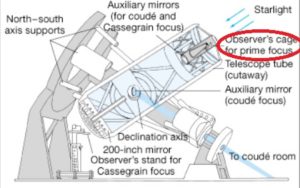
What these individuals may have been doing while in this energy-bathed state is anybody’s guess. But the whole thing has a palpable sexual aura to it.

And it is this just this elaborate and variegated tapestry of symbolism that has been hinted at and showcased by Fortean journalist and writer Jim Brandon in his Sirius Rising redux.

Introduction to Downard

Jim Brandon is the pen name of the author of the hard-to-find and much-pirated Weird America: A Guide to Places of Mystery in the United States[15] and The Rebirth of Pan: Hidden Faces of the American Earth Spirit.[16]

The original Sirius Rising (SR) recording has attained something of a buzz among Synchromystics and aficionados. Originally, recorded in the 1970s on reel to reel, SR is based upon a series of interviews with Synchromystic chieftain James Shelby Downard.[17]

Downard, who died in 1998 at the age of 85,[18] is as enigmatic as he is inimitable. The broad contours of his life have been somewhat unriddled by Richard Spence, professor of military (and other) history at the University of Idaho. Spence’s serious research draws upon his wealth of academic and research experience tracking down individuals who are trained to obscure their personal histories.

As Spence puts it: “…I spend an unhealthy amount of time delving through passenger lists, census records, investigative files and similar databases trying to piece together the movements and associations of spies and kindred shady types. …Using the same techniques, I decided to see what I could turn up on Downard.”

I won’t spoil for you the experience of following along with Spence as he recounts his investigative journey. And I won’t reproduce much of the good doctor’s work, here – save for this.

In a paragraph summarizing his tentative conclusions, Spence opines: “Shelby James Downard was unequivocally real. However delusional or exaggerated his adventures may have been, they are woven around a framework of real places, people and events. …There is …a multitude of puzzling coincidences, perhaps signifying some larger reality we cannot see or understand, perhaps signifying nothing.”[19]

I highly encourage interested readers to search for “Searching for James Shelby Downard.”

The Sirius Rising (SR) recording

Brandon’s newly revamped SR has two foci.

On the one hand, there is the centerpiece symbol: Sirius. As I already noted, Sirius’s various layers of meaning and interconnections with other areas of research are endless fascinating.

On the other hand, though, Downard himself is magnetic and captivating. Shelby, as his friends apparently knew him, is something of a hidden “power” behind the work of multiple, contemporary researchers and theorists. In this way, Downard himself is a Sirius symbol. He’s the hidden sun behind the brighter lights of Forteans and Synchronmystics including Michael Hoffman, Loren Coleman, and the SR interviewer himself, Jim Brandon.

For more on Downard and his unique œuvre, see HERE.

A rough outline of the SR presentation – which is actually part 1 of a series – is as follows.

  1. Introduction: There is a secret society in America
  2. Three assassinations (Two Kennedys and Martin Luther King, Jr.)
  3. The ‘Killing of the King’ (Alchemical Rite and the trail leading to it: The ‘Journey of Death’)
  4. Destruction of ‘primordial matter’ – The ‘Trinity Site’
  5. The moon trip – Jules Verne & Cape Canaveral
  6. The Palomar telescope (Saturn, ‘mystic rays,’ and the folks who ‘tune-in’ on them)

Along the way, Brandon and Downard explore such themes and topics as:

  • The 33-degree latitude line
  • Alchemy
  • Androgyne and hermaphrodite symbolism
  • CERN
  • Cape Canaveral
  • Freemasonry (Egyptian & Scottish Rites)
  • The Hellfire Club
  • The Jornada del Muerto
  • Kern Gate
  • The Knights Templar
  • Ley Lines
  • Loch Ness
  • Mount Palomar
  • The Ordo Templi Orientis
  • The Pentagon
  • Phoenix lore
  • Ritual murder
  • Sex Magic
  • The Symbionese Liberation Army
  • Vacaville
  • Washington D.C.

And mentions such personalities – whether notable or virtually unknown – as:

  • Fidel Castro
  • Elizabeth Chudleigh
  • Franklin Cover
  • Aleister Crowley
  • Sir Francis Dashwood
  • Donald David “Cinque” DeFreeze
  • Henry Flagler
  • Dion Fortune
  • Leslie Groves
  • Tranchell Hayes
  • Patty Hearst
  • Edgar Hoover
  • Lyndon Baines & “Lady Bird” Johnson
  • Carl Gustav Jung
  • John Keel
  • John F. & Jacqueline Kennedy
  • Jack Parsons
  • Albert Pike
  • James Earl Ray
  • John D. Rockefeller
  • Jack Ruby
  • Georgia Tann
  • Jules Verne
  • Allan Witwer

To obtain the CD domestically, try emailing Loren Coleman: LColeman [@] maine.rr.com.

Last I checked, the recording was selling for $17, postpaid.

Notes:

[1] The Ancient Egyptians referred to this star as “Sothis,” and it was reputed to be the star of the Goddess Isis.

[2] For example, Kenneth Grant alleged that occultist Edward Alexander (“Aleister”) “Crowley identified the heart of the Thelemic current with one particular Star. In Ocuclt Tradition, this is ‘the sun behind the Sun,’ the Hidden God, the vast star Sirius, or Sothis, which opened the zodiacal year of 365 days as well as the Great Year of approximately 26,000 years,” The Magical Revival, London: Skoob Books Publ., 1991, p. 50. This has been echoed all sorts of places. “The first major symbol to discuss is the point within the circle or the symbol of the Sun. …The point within the circle also represents the All-Seeing Eye that means a watcher of this world which is Typhon and Sut. …The point within the circle has yet another meaning. This point within the circle represents two suns.  Our normal sun that’s visible in daylight, and the sun behind the sun, which represents Sirius.” At least, according to an alien enthusiast calling him- or herself HiddenLight777 in an article titled “Extraterrestrial Symbolism,” Ja. 25, 2009, <https://hiddenlight777.wordpress.com/2009/01/25/extraterrestrial-symbolism/>. The “extraterrestrial” angle is not limited to dark cyber oubliettes. For a more mainstream exploration, see Robert Temple’s The Sirius Mystery, originally published by Futura (London, 1976) and cited elsewhere in this article – though, in a later edition.

[3] John Anthony West, Serpent in the Sky: The High Wisdom of Ancient Egypt, Wheaton, Ill.: Quest Books, 1993, p. 97, <https://books.google.com/books?id=0S1qpP7By9IC&pg=PA97>.

[4] Elsewhere, the Blazing Star has been put forward as a symbol of the alchemical quintessence. See Timothy Hogan, The Alchemical Keys to Masonic Ritual, Morrisville, N.C.: Lulu, 2007, p. 22.

[5] Albert Pike, Morals and Dogma, Richmond, Virg.: L. H. Jenkins, 1946, pp. 14-15 and 486. Cf. Craig Heimbichner and Adam Parfrey, Ritual America: Secret Brotherhoods and Their Influence on American Society: A Visual Guide, [Port Townsend, Wash.:] Feral House, 2012, p. 158. (CAPITALIZATIONS in original.)

[6] The name “Sothis” also crops up in Gustav Davidson’s A Dictionary of Angels – Including the Fallen Angles (paperback ed., New York: The Free Press, 1971, p. 278), where we read: “Sothis (Sotis) – angel of an hour. [Rf. H.D.’s poem ‘Sagesse’; Ambelain, La Kabbale Pratique].” Also, on page 219: “Pahaliah – an angel invoked to convert heathens to Christianity. He rules theology and morals and is one of the angels bearing the mystical name of God Shemhamphorae. Pahaliah’s corresponding angle is Sothis. [Rf. Ambelain, La Kabbale Pratique, p. 264].” The reference to “Christian” proselytism is somewhat laughable. The so-called “Shemhamphorae” – or Shem ha-Mephorash, or Shem Hamphorasch, etc. – means the “ineffable name” and designates seventy-two alleged “mystical” names of God, divined through the application of Sod (esoteric interpretation) to the Old Testament Book of Ezekiel (specifically, chapter 14, verse 19-21), and part of Jewish Kabbalism.

[7] Patricia Turner and Charles Russell Turner, “Sothis,” Dictionary of Ancient Deities, Oxford: Oxford Univ Press, 2000, p. 438.

[8] Turner and Turner, “Sirius,” op. cit., p. 433.

[9] Robert Anton Wilson, Cosmic Trigger Volume I: Final Secret of the Illuminati, 23rd printing, Las Vegas, N.V.: New Falcon Publ., 2011, p. 87.

[10] Dennis Hauck, p. 118.

[11] Ibid., p. 119.

[12] Ibid.

[13] In the New Testament biblical Book of Revelation, Jesus is referred to as the “Alpha and the Omega, the first and the last, the beginning and the end.” Revelation chap. 22, verse 1. See also Rev. 1:8, 1:17-18, and 21:6-7. These references hearken back to the Old Testament Book of Isaiah (see 44:6 & 48:12) where Yahweh is described as speaking of himself in similar terms.

[14] Robert K. G. Temple, The Sirius Mystery, Rochester, Vt.: Destiny Books, 1987, p. 29. Researcher Peter Levenda relates: “If we are to believe Robert Temple, for example (and there is no reason why we should not), then the US government was extremely interested in his research into the African Dogon tribe — the primitive tribe that knew of the existence of both Sirius A and Sirius B, including having much detailed information about the physical and chemical composition of both, as well as an accurate calendar of the double star’s movements — and attempted  to keep Temple from publishing his results in The Sirius Mystery, an attempt that obviously failed. Whether or not the attempt was a genuine, albeit half-hearted, effort on the behalf of the CIA to stop Temple from publishing, or was itself part of a disinformation campaign or some other psy-war experiment, is not known. What is known is that the CIA knew in detail of Temple’s research long before he had gone to press.” Peter Levenda, Sinister Forces: A Grimoire of American Political Witchcraft: Book Three: The Manson Secret, Walterville, Ore.: Trine Day, 2011, pp. 273-274.

[15] New York: Dutton, 1978.

[16] Dunlap, Ill.: Firebird Press, 1983.

[17] Jim Brandon distributed the original SR recordings as a set of cassette tapes. Some correspondents received one cassette. Others received more than one. Only a handful possess the original set in cassette format. More recently, a few copies of SR recordings have made the rounds as audio CDs. But, for the most part, the recordings have remained inaccessible.

[18] Born March 13, 1913 and died March 16, 1998.

[19] Richard B. Spence, “Searching for James Shelby Downard.” The publication history of this article is somewhat complicated. I first encountered it, with an introduction penned by Fortean Adam Gorightly, on the website ForteansWest, dated June 2012, <http://forteanswest.com/lowfi/editorials/richard-b-spence-june-2012/>. Spence’s article had also been picked up by Paranoia magazine, and published on pages 20-24 of issue #52, Summer 2012. The ForteansWest link became nonfunctional sometime around 2015. That same year, Spence revised and expanded his article. Though, I am unaware whether this longer piece has found a home online.

*********************************

“Sirius”

“When sweet-eyed spirit round the windows hover,
At the first breathing of the gloaming grey,
And the soft shadows of the evening cover
The sins and sorrows of the dying day;

“Then the sad moon, in nightly penancy dreary,
Crosses the pathless desert of the sky,
And hastes, with pallid face and footsteps weary,
A soul that may not rest and dare not die.

“But when she sinks beneath the rim of Ocean,
And hastens to her home afar from earth.
To hide her silent glitter with a fresher mirth.

“They look on us with glances true and tender,
Piercing our spirits with the sleepless eyes;
And one among them shines with tenfold splendour,
Brighter than all the children of the skies.

“O Prince of all the gleaming sons of Heaven!
O Leader of the glad celestial host!
Thous art to me the dearest joy of even;
Thou art the friend my spirit longs for most.

“I know that thou canst hear my vainly calling,
In that undying heaven where thou art;
I know that thou canst see my sad tears falling;
I know that they keen sight can read my heart,

“Wilt thou not speak to me, O child of glory,
And tell me why my heart so yearns for thee?
I know that thou canst tell me all our story,
All that we knew ere earth began to be.

“Thou wilt not speak! And yet I love thee, spirit,
More than I love children of this earth;
And when I shall, in my last days, inherit
The dim great halls of him who knows no mirth,

“Let me be laid where, in the flower-strewn meadows,
Over my head the long lush grass shall wave,
And do thou come with the soft midnight shadows,
And look upon me in my silent grave.”

(Alexander Richard Eagar, “Sirius,” Prometheus: And Other Poems, Dublin: E. Ponsonby; London: Simpkin, Marshall, & Co., 1877, pp. 48-49, <https://books.google.com/books?id=OQlLAAAAIAAJ&pg=PA48>.)
SynchroMysticism and ‘Twilight Language’: Michael A. Hoffman II

Michael A. Hoffman is as controversial a contemporary researcher and writer as one can find. But with around eight diverse and original titles to his credit, he is an imaginative and intriguing thinker.

Often tackling religious topics, he has authored several books that are concerned with Roman Catholicism. One such offering, hot off the press (May, 2017) is The Occult Renaissance Church of Rome. Historically, the Renaissance and the Reformation (and pre-Reformation) are connected. Hoffman excavates some of the history, with an emphasis upon how neo-platonic and occultic sub-currents within the Catholic Church converged to create a stream that is arguably diabolical.

So-called “Traditionalists,” or “Trads” (among others), will also find much of interest in the 2013 Usury in Christendom. As the subtitle (“The Mortal Sin* That Was and Now Is Not”) makes clear, this volume takes the Church to task concerning its changing teaching on lending money at interest. (For other offbeat Catholic writers, see Michael Davies, Solange Hertz, E. Michael Jones, and Robert Sungenis.)

(* In Catholic parlance, a “mortal sin” is held to be “a grave offense against God’s law, which brings spiritual death to the soul by depriving it of its supernatural life, sanctifying grace.”)

Hoffman has also penned a provocative, 1,100-page tome on Judaism: Judaism Discovered. This 2008 work delves into such mystically charged topics as goddess cults, moon worship, and sex magic -all within Judaism. For a more accessible introduction to these (and other) subjects, see Judaism’s Strange Gods which, in its 2011 edition, is a condensed version of the longer treatise. (Book collectors, take note: The original, 2000 edition of Judaism’s Strange Gods may eventually be prized as a rare find. Other writers in this genre include Johannes Alzog, Joseph Barclay, Isidore Bertrand, Johannes Buxtorf, Luigi Chiarini, Gustaf Dalman, Johann Eisenmenger, Theodor Keim, Heinrich Laible, Martin Luther, Raymond Martini, Alexander McCaul, Bernhard Pick, Peter Schaefer, and Johann Wagenseil.)

Whereas, Peter Levenda and Christopher Knowles appear generally left-leaning, socially, Hoffman is (on many issues), plausibly fairly classified as a staunch rightist. (Loren Coleman, whatever his personal sympathies, seems to try to stay politically neutral and uninvolved. )

Nevertheless, in contradistinction to many self-professed “conservatives,” Mr. Hoffman sides with Israeli critics such as Uri Avnery, Noam Chomsky, Norman Finkelstein, Paul Findley, J. William Fulbright, Philip Giraldi, Baruch Kimmerling, Alfred Lilienthal, Victor Marchetti, Ray McGovern, John Mearsheimer, Victor Ostrovsky, James Petras, Israel Shahak, Israel Shamir, Yoav Shamir, Stephen Walt, Alison Weir, Philip Weiss, and others. His middle-eastern investigations issued in a condemnation of what he termed Israeli “war crimes and atrocities.” His The Israeli Holocaust Against the Palestinians was co-written with one Moshe Lieberman and was published in 2003.

An earlier effort, They Were White and They Were Slaves (1991-1992), was recently magnified in importance when its titular thesis was roundly denied by various media outlets, including the Huffington Post, the New York Times, and Slate.

For purposes of this weblog, Hoffman’s principal book of interest is his Secret Societies and Psychological Warfare. Originally released in 1989, it was subsequently reissued in a substantially updated edition in 2001 – just prior to the terrorist attacks of September 11.

In this publication, which in some circles has achieved a kind of cult-classic status, Hoffman discloses arcane notions such as the occultic roots of modern Catholicism and Protestantism, “serial murder” as a species of psychological warfare, electronic methods of “programming” people both individually and collectively, and much else besides. Along the way, he discusses Alchemy, Freemasonry, and Satanism.

As one of James Shelby Downard‘s two main protégés, Hoffman also expends considerable effort expanding upon Downard’s penetrating conception of “mystical toponomy” (that is, the SynchroMystic aspect of place names). However, he also explicates his own thoughts concerning an ancient and little-understood argot called “Twilight Language.”

Loren Coleman‘s readers will already be well-familiar with this latter term, since Coleman co-opted it as the title of his weblog. In Coleman’s lexicon, it seems to be a “catch-all” for any “name game” or SynchroMystical connection – whether mystical-toponomical, numerological, or what have you.

Hoffman writes: “There is a dark poetry to ritual murder, to twilight language, to the fantastic convergences known as coincidence [i.e., synchronicity]. Most ‘conspiracy researchers’ miss these. The best investigator – of the occult or of almost anything else – has a childlike sense of curiosity and wonder about the seemingly mundane things.”

In a footnote, he adds: “In the secret societies, ‘twilight language,’ was advertised as the ‘Adamic language,’ the language Adam learned from God in Eden, ‘the key to divine knowledge.'”

Who Started SynchroMysticism? James Shelby Downard

Who really kick started SynchroMysticism? The question is easily enough posed. Answering it is another matter.

We have already showcased the renowned Swiss psychoanalyst, Carl Jung. He is arguably the fountainhead of the concept of synchronicity. It is by no means clear that Jung did not himself have “mystical” inclinations.

Still, if Jung is justly thought of as the “godfather” of the rigorous investigation of coincidence (as he arguably is), then James Shelby Downard is perhaps, and equally fairly, considered to be the godfather of SynchroMysticism. Indeed, the ubiquitous Loren Coleman treats Shelby Downard in precisely this way.

Coleman refers to Mr. Downard as “an American theorist and pamphleteer who shared his thoughts about conspiracies, coincidences, synchronicity, and symbolism,” and points readers to a gripping booklet written by the self-proclaimed “crackpot historian” and “Discordian” enthusiast, Adam Gorightly.

Gorightly, who is the author of such works as Historia Discordia: The Origins of the Discordian Society (New York: RVP Press, 2014), The Prankster and the Conspiracy: The Story of Kerry Thornley and How He Met Oswald and Inspired the Counterculture (New York: Paraview Press, 2003), and The Shadow Over Santa Susana: Black Magic, Mind Control And The Manson Family Mythos (Lincoln, NE: iUniverse, 2001), tackles our little-known SynchroMystic trailblazer in James Shelby Downard’s Mystical War (College Station, TX: Virtual Book Worm 2008).

James Shelby Downard’s Mystical War is an excellent introduction to the titular hero. Gorightly provides an accessible sketch of some of the noteworthy events in the life of Mr. Downard. At least it’s a bit more tractable than Downard’s own, sometimes rambling but always enthralling, autobiography, The Carnivals of Life and Death: My Profane Youth: 1913-1935 (Los Angeles: Feral House, 2006).

Perhaps more importantly for present purposes, an understandable primer into some of Downard’s less comprehensible ideas such as “mystical toponomy.”

“Toponomy,” of course, is the study of place names.  “Mysticism,” generally speaking, is the practice of seeking “union” with the Divine – as well as beliefs attending and supporting that practice. However, in Downard’s idiom, the word “mystical” seems to have the sense of “esoteric.” The idea is that certain place names appear to have recondite significance and turn up in peculiar connections, to say the least.

Gorightly provides the illustration of the “Mason Road,” in Texas. This road ties together with a sweeping hypothesis concerning the assassination of former U.S. President John F. Kennedy. In Downard’s proposal, the murder of JFK, whatever else it may have been, was a grand enactment of a ritual designated by the 19th-20th-century Scottish anthropologist Sir James Frazer in his The Golden Bough: A Study in Comparative Religion (London: Macmillan and Co.,  1890). And, to Shelby Downard, the alchemically permeated brotherhood of Freemasonry was heavily implicated.

A short post of this sort cannot possible do justice to the depth or originality of such a theorist as James Shelby Downard. Readers eager for even more are highly encouraged to dive into the various offerings of “Downardiana,” including – once they feel up tot he task – Downard’s own musings.

To get you started, we note that besides Gorightly’s tract, Dr. Richard Spence has also penned an outstanding article on Downard, now available in Paranoia Magazine (Issue #52).

In an upcoming installment, we will spotlight Michael A. Hoffman II, Shelby’s protégé in matters Fortean and SynchroMystic. Please, check back for that update (among others). [Update: The article is now online, HERE.]

Postscript: We have previously mentioned Christopher Knowles‘s sensible observation that it is tricky business trying to single out a single pioneering soul and labeling him or her “the” founder of a phenomenon as multifaceted as SynchroMysticism. We acknowledge this. (For more detail, see here.) Still, Shelby Downard was significant (or perhaps incomparable) in many ways. Highlighting him for special approbation is, in our opinion, and in the opinion of others mentioned above, entirely appropriate.

SynchroMysticism in Books: Peter Levenda

As mentioned in the previous post, Peter Levenda is a person readers are likely to encounter as the probe the sometimes murky recesses of esotericism, occultism, and, yes, SynchroMysticism.

Levenda, similarly to Christopher Knowles, seems a bit more left-leaning than some of the individuals that we will look at in upcoming posts.  Professionally, he is an author and offbeat historian of sorts. An early focus was on the obscure intersection of Nazism and, well, magic.

In this genre, Levenda has three impressive offerings. The primary book of interest to those who study historic “Hitlerism” is his 1995 book, Unholy Alliance: A History of Nazi Involvement With the Occult (New York: Avon). Of more specialized appeal is his quirky, 2012 speculations that Hitler escaped Germany at the conclusion of World War Two. (See Ratline: Soviet spies, Nazi Priests, and the Disappearance of Adolf Hitler, Lake Worth, FL: Ibis Press.) More recently, in his The Hitler Legacy: The Nazi Cult in Diaspora, How it was Organized, How it was Funded, and Why it remains a Threat to Global Security in the Age of Terrorism (Lake Worth, FL: Ibis Press, 2014), he has applied his historical views to more contemporary problems.

In this way, Levenda’s subject matter overlaps with the more mainstream academic publications of the later British Professor Nicholas Goodrick-Clarke. In such texts as The Occult Roots of Nazism: The Ariosophists of Austria and Germany, 1890–1935 (Wellingborough, U.K.: Aquarian Press, 1985), Hitler’s Priestess: Savitri Devi, the Hindu-Aryan Myth and Neo-Nazism (New York: NYU P, 1998), and Black Sun: Aryan Cults, Esoteric Nazism, and the Politics of Identity (New York: NYU P, 2001), Goodrick-Clarke also explored the cryptic conjunction of 20th-century German National Socialism and the dark arts.

As a survey of the titles suggests, both Goodrick-Clarke and Levenda deal at length with personalities like Rudolf Hess (who had a well-known affinity for astrology and esotericism) and Heinrich Himmler (who had charged the Ahnenerbe with the task of validating Aryan and Nordic mythology).

But they also get into less-familiar territory and explore such controversial topics as the Teutonically tinged occult philosophy of “Ariosophy,” begun by Lanz von Liebenfels and Guido von List. Ariosophy (literally, “Aryan wisdom”) was, like Rudolf Steiner’s “Anthroposophy,” an offshoot of Russian mystic Helena Blavatsky’s Theosophical Society. Readers may recall that Blavatsky had transplanted herself to Great Britain and founded “theosophy” (the “wisdom of God”) along with Colonel Henry Steel Olcott. The society was continued by figures such as Alice Bailey and Annie Besant.

Meanwhile, the occultist R. A. Schwaller de Lubicz, who also had links to the seemingly all-pervasive Theosophical Society, represents a connection between German and French occultism. Schwaller de Lubicz is one of the candidates for having penned the alchemical treatise The Mystery of the Cathedrals, attributed to one “Fulcanelli,” who the former claimed to have once met.

At any rate, Levenda has also produced several investigative tomes that may be of more general interest to those with a SynchroMystic turn of mind.

At the top of this list must surely be his Sinister Forces trilogy: The Nine: A Grimoire of American Political Witchcraft (with Jim Hougan, Walterville, OR: Trine Day, 2005), A Warm Gun: A Grimoire of American Political Witchcraft (with Dick Russell, Walterville, OR: Trine Day, 2005), and The Manson Secret: A Grimoire of American Political Witchcraft (Walterville, OR: Trine Day, 2006). The books delve into “the roots of coincidence and conspiracy in American politics, crime, and culture,” and Levenda purports to disclose riveting ties “between religion, political conspiracy, and occultism.”

Levenda has also made forays into the arcane subject of alchemy that, readers will recall, was of seminal importance to synchronicity’s “founding father,” Swiss polymath and psychiatrist, Carl Gustav Jung. In such treatises as Stairway to Heaven: Chinese Alchemists, Jewish Kabbalists, and the Art of Spiritual Transformation (New York: Continuum, 2008), Tantric Temples: Eros and Magic in Java (Lake Worth, FL : Ibis Press, 2011), and The Tantric Alchemist: Thomas Vaughan and the Indian Tantric Tradition (Lake Worth, Florida : Ibis Press, 2015), he introduces readers to the related disciplines of alchemy and Tantrism, which have had such a profound influence on Western SynchroMysticism.

A versatile writer, Levenda has expanded his oeuvre with volumes on Freemasonry and on the 20th-century, American horror savant H. P. Lovecraft. Lovecraft’s Cthulhu Mythos has practically achieved cultic status in the years since his untimely death on the Ides of March, 1937.

On Freemasonry, which is itself arguably an outgrowth of the alchemically infused Rosicrucianism of the early 1600s, see: The Secret Temple: Masons, Mysteries, and the Founding of America (New York ; London : Continuum, 2009) and The Angel and The Sorcerer (Lake Worth, FL : Ibis Press, 2012).

On Lovecraft and the Lovecraftian universe, see Gates of the Necronomicon (written by the mysterious “Simon” and attributed to Levenda, New York: Avon, 2006), The Dark Lord: H. P. Lovecraft, Kenneth Grant, and the Typhonian Tradition in Magic (with James Wasserman, Lake Worth, FL: Ibis Press, 2013), and The Lovecraft Code (Lake Worth, FL : Ibis Press, 2016).

Who Writes on SynchroMysticism and Synchronicity?

Beside the seemingly ever-present Loren Coleman, and the  other individuals previously highlighted (so far: Jay Dyer, Carl Jung, and Jake Kotze), where else can interested readers turn for more examples and more information?

Here, we will list two (well, three) other others.

The first additional commentator of interest is the comic-book artist and author, Christopher Knowles. He is otherwise known for insightful books such as Our Gods Wear Spandex: The Secret History of Comic Book Heroes (with Joseph Michael Linsner, Newburyport, MA: Red Wheel Weiser, 2007),  The Complete X-Files: Behind the Series, the Myths, and the Movies (with Matt Hurwitz, Insight Editions, 2008), and The Secret History of Rock ‘n’ Roll: The mysterious roots of modern music (Berkeley, CA: Viva Editions, 2010).

Knowles’s weblog, The Secret Sun, is replete with references to SynchroMysticism and synchronicity, as a simple Google search will reveal. One particular post, “Credit Where Credit is Due,” eloquently makes one point that this author has been at pains to disclose: namely, the relevant areas of inquiry derive from the input and thought of many key people.

It is perhaps quite true to say that Carl Jung, more than anyone else, deserves recognition for initiating these studies. However, as Jung himself makes clear, innumerable, pertinent pieces of background came to him by way of reflections upon ancient alchemy (among other sources).

In addition to the above-mentioned post, which is ought to be given a careful read by interested students, Knowles has countless others that should both entertain visitors to his blog, as well as enlighten those wishing to contend with (if not quite get a handle on) SynchroMysticism.

A second fascinating analyst is the curious S. K. Bain, whose Most Dangerous Book in the World: 9/11 as Mass Ritual (Walterville, OR: Trine Day, 2012) contains a foreword by Peter Levenda (on whom more in a future writing). In Bain’s telling, the attacks on the Pentagon and World Trade Center, on September 11, 2001, were (in the words of the publisher’s able summary) an “occult-driven… Global Luciferian MegaRitual …a psychological warfare campaign built upon a deadly foundation of black magick and high technology.” It’s quite a SynchroMystical ride.

Something of a companion volume followed. In “Sherwood Kent’s” Most Dangerous: A True Story (Walterville, OR: Trine Day, 2016) one descends into a nightmarish tale abounding in disturbing and lurid instances of synchronicity.

Stay tuned.

Synchronicity Explained: Carl Jung

Little substantive progress can be made in apprehending (let alone comprehending) SynchroMysticism, or in advancing as a SynchroMystic, without grappling seriously with the work of the noted, 19th-20th-century Swiss analytic psychiatrist, Carl Gustav Jung. With the possible exception of Sigmund Freud (and if one leaves aside somewhat proto-scientific thinkers, like David Hume and John Locke), there is arguably no bigger name in the history of psychology.

Jung pioneered numerous, somewhat abstruse (if not vexed) concepts that have now become common currency in the English language. Entities and phenomena – or alleged entities and phenomena – such as “archetypes,” the “collective unconscious,” “extraversion” and “introversion,” nervous “complexes,” and, most notably from our standpoint, synchronicity.

In this seminal intellect’s lexicon, “synchronicity” marks out a sort of “acausal connecting principle.” What in the world does that mean?

Well, for some principle, P, to be a causal connecting principle would mean for P to explain how two things (say A and B) are related in terms of cause and effect. For instance, A might cause B; B might cause A; C might cause both A and B; C might cause A while D causes B; and so on.

In contemporary jargon, the word “cause” typically designates what Aristotle referred to as an “efficient cause.” He distinguished several other sorts of “cause” or, perhaps more accurately, of explanation.

Consider Mount Rushmore. To Aristotle, some object has first of all a “material cause.” In the case of Mount Rushmore, the material cause is, presumably, granite. Next, the object has a “formal cause.” This is roughly to say that the object has some pattern that it embodies or exhibits. Mount Rushmore is modeled upon the past, real-life visages of Thomas Jefferson, Abraham Lincoln, Theodore Roosevelt, and George Washington.

But an object also has some “efficient cause.” The quick and dirty way of getting a fix on this sort of cause is to think of the agent who applied the form to the matter. In the present case, the straightforward efficient cause of Mount Rushmore was the 19th-20th-century American sculptor Gutzon Borglum. Lastly, to Aristotle, an object also has a “final cause.” As a first pass, we can understand this as the purpose or reason for which the efficient cause acted. Let’s suppose that Borglum carved the faces of the four, previous-named presidents into the granite in order to honor the famous statesmen and increase the tourism business in South Dakota. These considerations, then, would count as final causes.

In any case, twenty-first-century scientific inquiry has little use for the notions of “formal” and “final” causation. Matter, on the other hand, is the work-a-day scientist’s bread and butter. However, referring to matter as a “cause” may have fallen a bit out of favor. That leaves only efficient causation.

Be that as it may, any of the four “causes” can be conceived as “connecting principles.” It’s easy – indeed even trivial – to do so. For example, we can say that “Mount Rushmore” and “granite” are connected in virtue of the fact that the former is “made out of” the latter. Or again, we can say that “Mount Rushmore” and “Jefferson, Lincoln, Roosevelt, and Washington” are connected in virtue of the fact that the former “resembles” the latter. Etc.

What Carl Jung wants to say, then, is that there are additional, “connecting principles” that have nothing to do with causation. Perhaps they have very little even to do with any kind of explanation.

Causation is often taken to be explanatory. If I break out in small, itchy blisters and it turns out that I have chickenpox, then we could say both that my blisters were caused by the chickenpox (varicella) virus and that the chickenpox explains my having broken out in said blisters.

Suppose, however, that John has newly arrived in a large city. He calls a phone number for some random job lead that he has been given only to discover that the person sitting next to him on the bus is the one who answers the call. That “John called X” and that “John was next to X on the bus” are, on the face of it, related neither in terms of causation nor explanation. It seems obvious that John calling X did not cause X to be next to him on the bus. Equally, though, John and X being near each other on the bus does not explain John calling X on the phone (or vice versa).

The two events – John’s call and John and X being in close proximity on the bus at exactly the same time as the phone call – were related in time merely by happenstance. It was a “coincidence.” Or so it would seem.

The two events are connected. If nothing else, they happened simultaneously. Importantly, the sort of connection in view is not causal. It is acausal. Hence, we have what Jung called an “acausal connecting principle.”

When this sort of connection occurs in a noteworthy context or seems to be imbued with some sort of significance, it is termed a synchronicity.

When a person is conscious of, revels in or studies, these sorts of synchronicities, that person could be termed a “SynchroMystic” and be said to have an interest in “SynchroMysticism.”

SynchroMysticism and Esotericism: Jay Dyer

One of the most common questions people have after encountering SynchroMysticism is: What is all this?

There are really two approaches to drafting a sort of first-pass answer.

Number one, a person could try to get a grip on the notion from a conceptual or theoretical standpoint. This is certainly commendable and possibly fruitful. Many of the posts in this series will be attempts to do just this – to “come to terms” with SynchroMysticism (in the sense propounded Mortimer J. Adler and Charles Van Doren). However, for many people, there is a far more accessible, practical, and (frankly) engaging avenue.

To put it plainly, number two, a person could just interact with various “Synchs” (as the meaningful coincidences are called) and learn by doing, as it were. In this vein, we will shortly be looking at various examples of SynchroMysticism. Or, at least, I will direct interested readers toward places where such examples may be found, mined, and reflected upon.

One rich resource, in this regard, is the film industry.  It is needful, though, to prime oneself, since what is envisioned is (emphatically) not merely grabbing a box of popcorn and “vegging out” in front of a television or theatre screen. Mindless pastimes have been starkly painted as soul-sucking activities that may literally lead us to amuse ourselves to death, to steal a phrase from the late, 20th-21st-century American author Neil Postman.

On the contrary, what is in view is a critical inspection of select Silver-Screen offerings. To obtain the requisite preparation for this interpretive task, it is highly recommended that neophytes look over the shoulders of those individuals who have as close to a proven track record as it is feasible to get in these matters.

There are several individuals who verge on expertise and whose output is worthy of careful study. (Again, we refer guests to Loren Coleman.) For the purposes of being introduced to the art and science of movie hermeneutics, Jay Dyer ranks surely high on the list of authorities who ought be consulted.

Dyer’s 2016 book, Esoteric Hollywood: Sex, Cults and Symbols in Film (Waterville, OR: Trine Day), is one of the staple texts for any SynchroMysticism 101 course.

Before proceeding, it is worth pondering the word “esoteric” for a moment.

“Esoteric” stands in contrast to “exoteric.” Both words derive from Greco-Roman vocabulary. Specifically, exōterikós marks out something that is “external” or directed “outwardly.” (The word “extrovert” uses the prefix “ex-” similarly.) The idea, here, is that an exoteric doctrine is one that is submitted for mass consumption; it’s promulgated to be believed (and perhaps understand) by the general public.

On the other hand, esōterikós had to do with something that is “internal” or “inwardly” oriented.* Hence, an esoteric principle or teaching is one that is reserved for a much smaller, and possibly private or restricted, group. The subgroup could be initiates into some mystery school or secret society, for instance. In any case, esotericism is the probing into such arcane and perhaps “classified” information.

Mr. Dyer acclimates readers to these matters in a way that is both captivating and enlightening.

In the course of his book, he exposes novices to a way of processing cinema on a deeper level than many will have taken notice of before. Veterans will have much with which to contend as well.

Dyer gives these motion pictures their own, dedicated chapters.

Careful reading of Dyer’s evaluations, in conjunction with a person’s own viewing of the movies in question, constitutes good SynchroMystical training. And most of this is embedded within a very absorbing and lively presentation.

To be sure, Dyer also touches upon theory. For example, he writes:

Synchronicity is real, and the inner worlds are connected to the outer worlds, but in my estimation all this needs to be purged of the gnostic notions of external reality being an “illusion.”

We will delve more into the above notions in future posts. For now, happy watching.

* Commonly used words beginning with “eso-” are in somewhat short supply. Interestingly, the Greek phageîn meant “to eat.” Our anatomical word “esophagus” could be – obscurely – thought of as an “internal thing” associated with eating. For more etymological musings, see The Etymologicon.

As a postscript, it is worth noting that there are numerous other films that deserve careful viewing from the budding or practiced SynchroMystic.  Some of them are linked to, below.

SynchroMysticism Applied: Loren Coleman

Loren Coleman is far and away the most prolific and well-known SynchroMystic on the web today. With over forty book titles to his credit, many of which are on the subject of cryptozoology (i.e., the study of alleged “hidden animals,” like “Big Foot” and the famed “Loch Ness Monster”), Coleman looms large on (what we might call) paranormal wavelengths.

For an introduction to the fascinating possibility that the world’s fauna include more species than those so-far cataloged and on display at your city menagerie, Coleman is the go-to guy.

Among his cryptozoological print offerings are Bigfoot! The True Story of Apes in America (New York: Paraview, 2003), Cryptozoology A to Z (with Jerome Clark, New York: Simon and Schuster, 1999), The Field Guide to Bigfoot and Other Mystery Primates (with Patrick Huyghe, New York: Anomalist, 2006), Monsters of Massachusetts (Mechanicsburg, PA: Stackpole, 2013), and Mysterious America (Kindle Edition, 2007).

He also maintains the cryptozoologically dedicated weblog, CryptoZooNews, and is curator of (and, presumably, docent at) the International Cryptozoology Museum at Thompson’s Point in Portland, Maine.

Of primary interest to us here, however, are the industrious Mr. Coleman’s other, more Fortean and SynchroMystical, researches.

Prominent in this regard are his innumerable posts on the Twilight Language weblog, which boasts well over 4 million total visitors.

The site’s name is a reference to an obscure, symbol-infused “language” that has apparent connections with various, Eastern, religious concepts – especially in certain Buddhist sub-traditions. (See here.)

In his 2004 book, The Copycat Effect: How the Media and Popular Culture Trigger the Mayhem in Tomorrow’s Headlines (New York: Simon and Schuster), Coleman wrote:

“Twilight language” concerns, from psychology, the hidden significance of locations, dates, and other signs; from religious studies, the hidden symbolism that lies in the texture of the incidents; and, from criminology, the profiling insights that have revealed the ritualistic nature of certain crimes and violent incidents.

In Coleman’s estimation, these “hidden significances” are largely discovered (or masked) in “Lexi-Links” (from the Greek léxis, meaning “speech” or “word” and the English “link,” which obviously has to do with the component parts of a chain) or what he elsewhere calls “name games.”

By “name games,” the prodigious Coleman seems to designate odd name-related patterns, or synchronicities, that crop up in newsworthy events from election results and political happenings to school shootings, serial murders, and suicides. The latter seem to occupy a conspicuous place in his thinking, due to a past, personal tragedy. (Incidentally, Coleman identifies 18th-19th-century German writer and Freemason Johann Wolfgang Von Goethe’s 1774 The Sorrows of Young Werther, available in a Dover Thrift Edition, as something of a locus classicus for suicide “copycatting.”)

These bizarre interconnections are perhaps best illustrated as opposed to merely described. The best advice for a person just dipping her toes into this unconventional territory is to simply learn by meditating upon Coleman’s various examples, embedded in his books and online posts.

Coleman seems less concerned with speculating about the possible, metaphysical foundations of “synchronicity,” and more focused upon engaging in and writing about examples of SynchroMysticism. This is evident in his above-mentioned “blogging” activities, which treat faithful readers to a steady diet of curious associations lying beneath interesting, and often world-historic, news events.

To date, Loren Coleman’s major, written statement on these matters is contained in the engrossing, and previously cited, The Copycat Effect, to which interested visitors are referred for further information. Happy reading.

SynchroMysticism Defined: Jake Kotze

SynchroMystic guru Loren Coleman credited author and filmmaker Jake Kotze with having coined the term “synchromysticism.” Coleman wrote:

The word “synchromysticism” was first coined by Jake Kotze in August 2006, on his website-at-the-time, Brave New World Order.* Kotze defined the concept as: “The art of realizing meaningful coincidence in the seemingly mundane with mystical or esoteric significance.” (Source.)

Let us mine some of the depths in this quotation.

One thing to notice is that the qualifier “meaningful” appears to do quite a bit of work. After all, on one definition of the word, “coincidence” merely marks out temporal correspondence.

Many of these correspondences are indeed mundane (both in the sense of being commonplace or worldly, and in the sense of being run-of-the-mill or, in a word, dull). For instance, as I type this, there is a song playing in the background, the air conditioner just kicked on, two Mourning doves are walking around outside, and so on.

Presumably, however, no one is tempted by the notion that there is any remarkable (i.e., meaningful) relationship between any of the scattered goings on that I just listed. For, at any given time, innumerable events are occurring simultaneously. The vast majority of these events with be nothing to write home about – whether individually or considered together.

What the synchromystic looks for, then, is not merely events that are temporally related, but events that are temporally associated in particular, “meaningful” ways.

Candidate events may have uninspired, “exoteric” (or outward and easily comprehended) meanings on the surface. But the synchromystic is the person who may notice esoteric significance lying under the uninteresting appearances.  (Or, at least, this is one way that person sympathetic to the project may understand it. Less sympathetic individuals may be tempted to the opinion that the synchromystic is “reading-into” events or engaging in wishful thinking or self-delusion.)

Kotze was a contributor to The Sync Book, published in 2011. He seems to take a monistic view of reality. On this sort of perspective, which appears (among other places) in some streams of Hinduism, all things are, ultimately “one.” Sameness is the fundamental property of existence, while difference is explained as illusion (maya).

Within this broad framework, synchronicity (that is, significant coincidence or simultaneity of “connected” events) is taken to be to a psychological phenomenon in which the percipient catches a glimpse of the “true,” undifferentiated nature of things.

Kotze’s view, while interesting, is far from the only view. In other posts, we will explore the views of other, influential thinkers from the famed Swiss psychoanalyst Carl Gustav Jung and Hungarian-British journalist Arthur Koestler, to lesser-known figures like the oraculist James Shelby Downard, and on to more contemporary commentators including the aforementioned cryptozoologist, Loren Coleman.

Stay tuned.

* Kotze’s weblog title is a composite of two phrases. Firstly, it is a reference to the so-called “New World Order.” Arguably, this phrase has at least two different interpretations. For more on the imperialistic interpretation, see books by Noam Chomsky and Henry Kissinger. For those with more conspiratorial turns of mind, see the “illuminist” interpretation propounded by persons like Mark Dice and A. Ralph Epperson. Secondly, Kotze’s phrase hearkens back to Aldous Huxley’s classic, 1932 novel, Brave New World. Huxley’s book, along with George Orwell’s dystopian nightmare, 1984, are practically required reading.