The All-Seeing Eye and unfinished pyramid on the back of the American $1 bill are among the most recognizable symbols in the United States. Their conventional interpretation is familiar: the Great Seal represents Providence, the thirteen original states, and the ideals of the American founding.
But the modern history of the symbol is considerably stranger.
In the second installment of our investigation into Bankers Trust, the Federal Reserve, and the symbolic architecture of American finance, we begin with a deceptively simple question: Who actually put the Eye and Pyramid on the dollar — and why?
The answer leads first to Treasury Secretary Henry Morgenthau Jr. and President Franklin D. Roosevelt, but then backward to Roosevelt’s Secretary of Agriculture and future Vice President, Henry A. Wallace. Wallace, in turn, was deeply fascinated by the Russian mystic and symbolist painter Nicholas Roerich, whom he regarded as a spiritual master.
According to the account explored here, Wallace discovered an obscure early-twentieth-century history of the Great Seal in the National Archives in 1934. He became particularly interested in the phrase Novus Ordo Seclorum — “New Order of the Ages” — and brought the material to Roosevelt. Roosevelt reportedly favored placing the Great Seal on American currency rather than the originally contemplated coin, and Treasury Secretary Morgenthau subsequently implemented the decision.
This creates a remarkable historical chain: Roerich → Wallace → Roosevelt → Morgenthau → the dollar.
But the story does not end with the Great Seal.
Roerich was associated with an elaborate tradition surrounding a mysterious “sacred stone,” sometimes identified by researchers with the Stone of Destiny, the Holy Grail, Jacob’s Pillow Stone, or the legendary Bethel Stone. One particularly curious version of the story claims that this object was delivered to Roerich in a wooden casket bearing the words “Banquer’s Trust.”
That detail brings the investigation back to the subject of Part One: Bankers Trust.
The connection becomes even more intriguing when we reconsider the pyramid. Bankers Trust’s former headquarters at 14 Wall Street was crowned by a monumental pyramid modeled in part on the Mausoleum at Halicarnassus — itself a tomb. Decades later, the bank’s successor headquarters at 130 Liberty Street stood directly beside the World Trade Center complex and was damaged during the destruction of the South Tower. During its subsequent demolition, human remains from the disaster were reportedly discovered on the roof.
Meanwhile, the dollar’s pyramid is conspicuously unfinished.
Its missing capstone invites another ancient association: the Egyptian Benben stone, traditionally associated with the first emergence of land at Heliopolis. The pyramid’s capstone, or pyramidion, was modeled upon this sacred stone. In the accompanying mythology, the Bennu bird — a self-renewing solar creature and traditional precursor of the phoenix — is associated with the Benben.
The symbolism therefore suggests a recurring pattern: destruction and rebirth, death and resurrection, chaos and order.
The American dollar’s reverse also contains the so-called eagle, which occult writer Manly P. Hall interpreted instead as a disguised phoenix. The phoenix, in turn, gives the story another symbolic connection with the destruction and subsequent rebuilding of the World Trade Center site.
And only blocks away sits the Federal Reserve Bank of New York at 33 Liberty Street.
Are all of these connections evidence of a single hidden plan?
That is not the claim.
The more interesting question, from the perspective of SynchroMystique, is whether meaningful patterns can emerge across history without requiring a single person or organization to consciously orchestrate every connection.
Carl Jung called this phenomenon synchronicity: an acausal connecting principle in which events, symbols, and meanings converge in ways that cannot necessarily be reduced to ordinary chains of physical causation.
The Eye on the dollar may therefore be worth examining not merely as a piece of American iconography, but as a symbolic object with a documented twentieth-century history — one that intersects with mysticism, political power, financial institutions, secret societies, ancient symbolism, and the recurring myth of death followed by rebirth.
The next time you pull a dollar from your wallet, look at the back.
A century after its founding, Bankers Trust has largely vanished from public memory. Yet its executives helped shape the Federal Reserve, its alumni occupied positions of extraordinary influence, and its name repeatedly surfaces at unexpected moments throughout modern American history. This investigation follows those recurring connections—from J. P. Morgan and Jekyll Island to intelligence agencies, Wall Street symbolism, and controversial financial episodes surrounding September 11—to ask whether one overlooked institution served as an enduring hub within America’s financial and political architecture. Rather than insisting on a single interpretation, the investigation invites readers to examine the historical record and draw their own conclusions.
Eyes Wide Shut, Jeffrey Epstein, and the Secret Society Hiding in Plain Sight
What if Stanley Kubrick’s final film wasn’t predicting Jeffrey Epstein—but revealing the kind of world that makes an Epstein possible?
In this new SynchroMystique™ video essay, we compare Eyes Wide Shut and the Epstein affair through the lens of Jungian synchronicity, symbolic pattern recognition, and cultural archetypes. Rather than advancing sensational claims, the presentation explores striking structural parallels involving secrecy, elite social networks, ritualized behavior, mutual compromise, and the insulation of concentrated power.
The result is less an investigation into any single individual than a meditation on recurring historical patterns—and why Kubrick’s final masterpiece seems increasingly prophetic in hindsight.
What happens when one forgotten Wall Street institution appears at the crossroads of finance, intelligence, political symbolism, esoteric history, and more than one of the most controversial episodes in modern America?
This investigation traces the remarkable history of Bankers Trust — from its origins within the J. P. Morgan financial network and its rôle in the rise of the Federal Reserve, through its pyramid-crowned headquarters at 14 Wall Street, to its later acquisition of Alex. Brown and eventual absorption into Deutsche Bank.
Along the way, unexpected connections emerge: Nicholas Roerich’s mysterious “wandering stone,” Henry Wallace’s fascination with esoteric symbolism, the appearance of the reverse Great Seal on the dollar bill, CIA executive Alvin Bernard A. B. “Buzzy” Krongard’s ties to Bankers Trust-Alex. Brown, the unresolved questions surrounding pre-9/11 options trading, and the destruction of the Deutsche Bank Building beside the World Trade Center.
Rather than arguing for a grand conspiracy per se, we examine the dense network of (documented) historical relationships through our usual pattern-detecting lenses of symbolism and Jungian synchronicity.
But, whether viewed as a patchwork of coincidence, an exploration in psychogeography or archetypal recurrence, or (indeed) bona-fide evidence of deeper historical forces, the story of Bankers Trust offers a striking case study in the strange ways power, symbolism, finance, and myth can intersect.
Who really bears the costs and risks of modern medicine?
In this new essay, I argue that the pharmaceutical industry’s greatest innovation may not be biomedical at all. Rather, it may be institutional.
Drawing upon legal history, public-choice economics, critical theory, and political economy, I trace how research costs, testing risks, malpractice exposure, and legal liability are systematically redistributed away from manufacturers and onto taxpayers, physicians, and patients.
Topics include the Bayh-Dole Act, off-label prescribing, the learned intermediary doctrine, regulatory capture, direct-to-consumer advertising, and the broader logic of instrumental rationality.
Whether one ultimately agrees or disagrees with the thesis, the resulting picture raises profound questions about how modern institutions distribute risk, responsibility, and reward.
Read the full essay on Substack. (Companion video is forthcoming.)
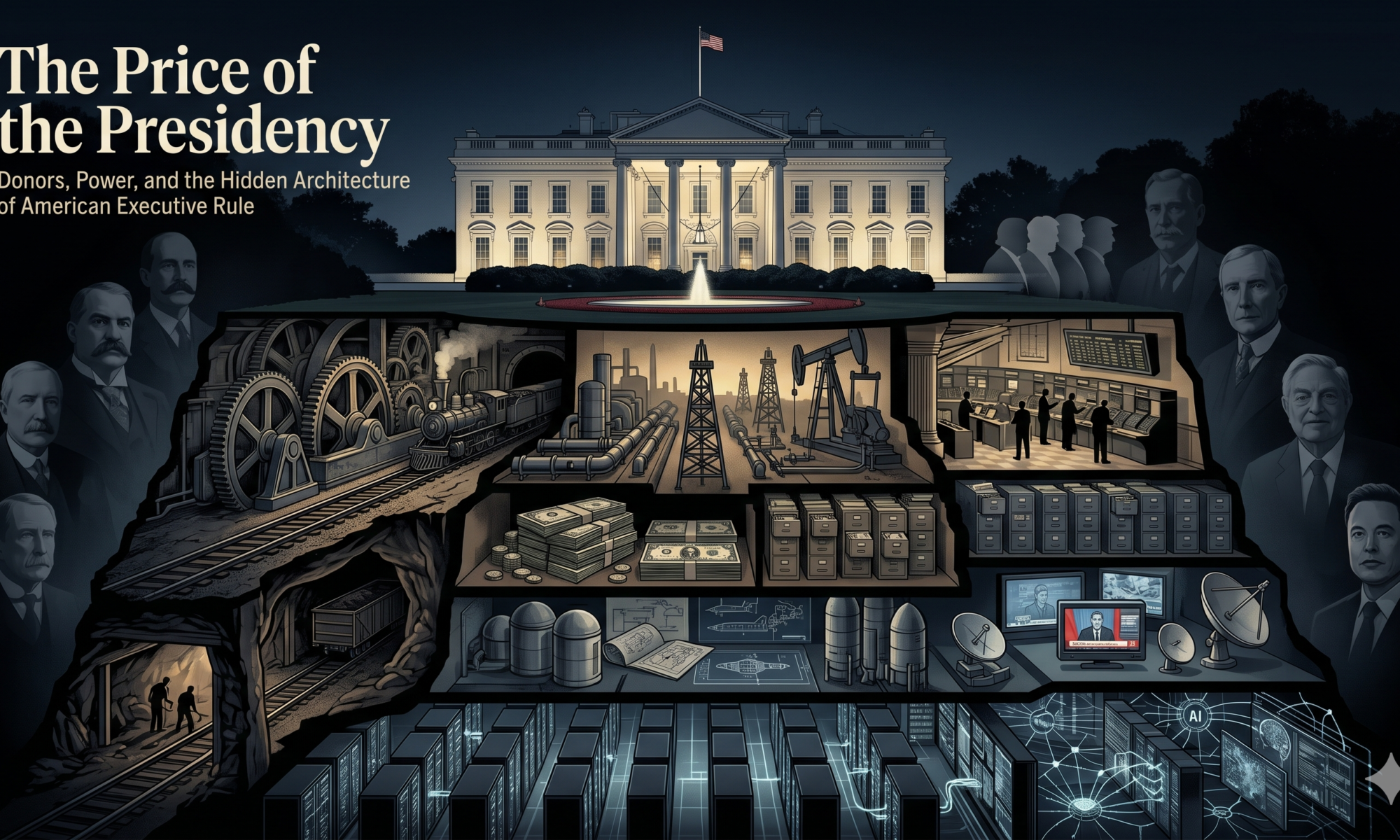
In this sweeping historical investigation, your faithful SynchroMystic, Matthew J. Bell, traces the evolution of presidential patronage from the Gilded Age of William McKinley and Mark Hanna to the age of Super PACs, billionaire donors, Silicon Valley influence networks, and “dark money.”
Far more than a mere catalog of wealthy benefactors, which you’ll nevertheless find, The Price of the Presidency examines how donor systems evolved into enduring political infrastructures capable not merely of influencing presidents — but potentially of generating the conditions under which executive power itself operates.
Touching on everything from the Rockefeller syndicate, the Bush and Kennedy dynasties, and the military-industrial complex to Citizens United v. FEC, ideological think tanks, and the modern “Deep State,” this essay (with expected video, forthcoming) explores whether presidents govern independently… or function inside pre-constructed systems financed by entrenched power networks.
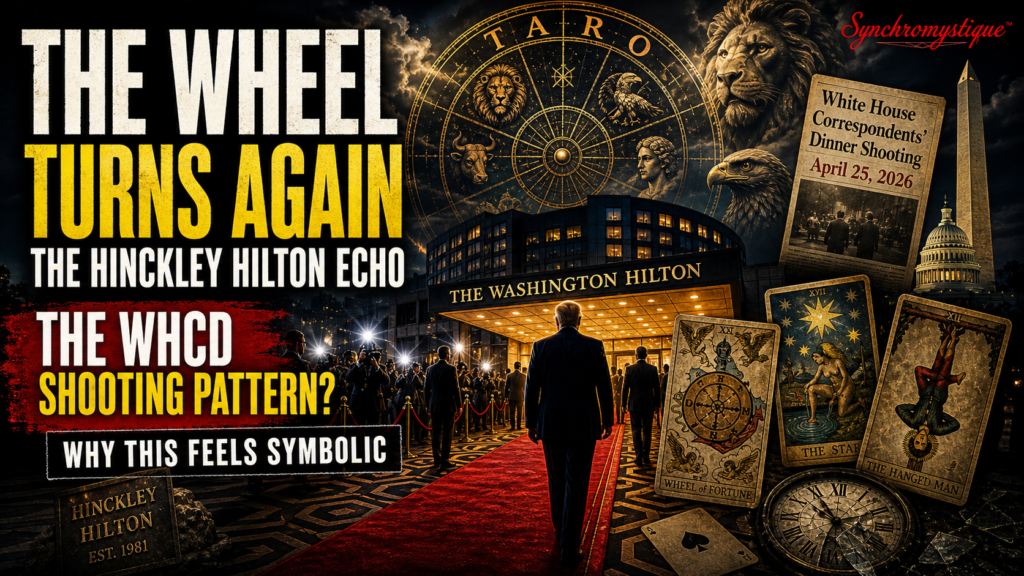
On April 25, 2026, violence disrupted the White House Correspondents’ Dinner at the Washington Hilton — a venue forever linked to the 1981 Reagan assassination attempt.
In this new investigation from The SynchroMystic, we explore the symbolic, historical, and esoteric dimensions surrounding the event.
From Tarot archetypes and ritual calendars to “Wheel of Fortune” recurrence patterns, Oz symbolism, political mythology, gematria claims, and the uncanny return to the “Hinckley Hilton,” this article examines how modern events become layered with symbolic meaning — whether intentionally or unconsciously.
Rather than making accusations, this presentation catalogs the synchronicities, symbolic echoes, historical parallels, and mythic patterns that observers have identified in the wake of the shooting.
If recurring symbolism, political ritual, occult interpretation, and cultural mythmaking interest you, this may be one of the most layered analyses yet.
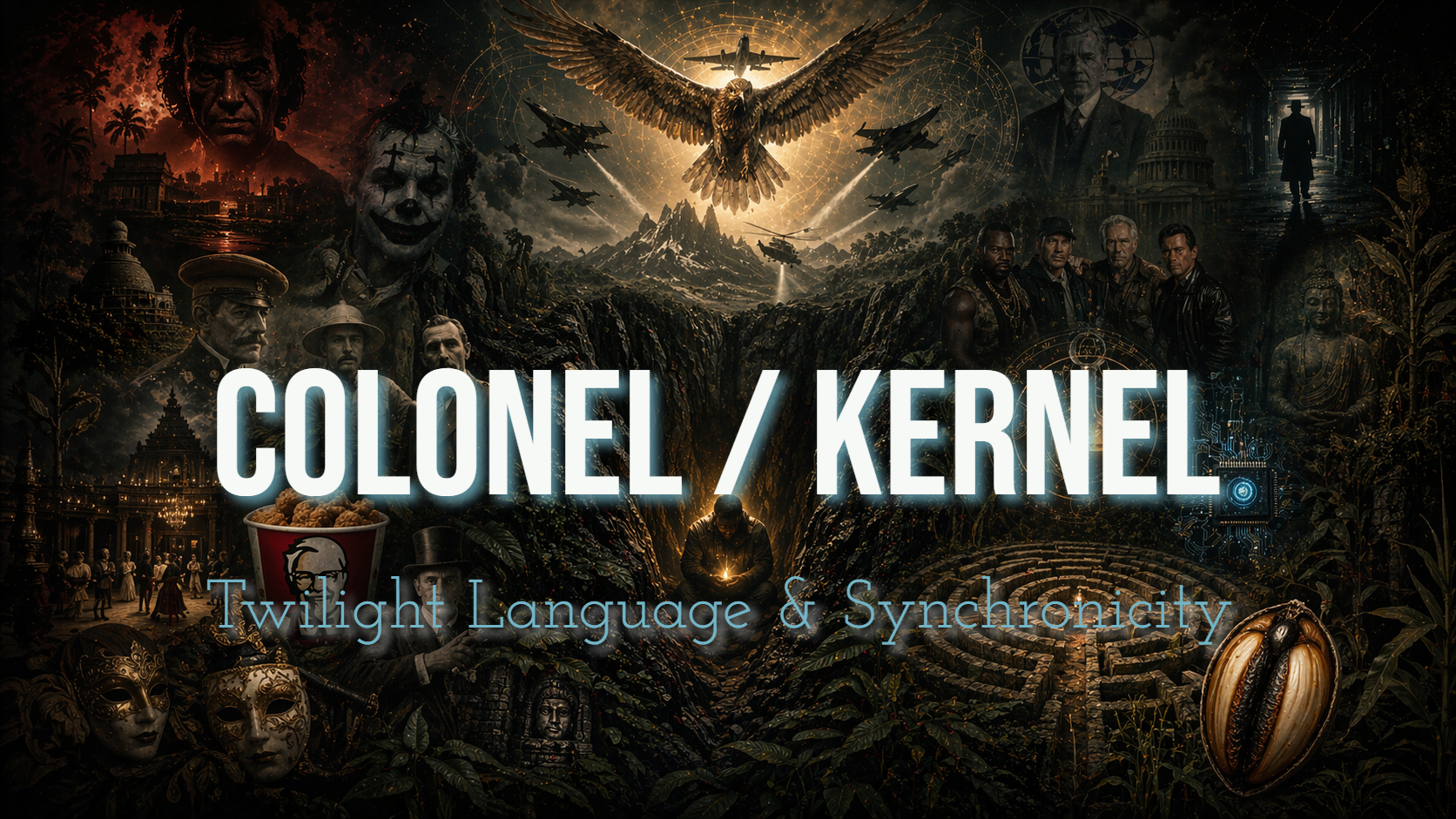
A widely circulated 2026 military rescue story — featuring a stranded “full-bird colonel” hiding in a mountain crevice — serves as the launching point for a deeper symbolic investigation.
This article/video — the latest in our ongoing Synchromystique™ project — explores the word “Colonel” as an archetypal mask appearing across history, fiction, and culture, from Colonels Kurtz (Apocalypse Now) and Cathcart (Catch-22) to Colonel Sanders (yeah, that’s KFC) and beyond. Through a lenses of Jungian syncrhonicity and Hoffmanian “Twilight Language,” the piece identifies a recurring pattern: the Colonel archetype serves to project of authority, identity, and persona.
But our inquiry goes further.
Because, when spoken, “colonel” shifts (sometimes imperceptibly) into “kernel” — the seed, the core, or the hidden center.
The modern rescue narrative becomes emblematic: authority stripped down to survival, rank reduced to signal, the mask collapsing into essence. The “Colonel in the crevice” becomes a living metaphor for descent, concealment, and rebirth. Curious timing for Springtime and Easter, wouldn’t you say?
This is not conventional analysis — it is symbolic cartography.
👉 Read the full article on Substack
COLONEL / KERNEL: by Matthew J Bell
A Synchromystical Meditation on Titles, Masks, & Seeds
‘Nazi’ Occultists, Part 2: 10 Party Members & Contemporaries (Full Version)
Intro
It’s the stuff of legend that Adolf Hitler – and, indeed, the entire Third Reich – was somehow empowered by occult forces.
According to one line of thought, the architect of German National Socialism was a powerful and shadowy occult adept identified as geopolitical strategist Karl Haushofer.
“Introduced by [Rudolf] Hess” – whom we will meet later – “General Karl Haushofer visited Hitler every day …[when the latter] was confined to prison at Landsberg” following the failed Beer Hall Putsch. Haushofer “spent hours with [Hitler,] expounding his theories …”. And it’s beyond question that Haushofer’s vision heavily influenced his pupil’s autobiographical Mein Kampf.
But, what researchers Louis Pauwels and Jacques Bergier insist upon, in their eye-popping volume The Morning of the Magicians, is that Haushofer exhibited “another personality – as a disciple of Schopenhauer[,] who had taken up Buddhism, [and as] an admirer of [Jesuit founder] Ignatius de Loyola…”. Haushofer is painted as the mystical mastermind behind Hitler.
Pauwels and Bergier suggest “that it was Haushofer who …chose the swastika as an emblem” for the new movement – the symbol being the ensign of an Aryan savior, as explained in Part 1.
Haushofer was “the magician …[and] secret master” pulling the strings of National Socialism.
Nowadays, it’s fashionable to disparage this as a flight of fancy. Tho… much the same judgment was expressed by an establishment insider, attorney Sidney S. Alderman – during the International Military Tribunal, no less. Colloquially known as the “Nuremberg Trials,” the IMT gave Alderman all the backing of United States Supreme Court Justice Robert H. Jackson.
On his own, Pauwels would connect Haushofer to the influential Armenian mystic George Ivanovich “G. I.” Gurdjieff.
We have mentioned Gurdjieff in passing before – such as in our video “10 Occultist Spies.”
We intend to feature him more prominently in our upcoming “Top Ten 20-Century Occultists.”
Those who fell under his sway – whether through books or personal encounters – include the offbeat “New Age guru” Bhagwan Shree Rajneesh, at least one of Tibet’s Dalai Lamas, and – if you believe the stories – the erstwhile Führer.
Naysayers are legion. But it’s worth contemplating the reasons such tales have plausibility – among them being the fact that many influential N.S principals had esoterica on their dossiers. So, in this video, we’ll pick up where we left off in Part 1. And we’ll catalog our top ten (10) occultists who operated within Hitler’s Germany.
Caveats and Disclaimers
Technically, starting around 1933, esoterics began receiving pushback from the government. By 1935, the National Socialist German Workers Party (NSDAP) had laws outlawing Masonic-style secret societies. These enactments – advanced by interior ministers such as Hermann Goering and Wilhelm Frick – negatively affected numerous völkisch neopagans, occultists, and organizations beyond Freemasonry. Orders were enforced by the “Security Service,” or SD, under Reinhard Heydrich. A few key groups – like the often-shocking Thule Society – had officially disbanded years before the crackdown.
Nevertheless, at various times, Germany was rife with occult activity. One of the most colorful of the era’s esoterics was the flamboyant hypnotist who comes in at number ten.
10 — Erik Jan Hanussen
In point of fact, Hanussen’s lasting reputation is partially owed to the Central Intelligence Agency’s principal predecessor, the Office of Strategic Services.
According to O.S.S. psychologist Walter Charles Langer, Adolf Hitler had been instructed in crowd manipulation, hypnotic suggestion, and even “mind control” by an expert “mentalist.” What name did Langer supply in his secret report? Erik Jan Hanussen.
Born Herschel Chaim Steinschneider, Hanussen eventually achieved fame enough to open a successful nightclub, which he named the “Palace of Occultism.” In this personal theater, Hanussen showcased a series of performances blending astrology, clairvoyance, mind-reading, telepathy, and other similar, “paranormal” talents.
Hanussen’s Wikipedia article claims that he was the real-life inspiration for the scheming magician Eduard Abramovich – alias “Eisenheim” – in the 2006 movie, The Illusionist, featuring actors Edward Norton and Jessica Biel.
Money for Hanussen’s extravagant and egocentric “palace” came from the success of his astrology-based newspaper. The publication garnered wide circulation based upon Hanussen’s renown as a “fortune teller.”
Hanussen was reputed to have predicted the infamous Reichstag Fire of February 27, 1933. Occurring one month into Adolf Hitler’s chancellorship, the event is routinely cited as a milestone in the inception of National Socialism. It also appeared to be an unsettling vindication of the National-Socialist claim that a vast Communist conspiracy had taken root in German soil.
One month after the politically convenient fire, sometime between the late evening of March 24 and the early morning of the twenty-fifth (1933), Hanussen was evidently assassinated. His death followed a brief arrest and interrogation by the Sturmabteilung (SA). This entire episode led many observers to suspect that the Reichstag fire had been an “inside job.” On this version of the story, and owing to his compulsion to wow his audiences with semblant prescience, Hanussen spilled the beans on sensitive plot details and became a liability.
It appears highly likely that Hanussen was running an ambitious “confidence-scam” operation. According to biographers, Hanussen had attempted to make a living as “a society reporter” back in his Vienna days. “During this time he [supposedly] blackmailed wealthy citizens with [the threat of publishing] rumors in tabloids and [he did, in fact, publish] the tricks of a fraudulent clairvoyant…”. This is ironic, since “he later adapted [similar techniques] himself.”
During the rise of National Socialism, Hanussen maintained profitable “contacts with the SA leadership,” and he was attempting to gain leverage over them “by financing their gambling debts and other [activities], especially [the procurement of] sexual services.”
In other words, he was something of a 1930s-German version of Jeffrey Epstein. And, like Epstein, Hanussen was not ethnically German.
And that leads us to note that Hanussen was also part of a little-known – or, at least, seldom-acknowledged – group that we’ll call Jewish (or part-Jewish) National Socialists.
Prominent members of this category include Luftwaffe Field Marshal Erhard Milch and Three-Star General Helmuth Wilberg.
One of the more remarkable, a proud descendant of the Jewish philosopher Moses Mendelssohn, was high naval officer Franz Viktor Mendelssohn. A master shipbuilder since World War I, he joined the party in 1934, according to Bryan Mark Rigg.
Of course, we can’t forget Emil Maurice. Not only was Maurice Adolf Hitler’s first personal chauffeur, but he was also a charter member – and some would say a founder – of the dreaded Schutzstaffel (SS). Staggering!
Lastly, we’ll mention Vice Admiral Bernhard Rogge. “Although he had a Jewish grandfather, Rogge received the …German Blood Certificate …from Hitler, declaring him to be an Aryan.”
For some time during World War II, Rogge was in command of an armed, ex-merchant ship named the Atlantis. And that seems as good as any opportunity to segue into our next figure…
9 — Alfred Rosenberg
Rosenberg had been a refugee from the Bolshevik takeover of Tsarist Russia.
He became a protégé of Dietrich Eckart and was quickly integrated into Völkisch circles in Germany – including into Rudolf von Sebottendorff’s Thule Society that we surveyed in Part 1.
Officially, Rosenberg had a ponderous and nearly untranslatable title. But, he operated something like the “Führer’s overseer” for education and training in matters relating to intellectual development and worldview reckoning.
The word “myth” here means “guiding idea” rather than “made-up story.” For Rosenberg, this starting premise has to do with “…the death of Materialism and Individualism” and the anticipated rise of a neopagan Volk.
In this, Rosenberg was shaped by Indian thought, the music of Richard Wagner, and the philosophy of Arthur Schopenhauer. For this background, see Part 1.
Rosenberg’s political thinking was indebted to the British-born theoretician Houston Stewart Chamberlain who, in 1899, published his pæan to Teutonism, The Foundations of the Nineteenth Century.
Within the pages of Rosenberg’s volume, the author detailed an “occult history” of the Aryan race whose “original home” had been the fabled and ill-fated lost civilization of Atlantis.
Far from the sun-kissed islands of Bimini or the conflict-riddled “Holy Land” of Palestine – two oft-favored locations for the vanished continent – Rosenberg situated Atlantis near the North Pole. This hyperborean focus was seamlessly woven into a tapestry that included the legendary Thule and that explained the symbolism of the “Black Sun.” The latter – found, for instance, as a mosaic in the SS-embellished Castle at Wewelsburg – was a stylized recollection of the arctic summer, when daylight was visible at midnight.
Along with William Scott-Elliot and numerous others, Rosenberg integrated the story of Atlantis into speculative anthropology.
But the genesis of this Atlantean mythos owes much to Theosophical foundress, H. P. Blavatsky, whom we profiled in our first installment …
On this roughly Blavatskian view, “…humankind has evolved through different phases of spiritual growth and intellectual development, each of these being known as a root race. The present state of humanity is broadly identified as the fifth root race. It was preceded by the Atlantean (fourth) and Lemurian (third) root races, both of which were engulfed in cataclysms.” In this picture, “…the blonde-haired blue-eyed race …[descended from the] Atlantean.”
Finally, Rosenberg was noteworthy for his opposition to the Roman Catholic Church. His method, in this, “is a staple of occult literature” – namely, playing up the “theme …that the true religion… has been concealed by an establishment conspiracy.”
Rosenberg lauded “the Albigensians, Waldenses, Cathars, Arnoldists, Stedingers, Huguenots, and reformed Lutherans,” as exemplars. Whoever was vilified as a “Heretic” by the Vatican was eulogized by Rosenberg as a “martyr of free research” and a “hero of Nordic philosophy.”
For Rosenberg, pure expression of volk free thinking was epitomized in people like the thirteenth-century Dominican neoplatonist Meister Eckhart. We have referred to him in several past videos including our deep-dive into “Neoplatonism.”
8 — Rudolf John Gorsleben
A one-time proponent of Ariosophy, he was a member of von Liebenfels’ Order of New Templars. Later, in Munich, he had brief dealings with Dietrich Eckart and Julius Streicher and would ultimately join the Thule Society.
Gorsleben’s lasting impact – if not memorialization of his name – was guaranteed by his groundbreaking modern translation of the Eddawhich, he believed, contained the vestiges of an ancient Aryan religion.
Building upon a foundation of esoteric genealogy laid by Guido von List, and continuators like Johannes Balzli, Gorsleben advanced an idiosyncratic etymology of the word “race,” which he leveraged to argue that pure-bred Germans (in particular) had peculiar claims to innate divinity.
Consequently, Gorsleben’s project, aborted by his premature death, became a quest to reawaken latent Aryan “occult powers” by employing a combination of hermetic, Kabbalistic, and magical procedures and genetic segregation. Gorsleben “elaborated upon the wisdom of the runes, mantic sciences, the Edda, and Teutonic astrology.”
Much of this was in line with the professed goals of Madame Blavatsky’s society. And when we get to Heinrich Himmler (in just a few minutes), we’ll see one result of this new Theosophical reading of the Edda. Specifically, it inspired a whole crop of esoteric archaeologists that combed the earth looking for evidence of Aryan prehistory – all under the ægis of the SS.
Believe it or not, a lot of this spirit has been carried over into some “Ancient-Astronaut” and “Ley-Line” investigations and movements as far flung as the New Age and Transhumanism.
7 — Gregor Schwartz-Bostunitsch
This Russian-born writer became estranged from his homeland following the Bolshevik Revolution, on which we hope to have more to say in the future.
Along with Gen. Anton Denikin, Cossack Grigory Semyonov, Baron Pyotr Wrangel, and others, Bostunitsch seems to have been highly placed within “White Russian” resistance movements.
These were so named because they contrasted with the red symbolism of the Communists.
After fleeing Soviet Russia and its murderous apparatchiki, he traveled – ostensibly, in search of mystical as well as political insight.
At first, Bostunitsch decamped for the Caucasus Mountains, where he met an unknown teacher that the late researcher James Webb identified as the pervasive G. I. Gurdjieff.
For more on him, look for our upcoming video “Top Ten 20th-Century Occultists.”
Later, Bostunitsch made his way to Bulgaria. There, he was received by a circle of Theosophists gathered around Peter Deunov, founder of the Universal White Brotherhood.
Intuitively, there is a parallel to the “Great White Brotherhood” of Madame Blavatsky, the Russian co-founder of the Theosophical Society whom we discussed in Part One.
The basic idea is that a group of perfected entities – known as “Ascended Masters” – guide or control the mundane world from behind the scenes.
Bostunitsch then mixed these ideas with Rudolf Steiner’s “Anthroposophy,” which our peripatetic expatriate discovered while shuttling between Yugoslavia and Germany.
Once in Germany, however, he abandoned the Steiner school – which he (like Dietrich Eckart) came to regard as part of a Judeo-Masonic conspiracy – and embraced Ariosophy instead.
Changing his surname to Schwartz-Bostunitsch, he set up shop with Alfred Rosenberg’s news agency and joined the S.S. in 1944.
From then on, he was much in demand as a lecturer. Given the honorific “Doktor Gregor,” Schwartz-Bostunitsch spoke throughout the Reich on Masonic intrigues.
“In May 1946, his name appeared for the last time on a prisoner list of SS officers compiled by the High Command of the American Armed Forces; this list is in a Moscow archive.” “[H]is eventual fate is unknown.”
6 — Karl Ernst Krafft
Born in Basel, Switzerland in 1939, he was regarded as an expert and insightful graphologist. “Graphology” refers to the purported determination of personality and psychological traits by scrutinizing the way a subject writes his or her letters.
In Donnie Darko, the 2001 cult classic by James “Richard” Kelly, police investigators work with school administrators to try to identify a vandal using a clumsy handwriting-analysis technique.
Elements of this were also present in the horrifying, 1888 Jack-the-Ripper serial-murder case, which had been overseen by then-commissioner Sir Charles Warren.
In a future video, we may turn our attention to some little-considered aspects of that momentous occurrence. It’s of interest for numerous reasons, not least of which was the fact that Warren was a high-ranking Freemason and later a principal founder of the significant Quatuor Coronati “research lodge” in London.
Even earlier, starting in 1867, Warren secretly explored the catacombs beneath the Jerusalem Temple Mount – a site that is increasingly portentous in the latest Arab-Israeli “war.”
In any case, Karl Krafft’s primary field was astrology. And, according to his admirers, he “had already proved himself a talented seer” when “[o]n November 2, 1939, he …predicted [imminent] mortal danger for [Adolf] Hitler…”.
Indeed, less than a week later, “[o]n November 8, Hitler spoke at a rally commemorating the anniversary of the Munich Beer Hall Putsch.” Moments after leaving the main podium, a bomb went off, devastating the stage and caving in the building’s superstructure. The explosion maimed over sixty people, and killed eight bystanders.
The first instinct of German police was to suspect Krafft’s involvement in what was obviously a well-planned, but failed, assassination attempt.
By successfully projecting his innocence, Krafft simultaneously testified to his psychic powers. He was straightaway promoted to a psy-op campaign termed “…the Nostradamus Project.”
“Nostradamus,” of course, was the almost “…magical pseudonym…” of the sixteenth-century French-born astrologer and prognosticator, Michel de Nostre Dame… . Nostradamus …published his famous predictive writings, The Centuries, in 1555.” He recorded alleged prophecies in nearly one thousand cryptic, four-line poems known as “Quatrains.”
According to numerous Western sources: “…Nostradamus at times seems to have had a remarkable foresight into the events of the French Revolution, and some have discerned references in his writings to [Italian leader Benito] Mussolini and [Adolf] Hitler.”
Krafft’s job was to interpret the famous French seer’s prognostications with a “pro-Nazi slant”. To illustrate, Krafft associated Hitler with Nostradamus’s “grand duke of Armenia”.
Krafft was also said to have originated the “notion that Nostradamus …predicted the German blitzkrieg [‘lightning war’] that resulted in the 1940 occupation of Paris…”.
Meanwhile, of course, “Allied” analysts were busy vilifying Hitler with other of Nostradamus’s passages. In Britain, this included MI5 operative and astrologer Louis de Wohl, psych-warfare propagandist Sefton Delmer, and Naval Intelligence agent (and later James-Bond creator) Ian Fleming. A well-known illustration of their efforts is the passage which “predicts” that Hitler was the “Western-European …child …seduce[d] a great many people.”
Finally, we’ll note that some say Hitler himself displayed signs of clairvoyance. According to Pauwels and Bergier, “Hitler predicted exactly the date of the entry of his troops into Paris… When he decided to reoccupy the Rhineland in 1935, all the experts in Europe, including the Germans, were convinced that France and England would resist. Hitler predicted that they would not. He also [supposedly] announced [in advance] the date of the death of [four-term American President Franklin D.] Roosevelt.”
Perhaps it was more than a coincidence that “one of the most heavily annotated books in Adolf Hitler’s personal library” was Ernst Schertel’s 1923 Magic: History, Theory and Practice.
Interlude
A number of second-stringers didn’t quite rate a full treatment, here. But, in passing, we’ll mention Count Karl Friedrich Dürckheim-Montmartin. Sometimes referred to in print as Karlfried Graf Dürckheim, he was a strident anti-Communist who, after World War II, converted to an idiosyncratic combination of Jungian “depth psychology” and Zen Buddhism.
Although largely forgotten today, Eugen Herrigel operated on a similar wavelength. In fact, Herrigel’s posthumously published “The Zen Way,” was supposedly translated into English by Alan Watts, who helped popularize and Westernize versions of Eastern religion.
One episode reported by Wulff was the Reich’s alleged attempt to locate ousted Italian Prime Minister Benito Mussolini in 1943.
Foreign-intelligence chief Walter Schellenberg was said to have put a number of esoterics on the trail of Il Duce. These included Wilhelm Gutberlet and Ludwig Straniak, …
…who are remembered for their prowess in the far-out field of “dowsing.” This is a form of divination in which the practitioner uses “[a] forked rod, or branch of a tree, which in the hands of certain people is said to indicate, by means of spasmodic movements of varying intensity, the presence of…” some sought-after item. Usually, this would be “…water and minerals underground.” But, in our case (it would seem), the target was Mussolini, who was recovered by the Luftwaffe working with an SS contingent under Otto Skorzeny.
5 — Ignaz Trebitsch-Lincoln
A Hungarian-born intriguer, his uncanny ability to disguise and reinvent himself was matched only by his seemingly endless capacity for charming political heavy hitters.
Reportedly, at one time or other, he had ingratiated himself with British Prime Minister David Lloyd George; American Federal Bureau of Investigation chieftain, J. Edgar Hoover; and German SS frontman, Heinrich Himmler.
Without question, Trebitsch-Lincoln is one of, if not the strangest characters on our list. Raised Jewish, he converted to Christianity and reportedly became a missionary in Canada.
Through various ecclesiastical channels in Anglicanism, he ended up in Britain where, in 1910, he managed to get elected to Parliament.
After bouncing amongst Germany, the Netherlands, and Romania, he “set himself up as a double (or rather a triple) agent during World War I,” according to his biographer Bernard Wasserstein.
A tangle of schemes followed, during which he had a run-in with the American Pinkertons – who had apparently been hired by the British Crown to apprehend him.
The Pinkertons, of course, were – and indeed, through a jumble of mergers and acquisitions, remain – a combination detective agency and security-guard force. Named after their founder, Allan J. Pinkerton, they rose to prominence during the fratricidal fray known as the “Civil War” when Pinkerton inveigled himself into upper-level Union circles. During the “Reconstruction Era,” his private army enforced corporate diktats when they were hired as “strikebreakers.”
The Pinkertons succeeded in locating Trebitsch-Lincoln and dragged him back to His Majesty’s Prison in Parkhurst, on the Isle of Wight. The commotion just previewed the coming attractions.
Trebitsch-Lincoln allegedly knew Dietrich Eckart, an early founder of the German Workers Party.
But, during the 1920s, he was mostly associated with a right-leaning German revolutionary government under Wolfgang Kapp. In fact, Trebitsch-Lincoln became the movement’s press secretary during its brief seizure of power in Berlin.
At this stage, he was agitating in favor of restoring monarchies all over Europe. These pro-royalists – including Waldemar Pabst – formed a loosely knit group referred to as the “White International.” The name was presumably intended to mark a contrast with the Communist International (Comintern) which was sometimes designated the “Red International.”
Trebitsch-Lincoln shuffled over to the island country of Sri Lanka (Ceylon), where he studied Buddhism. Incredibly, he underwent ordination (upasampadā) to become a monk.
Then, exploiting a network of Chinese warlords, Trebitsch-Lincoln finagled his way into the orbit of Tibetan Buddhists. Upon the death of the Thirteenth Dalai Lama in 1933, he declared himself to be the new Dalai Lama! Unsurprisingly, the outlandish claim received virtually no support in Tibet. However, his profession may have been championed in some Japanese circles – though, this was probably for geopolitical (rather than theological) reasons.
Incidentally, Russian occultist-painter Nicholas Roerich was also posing as a Dalai Lama.
Stranger still, the current – and supposedly bona fide – 14th Dalai Lama has been criticized for maintaining too cozy relationships with various National Socialists. For instance, “…he … cultivated friendly contacts with people such as the ex-SS [man] Bruno Beger… Beger …[was] a member of the …SS-Tibet Expedition organized by …in 1938/1939 whose primary goal was to find traces of an ancient, lost Indo-[Aryan] religion in the Himalayas. Some occult leaders in the SS were convinced that Tibetan Lamas are the key holders of these Indo-[Aryan] mysteries.”
The Dalai Lama was also friends with “…Heinrich Harrer, author of Seven Years in Tibet (a chronicle of his experiences with the Dalai Lama over seven years prior to his exile to India).”
In fact, Seven Years in Tibet was tackled by French film director Jean-Jacques Annand, with no less than Hollywood sex symbol Brad Pitt cast as the SS explorer, Harrer, himself.
For a mention of the erotically infused Tibetan Kalachakra Tantra, see “10 ‘Sex-Magic’ Cults.”
From Tibet, the already convoluted story takes a number of dizzying additional turns – with Trebitsch-Lincoln landing in Shanghai to begin his own monastery.
Then operating as a British-instituted “International Settlement,” Shanghai was still reeling from the fallout of the Opium Wars.
As the prospect of a second world war became ever likelier, Trebitsch-Lincoln is said to have been busy playing the Chinese and Japanese against one another. Coincidentally or not, Trebitsch-Lincoln’s time there seems to overlap with the so-called “January 28 Incident,” a Chinese-Japanese skirmish that led, months later, to the assassination of Japan’s premier.
For his final act, Trebitsch-Lincoln allied himself with Josef Meisinger, the Gestapo’s liaison to Tokyo. What he did in this capacity is not altogether clear. However, it’s worth recalling that Trebitsch-Lincoln fell within that subset of occultists who believed in, and advocated a search for, the group of legendary Tibetan adepts known as the “Ascended Masters.”
These enthusiasts included G. I. Gurdjieff and the above-named Roerich, both of whom we mentioned in our video “10 Occultists Who Were Accused Spies.”
Of course, as mentioned above, one of the principal theorists of this Great-White-Brotherhood mythos was H. P. Blavatsky, whom we profiled in Part 1.
The Stoic philosopher Seneca attributed to Aristotle the observation: “There is no great genius without a touch of madness.” One may be forgiven for suspecting that this might have applied to Trebitsch-Lincoln. Indeed, it may also apply to our next entrant.
4 — Karl Maria Wiligut
The details of his life before 1933 are sketchy. He appears to have been born into a fairly well-connected family of career military men – a tradition continued by Karl.
While stationed with the Austro-Hungarian infantry in Moravia around 1900, Wiligut encountered “a curious prehistoric [standing stone] called the Rabenstein…As a result, he began reading the books of Guido von List, …[the] founder of …Ariosophy ….”. [Silent slide follows.]
Wiligut then moved to Vienna, where he connected with Jörg Lanz von Liebenfels’s Order of New Templars, or O.N.T. We profiled both List and von Liebenfels in Part 1.
The O.N.T. became Wiligut’s entrée into Vienna’s wider occult world. That world included the Austrian branch of Madame H. P. Blavatsky’s Theosophical Society, which had been dominated by the little-remembered esoteric Friedrich Eckstein. Once again, we direct viewers back to Part 1, where we profile both Blavatsky and Eckstein.
At some point in all this, presumably during the 1920s, Wiligut was exposed to British occultist Violet Mary Firth.
Otherwise known as “Dion Fortune,” she will be a fixture in our upcoming “Top Ten 20th-Century Occultists.”
For now, we’ll note that her idiosyncratic esotericism (Anglo-centric though it may have been), was informed by racial theorizing. Fortune combined the legend of lost Atlantis with the voluminous lore associated with Britain’s mythical King Arthur.
All this must have resonated in Vienna as well, not least because Eckstein’s circle was partial to Wagnerian opera. In 1882, Wagner premiered Parsifalat his Bayreuth Festival Theatre. The production was based upon thirteenth-century German poet Wolfram von Eschenbach’s medieval romance Parzivaland centered around the Knight Percival’s search for the Holy Grail.
Wiligut was naturally focused upon Germanic mythology. Accordingly, he joined Gorsleben’s Edda Society, which we named above.
Where Wiligut really distinguished himself, however, was as a clairvoyant. He complemented book learning with his own, alleged ancient “ancestral memory.” This amounted to numerous “…tales of prehistoric Aryan glory…”. SS-Reichsführer Heinrich Himmler – whom we will discuss in a moment – is said to have much “enjoyed listening to [Wiligut].” And that endorsement sufficed to launch Wiligut into the stratosphere.
But his most “‘spectacular contribution’ …to National Socialist Germany was the development of the Wewelsburg as the castle and ceremonial center of the SS order. Acquired by the SS in 1934, …the castle …[was conceptualized by] Wiligut … as the ‘center of the world,’ an Ariosophic ‘Vatican’ and [an] occult academy.”
This legacy was passed to more recent figures such as Temple of Set founder, Michael A. Aquino. The now-retired lieutenant colonel, who had reportedly worked in psychological-warfare operations – or “PsyOps” – for the U.S. Army, inaugurated his “Order of the Trapezoid following a magical working …performed at the Castle of Wewelsburg in 1982.”
Contemporary neopagan and Odinist, Stephen Flowers – known for his studies on runology – joined Aquino’s group in 1984. For some background information, once again see Part 1.
Another “conspicuous [example]” of a person “who sympathize[d] with some aspect of National Socialist imagery or ideology …is Anton [LaVey]…,” whom we ranked in “Top 10 Occultists.”
LaVey introduced the German-language text of his “…ritual …‘The Electrical Preludes’… published in his 1972 work The Satanic Rituals” with an alleged quote from Dietrich Eckart.
Eckart himself was a mystic in the mold of Jacob Böhme and Angelus Silesius – both of whom owed much to Medieval Neoplatonists Meister Eckhart, Johannes Tauler, and Heinrich Suso.
But, as we tune off the darker, LaVeyan frequency, we’ll note that not all active, World-War-II-era German occultists were National Socialists. One example was runologist Friedrich Bernhard Marby, who was supposedly jailed under the Third Reich.
Another case in point: mystic and renegade Armanist Siegfried Adolf Kummer. His views evidently opposed those of the high-ranking, SS occultist known as “Himmler’s Rapustin,” whom we will meet later. The ensuing antipathy landed Kummer in the clink as well.
Then there’s Eugen Grosche. Better known as “Gregor A. Gregorius,” he founded the “Thelemic” Fraternitatis Saturni, or “Brotherhood of Saturn.”
This Brotherhood was continued by the likes of the now-deceased neo-pagan and runologist Karl Spiesberger.
Possibly, his runology competed with that endorsed by Adolf Schleipfer, who resurrected the Guido von List Society and the Armanic Order.
3 — Rudolf Hess
Adolf Hitler’s longtime deputy had actually been born in the esoterically saturated land of Egypt.
Like Hitler himself, Hess was “[a] vegetarian.” In this, both men were evidently influenced by Pythagoras, who advocated the dietary practice – as mentioned in our dedicated video.
To situate Pythagoras among the greatest esoterics of all time, see “Top 10 Occultists.”
As explained in Part 1 of our study, this orientation toward vegetarianism was funneled to Ariosophists via Richard Wagner and his occult-minded admirer Friedrich Eckstein.
One of the clearest-cut examples of a high-ranking Nationl-Socialist occultist, Hess was partial to astrology, Ariosophy, herbalism, hermeticism, and even magic.
However, unlike many others of similar temperament – including even Thule Society founder Rudolf von Sebottendorff – Hess viewed himself as an implacable enemy of Freemasonry.
This had partly to do with the fact that, historically, early founders of institutional Masonry associated with various Jewish rabbis (such as Judah Templo) and drew upon Kabbalistic symbols. (See, the similarity between the “Star of David” and the Compass and Square.)
This means that the occult landscape became, in essence, a spiritual battleground on which you had German neopagans facing off against Kabbalistic “sex magicians.”
And this wasn’t confined to Germany. According to Ordo Templi Orientis occultist and Wiccan founder Gerald Gardner, whom we profiled in “Top 10 Occultists of All Time,” …
… “[T]he [witch] covens of Great Britain [allegedly] met on the coast of England in 1940 …[and] raised …an intense agglomeration of spiritual energy …[called] the ‘burning brand’ – …and supposedly beamed a mental message to the führer: ‘You cannot come. You cannot cross the sea.’” Some sources refer to this as “Operation Cone of Power.”
Another version of what is likely the same story has it that the forest ritual was – in fact – a psy-op, hatched by Ian Fleming and Cecil Williamson and codenamed “Operation Mistletoe.” It’s not for nothing the world of spycraft has been called a wilderness of mirrors.
Of course, there were people who seemed to cross these battle lines. For instance, there’s the curious esoteric writer Karl Hermann Heise (1872-1939). At one time or other, Heise was involved with Guido von List’s Ariosophy and runology, Rudolf Steiner’s Anthroposophy, and Ernst Otto Hænisch’s quirky and eclectic cult known as “Mazdaznan.”
Although he was a stalwart anti-Mason, Heise nevertheless appears to have been affiliated with Leopold Engel and Theodor Reuss in their reconstituted Illuminati Order. Reuss, of course, went on to head the sex-magically-obsessed Ordo Templi Orientis.
But the ambiguities may cut even deeper. Peter Levenda asserts that the structure of List’s High Armanen Order was partially inspired by the Kabbalistic “Tree of Life.”
Of course, in List’s view, the Kabbalah was “erroneously thought to represent a Jewish mystical tradition.” List held that Armanism had been the wellspring of the relevant beliefs.
Rudolf Gorsleben’s Edda Society, eventually taken over by occultist and Wiligut-disciple Werner von Bülow (1870–1947), seems likewise to have explored ostensibly Kabbalistic sigils, such as the hexagram known variously as the “Seal of Solomon” or the “Shield of David.”
On the other hand, German mythology itself is replete with “tree” symbolism. For example, there’s Yggdrasil, the “World Tree,” mentioned by Hollywood’s Marvel Cinematic Universe in movies such asCaptain America: The First Avenger and Thor, both released in 2011.
Also keep in mind that, to many of these theorists, the events of the Bible (insofar as they were considered factual at all) were construed as having taken place in Germany. For example, to the previously discussed Wiligut, Jesus Christ was really an Irminist deity named Krist.
Mutatis mutandis, all this was not too dissimilar from the views of journalist William Comyns Beaumont who believed that the “…events …of the Bible …actually took place …in Britain”!
In List’s case, knowledge of the Kabbalah may have been mediated from the British-based Hermetic Order of the Golden Dawn via William Wynn Westcott and Franz Hartmann.
And, remember, in the early twentieth century, the Golden Dawn said it was the English branch of a German Secret Society! Golden Dawn founders Samuel Liddell “MacGregor” Mathers and William Wynn Westcott claimed that their order was chartered by a mysterious – and possibly fictitious – Rosicrucian adept. Allegedly the lovechild of ousted Bavarian King Ludwig I, this adept – supposedly named Anna Sprengel – tied the British magicians to German occultism.
Similar things are said about a certain American college fraternity headquartered at Yale Univ. Some suggest that “…Skull and Bones [just is] the Yale Chapter of a German society.”
Recall that: “From 1831 to 1832, [Skull-and-Bones founder William Huntington] Russell studied in Germany. It has been suggested [that] while there, he was initiated into a German society that inspired Skull and Bones. …[Of course, t]he [original] German ‘Illuminati’ was outlawed …by an edict of the Bavarian government in 1785 and it is assumed [by those suspect this wasn’t the end of the story] that they then became a truly secretive underground organization” after that. Although it’s anyone’s guess whether Skull and Bones is literally a continuation of the Bavarian Illuminati, this much is clear. The U.S. was periodically on its guard against Freemasonry.
This was no truer, perhaps, than in the aftermath of the 1826 William Morgan Affair.
As discussed in “Presidents & Secret Societies,” William Morgan was kidnapped and believed murdered by Freemasons for exposing the secrets of their order. The episode prompted the creation of the Anti-Masonic political party – the first major “third party” of note in U.S. history.
Similarly, “[i]n 1939, on the eve of World War II,” Rudolf Hess – along with other N.S. functionaries – worried “that the Third Reich was threatened by a sinister Judeo-Masonic conspiracy, which …was fomenting the imminent conflict.”
This was elaborated upon in 1943 by French film director Maurice Remy in his sensational Forces Occultes. The story follows the activities of an intrepid “young Frenchman who infiltrates the brotherhood to expose its role in starting the war.” We’ll have more in a future video. Look for “Ten 20th-Century Mystery Men” in which we’ll name a little-known behind-the-scenes operator who stands at ground level for the contemporary “Traditional-Catholic” movement.
Speculations abound regarding Hess’s possible esoteric connexions. As discussed in our first segment, one suggestion had it that he came out of alchemist R. A. Schwaller de Lubicz’s orbit.
To hear others tell it, Hess may have covertly followed the precepts of Aleister Crowley. The suspicion was that Theosophist and Ordo Templi Orientis acolyte Martha Küntzel, in the circle of Franz Hartmann, might have introduced Hess to the “Great Beast’s” quasi-religion of Thelema.
Hess was also a known disciple of geopolitician Karl Haushofer, whom we mentioned above. If the more lurid accounts of Haushofer have any truth, they would imply that Hess was one of the high-level operators in the über-secret Thule Society.
Regardless of the truth of these conjectures, “…Hitler’s deputy Rudolf Hess” – along with Heinrich Himmler, whom we will consider momentarily – are both “said to have consulted with …astrologer[s] before making important decisions…”.
Of course, they weren’t the only world leaders who were enamored with esoteric arts. Two-time British Prime Minister Sir Winston Churchill was initiated into an order of Druids in 1908. [2nd img]
And four-term United States President Franklin D. Roosevelt had so many secret-society affiliations we dedicated a portion of an entire video sketching some of them.
On the Russian mystic Nicholas Roerich, who was connected to FDR through 33rd U.S. vice president – the Iowan Theosophist Henry Agard Wallace – see “10 Occultist Spies.”
Four decades after WWII, Ronald Reagen famously – or, infamously, as it were – arranged his presidential schedule according to the advice of his astrologers (partly at the behest of his wife).
For more on this, look for our forthcoming presentation “10 Celebrity Astrologers.”
In Hess’s case, astrological devotion had a particularly dramatic attestation. I’m thinking of his “planned [personal] …secret mission” for which he allegedly depended on occult counselors.
“On May 10, 1941, Hess [allegedly] flew alone to Scotland, [ostensibly] hoping to forge an accord between the Germans and their fellow Aryans in Great Britain.”
The story goes that “[t]he mission failed miserably…” and, after 1966, Hess ended up in virtual solitary confinement for decades until he supposedly ended his own life in 1987.
Or… did he?
Among the people to raise doubts about this account is a man described by “Big Five” Publishing giant HarperCollins as a “surgeon and forensic expert of international repute.”
According to W. Hugh Thomas, writing in his book The Murder of Rudolf Hess, the man long incarcerated in Spandau had not been Hess, but a double.
These days, the Google-approved view is that various DNA tests have put paid to this worry.
Whether this is so or not, we’ve no idea. We can’t comment on questions about the chain of evidence or about the reliability and trustworthiness of the testing procedures. But, it’s curious to us that these press releases are seldom (if ever) cross-checked with numerous mainstream admissions about widespread distortions – or outright fabrications – of genetic-test results. In the words of one U.S. attorney and “forensic pathology expert”: “In the United States[,] we take science as gospel. …The public perception is that faking science is rare. The truth is[,] it happens all the time.”
This isn’t even to note, additionally, that if facial characteristics are determined by our genetics, then it follows (fairly trivially) that two people with similar appearance will have genetic overlap – regardless of family relationship.
One-time Spandau commandant, Col. Eugene K. Bird, advanced a different hypothesis. In Bird’s view, Prisoner #7 had genuinely been Rudolf Hess. But Bird felt that many mysteries had simply been swept aside regarding Hess’s daring flight.
Why had Hess been attempting to meet with Royal Air Force Commodore Douglas Douglas-Hamilton, 14th Duke of Hamilton? Had Hitler been aware of Hess’s intentions? Had Hess been aware of the Fürher’s Operation Barbarossa, an invasion of the Soviet Union carried out one month after Hess’s arrest? Why was Hess being held by himself, presumably at lavish expense, in a fortress designed to hold hundreds?
Significantly, despite their different emphases, Bird and Thomas concurred in supposing that Spandau Prisoner #7 had been murdered. And, of course, all the lingering genetic questions go no distance toward deciding whether an arthritic 93-year-old man with limited range of arm motion could manage to have hanged himself from a window latch using an electrical cord.
2 — Otto Rahn
He was “a medievalist who had made a study of the lost cultures of Provence and Languedoc. [But, above all,] Rahn, who had lately become an officer in the SS, was fascinated with the Holy Grail. He read great significance into the passages from Parzifalin which Wolfram [von Eschenbach] describes the sources of his work,” especially the mysterious poet “Guyot.”
We may focus upon Grail mythology another time. For now, suffice it to say that there have been two main schools of thought on what the Grail is. According to one, owing to 12th-century French Troubadours Chrétien de Troyes and Robert de Boron, the Grail is a cup.
This view is commonly taken in popular depictions like John Boorman’s 1981 Excalibur and Steven Spielberg’s 1989 Indiana Jones and the Last Crusade. Usually, this sort of Grail is identified as the vessel used by Jesus Christ during the last supper and, perhaps, the one used by Joseph of Arimathea to catch Jesus’s blood when He was crucified. Following Eschenbach…
“…Rahn believed [instead]… that the grail was not a cup but a set of stone or wooden tablets on which the sum of all esoteric knowledge had been inscribed, probably in runic characters.”
The story seems to begin in the Old Testament Book of Genesis, chapter four. In the genealogy given for Adam and Eve’s son Cain, one “Lamech” appears as the father of four children.
His offspring are said to have originated various primitive arts and sciences. Several extra-biblical traditions suggest that they may have learned these from various fallen angels and that they recorded the particulars on two tablets. These stories may underlie Eschenbach.
In any case, Heinrich “Himmler and at least a few of his colleagues came to believe that the tablets might prove to be the long-lost Book of the Aryans – a pagan ‘Ten Commandments,’ which would support their notion of an Aryan super-race.”
In Parzifal, the Grail Castle – headquarters of the “Fisher King,” Amfortas (or Anfortas) – is referred to as “Munsalvæsche.” The mysterious word permits no definitive translation. But, scholars specializing in the medieval languages of Occitan and Provençal, speculate that it either meant “Wild Mountain” or “Mount of Salvation.”
Rahn identified Munsalvæsche with the old Cathar stronghold “Montségur, in Languedoc.”
Before the Cathars were slaughtered by Catholic, anti-Albigensian crusaders, “four …[knights] escaped …by lowering themselves down the cliff …on ropes and then made off with the grail.”
In this Cathar spirit, Rahn sought the Grail to restore the supposed original form of Christianity. To Rahn, this was a thoroughly Germanic neopaganism in which the truth – or the “Light” – “was [not] represented by …Jesus or Jehovah …but by …the ‘Light-Bearer’ …Lucifer.”
Twice, Himmler allegedly sent “…Rahn to rummage through the ruins of Montségur” in order to find and retrieve this Grail.
“No one can today say with certainty whether or not the grail was ever captured by Nazis. …Otto Rahn committed suicide after returning from Montségur for the second time, and he took to the grave whatever secrets he knew.”
Of course, Rahn’s mystique persists… not least in the character – Indiana Jones – he is said to have partially inspired.
1 — Heinrich Himmler
The man who served Adolf Hitler as Reichsführer of the much-dreaded Schutzstaffel (“SS”), or “Protection Squad” was also the confluence for many of the occult currents we have surveyed.
Like Hess, Himmler covered many of the occult bases that were then au courant. His interests ran to astrology, herbalism, hypnosis, runology, spiritualism, and telepathy.
Essentially, he “combined …occult revival with an illuminated nationalism.” So, Himmler was, in a sense, an Idealistic Nationalist. But, for Himmler, National Socialism had nothing to do with Communism – except for being its mortal enemy!
The sense of “socialism” was instead grounded in a “feeling of unity” – arising from shared Nordic-Teutonic ancestry – and it drove toward a thoroughly spiritual society. A more accurate phrase might well have been (something like) Germanic Tribalism.
Like Alfred Rosenberg, Himmler was keyed-in on the wavelength of Ariosophy which, as discussed in Part 1, aimed to resurrect distinctly German forms of neo-paganism.
To this end, Himmler poured the SS out of the mold of the Catholic crusaders. In fact, the SS even bore a resemblance to the much-later Jesuits. Indeed, Adolf Hitler referred to Himmler as “my Ignatius Loyola.” Ignatius of Loyola, of course, had been the principal founder of that order, whose official name is the Society of Jesus and which had been instituted as the militant right arm of the Counter-Reformation.
“In its command structure, secret oaths, and rituals, the SS was fashioned after the knightly religious brotherhoods of medieval Germany.” The SS had its own secret ceremonials and sanctuaries, including one at the previously mentioned Wewelsburg Castle.
And Wewelsburg was only one of a network of castle-sanctuaries belonging to the order.
A primary vehicle for systematizing his worldview perspective “was the organization known for short as the Deutsches Ahnenerbe, which Himmler made part of the SS.”
Under the auspices of the SS-Ahnenerbe, Himmler conferenced with various esoterics and “orientalists” with an eye toward “construct[ing] …a new Indo-[Aryan] Nazi Religion.”
The Ahnenerbe made documentary films promoting pagan ritualism.
And it undertook archaeological and exploratory expeditions. Himmler’s anthropologists sought confirmation – for example, in artifacts and runes – of root-race Theosophy.
According to Pauwels and Bergier, it was the Ahnenerbe that had made contact with the “secret masters” of Shambhala – as described in Kalachakra Tantra.
And it was the Ahnenerbe that sought fabled, and supposedly power-infused, objects like the Holy Grail and the Spear of Destiny – if Trevor Ravenscroft is to be believed.
Himmler’s occultism inspired comics such as the Hellboy franchise. As to the legendary Grail, Himmler himself looked for it at the Benedictine monastery of Montserrat near Barcelona, Spain.
The SS chief had been following up on the same lead we previously noted when we discussed Otto Rahn. In Himmler’s estimation, clues regarding the identity of the Grail castle of Munsalvæsche actually led to Montserrat.
As far as we know, Himmler came up empty handed. But the SS-Ahnenerbe’s fascination with magical totems has inspired numerous Hollywood films – including several installments of the Indiana Jones franchise – not least, the inaugural, 1987 blockbuster Raiders of the Lost Ark.
Then there are the intriguing claims of curious, Austrian-born Anthroposphist and homeopath Walter J. Stein. The one-time physician to British Prime Minister Sir Winston Churchill predicted that “…the true grail would be made manifest in the world as a global form of finance capital.”
Perhaps this is the sub rosa reason for the close connexion between economic powerhouses like the Bank of England and the Federal Reserve System and the ancient art of alchemy.
It would be tempting to say that the conclusion of the Second World War closed the book on the occult themes canvassed herein. But, several factors suggest that this is mistaken.
A direct descendant – often credited to Heinrich Himmler – is the current often called “Esoteric Hitlerism,” a seminal articulation of which was owed to Maximiani Julia Portaz. Better known as “Savitri Devi,” she associated Germans with Hindus and considered Adolf Hitler to have been an incarnation (or “Avatar”) of the major Indian god Vishnu.
We mentioned Devi, in conjunction with intelligence work, in “10 Occultist Spies.”
Another mentionable is the Chilean statesman Miguel Serrano. Serrano, who included Swiss psychologist Carl Jung and novelist Hermann Hesse among his associates, created a stream of Esoteric Hitlerism combining ceremonial magic with Kundalini Yoga.
A tangent line involves Britain’s “royals.” Shortly after abdicating, the man who was briefly King Edward VIII toured N. S. Germany – which, to quote from his Wikipedia article, “…fed rumours that he was a Nazi sympathiser.”
How wide-spread these “sympathies” might have been is a still largely unexplored question. But it’s been given renewed impetus owing to frontpage images such as (in Jan. 2005) of Prince Harry sporting a Nazi uniform – complete with a Swastika armband.
The possibly illegitimate prince, who is routinely presented by the media as something of a pariah within King Charles’s family, now says that Prince William and Princess Catherine (known as “Kate Middleton”) put him up to the stunt.
One does wonder – especially given The Sun’s revelations, ten years later, that the late Queen Elizabeth II herself may have been introduced to (well …let’s just say) now-politically incorrect beliefs when she was a girl.
When she grew older, Elizabeth was successfully wooed by a dashing scion of the German House of Schleswig-Holstein-Sonderburg-Glücksburg. Of course, by the time of their marriage in the numerologically interesting year 1947, he was styling himself Prince Philip Mountbatten.
In the post-war environment, Philip’s three surviving sisters weren’t invited to the ceremony. Two of them had married royals who became members of the National Socialist Party …
…as had Princess Cecilie who died prematurely – with her husband – in a plane crash in 1937. Brother Philip attended her funeral surrounded by “Nazi” regalia, Swastikas, and Storm-Trooper outfits. (Many of these owed their designs to R. A. Schwaller de Lubicz. And, doubtless, many were manufactured by Hugo Boss, as mentioned in Part 1 of our study.)
We also note that the Greek angle has interesting elements we may develop in a future video. To get started now, see our presentation “10 Mysterious Mediterranean Islands.”
Tie-ins may be discerned from the fact that Prince Philip was born on the Island of Corfu. He maintained a lifelong relationship with the Greek Orthodox Church. This latter fascination was reportedly passed to his son, Charles III. Obviously, British royalty has to display affection for, and involvement in, Anglican Protestantism – specifically, the Church of England.
Still, Philip and Charles made numerous, mysterious pilgrimages to Holy Mount Athos on the male-only Halkidiki Peninsula. This would be a digression, presently, were it not that, “[d]uring the German occupation of Greece, the [Holy Administration’ governing peninsular affairs] formally asked Adolf Hitler to place the monastic community under his personal protection. Hitler agreed and received the title ‘High Protector of the Holy Mountain’ …from the monks.” Evidently true to his word, Hitler’s safekeeping preserved “The monastic community … [from] significant damage during the war.”
We’d be negligent if we didn’t acknowledge “Western” appropriation of German engineers and intelligence agents. We’re thinking, of course, of the U.S. Army Counterintelligence Corps’s “Operation Paperclip,” which brought rocket scientist Wernher von Braun (&c.) into America. …possibly with the help of a Central Intelligence Agency asset named Clay Shaw.
There’s also German General Reinhard Gehlen, whose anti-Soviet “Gehlen Organization” fell under the sway of the likes of William Donovan, Allen Dulles, and Walter Bedell Smith. In other words, Gehlen came in at the ground floor of the creation of U.S. Central Intelligence.
We can’t forget Nikolaus “Klaus” Barbie, the former Gestapo chief and interrogation expert who was shielded by the CIA and the CIC and who – among other things – supposedly trained “Death Squads” in South American countries like Bolivia.
The so-called “School of the Americas” institutionalized training “for dictators, torturers and assassins,” as Noam Chomsky has observed in several places.
Apparently, the Israeli spook shop, Mossad, got in on the action by recruiting former Waffen-SS Obersturmbannführer and special-tactics expert Otto Skorzeny.
Finally, there’s the Bush family that produced the ex-Director of Central Intelligence and, later, 41st U.S. President, George Herbert Walker Bush, whom we discussed in “10 Occultist Spies.”
Family patriarch “…Prescott Bush …worked for …[the private investment-banking house] Brown Brothers Harriman (BBH), [which] acted as a U.S. base for the German industrialist, Fritz Thyssen, who helped finance Hitler in the 1930s…”.
And what rôle was played in this regard by Sosthenes Behn, founder of International Telephone & Telegraph, now known as ITT Inc.? In August 1933, Behn became one of the first American businessmen to visit “the new Chancellor of Germany, Herr Hitler…” – ostensibly on behalf of National City Bank.
Further details are suggestive – tho, admittedly, inconclusive. One is the oft-alleged complicity of the Bank for International Settlements in “…transferr[ing] …[National Socialist] money to Argentina (and other Latin American countries) via the Vatican.”
Recall that the current “Vatican Bank” (technically euphemized as the Institute for the Works of Religion), founded in 1942, is run by a Board of Superintendents who report – ultimately – to the Pope. And that office, presently, is occupied by a Novus-Ordo Jesuit going by the name “Francis.” Born Jorge Mario Bergoglio, he hails from – and was a bishop in – Argentina.
We won’t even get into Benedict XVI’s conscription into the Hitler Youth as a lad in 1939.
Antony Sutton, writing in the introduction to his 1976 investigation, Wall Street and the Rise of Hitler, remarked upon the “obvious” need to seriously consider “…the mystical origins” …and the neo-pagan historical roots of Naziism, the Bavarian Illuminati and the Thule Society…”.
On that note, which throws us back upon our current – and important – topic, look for the future video “10 Precursors to the Illuminati.” And we’ll expand our investigations. So …stay tuned!
[Note: Some hyperlinks herein resolve to Amazon.com in service our our affiliate status. Your much-appreciated purchases assist our publication and research efforts. Thanks!]
The above is the nearly hour-long, extended version of the sampler video posted publicly on YouTube.
Intro
The 20th century has been characterized by many historians as an exhibition of horrors perpetrated by a host of totalitarian world leaders.
Among the usual nominees for the “worst of the lot” are: Khmer Rouge kingpin Pol Pot, Ottoman vizier Talaat Pasha, Indonesian military dictator Suharto, Bosnian-Serb General Ratko Mladić, and Ugandan autocrat Idi Amin.
Although numerous others could – and perhaps should – be listed, unfailingly, at the top of this list, one finds Communist “Chairman,” Joseph Stalin and (of course) German Führer, Adolf Hitler.
…we have alluded to some of the (perhaps surprising) connexions between Marxism – and its myriad varieties – and the occult. The phenomena deserve their own video. So, stay tuned!
But in this presentation, slated for two parts, we will take a closer look at the latter case, and sketch an answer to the question, was there an esoteric or SynchroMystic foundation toNational Socialism?
Fun fact: The slang word Nazi was coined by German Communists in the 1920s as a derogatory – and supposed – acronym for a longer phrase.
Namely, the political description “National Socialist,” which was (of course) the first part of the full name National Socialist German Workers’ Party.
But if we were dealing with a true acronym in the usual sense, it would be something more like N-A-S–O, rather than N-A-Z-I. And we’d be saying /NAH-zoh/ rather than /Nah-tsee/.
In truth, “Nazi” is only an abbreviation for the seemingly innocuous word National. It leaves off the word “socialism” altogether. Socialism was crucial to the NSGW party. So…what gives?
While it’s true that, in the vast majority of early-twentieth-century circles, the word “National” was entirely politically neutral, this was not the case for Communists! We can get an intuitive “fix” on the situation merely by looking at the name of the Soviet-controlled organization against which Germany claimed to be contending. Of course, I’m referring to the “Comintern” – or Communist International. It sprang up in 1919 and self-professedly would stop at nothing short of world domination. Literally.
To be clear: Communists didn’t have a problem with German “Socialism.” Far from it! According to orthodox Marxism, socialism is a vital transitional stage between capitalism and pure communism. Instead, then – as now – Communists were opposed to any and all forms of Nationalism. Germany’s cardinal sin, then, was nationalism – hence, “Nazi” became a swear word.
But, this datum has been flushed down George Orwell’s proverbial “Memory Hole.” And the resultant picture of history has become distorted.
To try to recover a truer picture, we must glance further back – to the 19th century. There, we find a veritable powder keg that, when ignited by the spark of ambition, sets the world ablaze. Our main focus will be on several counter-currents formed in opposition to Enlightenment and Darwinian versions of deterministic materialism. But, to round things out, we’ll briefly tackle materialist trends as well.
Concerning the former, in France, Alphonse Louis Constant became a major figure in what is now described as the “Nineteenth-Century Occult Revival.”
Better known as Éliphas Lévi, whom we profiled in “Top 10 Occultists of All Time,” Constant became “…the narrow channel through which the whole Western tradition of magic flowed to the modern era.”
In Germany, a strain of Romanticism, going back to philosophers and litterateurs like Johann Wolfgang von Goethe, built to a crescendo in the immersive, musical theatrics of Richard Wagner. For his part, Wagner drew heavily upon – and brought into vogue – portions of both Germanic mythology and the legendary King Arthur.
Similar streams existed in England. For instance, the Hermetic Order of the Golden Dawn cross pollinated Freemasonry and “ceremonial magic.”
On the literary front, Lord Edward Bulwer-Lytton, a 19th century British parliamentarian and statesman, wrote several novels that, believe it or not, exerted a tremendous impact in occult circles. One of the most famous of these, published in 1871, was originally titled The Coming Race. Now typically referred to as Vril, it posited the existence of quasi-angelic beings secretly existing in the center of the earth.
The storyline would eventually issue in the claim, for example, by researchers Louis Pauwels and Jacques Bergier in their 1960 bombshell book, The Morning of the Magicians, that a group of high-level German occultists were working in tandem with the Golden Dawn to find and exploit a mysterious energy known as the “Vril Force.” In the context of the lore, this “…was understood to be an enormous reservoir of energy in the human organism, inaccessible to non-initiates. It was believed that whoever became the master of the Vril force could …enjoy the total …[control] over all nature.”
Some writers further connected the “Odic Force” postulated by Baron Carl Reichenbach (and named after the Germanic god Odin). If these forces actually existed (they reasoned), then – just perhaps – some of us have become proficient with them.
Thus, some authors began to develop the idea that history is being controlled by a group of magical adepts who had done just that. In many versions of this tale, various “Ascended Masters” operate from a well-hidden subterranean layer (possibly under the Himalayan Mountains in Tibet). Finding these secret chiefs – and allying with or learning from them – became a major preoccupation of certain influential men in the National Socialist Party.
A lot of this speculation may be traced to a Russian-born mystic with an alleged penchant for plagiarism.
The Top Ten
1 — Helena Petrovna Blavatsky
We have already profiled “Madame” H. P. Blavatsky twice: once in the previously mentioned “Top 10 Occultists,” …
…and again in “10 Arcane Words,” where we sketch the basic contours of “Theosophy,” the philosophical-spiritual system with which she is most identified.
In sharp contrast with others (one of which we’ll get to momentarily), Blavatsky was known for her opposition to the evolutionary schema propounded by Charles Darwin and his many fawning admirers.
This was not because she opposed evolutionary thinking per se. On the contrary, one of the distinguishing features of Blavatskian Theosophy was its introduction of evolutionary progression to the Eastern concepts of karma and the “reincarnation of souls.” This resulted in a species of Esoteric Buddhism, to borrow the terminology of her Theosophical ally Alfred Percy “A. P.” Sinnett. No, what Blavatsky took issue with was Darwin’s materialism. In its place, and in such works as Isis Unveiled and The Secret Doctrine, she proposed a sophisticated blend of occultism and science.
At least, it appeared erudite to supporters of her Theosophical Society. Since at least 1895, critics – such as William Emmette Coleman and René Guénon – have produced compelling documentation of her many unacknowledged quotations from preëxisting esoteric sources.
Nevertheless, Blavatsky’s syncretism influenced numerous people, like Austrian writer Gustav Meyrink, whose best-selling 1915 novel, The Golem, popularized the recurring Jewish-Kabbalistic legend of a Frankenstein-like creature animated by magic.
Blavatsky also influenced nineteenth-to-twentieth-century German doctor and occultist Franz Hartmann. Hartmann, whom we will encounter repeatedly, would go on to promote alchemy, astrology, magic, and Rosicrucianism. All this culminated in his co-creation – with fellow occultists Carl Kellner and Theodor Reuss – of the erotically charged Ordo Templi Orientis.
On Reuss’s entanglements with the Prussian secret police, see “10 Occultist Spies.”
That Blavatsky was herself either a British or a Russian spy (or, perhaps, both!) was a possibility floated by esoteric scholar Kenneth Paul Johnson in his 1994 book, The Masters Revealed.
It’s held against Blavatsky, however, that (in her evolutionary musings) she magnified Sinnett’s notion of “root races.” The ponderous – and speculative – anthropology cries out for a suitably in-depth treatment. Since we can’t justify the digression now, we’ll simply tease the viewer by remarking that the fifth such race caused quite a stir in National-Socialist circles.
You see, she used the term Aryan, with a lot of the connotations and appurtenances that would have made any true-blooded Hitlerjugend sieg heil!
2 — Ernst Heinrich Haeckel
To get a more complete picture of the cultural and intellectual milieu out of which National Socialism sprung, it is necessary to shift, momentarily, into a materialistic gear. For that, we’ll turn – for number two – to the late-nineteenth- to early-twentieth-century naturalist and zoologist Ernst Haeckel
Whereas Thomas Huxley had been “Charles Darwin’s Bulldog” on the British Isles, in Germany, the chief popularizer of the new evolutionary theory was Haeckel.
His most famous – and controversial – contribution to Darwinism was the so-called “Biogenetic Law.” This is summarized in the jargon-laden aphorism “ontogeny recapitulates phylogeny.” On Haeckel’s view, embryos literally retrace their species’ evolutionary history as they develop. The idea is now widely rejected.
But before its retirement, the picture inspired numerous thinkers. Not least was the famed – and gnostically inclined – Swiss psychoanalyst, Carl Gustav Jung.
Jung’s notions of “archetypes” and the “collective unconscious” posited psychological analogs of Haeckel’s “recap” theory. In Jungian terms, your mental development harkens back to humanity’s earliest origins.
…Jung had also been inspired by the sixteenth-century Belgian hermeticist and Paracelsian physician, Gerhard Dorn. And these interests led him to spiritualism, synchronicity, and other esoterica.
And then there’s the much-admired polymath Rudolf Steiner, founder of “Anthroposophy,” about whom we hope to have more to say in a forthcoming video. Steiner was also taken with Haeckel’s philosophy.
In these ways, Haeckel helped mold the twentieth-century mindset in several noteworthy respects. This is clearest in his native Germany, where social-Darwinism became especially influential.
Although various National-Socialist thinkers would apply Haeckel’s thought in ways not necessarily approved by the old man himself, the ordering of people into categories of racial inferiority and superiority are correlates of his evolutionary postulates.
Still, despite his impact upon bona fide esoterics – like Jung and Steiner – Haeckel was (arguably) broadcasting on a decidedly materialistic frequency.
3 — Guido von List
But, like Blavastky, many Germans were repulsed by the Darwin-Haeckel sort of materialism. And some attributed it – and its associated atheism – with a foreign worldview that was fatal to the German soul. Among those who took this view was Guido von List, number three.
The Austrian occultist and writer became an influential spiritual leader within the so-called Völkisch movement, a not-entirely-helpful label for some of the diverse conservative, populist-leaning currents that developed in Germany especially after 1890.The trend had numerous characteristics.
One was the tendency to attribute great significance to folklore. So, after immersing himself in Teutonic mythology – especially the thirteenth-century Icelandic collection known as the Edda – List was impelled to lobby for the restoration of the worship of the traditional Germanic god, Wotan. Naturally, List’s view was straightaway labeled Wotanism.
A contemporary incarnation of this was mentioned by Rolling Stone in an article on the “Capitol Riot.”
For our commentary, see the dedicated video.
Of course, the Norse equivalent to Wotan – the previously mentioned Odin – was played by the now familiar Anthony Hopkins in numerous, recent Thor movies in the Marvel Cinematic Universe.
List believed that “national greatness” was bound up with, and would only be recovered by, embracing “the wisdom of the ancients.” This commitment situated him within the broader landscape of what is now called “Heathenry” or “Neopaganism.”
It also placed his mysticism under the umbrella of something called Ariosophy. The word literally means “Aryan Wisdom.” Though…
List himself “called his doctrine Armanism after the Armanen, …a [hypothetical] body of priest-kings in the ancient Aryo-Germanic nation.” He formulated his doctrines “in 1902”, via “a mystical revelation.”
That year, List underwent an operation on his eyes. The procedure left him in “virtual blindness” for months. Similarly to fabled “blind seers” – such as Phineus and Tiresias, whom we mentioned (for example) in “Be My Valentine” – …
…List reported having flashes of spiritual insight into mytho-history. This enabled him to unlock what he termed “The Secret of the Runes.”
“Runes” are the written characters that preceded the Latin alphabet for speakers of ancient Germanic languages. They’re often imbued with mystical importance and connected with divination.
As it happens, the Catholic Cistercian religious order created – or inherited – a runic cipher system around the thirteenth century. Details would take us too far afield, presently.
Suffice it to say that Cistercian numerals figure into more than one legend – including a theory that the Holy Grail ended up in the United States of America.
In any case, who was said to have pored over List’s runology book shortly after its publication? None other than Adolf Hitler.
The future Führer’s interest is explicable, some think, due to List’s supposed prediction about the rise of a divinely ordained Aryan King. This heroic figure would “inaugurate …[a] thousand-year reich,” beginning around 1932 – precisely when Hitler was gearing up for his explosive rise to power.
And List’s impact persists to this day. Some incarnations of “Odinism” still incorporate aspects of his runology, as is apparent, for example, in the work of American occultist Stephen E. Flowers, a.k.a. “Edred Thorsson.”
But, closer to his own time, List’s legacy was carried forward through the Guido von List Society. Founded in 1908, its upper echelon included the industrious Philipp Stauff, who was also a high-ranking member of the group started by our next figure[, number four.]
4 — Jörg Lanz von Liebenfels
The Austrian mystic and racialist born Adolf Josef Lanz had spent time as a Cistercian monk before changing course. No word on whether he was privy to Cistercian runology or the Grail’s whereabouts.
But, shortly after his stint in Holy Cross Abbey, smack in the Vienna Woods, he pursued the more völkisch occupation of Arisosophy, which word he coined. As a broad and general concept, it was less a system of doctrine and more a generalized commitment to a sort of race-based mysticism.
In Liebenfels’ case, the crucial beliefs – initially termed “Theo-Zoology” – reflected a form of Manichæist dualism “in which Aryans and non-Aryans were …locked in a [mortal] battle for world dominion.” Theo-Zoological anthropology had it that the earliest Aryans lived near the North Pole. Through injudicious interbreeding “with ‘dæmon’ races,” however, these aboriginal polar inhabitants “lost …[their innate] superhuman powers” – the “electron of the gods.” All was not lost, however.
These capacities were recoverable due to the intercession of an “Aryan Christ.” This potential had been long obscured by Jewish theological accretions. But the “True Gospel” was faithfully preserved and transmitted by a handful of Gnostic sects and military-religious orders, such as the Knights Templar.
To this end, from his headquarters in an old ruined castle that he dubbed “Burg Werfenstein,” von Liebenfels founded (in 1907) the Ordo Novi Templi, or “Order of New Templars.”
In line with his idea of a “‘restored’ gospel,” he “developed a New-Templar liturgy and ceremonies” – just as Aleister Crowley would later do for the so-called “Gnostic Catholic Church.”
Starting in 1905, von Liebenfels published a magazine dedicated to Ariosophy. Titled Ostara, it was named after the Teutonic “spring goddess” and made an archaic reference to the vernal equinox.
Again, some of this may have interesting intersections with Crowley – whom we have profiled several times, such as in “Top 10 Occultists” …
The self-styled “Great Beast 666” likewise involved himself in a quasi-Templar organization (the Ordo Templi Orientis) and, in 1908, he began printing a similarly titled newsletter (The Equinox).
Remarkably, no less a personage than Adolf Hitler was said to have been “among …[the] regular readers” of Liebenfels’ Ostara.
Legend even has it that the “young Hitler might have visited Lanz [in person] around 1909.” Whatever the truth of such stories, they eventually led chroniclers to nickname von Liebenfels’ The Man Who Gave Hitler the Ideas. But having “ideas” is one thing. Having the machinery to put them into practice is another.
Enter our next figure, number five.
5 — Theodor Fritsch
Around 1910, this German journalist and publisher created the Germanenorden, or “Teutonic Order.” Its aim was to “monitor Jewish and revolutionary-anarchist and socialist activity” and to carry out “clandestine operations” against those whom it designated national enemies.
Similarly to Liebenfel’s Order of New Templars, and to List’s High Armanic Order, it dressed up its “ceremonies …[with] elements borrowed from …Norse mythology, Masonry, and [the much-revered composer Richard] Wagner.”The Masonic connexion has a caveat. We’ll wait until Part 2 to register it.
Here, I’ll simply appeal to an analogy. The Catholic Knights of Columbus also “drew inspiration” from Masonry. E.g., they initially adopted a system of three “degrees” – later expanded to four. But, according to the Knights’ founder, Fr. Michael McGivney, this approximation of masonic initiation was intended to attract members and so “…to prevent people from entering…” Freemasonry properly so-called.
Similarly with the Germanenorden. Of special significance is the fact that the Germanenorden’s “official emblem” was the now-infamous Hakenkreuz, the “hooked-cross” symbol better known as the Swastika.
Tho, the aforementioned Guido von “…List is known as the [original] popularizer of [this]… [quasi-Messianic] symbol …” – which (supposedly) represented “an ‘invincible’ Aryan Savior.”
Eventually, the Germanenorden splintered. One half, loyal to Fritsch, was led by Eberhard von Brockhusen. A second branch, under the direction of Hermann Pohl, was eventually converted into the German Order of the All-Father of the Holy Grail.
Once again, we owe to Hollywood – and its Marvel Cinematic Universe – the reintroduction of references to the god Odin as All-Father.
Shortly, however, the now-forgotten Pohl would be accompanied – and, in fact, upstaged – by our next occultist. Born Alfred Rudolf Glauer, he is better known as …
6 — Rudolf von Sebottendorff
As noted, Sebottendorff spun out of Theodor Fritsch’s orbit. In fact, Sebottendorff claimed to have been “initiated” by Frtisch. Even by the standards of this list, he was a strange character. A convinced alchemist and astrologer, Sebottendorff was also a habitué of the German Theosophical Society.
He also wrote on Rosicrucianism, …
which we have mentioned tangentially in several videos, including “10 ‘Sex-Magic’ Cults.”
Anticipating later writers such as Manly Palmer Hall, Timothy Hogan, and Robert Lomas, Sebottendorff made the curious claim – also the title of his 1924 book – that the “The Practice of Ancient Turkish Freemasonry” was “The Key to Understanding Alchemy.”
We regret lacking time to bring in the myriad crypto-political connexions arising out of this Turkish angle. Interested viewers should note that we briefly touched on some of these in “10 Occultist Spies.”
In fact, Sebottendorff’s Wikipedia article asserts that he too had possibly been “…an agent of the German military intelligence in neutral Istanbul during the period 1942-1945, while apparently also working as a double agent for the British military.”
Coincidentally or not, George Ivanovich Gurdjieff’s principal English disciple, John G. Bennett, had also been associated with military intelligence in Turkey.
Similarly, U.S. spymaster Allen Welsh Dulles had likewise been stationed in Istanbul before his tenure at the Central Intelligence Agency. While we’re distracted from Sebottendorff anyway, we may as well report that, according to biographer Peter Grose, Allen Dulles had a tête-à-tête …
…with then-chancellor Hitler – in 1933. I’m sure there’s nothing at all suspicious in the fact that a future CIA insider met with Adolf Hitler on the literal eve of the latter’s total domination of the German political machine.
As to what the meeting was about, we’re left to guess. You see, the chief spook, “who never missed an opportunity to tell a good story,” felt that whatever happened was so secret that he allegedly felt compelled to withhold details even from lifelong colleague Richard Helms.
As for Sebottendorff, he actually lived in Turkey for many years. While there, he was introduced to the Jewish mystical Kabbalah as well as to Sufism, which is a Gnostic version of Islam.
Sebottendorff is mainly remembered as the prime mover of the now-conspicuous Thule Society, a militant – and allegedly occult-minded – offshoot of the Germanenorden.
For those not in the know, “[t]he legend of Thule is as old as the Germanic race. It was supposed to be an island that had disappeared somewhere in the extreme north. …Like Atlantis,” with whose mythology it dovetails, “Thule was thought to have been the magic center of a vanished civilization.”
It’s worth noting that the Thule Society was headquartered in München. You may recall that, from the standpoint of creeping Marxist-Leninism, Munich (as we say it in English) was at the time in the proverbial belly of the beast. In fact, it was likely only in virtue of a Thule-led guerilla campaign that the “Communist Republic of Munich” (also referred to as the “Bavarian Soviet”) was as short-lived as it was.
Several decades later, Zionist partisans (including future Israeli Prime Minister Menachem Begin) would emulate the Thule’s success (without crediting it, of course) to subvert the British-controlled government in Mandatory Palestine.
In any event, “[t]he Thule Society had an upper-class orientation” – not unlike the Armanist branch of Ariosophy. “To attract the working class for the Aryan cause, Thulean initiates in 1918 launched the …German Workers’ Party[.] [I]n 1920, …[this was] reorganized …into the NSDAP …, or National Socialist German Workers’ Party…” by Adolf Hitler.
It was by way of the Thule Society that the swastika found its way onto the emblem of the NSDAP, colloquially – if inaccurately, as we have noted – designated the “Nazi Party.”
Although Hitler himself may never have been in tow, Thule meetings throughout the late 1910s and early 1920s routinely hosted theorists like Rudolf Hess and Alfred Rosenberg, about both of whom we will have much more to say in Part 2.
Probably for these reasons, in 1933, Sebottendorff “…published a book entitled …‘Before Hitler Came’ …, in which he claimed that the Thule Society had paved the way for the Führer.”
However, Sebottendorff himself fell out of favor. The circumstances of his death are unknown. According to some reports, his lifeless body was discovered floating in the Bosphorus River in May 1945. Others claim that he had escaped arrest warrants and fled to Mexico, where he died at an unknown time. The latter is reminiscent of American journalist Ambrose Bierce, over three decades before. Stephen Flowers conveys a report that Sebottendorff didn’t die until December 10, 1965 – in Turkey.
Fast forward to 1960. A French journalist named Louis Pauwels co-authored the astonishing book The Morning of the Magicians, along with one Jacques Bergier. Born Yakov Mikhailovich Berger, Bergier’s background supposedly included training in Talmud and Kabbalah, obtaining a degree in chemical engineering, working in the field of atomic physics, and participating in the French resistance. All this amounted to an interest in alchemy, twentieth-century style, with all its visions of nuclear transmutation and cold fusion. And it yielded two further outcomes.
Firstly, according to his 1978 New York Times obituary, and curiously in line with the spy-related undercurrent of our present topic, Bergier “became a part-time consultant for French intelligence…”.
Secondly, and more prominently, he cultivated a longstanding interest in “science fiction” or, more specifically, with “…the borderland between science and speculation”.
On that wavelength, he and Pauwels advanced the thesis that “…it was under the influence of [shadowy geopolitical theorist] Karl Haushofer that the …[Thule Society] took on its true character of a society of Initiates in communion with the Invisible, and became the magic center of the Nazi movement.” For more on this, watch for the release of Part 2 of this study!
7 — Alfred Schuler
Alfred Schuler, number seven, was one of the charter members of the occult-oriented, and provocatively named, “Cosmic Circle” which – for a time – operated in the previously discussed city of Munich.
The Munich circle overlapped with the “George-Kreis” that revolved around poet Stefan George. Schuler evidently encouraged George (and his Jewish publisher, Georg Bondi) to place a hakenkreuz on the cover of his literary magazine. Thus, along with Guido von List, Schuler was one of the first people to seriously investigate the swastika that we first mentioned in conjunction with Theodor Fritsch’s Germanenorden.
In a study prepared for the U.S. National Museum (which later became the Smithsonian Institution), Thomas Wilson calls “The Swastika …The Earliest Known Symbol” – a sentiment echoed by The Penguin Dictionary of Symbols (under the relevant entry).
The swastika is also “[o]ne of the …most widely spread… symbols in existence…” It can be found throughout Asia in Buddhism, Hinduism, Jainism, and other streams of Eastern religion.
Much the same design is locatable throughout the Americas as well.
And, of course, it supposedly also has ancient roots in Europe, where – for example – some have identified swastikas in the iconography of the Celts and Etruscans.
In short, the symbol – in various forms and permutations – spans the globe.
It even shows up in Ancient Greek art where one such insignia is constructed by conjoining four capital gammas. This symbol – the tetragammadion – is lexically similar to the primo Kabbalistic sigil known as the Tetragrammaton, which represents a magical power-formula, as discussed in “10 ‘Sex-Magic’ Cults.”
Not entirely unlike the Pentagram, which can be drawn “point up” or “point down,” …
…the swastika is said to possess benevolent or malevolent properties depending upon whether it is “spinning” clockwise or counterclockwise.
According to Pauwels and Bergier, “[t]he earliest known specimen of the swastika is supposed to have been found in Transylvania, dating from the end of the Polished Stone Age” or Neolithic Period.
As we pointed out in our video on the “Stone of Destiny,” the current British king, Charles III, has openly bragged about his ancestral relationship to bloodthirsty, fifteenth-century Transylvanian warlord Vlad the Impaler. Vlad was the real-life inspiration for Dracula and its numerous spinoffs of the vampire legend.
We would also be remiss if we neglected to observe that the swastika was a favorite of Russia’s last empress, Alexandra Feodorovna. She supposedly even hand scrawled the symbol on a window in the Ipatiev [ee-POT-ee-if] House, where she was under arrest, right before her murder by Bolsheviks.
The swastika’s resurrection in Germany preceded, and fed into, the myriad rivulets that converged to create National Socialism. And it is from this standpoint, also, that Schuler is an intriguing fellow. Among his many influences were French magicians Éliphas Lévi and Gérard Encausse (or “Papus”).
As stated earlier, Lévi is so pivotal, we’ve profiled him in several videos, including “Top 10 Occultists.” According to Lévi, a “Transcendental Magician” is a person who has learned to harness an Odic-like force called the “Astral Light.”
We discuss – and identify – Lévi’s own now-largely-forgotten Kabbalistic teacher in “10 Secret Adepts.”
Suffice it to say that Lévi’s occultism was steeped in ceremonial magic, Kabbalah, and tarot. But it was partially through Schuler – and others in the “Cosmic Circle” – that these elements made their way into German esotericism. Schuler never joined the National Socialists – in fact, he died in 1923. But he did link Lévi’s astral-magic with the Völkisch notion that the magical “light” was carried through the blood. The purer a person’s blood, the more potent a magus he or she can become.
The belt of transmission also involved the seemingly ever-present Theosophical Society. For instance, in Adyar, India, Madame Blavatsky was associated with future Ordo-Templi-Orientis co-founder Franz Hartmann. Hartmann is also listed as having exerted an influence upon Schuler – two ceremonial magicians mixing in gnosticism and neopaganism.
8 — Wilhelm Teudt
Teudt’s background lay in German Protestantism. Especially during the nineteenth century, Germany became a breeding ground for liberal Christianity. Usually credited to Friedrich Schleiermacher, this tradition denies the miraculous and (at best) relegates Jesus to the status of a first-century guru.
One facet is so-called “Higher Criticism” which demoted the Bible from the “word of god” to a mere sectarian collection of near-eastern folklore. Early on, bible criticism was dominated by several distinguished Germans, such as Karl Heinrich Graf, David Strauss, Wilhelm Vatke, and Julius Wellhausen.
But it also included New Testament scholar Ferdinand Christian Bauer. Bauer’s stomping ground had been the liberal University of Tübingen, where Wilhelm Teudt later received some of his training as a cleric. Bauer’s main theory had been to suppose that early Christianity just was a Hegelian synthesis of competing Jewish and Gentile influences.
Besides this postulated antipathy, liberal Protestantism tended towards anti-Catholicism.
By the time of his most productive period, Teudt seems to have more or less renounced any prior commitment to Christianity, liberal or not. He turned instead to esoteric archaeology. Teudt was especially obsessed with an inexplicable and massive sandstone rock formation located in Teutoburg Forest. Known as the Externsteine, it is sometimes called the “German Stonehenge.”
It was supposedly in this area, that “[a]n ancient cult of light worshippers began the practice of hewing chambers out of the rocks and performing rituals…”.
Similarly to various students of other prehistoric monuments, Teudt supposed that the Externsteine had been “an ancient observatory, dating back to pagan times.” Of course, much the same story is sometimes told about the previously named Stonehenge – which, coincidentally or not, together with the Externsteine (and the City of London), sits along the fifty-first degree of north parallel latitude.
Teudt’s investigations into this anomalous area led him to identify the mystical location as “the height of a system of straight pathways [he] called …‘holy lines.’”
Virtually simultaneously, “…German regional planner Dr. Josef Heinsch was studying …the alignment of ancient churches with …[various] ‘Holy Hills’ …”. Viewers may be reminded of the work done by British inventor and photographer Alfred Watkins, whose theorizing about sacred sites in England led him to develop the analogous notion of “ley lines.”
Esotericist John Michell would embellish Watkins’ ideas and combine them with other aspects of “sacred geometry” and “earth mysteries” – for example, in his 1969 book, The View Over Atlantis.
Although we won’t expand on this, here, I’ll simply say: Remember these themes for Part 2!
Some contemporary researchers, have likened these conjectural lines – and the sacred sites they allegedly connect – to terrestrial equivalents of acupuncture points on the human body.
There is the further, obvious synchronicity of Heinsch, Teudt, and Watkins all concurring. Keep in mind that, according to Time-LifeBooks at any rate: “None of these investigators was aware of the work of his contemporaries.” Amazing! On this note, permit us a brief digression.
Interlude: Friedrich Nietzsche
In 1889, Nihilistic philosopher Friedrich Nietzsche published his volume “Twilight of the Idols.” The title was a take off of “Twilight of the Gods,” the final installment of Richard Wagner’s epic “Ring Cycle.” Nietzsche’s corruption of the phrase was a jab against Wagner, his former friend and mentor.
Wagner’s own title is a reference to Ragnarök. In Teutonic mythology, Ragnarök designates a final, cataclysmic theomachy resulting in the destruction – and then renewal – of the world. The director known as “Taika Waititi” explicitly incorporated this theme into his 2017 movie, Thor: Ragnarok.
A more implicit – and less clumsy – incorporation of these mythological themes was woven into Francis Ford Coppola’s 1978 meditation on the psychology of war, Apocalypse Now. In a haunting scene, sound engineer Walter Murch sonically immerses audiences in Wagner’s unforgettable “Ride of the Valkyries” as a squadron of American helicopters turns a Viet-Cong-controlled village into a bullet-riddled waste.
In his iconoclastic work, Nietzsche asserted that “[g]reat human beings are necessary…”. He seemed to suggest that the “Spirit of the Age” itself caused certain ideas and movements to burst into history – almost mechanically – due to the accumulation of some sort of socio-philosophical “energy”.
Thinking of the unconscious convergence of Wihelm Teudt and Alfred Watkins, was there something in the twentieth-century mode of sensibility that demanded this exploration of Vril-like “earth energies”?
Or, should I say of these chthonic powers? After all the Cthulhu Mythos of fantasy-horror writer Howard Phillips “H. P.” Lovecraft was arguably broadcasting on these frequencies as well.
Of course, Nietzsche wasn’t an occultist. For him, these forces weren’t “magical,” per se. Probably, the closest approximation would be to say that they are artistic forces. – but, not in the narrow sense of museum exhibits. In his 1872 The Birth of Tragedy, Nietzsche defined “art” as the compulsion “to transform [something] into perfection” and, essentially, to bring the world into conformity with will.
Here, Nietzsche followed Arthur Schopenhauer. In his monumental World as Will and Representation, Schopenhauer emphasized human volition. For these thinkers, there’s a certain way of living that constitutes an artistic use of one’s will. In fact, in many ways, this notion anticipated Aleister Crowley (who later predicated his quasi-religion of “Thelema” on this near-deified conception of human will).
Schopenhauer also arguably paved the way for H. P. Blavatsky (and subsequent generations of Western occultists) by drifting toward philosophical Buddhism. But…
Schopenhauer was dubbed the “philosopher of Pessimism” for good reason. He thought the universe’s central principle was aimless, blind will, and that art was the only liberation or relief one could hope for.
Nietzsche would elaborate upon this increasingly bleak, explicitly anti-Christian, and utterly naturalized worldview orientation. His declaration of the “death of God” shattered the traditional conception of ethics. In its place, Nietzsche elevated a naked, Schopenhauerian Will to Power.
Far from being confined to the Ivory Tower, these ideas were stirringly depicted by German film director Leni Riefenstahl, most obviously in her 1935 tour de force “Triumph of the Will.”
In simplest terms, only a select few – the Übermenschen, or “Super-Men” – displayed the fortitude to go Beyond Good and Evil and create their own, radically individualistic, systems of values.
This mindset was dramatically and tragically illustrated by Alfred Hitchcock in his classic 1948 psychological thriller Rope. Ironically, Rope applies Nietzschean themes to a case study inspired by real-life crime in which two Jewish university students – Nathan Leopold and Richard Loeb – murdered a teenage Jewish boy named Bobby Franks.
All this to say that even if Nietzsche himself wasn’t overly enthusiastic about some of the tendencies that resulted in German National Socialism, it’s undeniable that he helped lay the groundwork.
Legal theorist Carl Schmitt, economist Werner Sombart, historian Oswald Spengler, and sociologist Max Weber – among many others – owe Nietzsche a huge intellectual debt.
Indeed, considering Nietzsche’s impact on Judeo-Catholicism (via people like Martin Buber and Max Scheler); on the philosophy of Existentialism via Martin Heidegger (as well as Albert Camus, Karl Jaspers, and Jean-Paul Sartre); on psychoanalysis (through Sigmund Freud and Carl Gustav Jung); not to mention on the political scene (e.g., in Leo Strauss’s “Neo-Conservatives”) – it’s tempting to say the entire 20th century is Nietzschean. Anyone using phrases like “power politics” and “value theory” bears this out.
9 — Friedrich Eckstein
Although his name is little-mentioned today, Friedrich Eckstein, number nine, was a well-known figure in “artsy” and occultic circles in Germany before the Second World War.
At one time or other, his admirers and companions included such celebrities as composers Anton Bruckner and Hugo Wolff; poets Hugo von Hofmannsthal and Rainer Maria Rilke; Communist majordomo Leon Trotsky; and psychoanalytic pathfinder Sigmund Freud.
Eckstein was also friends with novelist Arthur Schnitzler, who wrote the Dream Story adapted by famed director Stanley Kubrick into the 1999 film Eyes Wide Shut – …
One of Eckstein’s most devoted disciples was Golem-novelist Gustav Meyrink, whom we named when discussing H. P. Blavatsky.
Meyrick went on to write several other occult-themed stories, including Walpurgisnacht.
Walpurgis Night, has been long-asserted to have primordial associations with witchcraft. It occurs on April 30th and is frequently conjoined with Beltane – or “May Day” – on the calendar of pagan holidays.
Of course, Anton Lavey founded the “Church of Satan” on April 30, 1966 in San Francisco, California.
Coincidentally or not, Adolf Hitler’s official date of death – presumably via suicide in his Führerbunker – is recorded as April 30, 1945.
In any case, Eckstein traveled seeking esoteric knowledge. In 1884, he met Blavatsky – as well as other Buddhist – er, excuse me, Theosophical – leading lights such as Henry Steel Olcott and A. P. Sinnett.
A few years later, he corresponded with British socialist and suffragette Annie Besant, who largely took over theosophy after Blavatsky’s death.
Eckstein was also associated with Edward Maitland, a London-based occultist who, along with feminist and Theosophist Anna Kingsford, started a group called the Hermetic Society. Besides his encouragement of esotericism in “Albion,” one mystical name for England, Eckstein apparently helped to combine several lines of occultism into German Ariosophy.
For example, he was captivated by ancient mysticism and waxed nostalgic about the Jewish Essenes and the Knights Templar, possibly because of the significance he felt these might have for a revisionist form of Gnostic-flavored Christianity.
And he was partial to Neoplatonism. Since we have summarized this in a five-minute overview, …
…as well as in an hour-long “deep dive,” we won’t go into any details, here.
Though his name may have receded into the shadows, Eckstein had a pronounced effect upon the thinking of Ordo-Templi-Orientis co-founder Franz Hartmann, whom we bumped up against already.
Perhaps the most illustrious esoteric student to have emerged from Eckstein’s circle was founding Anthroposophist Rudolf Steiner.
Eckstein, along with Hartmann and Marie Lang – Austrian feminist and Theosophist – introduced Steiner to “oriental thought, medieval mysticism, Neo-Platonism, and the Cabala…”. In other words, Eckstein was among the group that set Steiner on his path.
We anticipate profiling Steiner – along with Edgar Cayce, Dion Fortune, and others – in an upcoming video tentatively titled “Top 10 Twentieth-Century Occultists.” So…stay tuned!
The Eckstein-run Theosophical group in Vienna was greatly affected by Richard Wagner’s 1880 treatise Religion and Art. “Wagner called for Art’s return to its high vocation of symbolically expressing divine truth, and he announced his program to redeem the world from materialism by the practice of symbolically conceived music.” The Schopenhauerian and Nietzschean notes are unmistakable.
Of course, Jewish critics have decried Wagner for another publication — “…Judaism in Music [published] in 1850 …and reissued …in 1869…”. In the essay, written at least partially as a return volley fired against the caustic critic Edouard Hanslick, Wagner essentially claimed that Jewish-produced music was irreducibly commercial in its ambitions. He argued that this diminished – or entirely undermined – any pretensions it had to be deeply moving or purely artistic.
Regardless of the merits or demerits of Wagner’s analysis, it is well-established that it impressed Adolf Hitler, who “…forged close ties to the Wagner family in the 1920s.” According to Theodor Adorno, Wagnerian opera helped to inspire Hitler’s mindset.
Of course, Adorno was part of a group of Marxist sociologists called the “Frankfurt School.” Unwelcome in Germany, Adorno decamped for the U.S. where he worked on a Rockefeller-Institute-funded project for analyzing the effectiveness of radio propaganda. But that’s a story for another time.
In any event, Adorno-type criticisms have resulted in “…an unofficial ban on live performances of Wagner in Israel…” that persists to the present day.
This is awkward since Eckstein, who was born Jewish, was unquestionably a Wagnerite.
It was the stuff of legend that when Wagner staged his Arthurian epic Parsifal at Bayreuth in 1882, Eckstein had walked there “in sandals, like Tannhäuser,” a thirteenth-century German poet, who had himself been the subject of a Wagnerian production in 1845.
Finally, Eckstein helped revive interest in Pythagoreanism, as evidenced by his dual penchant for mathematics and vegetarianism – which latter commitment was shared by Kingsford and Maitland. And, indeed, the maestro Wagner is also said to have championed the dietary practice – at least, in principle!
…as did …Adolf Hitler himself! – reportedly fairly consistently. Of course, this is much to the consternation of today’s crop of liberal pundits, who vociferously abjure the association.
For more on Pythagoras, whom Freemasons fondly recall as their “ancient friend and brother,” see our dedicated video. But, speaking of Pythagoras, let’s look at our final precursory figure, number ten…
10 — René Adolphe Schwaller de Lubicz
R. A. Schwaller de Lubicz was an Alsatian-born archaeologist who is best-remembered for having applied recondite principles of Pythagorean numerology to the field of Egyptology.
Specifically, he pioneered the study of esoteric archaeology and theorized that supreme power nodes – such as the Temple of Luxor – embodied elements of “sacred geometry.”
Firstly, this convinced him that “medieval masons had …roots in ancient Egypt” – an idea also found (sometimes in modified forms) in writers such as Frank C. Higgins, Gerald Massey, and Manly P. Hall.
Secondly, taking a page from the ancient hermeticists, who believed in arcane correspondences between the “macrocosm” of the universe and the “microcosm” of the human being, he argued that the monuments of Egypt displayed a secret anatomical structure.
Schwaller thus blended the arcana of fabled alchemy with the pervasive Theosophy of – who else? – Madame Blavatsky.
In fact, Schwaller’s interest in the hermetic proto-science was so intense – and his apparent mastery so profound – that he has occasionally been advanced as the real-life adept who, under the nom de plume “Fulcanelli,” wrote the supposedly magisterial volume The Mystery of the Cathedrals.
Whether he was merely a fellow traveler with Fulcanelli, or the illusory genius himself, he was next linked to the “Brothers of Heliopolis.”
We also note that Schwaller allegedly spent time in the city of Palma, on the SynchroMystically interesting Island of Mallorca, which was among those profiled in our “Mystery Mediterranean.”
Gary Lachman sees Schwaller as having been influenced by the “new physics” springing from Ernst Mach, Albert Einstein, and Hermann Minkowski as well as Quantum Mechanics, as articulated by Niels Bohr, Werner Heisenberg, Wolfgang Pauli, and others.
Incidentally, since its formulation, this “new physics” has taken on a veneer of New-Age religiosity.
Principles such as “complementarity,” “relativity,” and “uncertainty” suggested to people such as Schwaller that humans needed to “stretch …[their] minds beyond … ‘either/or’ …logic” and build a metaphysics around the notion of “opposites.”
This principle goes some distance toward explaining Schwaller’s attraction to alchemy. After all, one of that discipline’s well-known – albeit cryptic – maxims is the phrase conjunctio oppositorum, or the “union of opposites.” Additionally, this commitment enlarged or played upon two tendencies.
One was the popular slide toward broadly Buddhist-Hindu ways of thinking.
In folk philosophy, one often hears a contrast between “Western reasoning” (which is supposedly the exclusivist, either-or variety) and “Eastern reasoning” (which is presented as inclusivistic and both-and).
As to whether the adoption of so-called “Eastern logic” assumes or necessitates an either-or rejection of “Western logic,” many enthusiasts are at a loss.
Another trajectory was the reappearance of organized Gnosticism – for example, via the Ecclesia Gnostica Catholica and its dizzying array of offshoots. The connexion, here, is the typical Gnostic picture of reality, which consists of a convoluted hierarchy of nested pairs called “syzygies.” What’s a “syzygy,” you ask? It’s a conjunction of opposites, of course!
Regardless, all this climaxed, in 1919, with the creation of a mystical-political society that just may have counted Adolf Hitler’s future deputy, Rudolf Hess, as one of its members.
Schwaller’s association was called, in English, “The Watchers” – a name curiously shared with “…a group of fallen angels described in biblical apocrypha, who mated with women, giving rise to a race of hybrids known as the Nephilim—called giants in the Book of Genesis [chapter] 6 …[verse] 4.”
Musicologist and occult researcher Joscelyn Godwin couldn’t help drawing a line – however tentatively – between Schwaller’s group and the Thule Society.
Finally, an intriguing sidelight is the “uniform” Schwaller “designed for himself and his disciples.” You see, it “…was subsequently adopted by the SA” – that is, the Stürmabteilung, or “Storm Troopers.”
This section was “the forerunner of the SS” – or Schutzstaffel (“Protection Squadron”) – and “were instrumental in [Adolf] Hitler’s rise to power.”
Of course, Schwaller wasn’t alone in this. In a 2011 article subtitled “Hitler’s Tailor?” and appearing in the left-leaning Huffington Post, we read that Hugo Boss and his “company made uniforms for the Wehrmacht (armed forces), SS (security forces) and Hitler Youth.”
Finally, although we have yet to discover any heavy-duty, mainstream hit-piece directed at them, there’s also the Dassler brothers, Adolf and Rudolf. They founded a shoe company together in 1919 and both dutifully joined the NSDAP – from its earliest days right up through the conclusion of World War II. During so-called “Denazification,” however, “Adi” and “Rudi” opted to curry favor with the “Allied” occupation by denouncing one another. By 1948, their jockeying led to the complete dissolution of Dassler Brothers Shoe Factory and prompted the creation of the rival manufacturers Adidas and Puma.
Outro
Of course, we’ve only scratched the surface here. In future presentations we may pursue tantalizing leads such as the occult lineage of Joseph Anton Schneiderfranken. Better known as Bô Yin Râ, the German spiritual teacher was singled out by Rudolf von Sebottendorff as the exemplar of “pure Aryan religion …in his day.”
It’s not entirely clear how much of this is detectable in the thought of contemporary “alt-religious” sensation Eckhart Tolle. But the latest in a string of self-appointed – and German-born – gurus (his real name, after all, is Ulrich Leonard Tölle and he hails from North Rhine-Westphalia) has been poring over Bô Yin Râ’s volume’s since he was a teenager.
Celebrities aside, the rise of German National Socialism, like any other aspect of world history, is a complex thing. As such, it defies any over-simplistic reduction – whether tidy or untidy – to a single factor. Unsurprisingly, there are many additional, powerful precursory elements that could be identified beyond the scattered esoterica we have amassed. Various ethical and theological reassessments – like those we traced to Arthur Schopenhauer and Friedrich Nietzsche – were taking shape against an increasingly “scientistic” backdrop where the evolutionary theory of Charles Darwin was fast supplanting Creation mythology.
We shouldn’t forget that “Eugenics” and “Social Darwinism” – articulated first by Englishmen like Francis Galton, Thomas Malthus, and Herbert Spencer – were informing civic policies all over the globe. Along with the occult framework we canvassed, this roiling socio-cultural stew would ultimately coalesce and be incorporated into the political doctrines of German National Socialism.
In our follow-up segment, we propose to examine ten (10) further individuals, many of whom – like the above-named Rudolf Hess – were card-carrying National Socialists and in whom these trends crystallized. So… stay tuned!
And if you enjoyed the video, we would appreciate it if you’d give us a “Like.”
Subscribe…
…– and turn on Notifications – to be sure not to miss our follow-up presentation.
Please share the video with anyone you think might have an interest.