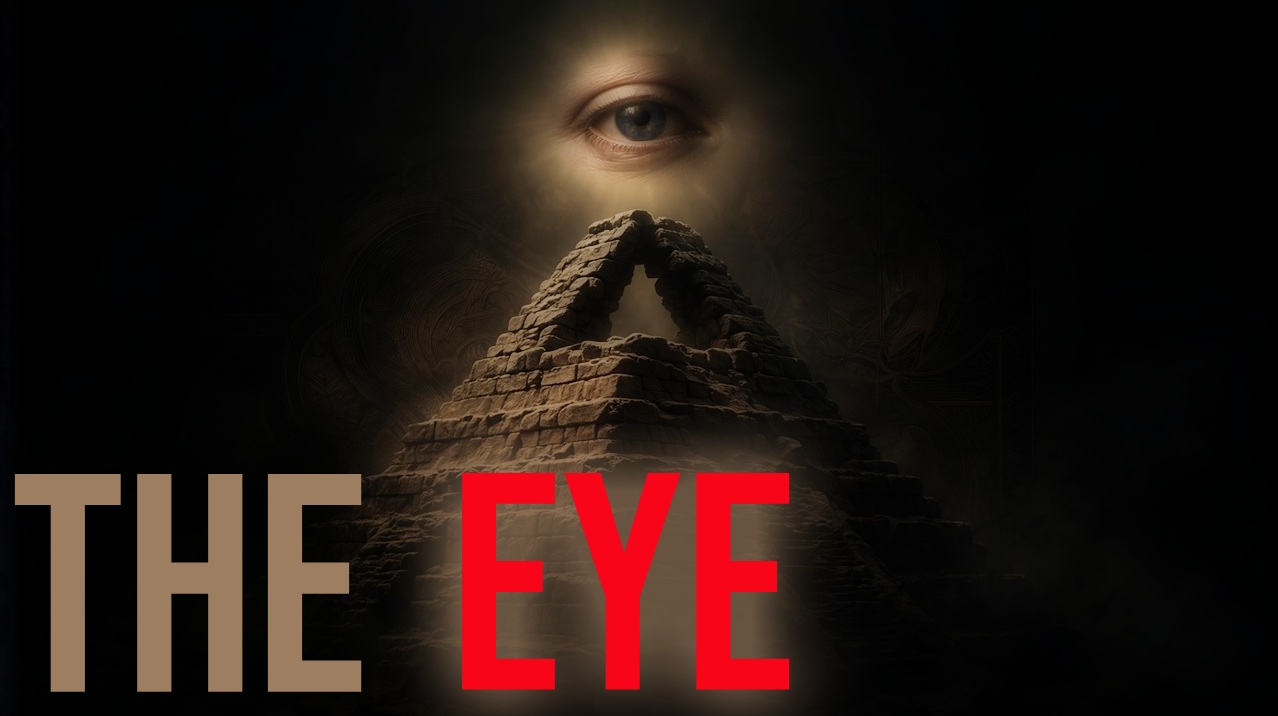
The All-Seeing Eye and unfinished pyramid on the back of the American $1 bill are among the most recognizable symbols in the United States. Their conventional interpretation is familiar: the Great Seal represents Providence, the thirteen original states, and the ideals of the American founding.
But the modern history of the symbol is considerably stranger.
In the second installment of our investigation into Bankers Trust, the Federal Reserve, and the symbolic architecture of American finance, we begin with a deceptively simple question: Who actually put the Eye and Pyramid on the dollar — and why?
The answer leads first to Treasury Secretary Henry Morgenthau Jr. and President Franklin D. Roosevelt, but then backward to Roosevelt’s Secretary of Agriculture and future Vice President, Henry A. Wallace. Wallace, in turn, was deeply fascinated by the Russian mystic and symbolist painter Nicholas Roerich, whom he regarded as a spiritual master.
According to the account explored here, Wallace discovered an obscure early-twentieth-century history of the Great Seal in the National Archives in 1934. He became particularly interested in the phrase Novus Ordo Seclorum — “New Order of the Ages” — and brought the material to Roosevelt. Roosevelt reportedly favored placing the Great Seal on American currency rather than the originally contemplated coin, and Treasury Secretary Morgenthau subsequently implemented the decision.
This creates a remarkable historical chain: Roerich → Wallace → Roosevelt → Morgenthau → the dollar.
But the story does not end with the Great Seal.
Roerich was associated with an elaborate tradition surrounding a mysterious “sacred stone,” sometimes identified by researchers with the Stone of Destiny, the Holy Grail, Jacob’s Pillow Stone, or the legendary Bethel Stone. One particularly curious version of the story claims that this object was delivered to Roerich in a wooden casket bearing the words “Banquer’s Trust.”
That detail brings the investigation back to the subject of Part One: Bankers Trust.
The connection becomes even more intriguing when we reconsider the pyramid. Bankers Trust’s former headquarters at 14 Wall Street was crowned by a monumental pyramid modeled in part on the Mausoleum at Halicarnassus — itself a tomb. Decades later, the bank’s successor headquarters at 130 Liberty Street stood directly beside the World Trade Center complex and was damaged during the destruction of the South Tower. During its subsequent demolition, human remains from the disaster were reportedly discovered on the roof.
Meanwhile, the dollar’s pyramid is conspicuously unfinished.
Its missing capstone invites another ancient association: the Egyptian Benben stone, traditionally associated with the first emergence of land at Heliopolis. The pyramid’s capstone, or pyramidion, was modeled upon this sacred stone. In the accompanying mythology, the Bennu bird — a self-renewing solar creature and traditional precursor of the phoenix — is associated with the Benben.
The symbolism therefore suggests a recurring pattern: destruction and rebirth, death and resurrection, chaos and order.
The American dollar’s reverse also contains the so-called eagle, which occult writer Manly P. Hall interpreted instead as a disguised phoenix. The phoenix, in turn, gives the story another symbolic connection with the destruction and subsequent rebuilding of the World Trade Center site.
And only blocks away sits the Federal Reserve Bank of New York at 33 Liberty Street.
Are all of these connections evidence of a single hidden plan?
That is not the claim.
The more interesting question, from the perspective of SynchroMystique, is whether meaningful patterns can emerge across history without requiring a single person or organization to consciously orchestrate every connection.
Carl Jung called this phenomenon synchronicity: an acausal connecting principle in which events, symbols, and meanings converge in ways that cannot necessarily be reduced to ordinary chains of physical causation.
The Eye on the dollar may therefore be worth examining not merely as a piece of American iconography, but as a symbolic object with a documented twentieth-century history — one that intersects with mysticism, political power, financial institutions, secret societies, ancient symbolism, and the recurring myth of death followed by rebirth.
The next time you pull a dollar from your wallet, look at the back.
In 1961, President John Fitzgerald Kennedy spoke to the American Newspaper Publishers Association, remarking, in part: “The very word ‘secrecy’ is repugnant in a free and open society; and we are as a people inherently and historically opposed to secret societies, to secret oaths, and to secret proceedings.”[1]
That these comments issued from JFK is interesting for several reasons. A main one is that his life would be publicly and violently snuffed out two and a half years later in what the United States House of Representatives Select Committee on Assassinations concluded was “probably” the “result of a conspiracy.”[2]
For more, see “10 Reasons to Believe JFK Was Killed by Conspiracy.”
That JFK would direct this message to newspaper men is also intriguing, not least because of post-Watergate-scandal revelations, reported by journalist Carl Bernstein, of collusion between the intelligence community and the press. More on these disquieting disclosures in a future video.
I take these – and myriad other – tidbits as indications of just how often the American people are kept in the proverbial “dark” about the inner workings of their own government.
This can be quickly – albeit roughly and even playfully – illustrated by surveying some of the ostensible “public servants” who were devotees of various organizations that, well… let’s just say aren’t entirely forthcoming about the goings on at their meetings. In this presentation we’ll do just that, by looking at the top ten Presidents of the United States alleged to have been card-carrying members of secret societies.
Caveats
This is intended for educational or entertainment purposes only. No allegations of wrongdoing, on the part of any individual or organization, are expressed or implied. The information supplied herein has been gleaned from public records. Its factuality is assumed. Referenced rankings and statistics are for comparison or illustration and have not been calculated with scientific rigor.
Introduction
According to authors Craig Heimbichner and Adam Parfrey, at “…the beginning of the twentieth century, …as many as one-third of all Americans belonged to a secret society…” of some kind.[3]
Without a doubt, the largest and best-known of these groups is Freemasonry.
Freemasonry, or the “Ancient Free and Accepted Masons,” are bundle of traditionally fraternal – that is, male-member-only – associations. The complicated origin story is not without interest and has been the subject of endless debate and speculation. To do it justice, it should probably have its own devoted presentation. But a few brief comments are in order, here.
Some historians trace Freemasonry, sometimes called the “Craft,” back to various societies of artisans, called collegia, that existed in Roman times. These may – or may not – have segued into Medieval trade guilds, specifically ones organized for stonemasons. These are craftsmen who have been trained to build, cut, and otherwise work with stone.
Allowing for technological developments and stylistic innovations, stonemasons have been credited with construction projects ranging from Europe’s great cathedrals, all the way back to the pyramids of Egypt and even the Biblical Tower of Babel.
At some point, approximately during the 17th century, groups of work-a-day masons began to fellowship with select men who did not have anything to do with stone, professionally. These first “non-operative” inductees were likely nobility or other wealthy patrons and their admission into the “order” launched so-called “speculative freemasonry.”
This is a fitting name since much has been conjectured about possible links between Freemasonry and streams of bona fide esotericism, such as alchemy, Kabbalah, and Rosicrucianism.
And many colorful connexions are asserted – with varying degrees of credibility – with all manner of predecessors from Gnostic-heretical groups like Catharism and Manichæanism, …
…military-religious orders such as the Knights of Malta and the Knights Templar, and other things besides.
The official emergence of institutional Freemasonry, as it’s known today, dates to the founding of what was then called the Grand Lodge of London but is today – after various growth and mergers – the United Grand Lodge of England. Masonic assemblies are termed “lodges.”
For various socio-political reasons, the order experienced explosive growth and even migrated across the ocean to America where many of the United States’s Founding Fathers, including Benjamin Franklin,[4] eagerly joined.
We highlighted Franklin in the video “10 Occultists Who Were Accused SPIES.” In that place we get into the possibility that was decidedly more satanic than the usual portrayals of him let on.
Ignoring, presently, the several U.S. Presidents who were members of multiple secret societies, we may name at least nine who almost certainly belonged to the Freemasons.
These include our first head of state, the Revolutionary War hero, George Washington;[5] …
…James Monroe, whose “Monroe Doctrine” arguably became the foundation of U.S. Imperialism; …
…Andrew Jackson, the hero of the War of 1812…
…whose opposition to the Second Bank of the United States is largely forgotten, but which loosened the grip of private interests over the nation for 80 years (until the creation of the Federal Reserve System); …
…James Polk, who spearheaded the country’s expansion into the south and west; …
…James Buchanan, whose legacy was, in part, the disastrous fratricidal conflict known as the “Civil War”; …
…Andrew Johnson, reportedly so inebriated at his vice-presidential inauguration he was nearly unable to recite his oath of office,[6] who became president after the assassination of Abraham Lincoln; …
…James Garfield, one of four “commanders in chief” to have been assassinated, and the only White-House occupant to have created a unique proof of the Pythagorean Theorem; …
For more information on the esoteric importance of Pythagoras, see our dedicated video.
…Lyndon Baines Johnson, Kennedy’s successor – allegedly implicated in the assassination by former Central Intelligence Agency asset E. Howard Hunt – whose “Great Society” program ushered in the Civil Rights Act and Medicare; …
…and Gerald Ford, birth name “Leslie Lynch King, Jr.,” remembered mainly for his participation in the Warren-Commission whitewash and for “pardoning” Richard Nixon who, you’ll recall, had been charged with abusing presidential power and obstructing justice to cover up the Watergate burglary.[7]
There are also a few others with possible masonic affiliations. Depending on the prejudices of the source, these possibilities may be leveraged into affirmations (as with some anti-Masonic authors) or are vociferously denied (as is the standard line from Masonic apologists).
Prominent, here are Thomas Jefferson, drafter of many of the nation’s important foundational documents (including the Declaration of Independence), and James Madison, who (alongside Alexander Hamilton and John Jay) helped write the Federalist Papers; …
…as well as Ulysses S. Grant and Rutherford B. Hayes, both of whom presided over the so-called “Reconstruction” era.
If we expand our list slightly, we might include William Jefferson “Bill” Clinton, born William Blythe III, to bring our count to fourteen.
You see, “Slick Willie” is touted as perhaps the most famous past member of the Order of DeMolay (now “DeMolay International”).
This group, which is basically Freemasonry for boys, was founded in 1919 and named after Jacques de Molay, a 14th-century of Knight Templar whose tenure as head (or “Grand Master”) of that military order coincided with its dissolution at the hands of King Philip IV of France and Pope Clement V. High-ranking Templars were accused of assorted crimes – such as desecrating Christian icons and sodomy – and many, including de Molay himself, were burned at the stake.
The junior masonry named in de Molay’s honor claims to instill values such as fierce loyalty, even in the face of death. It seems to have helped form our 42nd President, perhaps priming him for his instruction, under Georgetown University Professor Carroll Quigley, …
…in the history of the shadowy Round Table Group, a consortium of “think tanks” that were ostensibly the brainchild of 19th-century British colonialist and diamond magnate, Cecil Rhodes.
So far, we’ve limited ourselves to men who supposedly confined their fraternal horizons to Freemasonry. And we’re already knee deep in cryptopolitical intrigue!
The ‘Top-10’
But there are eleven others who apparently took to oaths and secret handshakes with more enthusiasm. These fellows were connoisseurs of confidential information and the societies that purport to guard it. I’ve loosely arranged the names as a “top-ten” list, where the entrants are ranked in descending order according to the number of societies they belonged to.
Admittedly, though, this list is a bit awkward.
Firstly, there are only five numerical positions represented. This is because there are so many “ties” – that is, occasions where a president has the same number of fraternal affiliations as one or more of his confrères.
Secondly, I’m not pretending to have plumbed the depths of each president’s membership profile. To put it another way, I may have neglected a few connexions.
I wasn’t especially concerned with thoroughness because, thirdly, this list is intended to be on the lighthearted side and doesn’t give any consideration to the possible cryptopolitical “weight” of any of the organizations included.
Finally, for expedience, I have only counted ten (or so) secret societies. While the inclusions are, I think, justifiable and representative of the field of options, they are not exhaustive.
In other words, the entire list is open to question. So, don’t take it too seriously!
Number 8
All that said, coming in at “number eight” (or, #s 8, 9, 10, and 11), we have a four-way tie among William Howard Taft, John Fitzgerald Kennedy, Richard Milhouse Nixon, and George W. Bush who each belonged to at least two, publicly identifiable secret societies.
Infamous for his Watergate shenanigans – which we got into in “10 Occultist Spies” – …
…Nixon is routinely found on lists of the most hated or worst U.S. presidents.
One story has it that Nixon – who was supposedly self-conscious of his humble origins – was launched into power by the secretive “Committee of 100.” Not to be confused with the contemporary association of Chinese-American businessmen, the earlier incarnation was allegedly a consortium of rich California Republicans looking to unseat a popular “New Deal” Democrat named “Jerry” Voorhis.
As he rose to prominence, Nixon made his way onto the ticket with Dwight Eisenhower. However, revelations that Texas oil men had established a slush fund for him worth about $18,000 threatened to stop his career in its tracks.
He went on “air,” as it were, and delivered his now famous “Checkers speech.” Among other things, Nixon admitted receiving a cute puppy as a political gift but stated that, due to his family’s newfound affection for it, he resolved to keep it regardless of the consequences. The comments saved him and ultimately paved the way to the presidency over a decade later.
An interesting side note is that ol’ Tricky Dick himself “just happened” to be in Dallas, Texas on November 22, 1963. Officially, he was there in his capacity as legal counsel for the Pepsi Corporation.
Unofficially, well… there’s a video presentation that gets into the topic, if you’re interested.
Speaking of JFK, his inclusion on this list may seem odd given our opening quotation.
Then again, politicians have a generally poor reputation for consistency. As the 15th-16th-century Italian Renaissance philosopher Niccolò Machiavelli argued, political rhetoric is “…power-oriented in the sense that the orator’s mission was to mold his listeners’ responses and work on their wills.”[8]
It has long been rumored that JFK was, well… let’s say… given a “boost” on election day from certain “fixers” in the Chicago mob. Word on the street once was that JFK’s dad, Joseph Kennedy, made a deal with mafioso Sam Giancana to help get “Jack” into the White House. Apparently, someone either forgot to tell JFK, or he and his family decided to double cross La Cosa Nostra.
For, when JFK leveled up, his brother “Bobby” Kennedy continued his longstanding crusade against the “Outfit.” Usually pooh-poohed by academic types, this theory has been advanced to explain the spate of high-profile assassinations that seemed to disproportionately affect the Kennedys in the 1960s.
Perhaps, however, one may be tempted to give JFK a “pass.” For besides his membership in a group (to be discussed in a few minutes) that, by most accounts, was simply a drinking club, his primary affiliation seems to have been with the Fraternal Order of Eagles.
This group, initially formed in 1898 by a half dozen theater proprietors, subsequently became more politically active. It claims to be staunchly anti-Communist and claims credit for the institution of the Mother’s Day holiday as well as for campaigning in support of Franklin Roosevelt’s “New Deal” policies, including Social Security. In other words, the Fraternal Order of Eagles seems to operate fairly transparently – by secret-society standards, anyway.
Things are a bit different, however, the Yale-University-based order called “Skull and Bones,” which was introduced in the aforementioned “10 Occultists Who Were Accused SPIES.”
Founded by Connecticut businessman and politician William Huntington Russell, …
…it conducts its secretive rituals inside a windowless stone building cheerfully named the “Tomb.”
Sometimes referred to as “Chapter 322,” speculation abounds that this Ivy-League frat house functions as an American arm of the legendary New-World-Order architects known as the “Illuminati.”
In fact, according to a recent edition of Heart’s Biography magazine: “It is speculated that the number refers to the year 322 BCE, when Athens transformed from democracy to plutocracy following the death of the Greek orator Demosthenes.”[9]
Be that as it may, it is exceedingly interesting that Skull and Bones, with all its bizarre and – reportedly, sexualized – initiations, “just happened” to spring up in the aftermath of the William Morgan Affair that precipitated organized anti-Masonry in the United States.
The sordid scene unfolded in the town of Batavia, New York in 1826. One William Morgan – either a disgruntled ex-Mason or a lodge crasher, depending on the account you read – was arrested on a flimsy pretext. He was subsequently kidnapped by a posse of Freemasons who apparently gained access to him by posting his bail. Like that of Teamster boss James Riddle “Jimmy” Hoffa, Morgan’s fate is often said to be “unknown.” But the presumption, partially informed from a deathbed confession of one of the alleged perpetrators, was that Morgan was murdered.[10]
The motive was Freemasonic resentment toward Morgan because of a book-length exposé he wrote disclosing the secrets of their order.
In any event, the first “Third” political party in the U.S. was the short-lived Anti-Masonic Party, established in 1828. So it was, in 1832, during the ensuing anti-Freemasonic furor, that Skull and Bones cropped up in New Haven.
Its membership roster is a “Who’s Who” of American finance, industry, and politics. So-called “Bonesmen” have included Central Intelligence Agency “counter-intel” chieftain, James Jesus Angleton, Time-Life publisher Henry Luce, and Stephen Allen Schwarzman, the founder of the private-equity powerhouse Blackstone.
Numerous other names could be added to the list. But, for our purposes, we draw attention back to two. Number one, there’s William H. Taft, the only U.S. President to also have been a Chief Justice of the Supreme Court.
William Taft’s father, Alphonso Taft, helped get Skull and Bones going.
Number two, we have George W. Bush. Of course, “Dubya” was the son of George Herbert Walker Bush, …
…who we’ll get to shortly.
Both Bushes followed in the footsteps of Bush I’s father, Prescott, who – in 1917[11] or 1918[12] – allegedly used him time as a “Yalie Bonesman” to dig up the skull of the famous Apache Indian Geronimo and whisk it back to New Haven as an ornament.
The 2004 presidential election pitted Bonesman John Kerry against Bonesman George W. Bush.
Number 5
At number five,[13] we have a three-way tie. This triad is distinguished for the trio of secret fraternal organizations that make up its curriculum vitæ. And it is comprised of William McKinley, Ronald Reagan, and the previously named George Herbert Walker Bush. There are a few highlights – or lowlights – from this group.
For one thing, we have yet another president (McKinley) who was outright assassinated; …
…one president (Reagan) who was almost assassinated; …
…and a third (Bush I) who – at one time – was the director of a government agency that specializes in spycraft, covet action, and so-called “black ops,” including assassination.
All three were Republicans.
By way of a little background, we may turn to the History Channel which, in 2012, aired a series titled The Men Who Built America.
Over eight installments,[14] the “docudrama” staged fictionalized reenactments – purportedly based on real events – of portions of the lives of some of America’s “robber barons.”
The individuals spotlighted were 19th-century shipping and railroad tycoon Cornelius Vanderbilt; …
…19th-20th-century oilman John D. Rockefeller; …
…19th-20th-century industrialist Andrew Carnegie; …
…financier and Rothschild-banking asset J.P. Morgan; …
…and pioneering automobile manufacturer Henry Ford.
Episode #7, titled “Taking the White House,” centers on the attempt, by “Vanderbilt, Rockefeller, Carnegie and Morgan” to “unite in a bid to buy the White House by striking a lucrative deal with Ohio Governor, William McKinley.”[15]
According to the History Channel, this “bid” consisted at least partially of a “donation” of $30 million to McKinley courtesy of the above-named money trust.[16]
McKinley’s close ties to finance and industry, and his opposition by populist-Democrat and master orator William Jennings Bryan created – or, at least, cemented – the idea that Republicans are the “party of the rich.”
Further reinforcing this notion has been the tendency of Republican presidents – including Nixon,[17] Reagan and Bush I – to belong to yet another cryptic and private group. In this case, it is one that annually meets in Sonoma County, California, in the shady surrounds of imposing redwood trees.
Called the “Bohemian Club,” it hosts a summer retreat at the eponymous “Bohemian Grove” in Monte Rio, some 70-odd miles north of San Francisco.
Originally founded in 1872 by a cadre of newspaper men, it morphed into a clique for economic heavy-hitters and kingmakers. The “Grove” is an interesting symbol in its own right – one which I hope to explore in a future installment.
But as a literal forest hideaway, it appears to date from around 1901.
This was the era of President Theodore “Teddy” Roosevelt, among whose claims to fame is launching the “conservationist movement,” which reclassified massive tracts of the country’s land as “National Parks,” making them off limits to developers.
…Unless, that is, you’re among the privileged class. Then you can go ahead and build your magnificent woodland haven in the middle of the John Muir Woods and have the grounds cared for by the National Park Service.[18]
As Mel Brooks’ character repeatedly exclaims in The History of World, Part 1: “It’s good to be the king.”
By some accounts, until Donald Trump took office, “[e]very Republican president since Herbert Hoover [had] belonged to the club.”[19]
A centerpiece of the “Summer High Jinks” spectacle performed at the Grove every year is a psychodrama titled the “Cremation of Care.” It features the supposedly mock-sacrificial immolation of a figure – designated “Dull Care” – below a humongous wooden owl (whose character, at one time, was voiced by a recording of longtime Columbia Broadcasting System anchorman Walter Cronkite).
For more on this conscience-banishing ritual, see “10 Occultists Who Were Accused SPIES.”
Number 3
In third place,[20] we have a two-way tie of those who belonged to no fewer than four secret societies.
Here, we’ll recall “Rough Rider” Teddy Roosevelt, whose corporate “monopoly-busting” is reputed to have struck a blow for the little guy, …
…but which resulted in John D. Rockefeller’s net worth skyrocketing to levels it hadn’t hit previously. I won’t hazard any guesses about whether this outcome was foreseen or unforeseen, intended or not intended. It is routinely asserted that Roosevelt took a turn to the left.
Indeed, he eventually opposed his former protégé, Bonesman William Howard Taft, in the 1912 election.
When the Trust Buster failed to obtain the Republican nomination, in the contest that wound up in the favor of Democratic Woodrow Wilson, he created his own third party.
Officially named the “Progressive Party,” it was popularly nicknamed the “Bull Moose Party,” after a bombastic comment from Roosevelt who defiantly claimed that he remained “strong as a bull moose” after being thrown over for Taft at the Republican Convention.
The bombastic phrase was typical for Roosevelt. But it’s noteworthy that he was a member of the Loyal Order of Moose.
The secret society, now known as Moose International, follows the overarching pattern – for initiations, advancement, and meetings – long established by Freemasonry.
Like numerous other groups, however, it appears to have been primarily catered to men who wished periodically to blow off steam and get loaded. In this vein, it is usually depicted as a rival to another, similar drinking club called the Order of Elks.
In the mold of social organizations with quirky beginnings, the Elks is said to have begun life in 1868 as a get-together of a minstrel troupe that called itself the “Jolly Corks.”
Once upon a time, justifiably or not, the group had a reputation for ribaldry. It was thought that their meetings were occasions – or even pretexts – for drunkenness, indecency, and even orgies.
This description hearkens to tales of the 18th-century “Hell-Fire Club,” one incarnation of which boasted Benjamin Franklin as a member.
We got into this in a little more detail in “10 Occultists Who Were Accused SPIES” and we mentioned it in passing in “10 ‘Sex-Magic’ Cults.”
After the passage of some time, and a dash of remedial “P.R.,” the modern association “rebranded” itself as benefit society, under the expanded named “Benevolent and Protective Order of Elks.”
Minimally, that means insurance sales.
One of the Elk’s members, at some stage of its evolution, was 33rd U.S. President, and 33rd-Degree Freemason, Harry S. Truman – who, …
…some say, had his early governmental ambitions bankrolled by fraudster “political boss” Tom “T. J.” Pendergast.
As Michael Hoffman once noted, “Give ‘Em Hell Harry” – true to his nickname – “did just that” by authorizing the vaporization of several hundred thousand Japanese at Hiroshima and Nagasaki when the United States of America became the first and (so far!) only country in world history to use atomic weapons in war.
Perhaps it’s meaningful that Truman was also a prominent member of Ancient Arabic Order of the Nobles of the Mystic Shrine, colloquially called the “Shriners.”[21] Their presumably once-secret vow, the alleged text of which is now widely available from online and print sources, reads like a blood oath invoking “…Allah, the God of Arab, Muslim and Mohammed…”.[22]
In any case, their characteristic headgear, a tasseled conical red hat called a “fez” is often adorned with Islamic-esque symbols like the curved sword (called a “scimitar”) and the crescent moon. Some anti-Masons, Protestant Fundamentalists, and others of a generally paranoid bent sometimes fret about the deep color of the hat. Occasionally, it is suggested that it is blood red – in commemoration of some past, but difficult to precisely identify, Muslim-instigated slaughter of Christians.
Nowadays, the name “Shriner” is perhaps more frequently conjoined with the word “hospital” than with anything else.
Though, to be fair, this talk sometimes invites “Moolah clowns” – and they can be horrifying enough.
Who said secret societies were only for Republicans? Right, just ask Kennedy or Truman!
Sidelight: Royal Order of Jesters
Some secret organizations contain even more reclusive societies within the larger society. In at least one case, these are nested several layers deep – like “Russian dolls.”
Take, for example, the fact that the Shriners only accept “master masons” in good standing. These are men who have attained the Third Degree within basic, Blue Lodge (or “Craft”) freemasonry.
But – by invitation only – a select few Shriners may be asked to join the more obscure Royal Order of Jesters which, by its own admission, is dedicated to enjoyment and merrymaking.
The Jesters were reportedly founded in 1911, adopting for themselves a vaguely sinister totem called the “Billikin” …
…– among other symbols, some of which evince an apparent fascination with death (one apparently shared by other orders, such as the previously named Skull & Bones).
Weirdly, the Billiken isn’t unique to the Jesters. In fact, earlier claim to it may have been made by the Catholic, Jesuit-controlled Saint Louis University, which refers to the Buddha-looking sigil – and stylized variations, thereof – as its “good-luck charm” and mascot.
Once prosecuted back east on charges of prostitution and human trafficking (with hints of deadlier antics), the Royal Order of Jesters has been investigated for its – shall we say? excessive partying – by now-absentee researcher Sandy Frost.
However, as of this recording, an eye-opening piece is readily available at Medium.com, the “blogging” website started by Twitter cofounder Evan Williams. No fewer than two U.S. Presidents are said to have had connexions with these exclusive fun-seekers.
The first was Missourian Harry S. Truman.
The second? Gerald R. Ford – whose wife, Betty Ford, became something of a byword for alcoholism – not least through her own struggles and via her eponymous “substance-abuse” clinic.
Number 2
Now we’re really “up there,” as it were, on our list. One, two, …even four secret-society affiliations is small potatoes for our next president who, according to the record, maintained at least six such memberships.
We’re speaking of 29th President, Warren Gamaliel Harding – who popularity at the time of his election quickly eroded in the face of numerous, unflattering posthumous disclosures.
Among minor accomplishments, Harding is remembered for the creation of the Veteran’s Bureau which, through various twists and turns, has become the United States Department of Veterans Affairs.
Though, it is arguable that the most distinctive things about him were the strangeness of his death and the brevity of his presidency that, nonetheless, was riddled with scandal.
In one writer’s bitingly sarcastic appraisal, Harding was “[a] newspaper publisher who became president of the U.S. And gave dirty politics a bad name by surrounding himself with some of the most dishonest and corrupt chiselers of all time.”[23]
He wasn’t even close to having occupied his office for the absolute shortest amount of time – that dubious “award” goes to 9th President, William Henry Harrison.
Still, he’s one of ten presidents to have served less than a single full term, for one reason or other.
In the case of Warren G. Harding, accounts vary slightly. The cause of death has various been attributed to any, or some combination, of the following: cardiac arrest, cerebral hemorrhage, food poisoning, and pneumonia. I plan to spend just a tad more time with this curious story in a forthcoming video.
But, for now, suffice it to say that Harding’s peculiar demise punctuated a presidency the climax of which was, at least retrospectively, the bribery fiasco known as “Teapot Dome.” The upshot of the affair was that Harding’s Secretary of the Interior, Albert Fall, was convicted of accepting money from oil men – including Harry Ford Sinclair – to secretly transfer land rights from the Navy to private business interests.
Well, to be precise, Harding gave Fall control of Teapot Dome by executive order. Then Fall handed it over to Big Oil. I suppose that provides a veneer of “deniability.”
Maybe that would be giving Harding too much credit. One source alleged that he spent more time playing poker than governing the nation. Harding hosted regular poker games attended by a fair few of his “Ohio Gang,” including “…Fall, Attorney General Harry Daughtery, [gofer] Jesse Smith, and Veterans Bureau head Charles R. Forbes. After the Teapot Dome scandal, Fall and Forbes went to jail, Daugherty got two hung juries, and Smith committed suicide.”[24]
Or…was it murder?
Anyway, Harding loved his secrets. Like McKinley before him, he was a member of the Independent Order of Odd Fellows, a group whose origins are as mythologized as those of Freemasonry – from which it may have emerged.
Ignoring the surely fantastical claims of 11th-century beginnings, the Odd Fellows can be documented in 18th-century England, where it attracted such members as dissident journalist and politician, John Wilkes.
Wilkes was also a member of the previously mentioned Hell-Fire Club, which we covered in greater depth in “Top 10 Occult Spies.”
The Odd Fellows was subsequently associated with the rakish British monarch George IV. In turn, King George had dealings with portrait artist Richard Cosway.
Cosway was connected to an erotic-mystical circle via English Romantic artist, poet, and Emanuel-Swedenborg enthusiast William Blake…
…whom we discussed in “Top 10 ‘Sex-Magic’ Cults.”
The Odd Fellows crossed the Atlantic with Thomas Wildey, who founded a lodge in Baltimore.
This North American progenitor initially catered more to the blue-collar set than had its ancestor from London. This explains Harding’s involvement, since he started off as a “working man,”[25] selling insurance and doing other odd jobs in his youth.[26]
Like the exclusive Skull-and-Bones fraternity, the Odd Fellows has – or had – a fascination with death symbolism. According to the Washington Post, human “…skeletons …reside in closets, drawers, attics and crawl spaces in Odd Fellows lodges nationwide.”
Reportedly, these remains are invoked as emblems “of mortality” during initiation ceremonies. According to one member, the skeletons are hidden and only make their appearances when a prospective candidate actually goes through the secret admission ritual.
The Odd Fellows appear to have derived these practices from the Freemasons – at least, those of the higher-degree Scottish Rite. In Masonic ritual materials, one can find innumerable references to coffins, “death’s head” skulls, skeletons, and other ritual paraphernalia.
Commentators as far flung as the 19th-century Presbyterian preacher Charles Finney and 21st-century writer John “Ed” Decker have asserted that members of the “Brotherhood” go so far as to drink wine from a human skull during the 30th-degree ceremony.
Predictably, this is denied by Masonic apologists, like S. Brent Morris.
But, the macabre spectacle was given credence by novelist Dan Brown, whose book The Lost Symbol – which Morris admitted “showed Masons in a pretty good light” – incorporates the scene into its opening pages.
Similarly to the Elks, the Odd Fellows were believed to incline toward the Bacchanalian.
One aspect of this suspicion was the fact that it was the Odd Fellows, rather than the Masons per se, who were accused of incorporating goats into their outrageous ritualism.
This would be an amusing irrelevance were it not for curiously recurring links between goat symbolism and devil worship. Notable mentions include: Aleister Crowley’s rendition of the #15 “Devil” card in the Tarot deck as well as Éliphas Lévi’s drawing of Baphomet, …
We can’t neglect the related, so-called “Goat of Mendes” or “Baphomet sigil” originally published – if not drawn by – occultist Stanislas de Guaita.
Reportedly, there’s also an obscure reference, in Masonry, to a “God of All Things” that later morphed into a “Grand Architect Of The Universe.” Those initials are awfully GOAT-like.[27]
Number 1
But even Warren G. Harding, with his half-dozen affiliations, can’t hold a candle to Theodore Roosevelt’s fifth cousin, Franklin Delano Roosevelt. By my (admittedly rough and unscientific) count, F.D.R. was a veritable aficionado of secret societies, having been actively involved with no fewer than seven of them over his lifetime.
A Democrat – in fact, theultimateDemocrat in the minds of his many admirers – F.D.R. was famously elected for a whopping four presidential terms. Of course, he only served three of them since he died a few months into 1945.
Officially, he is said to have died from an “intracerebral hemorrhage.”
He also suffered from diseases of his arteries and heart, and recent medical revisionists have suggested that, perhaps due to his longtime tobacco smoking, he may have died of cancer.[28] We may have an additional possibility to float in a follow-up presentation. Stay tuned.
In any case, and justifiably or not, F.D.R. is credited with helping to bring the United States out of the Great Depression. His so-called “New Deal” policies enlarged the federal government in the name of economic recovery and future stability.
He instituted the Federal Deposit Insurance Corporation, or FDIC, ostensibly to safeguard bank accounts.[29]
Though… according to financial advisor and writer Fredric Mark “Ric” Edelman, writing in his The Truth About Money (originally published in 1997): Nowadays, “…FDIC …has only $1.25 per $100.”[30]
FDR created the Social Security Administration as a sort of “social-insurance” program, including various old-age benefits.[31]
Not all these achievements were universally acclaimed. Some have proved more lastingly controversial than others.
For example, FDR is remembered for confiscating most privately held gold under the guise of rebooting the economy.
Meanwhile, some wealthy gold bugs – especially (one presumes) those within FDR’s Blue-Blood circle – were at least partially exempted from complying with the Executive Order 6102. You see, some holdings were treated as collector’s (or “numismatic”) pieces, rather than as circulating coin.
The Great Depression itself was a suspiciously selective catastrophe. Noble-Prize-winning economist Milton Friedman was among the more prominent people to call attention to the rôle of the Federal Reserve in crashing the America economy – despite the uncomfortable fact that the “Fed’s” whole reason for existing was ostensibly to prevent such misery.
All this led to the charge, from many of the “right side” of the politic spectrum, that Franklin Roosevelt was either an out-and-out Communist or, at the least, a sympathizer.
In fact, it seems that some American industrialists and money men became so fed up, that they attempted to orchestrate a coup d’état to remove Roosevelt from power.
In the basic narrative, which I hope to expound in a follow-up presentation, a highly decorated marine-corps officer, General Smedley Darlington Butler, was approached to lead the American Legion to facilitate this “regime change.”
[Video clip of Butler]
That F.D.R. came through the event unscathed testifies to the diligence of his attendant angel. The entire story – sometimes referred to as the “Business Plot” or the “Capitol Hill Coup” – is a fascinating chapter of American history. It seems to be a part of the complicated crypto-political backdrop for the so-called “January 6th Riot,” the symbolism surrounding which we sketched in a dedicated video.
Although we intend to tug on some conspiratorial threads in this tangled yarn in future installments, for now, we return to the fact that FDR maintained numerous secret-society connexions.
One of these was with the Knights of Pythias,[32] which organization Roosevelt is said to have joined during his long presidential tenure.
The Knights of Pythias, instituted during the fratricidal waste that is euphemistically termed the “civil war,” was apparently “chartered” – whatever that comes down to – by the federal government (either Abraham Lincoln or, more likely, Congress).
Its ritualism is based on the so-called Pythagorean ideal of friendship, as exemplified in the myth of Damon and Pythias.[33] This is just a single example of the abiding fascination with Pythagoras one discovers in esotericism. For examples, & for the reasons, see “Top 10 Occultists of All Time” …
…as well as the dedicated “Pythagoras.”
The Knights were founded in 1864 by a U.S. Treasury Department clerk named Justus Henry Rathbone. Rathbone was also a member of the so-called Improved Order of Red Men…
…which F.D.R., some years later, would also join.
The society adopted some of the symbols and vocabulary of Amerindians in a manner similar to the embrace of the trappings of Islam by the Masonic Shriners or – for that matter – like the Knights of Pythias’s own Knights of Khorassan.
The word “Khorassan” is interesting. It supposedly signifies the “east” or “sunrise.”[34] One author has it that “Khorassan signifies, in the old Persian language, Province or Region of the Sun.”[35]
It crops up in the romantic lore of St. Louis’s “Veiled Prophet Parade.”
And, more recently, we’re told there’s an offshoot (or upper echelon) of the dangerous al-Qaeda organization: an “ISIS”-like operation supposedly calling itself the Khorasan Group.
The name is explained as an obscure reference to the same general area that has been the key geo-political node and espionage epicenter for over a hundred years – and which you can discover more about in the video “10 Occultist Spies.” It was of great interest to mason and novelist Rudyard Kipling.
And this leads us back to F.D.R. for whom, arguably, a major preoccupation was Freemasonry.
The most flamboyant attestation of this is the fact that it was during Roosevelt’s presidential incumbency that the all-seeing eye symbol was placed on the U.S. dollar bill.
Well in advance of its implementation in the design of the dollar, eminent 19th-century Harvard art professor, Charles Eliot Norton, labeled eye-and-pyramid amalgam a “dull emblem of a masonic fraternity.”[36]
There are a few other key players in that drama, including FDR’s third-term vice president and mystic, Henry Agard Wallace; Wallace’s one-time personal, spiritual “guru,” the Russian Theosophist Nicholas Roerich…
…to whom we devoted a segment in the previously named “…Occultist …SPIES…” video…
…and hearkening back to the Knights of Pythias, FDR’s treasury secretary, Henry Morgenthau Jr. (You’ll recall that the Knights get their start in the imagination of a treasury clerk.)
According to Dr. Robert Hieronymus, a specialist on the United States Great Seal, Roerich likely suggested placing the all-seeing-eye symbol on the dollar. And then Wallace brought the idea to FDR, who simply instructed Morgenthau to use it.
The upshot is that presidential secret-society affiliations literally stare us in the face whenever we pay with cash – an occurrence that (admittedly) happens less and less often with each passing day. And, of course, it’s far from the only association between our currency and occultism. See “Top 10 Gold-Making Alchemists” for the magical origins of the serpentine “dollar sign.”
Conclusion
Did we miss – or miscount – anyone? What order would you have preferred? Feel free to drop us a comment, below.
But if you found something of interest, please be sure to “Like” the video and, if you’re not already subscribed to the channel, consider doing so in order to see more content similar to this.
If you think others might appreciate this content, do us a favor and share the link. And if you have video ideas or suggestions, don’t hesitate to let us know!
Copyright 2023, TheSynchroMystic. All applicable rights reserved.
[2]House Select Committee on Assassinations, Investigation of the Assassination of President John F. Kennedy: Hearings Before the Select Committee on Assassinations of the U.S. House of Representatives, United States Congress, Ninety-Fifth Congress, Second Session, Washington, D.C.: U.S. Govt. Printing Office, 1978-1979; online at <https://www.archives.gov/research/jfk/select-committee-report>.
[3]Adam Parfrey and Craig Heimbichner, Ritual America: Secret Brotherhoods and Their Influence on America, Port Townsend, Wash.: Feral House, p. xviii.
[4]For his part, Franklin presided over Masonic assemblies both in America and in Europe.
[5] According to the official website of the Thomas Jefferson Foundation, Inc., the third U.S. president “is frequently, yet falsely, linked to the Freemasons.” (“Fraternal Organizations,” Monticello.org, n.d., <https://www.monticello.org/research-education/thomas-jefferson-encyclopedia/fraternal-organizations/>.) No initiation records are extant that would be evidence of the contrary, as is usually pointed out by Masonic apologists (such as S. Brent Morris). Despite these protests, Jefferson is sometimes found on rosters of Masonic presidents. (See, e.g., “Masonic Presidents of the United States,” Harry S. Truman Library and Museum, National Archives, <https://www.trumanlibrary.gov/photograph-records/58-11>. Notice that James Madison is also depicted on the image.)
[6] Amy Wallace, David Wallechinsky, and Irving Wallace, The Book of Lists #3, New York: Bantam, 1983, p. 28.
[7] Jimmy Carter is sometimes listed as a Freemason. However, supposedly, this is based upon a misreading of the significance of that fact that he was sworn into office using George Washington’s Inaugural Bible, which was in the custody of a Masonic Lodge (St. Johns No. 1, New York). Carter is best remembered for brokering a peace deal between Egypt and Israel that concluded three decades of hostility – but also served as the catalyst for the creation of Baptist minister Jerry Falwell’s “Moral Majority,” which signaled a new partnership between Protestant Christians and the Republican political party. Fundamentalists were professedly dissatisfied with what they interpreted as a betrayal of the Israeli state.
[9] “Skull and Bones, Yale University,” Biography Presents Secret Societies, New York: Hearst Specials, 2023, p. 43.
[10]The confession is from Henry L. Valance, as published in Charles G. Finney, The Character, Claims, and Practical Workings of Freemasonry, Cincinnati: Western Tract & Book Society, ca. 1869, <https://www.gospeltruth.net/1869Freemasonry/freem_chap2.htm>.
[16]See, e.g., the episode summary available at the Internet Movie Database, “Taking the White House,” History Channel, season 1, episode 7; “Storyline” at IMDB, <https://www.imdb.com/title/tt18298200/>. Cf. The 1913 Pujo Committee Report, details about which can be found at “Money Trust,” Wikipedia, Feb. 3, 2023, <https://en.wikipedia.org/wiki/Money_trust>.
[17] According to Wikipedia’s summary of the “historical drama” Secret Honor, “…Nixon admits that he has been the willing tool of a political network he alternately calls ‘the Bohemian Grove’ and ‘The Committee of 100’.” “Secret Honor,” Wikipedia, Aug. 27, 2022, <https://en.wikipedia.org/wiki/Secret_Honor>; see Donald Freed and Arnold M. Stone, Secret Honor, Robert Altman, dir., New York: Cinecom, 1984, film.
[21]Cofounding credits are given to surgeon Walter Millard Fleming, allegedly a Masonic-degree collector almost as enthusiastic as John Yarker, and playwright William J. Florence (born William Jermyn Conlin).
[30] Ric Edelman, The Truth About Money, 3rd ed., New York: HarperBusiness; Rodale, 2004-2005, p. 63. (Earlier editions read: “…$1.22 per $100,” ibid.) The figure may have been updated for the 4th edition, published in 2010.
[32]Established in 1864 by a school teacher named Justus Henry Rathbone.
[33]The story goes that Pythias was sentenced by a tyrant to death for treason. Pythias accepts his punishment, but asked only for the latitude to conclude his personal business. The tyrant only agreed on the condition that Pythias’s bosom companion, the innocent Damon, submit to arrest to guarantee Pythias’s return. The tyrant is initially surprised that both men agree to this condition. The tyrant, expecting Pythias to simply disappear, anticipates Damon’s execution. But Pythias does come back. The astounded tyrant frees both men in admiration of their friendship.
“Something frightful has been going on for a long time.”
– James Shelby Downard, Sirius Rising
Introduction to Sirius
The heliacal rising (i.e., rising along with the sun) of the star Sirius is an annual celestial event bristling with symbolic import. In terms of literal astronomy, this is the time when the Sirius – otherwise known as Canis Major, or the “Dog Star” – is first visible in the night sky.[1] However, this is merely the exoteric level of the Sirius story. There is a veritable cauldron of symbolism bubbling just beneath the surface. S
For Sirius has a rich and layered history in mythology and mystery religion. And it is at this deeper, often hidden – or esoteric – level that has likely brought you to this page.
According to some commentators, Sirius was known, in priestly circles during ancient Egyptian times, as the “power behind the sun.”[2] Sirius is, thus, a sort of emblem for the notion of there being a “secret-sun.” (Put a pin in this idea.) This was quite a distinction at a time when the sun god (Ra, in the case of Egypt) was widely regarded as sitting at the pinnacle of the pantheon.
According to author John West: “Ancient sources declared that the Egyptians regarded Sirius as another and greater sun. Modern astronomy reveals that Sirius is a double star… [I]t may relate to the ‘central fire’ of Pythagoras. …It is possible that Egypt knew what some modern scholars suspect: that Sirius is the greater sun about which our sun and solar system orbits.”[3]
Numerous directions suggest themselves for further study.
Freemasonry
Allegedly, there is a freemasonic connexion in that Sirius is sometimes identified with the “Blazing Star” of the Blue Lodge (i.e., the basic three degrees of Craft Masonry).[4] Or, so writes masonic authority Albert Pike.
“To find in the BLAZING STAR of five points an allusion to the Divine Providence …is …fanciful; and to make it commemorative of the Star that is said to have guided the Magi …is to give it a meaning comparatively modern. Originally it represented SIRIUS, or the Dog-Star, the forerunner of the inundation of the Nile; the God ANUBIS, companion of ISIS in her search for the body of OSIRIS, her brother and husband. …The Ancient Astronomers saw all the great Symbols of Masonry in the Stars. Sirius still glitters in our Lodge as the Blazing Star (l’Etole Flamboyante).”[5]
The association of Sirius with the male god Anubis is interesting, especially since “Sothis[6] is the female form, deified as a goddess, of the dog star, Sirius. …Sothis is depicted as a woman with a star on her head and is also portrayed as a large dog. Shown riding side-saddle on the dog, she is known as Isis-Sothis.”[7]
‘Transsexualism’?
That Sirius should exhibit this sort of – dare I say – bisexuality may appear passing strange to us from our vantage point in the age of transsexualism.
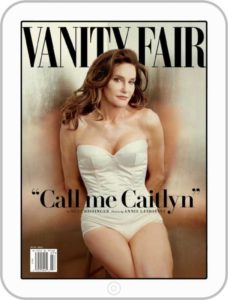
The July 2015 edition of Vanity Fair magazine had Jenner publicly declare: “Call me Caitlyn.”
Note the date. And then observe the following regarding our titular star. “Visible just before sunrise about the time of the summer solstice, Sirius signified the beginning of the sacred Egyptian year.”[8]
In 2015, the Summer Solstice occurred on Sunday, June 21. For those keeping track, that’s roughly nine days before the relevant issue of Vanity Fair would have hit newsstands. This is just the tip of the Synchromystical iceberg.
According to the late “Discordian” guru Robert Anton Wilson: “Celebrations of the Dog Star, Sirius, beginning on July 23, as the origins of the expression ‘dog days,’ meaning the days from July 23 to September 8, when the last rituals to Sirius were performed [in Egyptian culture].”[9]
Was Jenner’s announcement only coincidentally delivered in conjunction with the Dog Days? Was it made “doggy style”? By the way: What is the modern slang term for a female dog? Oh, never mind.
Saturn
I recall reading somewhere that “Saturn” is sometimes used as a code name for Sirius, but I’m too lazy to look it up. There are numerous interesting Saturn-star links.
Dennis Hauck, in his popular-level introduction to alchemy, states: “The shimmering triple ring of rocks and 10 moons …are remnants of [Saturn’s] greedy attempt to attract more mass with its powerful gravity. …Had Saturn been able to attract more mass, it would have transformed into a star, and our galaxy would have had two suns. But now ancient Saturn sleeps in darkness…”.[10]
Here we have another secret-sun symbol. Hauck invites us to compare this astronomical lore against Saturn’s mythological tale, where he “was imprisoned by his father …while still a child. The child conspired with his mother to overthrow his father and ended up castrating him with a sickle.”[11] When Saturn himself was later deposed by Jupiter, the former was relegated “to the darkness of the underworld.”[12]
Just in case this Saturnian “Christ-complex” wasn’t yet plain enough, Hauck finishes by adding that “…Saturn was the most important planet to the alchemists. They equated in with the First Matter and considered it both the beginning and end of the Great Work.” So, the alchemical Saturn is regarded to be “alpha and omega”[13] of the arcane practice of transformation.
In his book, The Sirius Mystery, writer Robert K. G. Temple says of Saturn that it “is known as ‘the star of limiting the place’ …”[14] to the Dogon peoples of Africa, which group is one of the main subjects of his book.
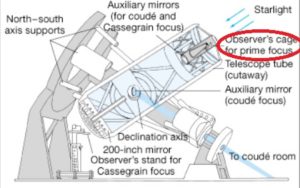
Downard suggested that the 200-inch Hale telescope at Palomar Observatory in California might sometimes have been pointed at Saturn. The details are a little murky, but Downard’s story has it that a person (or persons) unknown would actually climb into the telescope’s built-in viewing area and then allow themselves to be “irradiated” by the celestial “rays” that would stream through the massive optical device.
What these individuals may have been doing while in this energy-bathed state is anybody’s guess. But the whole thing has a palpable sexual aura to it.
And it is this just this elaborate and variegated tapestry of symbolism that has been hinted at and showcased by Fortean journalist and writer Jim Brandon in his Sirius Rising redux.
Introduction to Downard
Jim Brandon is the pen name of the author of the hard-to-find and much-pirated Weird America: A Guide to Places of Mystery in the United States[15] and The Rebirth of Pan: Hidden Faces of the American Earth Spirit.[16]
The original Sirius Rising (SR) recording has attained something of a buzz among Synchromystics and aficionados. Originally, recorded in the 1970s on reel to reel, SR is based upon a series of interviews with Synchromystic chieftain James Shelby Downard.[17]
Downard, who died in 1998 at the age of 85,[18] is as enigmatic as he is inimitable. The broad contours of his life have been somewhat unriddled by Richard Spence, professor of military (and other) history at the University of Idaho. Spence’s serious research draws upon his wealth of academic and research experience tracking down individuals who are trained to obscure their personal histories.
As Spence puts it: “…I spend an unhealthy amount of time delving through passenger lists, census records, investigative files and similar databases trying to piece together the movements and associations of spies and kindred shady types. …Using the same techniques, I decided to see what I could turn up on Downard.”
I won’t spoil for you the experience of following along with Spence as he recounts his investigative journey. And I won’t reproduce much of the good doctor’s work, here – save for this.
In a paragraph summarizing his tentative conclusions, Spence opines: “Shelby James Downard was unequivocally real. However delusional or exaggerated his adventures may have been, they are woven around a framework of real places, people and events. …There is …a multitude of puzzling coincidences, perhaps signifying some larger reality we cannot see or understand, perhaps signifying nothing.”[19]
I highly encourage interested readers to search for “Searching for James Shelby Downard.”
The Sirius Rising (SR) recording
Brandon’s newly revamped SR has two foci.
On the one hand, there is the centerpiece symbol: Sirius. As I already noted, Sirius’s various layers of meaning and interconnections with other areas of research are endless fascinating.
On the other hand, though, Downard himself is magnetic and captivating. Shelby, as his friends apparently knew him, is something of a hidden “power” behind the work of multiple, contemporary researchers and theorists. In this way, Downard himself is a Sirius symbol. He’s the hidden sun behind the brighter lights of Forteans and Synchronmystics including Michael Hoffman, Loren Coleman, and the SR interviewer himself, Jim Brandon.
For more on Downard and his unique œuvre, see HERE.
A rough outline of the SR presentation – which is actually part 1 of a series – is as follows.
Introduction: There is a secret society in America
Three assassinations (Two Kennedys and Martin Luther King, Jr.)
The ‘Killing of the King’ (Alchemical Rite and the trail leading to it: The ‘Journey of Death’)
Destruction of ‘primordial matter’ – The ‘Trinity Site’
The moon trip – Jules Verne & Cape Canaveral
The Palomar telescope (Saturn, ‘mystic rays,’ and the folks who ‘tune-in’ on them)
Along the way, Brandon and Downard explore such themes and topics as:
The 33-degree latitude line
Alchemy
Androgyne and hermaphrodite symbolism
CERN
Cape Canaveral
Freemasonry (Egyptian & Scottish Rites)
The Hellfire Club
The Jornada del Muerto
Kern Gate
The Knights Templar
Ley Lines
Loch Ness
Mount Palomar
The Ordo Templi Orientis
The Pentagon
Phoenix lore
Ritual murder
Sex Magic
The Symbionese Liberation Army
Vacaville
Washington D.C.
And mentions such personalities – whether notable or virtually unknown – as:
Fidel Castro
Elizabeth Chudleigh
Franklin Cover
Aleister Crowley
Sir Francis Dashwood
Donald David “Cinque” DeFreeze
Henry Flagler
Dion Fortune
Leslie Groves
Tranchell Hayes
Patty Hearst
Edgar Hoover
Lyndon Baines & “Lady Bird” Johnson
Carl Gustav Jung
John Keel
John F. & Jacqueline Kennedy
Jack Parsons
Albert Pike
James Earl Ray
John D. Rockefeller
Jack Ruby
Georgia Tann
Jules Verne
Allan Witwer
To obtain the CD domestically, try emailing Loren Coleman: LColeman [@] maine.rr.com.
Last I checked, the recording was selling for $17, postpaid.
Notes:
[1] The Ancient Egyptians referred to this star as “Sothis,” and it was reputed to be the star of the Goddess Isis.
[2] For example, Kenneth Grant alleged that occultist Edward Alexander (“Aleister”) “Crowley identified the heart of the Thelemic current with one particular Star. In Ocuclt Tradition, this is ‘the sun behind the Sun,’ the Hidden God, the vast star Sirius, or Sothis, which opened the zodiacal year of 365 days as well as the Great Year of approximately 26,000 years,” The Magical Revival, London: Skoob Books Publ., 1991, p. 50. This has been echoed all sorts of places. “The first major symbol to discuss is the point within the circle or the symbol of the Sun. …The point within the circle also represents the All-Seeing Eye that means a watcher of this world which is Typhon and Sut. …The point within the circle has yet another meaning. This point within the circle represents two suns. Our normal sun that’s visible in daylight, and the sun behind the sun, which represents Sirius.” At least, according to an alien enthusiast calling him- or herself HiddenLight777 in an article titled “Extraterrestrial Symbolism,” Ja. 25, 2009, <https://hiddenlight777.wordpress.com/2009/01/25/extraterrestrial-symbolism/>. The “extraterrestrial” angle is not limited to dark cyber oubliettes. For a more mainstream exploration, see Robert Temple’s The Sirius Mystery, originally published by Futura (London, 1976) and cited elsewhere in this article – though, in a later edition.
[4] Elsewhere, the Blazing Star has been put forward as a symbol of the alchemical quintessence. See Timothy Hogan, The Alchemical Keys to Masonic Ritual, Morrisville, N.C.: Lulu, 2007, p. 22.
[5] Albert Pike, Morals and Dogma, Richmond, Virg.: L. H. Jenkins, 1946, pp. 14-15 and 486. Cf. Craig Heimbichner and Adam Parfrey, Ritual America: Secret Brotherhoods and Their Influence on American Society: A Visual Guide, [Port Townsend, Wash.:] Feral House, 2012, p. 158. (CAPITALIZATIONS in original.)
[6] The name “Sothis” also crops up in Gustav Davidson’s A Dictionary of Angels – Including the Fallen Angles (paperback ed., New York: The Free Press, 1971, p. 278), where we read: “Sothis (Sotis) – angel of an hour. [Rf. H.D.’s poem ‘Sagesse’; Ambelain, La Kabbale Pratique].” Also, on page 219: “Pahaliah – an angel invoked to convert heathens to Christianity. He rules theology and morals and is one of the angels bearing the mystical name of God Shemhamphorae. Pahaliah’s corresponding angle is Sothis. [Rf. Ambelain, La Kabbale Pratique, p. 264].” The reference to “Christian” proselytism is somewhat laughable. The so-called “Shemhamphorae” – or Shem ha-Mephorash, or Shem Hamphorasch, etc. – means the “ineffable name” and designates seventy-two alleged “mystical” names of God, divined through the application of Sod (esoteric interpretation) to the Old Testament Book of Ezekiel (specifically, chapter 14, verse 19-21), and part of Jewish Kabbalism.
[7] Patricia Turner and Charles Russell Turner, “Sothis,” Dictionary of Ancient Deities, Oxford: Oxford Univ Press, 2000, p. 438.
[8] Turner and Turner, “Sirius,” op. cit., p. 433.
[9] Robert Anton Wilson, Cosmic Trigger Volume I: Final Secret of the Illuminati, 23rd printing, Las Vegas, N.V.: New Falcon Publ., 2011, p. 87.
[13] In the New Testament biblical Book of Revelation, Jesus is referred to as the “Alpha and the Omega, the first and the last, the beginning and the end.” Revelation chap. 22, verse 1. See also Rev. 1:8, 1:17-18, and 21:6-7. These references hearken back to the Old Testament Book of Isaiah (see 44:6 & 48:12) where Yahweh is described as speaking of himself in similar terms.
[14] Robert K. G. Temple, The Sirius Mystery, Rochester, Vt.: Destiny Books, 1987, p. 29. Researcher Peter Levenda relates: “If we are to believe Robert Temple, for example (and there is no reason why we should not), then the US government was extremely interested in his research into the African Dogon tribe — the primitive tribe that knew of the existence of both Sirius A and Sirius B, including having much detailed information about the physical and chemical composition of both, as well as an accurate calendar of the double star’s movements — and attempted to keep Temple from publishing his results in The Sirius Mystery, an attempt that obviously failed. Whether or not the attempt was a genuine, albeit half-hearted, effort on the behalf of the CIA to stop Temple from publishing, or was itself part of a disinformation campaign or some other psy-war experiment, is not known. What is known is that the CIA knew in detail of Temple’s research long before he had gone to press.” Peter Levenda, Sinister Forces: A Grimoire of American Political Witchcraft: Book Three: The Manson Secret, Walterville, Ore.: Trine Day, 2011, pp. 273-274.
[17] Jim Brandon distributed the original SR recordings as a set of cassette tapes. Some correspondents received one cassette. Others received more than one. Only a handful possess the original set in cassette format. More recently, a few copies of SR recordings have made the rounds as audio CDs. But, for the most part, the recordings have remained inaccessible.
[19] Richard B. Spence, “Searching for James Shelby Downard.” The publication history of this article is somewhat complicated. I first encountered it, with an introduction penned by Fortean Adam Gorightly, on the website ForteansWest, dated June 2012, <http://forteanswest.com/lowfi/editorials/richard-b-spence-june-2012/>. Spence’s article had also been picked up by Paranoia magazine, and published on pages 20-24 of issue #52, Summer 2012. The ForteansWest link became nonfunctional sometime around 2015. That same year, Spence revised and expanded his article. Though, I am unaware whether this longer piece has found a home online.
*********************************
“Sirius”
“When sweet-eyed spirit round the windows hover,
At the first breathing of the gloaming grey,
And the soft shadows of the evening cover
The sins and sorrows of the dying day;
“Then the sad moon, in nightly penancy dreary,
Crosses the pathless desert of the sky,
And hastes, with pallid face and footsteps weary,
A soul that may not rest and dare not die.
“But when she sinks beneath the rim of Ocean,
And hastens to her home afar from earth.
To hide her silent glitter with a fresher mirth.
“They look on us with glances true and tender,
Piercing our spirits with the sleepless eyes;
And one among them shines with tenfold splendour,
Brighter than all the children of the skies.
“O Prince of all the gleaming sons of Heaven!
O Leader of the glad celestial host!
Thous art to me the dearest joy of even;
Thou art the friend my spirit longs for most.
“I know that thou canst hear my vainly calling,
In that undying heaven where thou art;
I know that thou canst see my sad tears falling;
I know that they keen sight can read my heart,
“Wilt thou not speak to me, O child of glory,
And tell me why my heart so yearns for thee?
I know that thou canst tell me all our story,
All that we knew ere earth began to be.
“Thou wilt not speak! And yet I love thee, spirit,
More than I love children of this earth;
And when I shall, in my last days, inherit
The dim great halls of him who knows no mirth,
“Let me be laid where, in the flower-strewn meadows,
Over my head the long lush grass shall wave,
And do thou come with the soft midnight shadows,
And look upon me in my silent grave.”