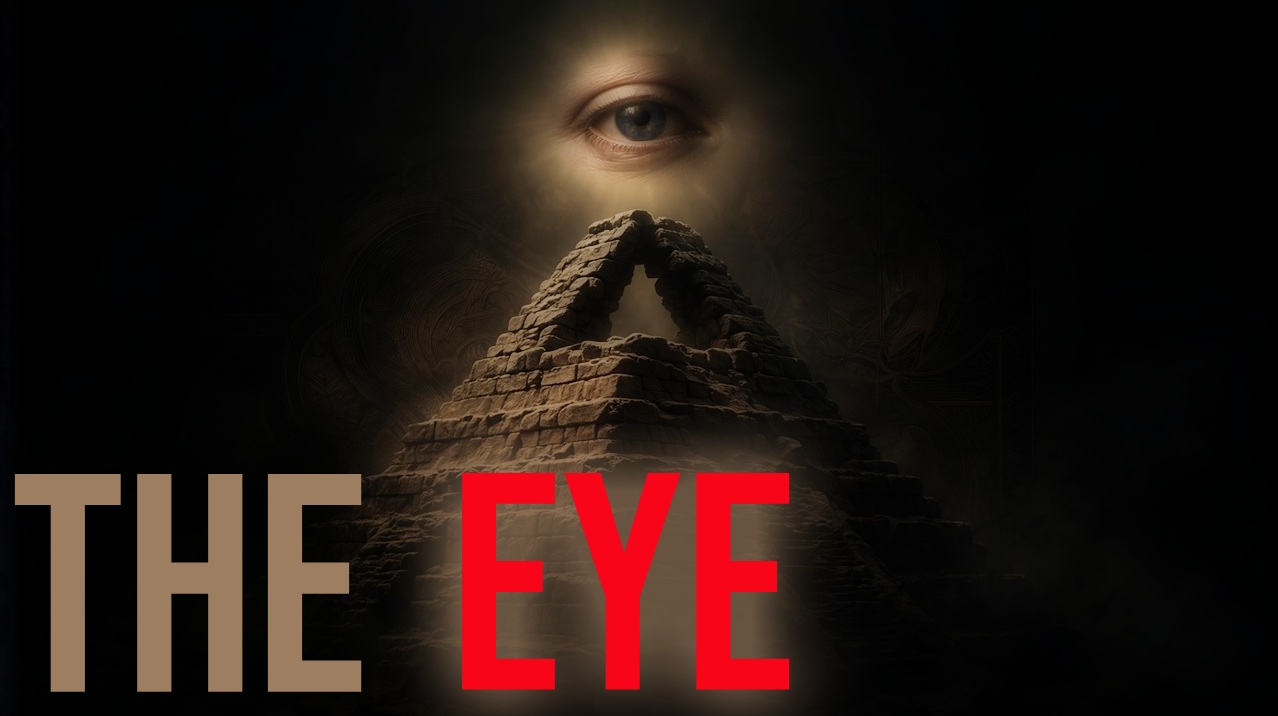
The All-Seeing Eye and unfinished pyramid on the back of the American $1 bill are among the most recognizable symbols in the United States. Their conventional interpretation is familiar: the Great Seal represents Providence, the thirteen original states, and the ideals of the American founding.
But the modern history of the symbol is considerably stranger.
In the second installment of our investigation into Bankers Trust, the Federal Reserve, and the symbolic architecture of American finance, we begin with a deceptively simple question: Who actually put the Eye and Pyramid on the dollar — and why?
The answer leads first to Treasury Secretary Henry Morgenthau Jr. and President Franklin D. Roosevelt, but then backward to Roosevelt’s Secretary of Agriculture and future Vice President, Henry A. Wallace. Wallace, in turn, was deeply fascinated by the Russian mystic and symbolist painter Nicholas Roerich, whom he regarded as a spiritual master.
According to the account explored here, Wallace discovered an obscure early-twentieth-century history of the Great Seal in the National Archives in 1934. He became particularly interested in the phrase Novus Ordo Seclorum — “New Order of the Ages” — and brought the material to Roosevelt. Roosevelt reportedly favored placing the Great Seal on American currency rather than the originally contemplated coin, and Treasury Secretary Morgenthau subsequently implemented the decision.
This creates a remarkable historical chain: Roerich → Wallace → Roosevelt → Morgenthau → the dollar.
But the story does not end with the Great Seal.
Roerich was associated with an elaborate tradition surrounding a mysterious “sacred stone,” sometimes identified by researchers with the Stone of Destiny, the Holy Grail, Jacob’s Pillow Stone, or the legendary Bethel Stone. One particularly curious version of the story claims that this object was delivered to Roerich in a wooden casket bearing the words “Banquer’s Trust.”
That detail brings the investigation back to the subject of Part One: Bankers Trust.
The connection becomes even more intriguing when we reconsider the pyramid. Bankers Trust’s former headquarters at 14 Wall Street was crowned by a monumental pyramid modeled in part on the Mausoleum at Halicarnassus — itself a tomb. Decades later, the bank’s successor headquarters at 130 Liberty Street stood directly beside the World Trade Center complex and was damaged during the destruction of the South Tower. During its subsequent demolition, human remains from the disaster were reportedly discovered on the roof.
Meanwhile, the dollar’s pyramid is conspicuously unfinished.
Its missing capstone invites another ancient association: the Egyptian Benben stone, traditionally associated with the first emergence of land at Heliopolis. The pyramid’s capstone, or pyramidion, was modeled upon this sacred stone. In the accompanying mythology, the Bennu bird — a self-renewing solar creature and traditional precursor of the phoenix — is associated with the Benben.
The symbolism therefore suggests a recurring pattern: destruction and rebirth, death and resurrection, chaos and order.
The American dollar’s reverse also contains the so-called eagle, which occult writer Manly P. Hall interpreted instead as a disguised phoenix. The phoenix, in turn, gives the story another symbolic connection with the destruction and subsequent rebuilding of the World Trade Center site.
And only blocks away sits the Federal Reserve Bank of New York at 33 Liberty Street.
Are all of these connections evidence of a single hidden plan?
That is not the claim.
The more interesting question, from the perspective of SynchroMystique, is whether meaningful patterns can emerge across history without requiring a single person or organization to consciously orchestrate every connection.
Carl Jung called this phenomenon synchronicity: an acausal connecting principle in which events, symbols, and meanings converge in ways that cannot necessarily be reduced to ordinary chains of physical causation.
The Eye on the dollar may therefore be worth examining not merely as a piece of American iconography, but as a symbolic object with a documented twentieth-century history — one that intersects with mysticism, political power, financial institutions, secret societies, ancient symbolism, and the recurring myth of death followed by rebirth.
The next time you pull a dollar from your wallet, look at the back.
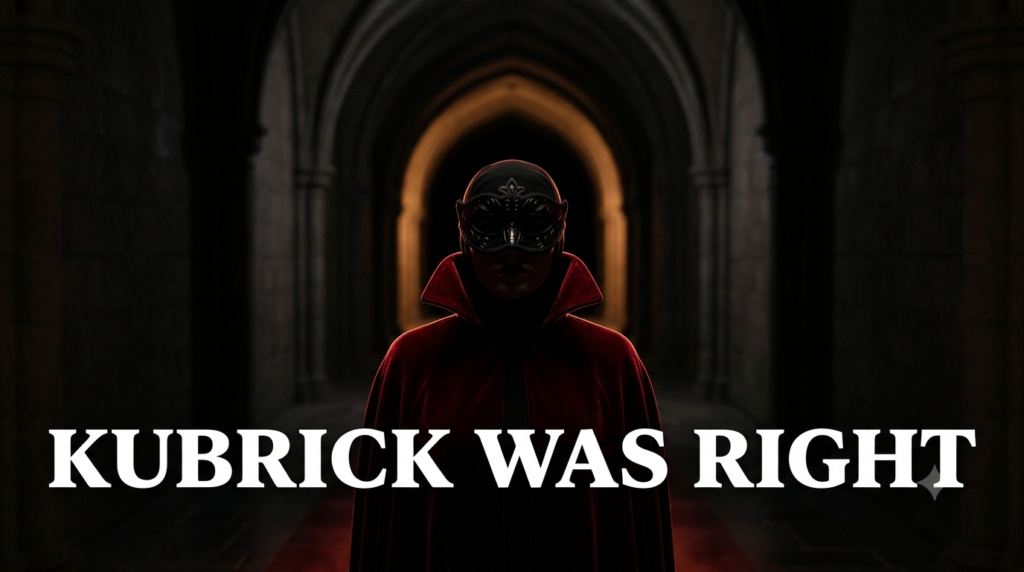
Eyes Wide Shut, Jeffrey Epstein, and the Secret Society Hiding in Plain Sight
What if Stanley Kubrick’s final film wasn’t predicting Jeffrey Epstein—but revealing the kind of world that makes an Epstein possible?
In this new SynchroMystique™ video essay, we compare Eyes Wide Shut and the Epstein affair through the lens of Jungian synchronicity, symbolic pattern recognition, and cultural archetypes. Rather than advancing sensational claims, the presentation explores striking structural parallels involving secrecy, elite social networks, ritualized behavior, mutual compromise, and the insulation of concentrated power.
The result is less an investigation into any single individual than a meditation on recurring historical patterns—and why Kubrick’s final masterpiece seems increasingly prophetic in hindsight.
What happens when one forgotten Wall Street institution appears at the crossroads of finance, intelligence, political symbolism, esoteric history, and more than one of the most controversial episodes in modern America?
This investigation traces the remarkable history of Bankers Trust — from its origins within the J. P. Morgan financial network and its rôle in the rise of the Federal Reserve, through its pyramid-crowned headquarters at 14 Wall Street, to its later acquisition of Alex. Brown and eventual absorption into Deutsche Bank.
Along the way, unexpected connections emerge: Nicholas Roerich’s mysterious “wandering stone,” Henry Wallace’s fascination with esoteric symbolism, the appearance of the reverse Great Seal on the dollar bill, CIA executive Alvin Bernard A. B. “Buzzy” Krongard’s ties to Bankers Trust-Alex. Brown, the unresolved questions surrounding pre-9/11 options trading, and the destruction of the Deutsche Bank Building beside the World Trade Center.
Rather than arguing for a grand conspiracy per se, we examine the dense network of (documented) historical relationships through our usual pattern-detecting lenses of symbolism and Jungian synchronicity.
But, whether viewed as a patchwork of coincidence, an exploration in psychogeography or archetypal recurrence, or (indeed) bona-fide evidence of deeper historical forces, the story of Bankers Trust offers a striking case study in the strange ways power, symbolism, finance, and myth can intersect.
On April 25, 2026, violence disrupted the White House Correspondents’ Dinner at the Washington Hilton — a venue forever linked to the 1981 Reagan assassination attempt.
In this new investigation from The SynchroMystic, we explore the symbolic, historical, and esoteric dimensions surrounding the event.
From Tarot archetypes and ritual calendars to “Wheel of Fortune” recurrence patterns, Oz symbolism, political mythology, gematria claims, and the uncanny return to the “Hinckley Hilton,” this article examines how modern events become layered with symbolic meaning — whether intentionally or unconsciously.
Rather than making accusations, this presentation catalogs the synchronicities, symbolic echoes, historical parallels, and mythic patterns that observers have identified in the wake of the shooting.
If recurring symbolism, political ritual, occult interpretation, and cultural mythmaking interest you, this may be one of the most layered analyses yet.
‘Nazi’ Occultists, Part 2: 10 Party Members & Contemporaries (Full Version)
Intro
It’s the stuff of legend that Adolf Hitler – and, indeed, the entire Third Reich – was somehow empowered by occult forces.
According to one line of thought, the architect of German National Socialism was a powerful and shadowy occult adept identified as geopolitical strategist Karl Haushofer.
“Introduced by [Rudolf] Hess” – whom we will meet later – “General Karl Haushofer visited Hitler every day …[when the latter] was confined to prison at Landsberg” following the failed Beer Hall Putsch. Haushofer “spent hours with [Hitler,] expounding his theories …”. And it’s beyond question that Haushofer’s vision heavily influenced his pupil’s autobiographical Mein Kampf.
But, what researchers Louis Pauwels and Jacques Bergier insist upon, in their eye-popping volume The Morning of the Magicians, is that Haushofer exhibited “another personality – as a disciple of Schopenhauer[,] who had taken up Buddhism, [and as] an admirer of [Jesuit founder] Ignatius de Loyola…”. Haushofer is painted as the mystical mastermind behind Hitler.
Pauwels and Bergier suggest “that it was Haushofer who …chose the swastika as an emblem” for the new movement – the symbol being the ensign of an Aryan savior, as explained in Part 1.
Haushofer was “the magician …[and] secret master” pulling the strings of National Socialism.
Nowadays, it’s fashionable to disparage this as a flight of fancy. Tho… much the same judgment was expressed by an establishment insider, attorney Sidney S. Alderman – during the International Military Tribunal, no less. Colloquially known as the “Nuremberg Trials,” the IMT gave Alderman all the backing of United States Supreme Court Justice Robert H. Jackson.
On his own, Pauwels would connect Haushofer to the influential Armenian mystic George Ivanovich “G. I.” Gurdjieff.
We have mentioned Gurdjieff in passing before – such as in our video “10 Occultist Spies.”
We intend to feature him more prominently in our upcoming “Top Ten 20-Century Occultists.”
Those who fell under his sway – whether through books or personal encounters – include the offbeat “New Age guru” Bhagwan Shree Rajneesh, at least one of Tibet’s Dalai Lamas, and – if you believe the stories – the erstwhile Führer.
Naysayers are legion. But it’s worth contemplating the reasons such tales have plausibility – among them being the fact that many influential N.S principals had esoterica on their dossiers. So, in this video, we’ll pick up where we left off in Part 1. And we’ll catalog our top ten (10) occultists who operated within Hitler’s Germany.
Caveats and Disclaimers
Technically, starting around 1933, esoterics began receiving pushback from the government. By 1935, the National Socialist German Workers Party (NSDAP) had laws outlawing Masonic-style secret societies. These enactments – advanced by interior ministers such as Hermann Goering and Wilhelm Frick – negatively affected numerous völkisch neopagans, occultists, and organizations beyond Freemasonry. Orders were enforced by the “Security Service,” or SD, under Reinhard Heydrich. A few key groups – like the often-shocking Thule Society – had officially disbanded years before the crackdown.
Nevertheless, at various times, Germany was rife with occult activity. One of the most colorful of the era’s esoterics was the flamboyant hypnotist who comes in at number ten.
10 — Erik Jan Hanussen
In point of fact, Hanussen’s lasting reputation is partially owed to the Central Intelligence Agency’s principal predecessor, the Office of Strategic Services.
According to O.S.S. psychologist Walter Charles Langer, Adolf Hitler had been instructed in crowd manipulation, hypnotic suggestion, and even “mind control” by an expert “mentalist.” What name did Langer supply in his secret report? Erik Jan Hanussen.
Born Herschel Chaim Steinschneider, Hanussen eventually achieved fame enough to open a successful nightclub, which he named the “Palace of Occultism.” In this personal theater, Hanussen showcased a series of performances blending astrology, clairvoyance, mind-reading, telepathy, and other similar, “paranormal” talents.
Hanussen’s Wikipedia article claims that he was the real-life inspiration for the scheming magician Eduard Abramovich – alias “Eisenheim” – in the 2006 movie, The Illusionist, featuring actors Edward Norton and Jessica Biel.
Money for Hanussen’s extravagant and egocentric “palace” came from the success of his astrology-based newspaper. The publication garnered wide circulation based upon Hanussen’s renown as a “fortune teller.”
Hanussen was reputed to have predicted the infamous Reichstag Fire of February 27, 1933. Occurring one month into Adolf Hitler’s chancellorship, the event is routinely cited as a milestone in the inception of National Socialism. It also appeared to be an unsettling vindication of the National-Socialist claim that a vast Communist conspiracy had taken root in German soil.
One month after the politically convenient fire, sometime between the late evening of March 24 and the early morning of the twenty-fifth (1933), Hanussen was evidently assassinated. His death followed a brief arrest and interrogation by the Sturmabteilung (SA). This entire episode led many observers to suspect that the Reichstag fire had been an “inside job.” On this version of the story, and owing to his compulsion to wow his audiences with semblant prescience, Hanussen spilled the beans on sensitive plot details and became a liability.
It appears highly likely that Hanussen was running an ambitious “confidence-scam” operation. According to biographers, Hanussen had attempted to make a living as “a society reporter” back in his Vienna days. “During this time he [supposedly] blackmailed wealthy citizens with [the threat of publishing] rumors in tabloids and [he did, in fact, publish] the tricks of a fraudulent clairvoyant…”. This is ironic, since “he later adapted [similar techniques] himself.”
During the rise of National Socialism, Hanussen maintained profitable “contacts with the SA leadership,” and he was attempting to gain leverage over them “by financing their gambling debts and other [activities], especially [the procurement of] sexual services.”
In other words, he was something of a 1930s-German version of Jeffrey Epstein. And, like Epstein, Hanussen was not ethnically German.
And that leads us to note that Hanussen was also part of a little-known – or, at least, seldom-acknowledged – group that we’ll call Jewish (or part-Jewish) National Socialists.
Prominent members of this category include Luftwaffe Field Marshal Erhard Milch and Three-Star General Helmuth Wilberg.
One of the more remarkable, a proud descendant of the Jewish philosopher Moses Mendelssohn, was high naval officer Franz Viktor Mendelssohn. A master shipbuilder since World War I, he joined the party in 1934, according to Bryan Mark Rigg.
Of course, we can’t forget Emil Maurice. Not only was Maurice Adolf Hitler’s first personal chauffeur, but he was also a charter member – and some would say a founder – of the dreaded Schutzstaffel (SS). Staggering!
Lastly, we’ll mention Vice Admiral Bernhard Rogge. “Although he had a Jewish grandfather, Rogge received the …German Blood Certificate …from Hitler, declaring him to be an Aryan.”
For some time during World War II, Rogge was in command of an armed, ex-merchant ship named the Atlantis. And that seems as good as any opportunity to segue into our next figure…
9 — Alfred Rosenberg
Rosenberg had been a refugee from the Bolshevik takeover of Tsarist Russia.
He became a protégé of Dietrich Eckart and was quickly integrated into Völkisch circles in Germany – including into Rudolf von Sebottendorff’s Thule Society that we surveyed in Part 1.
Officially, Rosenberg had a ponderous and nearly untranslatable title. But, he operated something like the “Führer’s overseer” for education and training in matters relating to intellectual development and worldview reckoning.
The word “myth” here means “guiding idea” rather than “made-up story.” For Rosenberg, this starting premise has to do with “…the death of Materialism and Individualism” and the anticipated rise of a neopagan Volk.
In this, Rosenberg was shaped by Indian thought, the music of Richard Wagner, and the philosophy of Arthur Schopenhauer. For this background, see Part 1.
Rosenberg’s political thinking was indebted to the British-born theoretician Houston Stewart Chamberlain who, in 1899, published his pæan to Teutonism, The Foundations of the Nineteenth Century.
Within the pages of Rosenberg’s volume, the author detailed an “occult history” of the Aryan race whose “original home” had been the fabled and ill-fated lost civilization of Atlantis.
Far from the sun-kissed islands of Bimini or the conflict-riddled “Holy Land” of Palestine – two oft-favored locations for the vanished continent – Rosenberg situated Atlantis near the North Pole. This hyperborean focus was seamlessly woven into a tapestry that included the legendary Thule and that explained the symbolism of the “Black Sun.” The latter – found, for instance, as a mosaic in the SS-embellished Castle at Wewelsburg – was a stylized recollection of the arctic summer, when daylight was visible at midnight.
Along with William Scott-Elliot and numerous others, Rosenberg integrated the story of Atlantis into speculative anthropology.
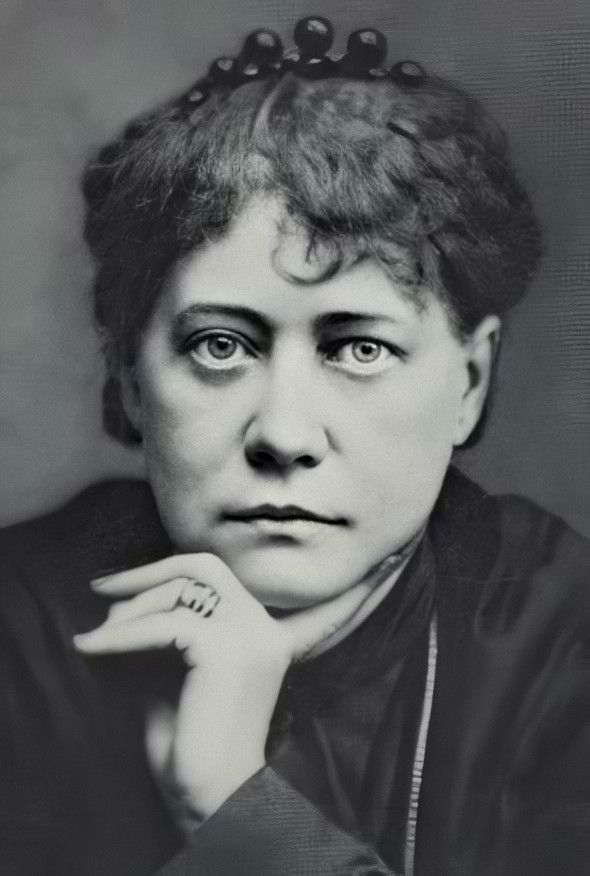
But the genesis of this Atlantean mythos owes much to Theosophical foundress, H. P. Blavatsky, whom we profiled in our first installment …
On this roughly Blavatskian view, “…humankind has evolved through different phases of spiritual growth and intellectual development, each of these being known as a root race. The present state of humanity is broadly identified as the fifth root race. It was preceded by the Atlantean (fourth) and Lemurian (third) root races, both of which were engulfed in cataclysms.” In this picture, “…the blonde-haired blue-eyed race …[descended from the] Atlantean.”
Finally, Rosenberg was noteworthy for his opposition to the Roman Catholic Church. His method, in this, “is a staple of occult literature” – namely, playing up the “theme …that the true religion… has been concealed by an establishment conspiracy.”
Rosenberg lauded “the Albigensians, Waldenses, Cathars, Arnoldists, Stedingers, Huguenots, and reformed Lutherans,” as exemplars. Whoever was vilified as a “Heretic” by the Vatican was eulogized by Rosenberg as a “martyr of free research” and a “hero of Nordic philosophy.”
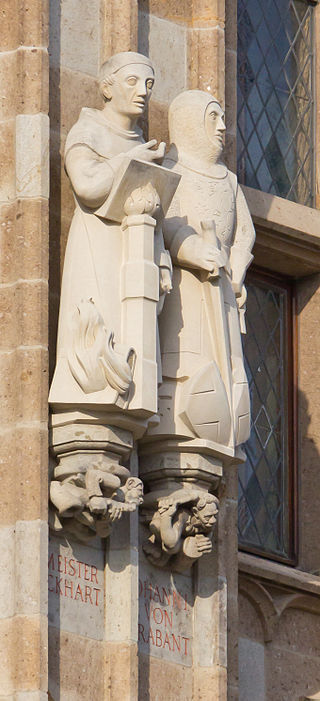
For Rosenberg, pure expression of volk free thinking was epitomized in people like the thirteenth-century Dominican neoplatonist Meister Eckhart. We have referred to him in several past videos including our deep-dive into “Neoplatonism.”
8 — Rudolf John Gorsleben
A one-time proponent of Ariosophy, he was a member of von Liebenfels’ Order of New Templars. Later, in Munich, he had brief dealings with Dietrich Eckart and Julius Streicher and would ultimately join the Thule Society.
Gorsleben’s lasting impact – if not memorialization of his name – was guaranteed by his groundbreaking modern translation of the Eddawhich, he believed, contained the vestiges of an ancient Aryan religion.
Building upon a foundation of esoteric genealogy laid by Guido von List, and continuators like Johannes Balzli, Gorsleben advanced an idiosyncratic etymology of the word “race,” which he leveraged to argue that pure-bred Germans (in particular) had peculiar claims to innate divinity.
Consequently, Gorsleben’s project, aborted by his premature death, became a quest to reawaken latent Aryan “occult powers” by employing a combination of hermetic, Kabbalistic, and magical procedures and genetic segregation. Gorsleben “elaborated upon the wisdom of the runes, mantic sciences, the Edda, and Teutonic astrology.”
Much of this was in line with the professed goals of Madame Blavatsky’s society. And when we get to Heinrich Himmler (in just a few minutes), we’ll see one result of this new Theosophical reading of the Edda. Specifically, it inspired a whole crop of esoteric archaeologists that combed the earth looking for evidence of Aryan prehistory – all under the ægis of the SS.
Believe it or not, a lot of this spirit has been carried over into some “Ancient-Astronaut” and “Ley-Line” investigations and movements as far flung as the New Age and Transhumanism.
7 — Gregor Schwartz-Bostunitsch
This Russian-born writer became estranged from his homeland following the Bolshevik Revolution, on which we hope to have more to say in the future.
Along with Gen. Anton Denikin, Cossack Grigory Semyonov, Baron Pyotr Wrangel, and others, Bostunitsch seems to have been highly placed within “White Russian” resistance movements.
These were so named because they contrasted with the red symbolism of the Communists.
After fleeing Soviet Russia and its murderous apparatchiki, he traveled – ostensibly, in search of mystical as well as political insight.
At first, Bostunitsch decamped for the Caucasus Mountains, where he met an unknown teacher that the late researcher James Webb identified as the pervasive G. I. Gurdjieff.
For more on him, look for our upcoming video “Top Ten 20th-Century Occultists.”
Later, Bostunitsch made his way to Bulgaria. There, he was received by a circle of Theosophists gathered around Peter Deunov, founder of the Universal White Brotherhood.
Intuitively, there is a parallel to the “Great White Brotherhood” of Madame Blavatsky, the Russian co-founder of the Theosophical Society whom we discussed in Part One.
The basic idea is that a group of perfected entities – known as “Ascended Masters” – guide or control the mundane world from behind the scenes.
Bostunitsch then mixed these ideas with Rudolf Steiner’s “Anthroposophy,” which our peripatetic expatriate discovered while shuttling between Yugoslavia and Germany.
Once in Germany, however, he abandoned the Steiner school – which he (like Dietrich Eckart) came to regard as part of a Judeo-Masonic conspiracy – and embraced Ariosophy instead.
Changing his surname to Schwartz-Bostunitsch, he set up shop with Alfred Rosenberg’s news agency and joined the S.S. in 1944.
From then on, he was much in demand as a lecturer. Given the honorific “Doktor Gregor,” Schwartz-Bostunitsch spoke throughout the Reich on Masonic intrigues.
“In May 1946, his name appeared for the last time on a prisoner list of SS officers compiled by the High Command of the American Armed Forces; this list is in a Moscow archive.” “[H]is eventual fate is unknown.”
6 — Karl Ernst Krafft
Born in Basel, Switzerland in 1939, he was regarded as an expert and insightful graphologist. “Graphology” refers to the purported determination of personality and psychological traits by scrutinizing the way a subject writes his or her letters.
In Donnie Darko, the 2001 cult classic by James “Richard” Kelly, police investigators work with school administrators to try to identify a vandal using a clumsy handwriting-analysis technique.
Elements of this were also present in the horrifying, 1888 Jack-the-Ripper serial-murder case, which had been overseen by then-commissioner Sir Charles Warren.
In a future video, we may turn our attention to some little-considered aspects of that momentous occurrence. It’s of interest for numerous reasons, not least of which was the fact that Warren was a high-ranking Freemason and later a principal founder of the significant Quatuor Coronati “research lodge” in London.
Even earlier, starting in 1867, Warren secretly explored the catacombs beneath the Jerusalem Temple Mount – a site that is increasingly portentous in the latest Arab-Israeli “war.”
In any case, Karl Krafft’s primary field was astrology. And, according to his admirers, he “had already proved himself a talented seer” when “[o]n November 2, 1939, he …predicted [imminent] mortal danger for [Adolf] Hitler…”.
Indeed, less than a week later, “[o]n November 8, Hitler spoke at a rally commemorating the anniversary of the Munich Beer Hall Putsch.” Moments after leaving the main podium, a bomb went off, devastating the stage and caving in the building’s superstructure. The explosion maimed over sixty people, and killed eight bystanders.
The first instinct of German police was to suspect Krafft’s involvement in what was obviously a well-planned, but failed, assassination attempt.
By successfully projecting his innocence, Krafft simultaneously testified to his psychic powers. He was straightaway promoted to a psy-op campaign termed “…the Nostradamus Project.”
“Nostradamus,” of course, was the almost “…magical pseudonym…” of the sixteenth-century French-born astrologer and prognosticator, Michel de Nostre Dame… . Nostradamus …published his famous predictive writings, The Centuries, in 1555.” He recorded alleged prophecies in nearly one thousand cryptic, four-line poems known as “Quatrains.”
According to numerous Western sources: “…Nostradamus at times seems to have had a remarkable foresight into the events of the French Revolution, and some have discerned references in his writings to [Italian leader Benito] Mussolini and [Adolf] Hitler.”
Krafft’s job was to interpret the famous French seer’s prognostications with a “pro-Nazi slant”. To illustrate, Krafft associated Hitler with Nostradamus’s “grand duke of Armenia”.
Krafft was also said to have originated the “notion that Nostradamus …predicted the German blitzkrieg [‘lightning war’] that resulted in the 1940 occupation of Paris…”.
Meanwhile, of course, “Allied” analysts were busy vilifying Hitler with other of Nostradamus’s passages. In Britain, this included MI5 operative and astrologer Louis de Wohl, psych-warfare propagandist Sefton Delmer, and Naval Intelligence agent (and later James-Bond creator) Ian Fleming. A well-known illustration of their efforts is the passage which “predicts” that Hitler was the “Western-European …child …seduce[d] a great many people.”
Finally, we’ll note that some say Hitler himself displayed signs of clairvoyance. According to Pauwels and Bergier, “Hitler predicted exactly the date of the entry of his troops into Paris… When he decided to reoccupy the Rhineland in 1935, all the experts in Europe, including the Germans, were convinced that France and England would resist. Hitler predicted that they would not. He also [supposedly] announced [in advance] the date of the death of [four-term American President Franklin D.] Roosevelt.”
Perhaps it was more than a coincidence that “one of the most heavily annotated books in Adolf Hitler’s personal library” was Ernst Schertel’s 1923 Magic: History, Theory and Practice.
Interlude
A number of second-stringers didn’t quite rate a full treatment, here. But, in passing, we’ll mention Count Karl Friedrich Dürckheim-Montmartin. Sometimes referred to in print as Karlfried Graf Dürckheim, he was a strident anti-Communist who, after World War II, converted to an idiosyncratic combination of Jungian “depth psychology” and Zen Buddhism.
Although largely forgotten today, Eugen Herrigel operated on a similar wavelength. In fact, Herrigel’s posthumously published “The Zen Way,” was supposedly translated into English by Alan Watts, who helped popularize and Westernize versions of Eastern religion.
One episode reported by Wulff was the Reich’s alleged attempt to locate ousted Italian Prime Minister Benito Mussolini in 1943.
Foreign-intelligence chief Walter Schellenberg was said to have put a number of esoterics on the trail of Il Duce. These included Wilhelm Gutberlet and Ludwig Straniak, …
…who are remembered for their prowess in the far-out field of “dowsing.” This is a form of divination in which the practitioner uses “[a] forked rod, or branch of a tree, which in the hands of certain people is said to indicate, by means of spasmodic movements of varying intensity, the presence of…” some sought-after item. Usually, this would be “…water and minerals underground.” But, in our case (it would seem), the target was Mussolini, who was recovered by the Luftwaffe working with an SS contingent under Otto Skorzeny.
5 — Ignaz Trebitsch-Lincoln
A Hungarian-born intriguer, his uncanny ability to disguise and reinvent himself was matched only by his seemingly endless capacity for charming political heavy hitters.
Reportedly, at one time or other, he had ingratiated himself with British Prime Minister David Lloyd George; American Federal Bureau of Investigation chieftain, J. Edgar Hoover; and German SS frontman, Heinrich Himmler.
Without question, Trebitsch-Lincoln is one of, if not the strangest characters on our list. Raised Jewish, he converted to Christianity and reportedly became a missionary in Canada.
Through various ecclesiastical channels in Anglicanism, he ended up in Britain where, in 1910, he managed to get elected to Parliament.
After bouncing amongst Germany, the Netherlands, and Romania, he “set himself up as a double (or rather a triple) agent during World War I,” according to his biographer Bernard Wasserstein.
A tangle of schemes followed, during which he had a run-in with the American Pinkertons – who had apparently been hired by the British Crown to apprehend him.
The Pinkertons, of course, were – and indeed, through a jumble of mergers and acquisitions, remain – a combination detective agency and security-guard force. Named after their founder, Allan J. Pinkerton, they rose to prominence during the fratricidal fray known as the “Civil War” when Pinkerton inveigled himself into upper-level Union circles. During the “Reconstruction Era,” his private army enforced corporate diktats when they were hired as “strikebreakers.”
The Pinkertons succeeded in locating Trebitsch-Lincoln and dragged him back to His Majesty’s Prison in Parkhurst, on the Isle of Wight. The commotion just previewed the coming attractions.
Trebitsch-Lincoln allegedly knew Dietrich Eckart, an early founder of the German Workers Party.
But, during the 1920s, he was mostly associated with a right-leaning German revolutionary government under Wolfgang Kapp. In fact, Trebitsch-Lincoln became the movement’s press secretary during its brief seizure of power in Berlin.
At this stage, he was agitating in favor of restoring monarchies all over Europe. These pro-royalists – including Waldemar Pabst – formed a loosely knit group referred to as the “White International.” The name was presumably intended to mark a contrast with the Communist International (Comintern) which was sometimes designated the “Red International.”
Trebitsch-Lincoln shuffled over to the island country of Sri Lanka (Ceylon), where he studied Buddhism. Incredibly, he underwent ordination (upasampadā) to become a monk.
Then, exploiting a network of Chinese warlords, Trebitsch-Lincoln finagled his way into the orbit of Tibetan Buddhists. Upon the death of the Thirteenth Dalai Lama in 1933, he declared himself to be the new Dalai Lama! Unsurprisingly, the outlandish claim received virtually no support in Tibet. However, his profession may have been championed in some Japanese circles – though, this was probably for geopolitical (rather than theological) reasons.
Incidentally, Russian occultist-painter Nicholas Roerich was also posing as a Dalai Lama.
Stranger still, the current – and supposedly bona fide – 14th Dalai Lama has been criticized for maintaining too cozy relationships with various National Socialists. For instance, “…he … cultivated friendly contacts with people such as the ex-SS [man] Bruno Beger… Beger …[was] a member of the …SS-Tibet Expedition organized by …in 1938/1939 whose primary goal was to find traces of an ancient, lost Indo-[Aryan] religion in the Himalayas. Some occult leaders in the SS were convinced that Tibetan Lamas are the key holders of these Indo-[Aryan] mysteries.”
The Dalai Lama was also friends with “…Heinrich Harrer, author of Seven Years in Tibet (a chronicle of his experiences with the Dalai Lama over seven years prior to his exile to India).”
In fact, Seven Years in Tibet was tackled by French film director Jean-Jacques Annand, with no less than Hollywood sex symbol Brad Pitt cast as the SS explorer, Harrer, himself.
For a mention of the erotically infused Tibetan Kalachakra Tantra, see “10 ‘Sex-Magic’ Cults.”
From Tibet, the already convoluted story takes a number of dizzying additional turns – with Trebitsch-Lincoln landing in Shanghai to begin his own monastery.
Then operating as a British-instituted “International Settlement,” Shanghai was still reeling from the fallout of the Opium Wars.
As the prospect of a second world war became ever likelier, Trebitsch-Lincoln is said to have been busy playing the Chinese and Japanese against one another. Coincidentally or not, Trebitsch-Lincoln’s time there seems to overlap with the so-called “January 28 Incident,” a Chinese-Japanese skirmish that led, months later, to the assassination of Japan’s premier.
For his final act, Trebitsch-Lincoln allied himself with Josef Meisinger, the Gestapo’s liaison to Tokyo. What he did in this capacity is not altogether clear. However, it’s worth recalling that Trebitsch-Lincoln fell within that subset of occultists who believed in, and advocated a search for, the group of legendary Tibetan adepts known as the “Ascended Masters.”
These enthusiasts included G. I. Gurdjieff and the above-named Roerich, both of whom we mentioned in our video “10 Occultists Who Were Accused Spies.”
Of course, as mentioned above, one of the principal theorists of this Great-White-Brotherhood mythos was H. P. Blavatsky, whom we profiled in Part 1.
The Stoic philosopher Seneca attributed to Aristotle the observation: “There is no great genius without a touch of madness.” One may be forgiven for suspecting that this might have applied to Trebitsch-Lincoln. Indeed, it may also apply to our next entrant.
4 — Karl Maria Wiligut
The details of his life before 1933 are sketchy. He appears to have been born into a fairly well-connected family of career military men – a tradition continued by Karl.
While stationed with the Austro-Hungarian infantry in Moravia around 1900, Wiligut encountered “a curious prehistoric [standing stone] called the Rabenstein…As a result, he began reading the books of Guido von List, …[the] founder of …Ariosophy ….”. [Silent slide follows.]
Wiligut then moved to Vienna, where he connected with Jörg Lanz von Liebenfels’s Order of New Templars, or O.N.T. We profiled both List and von Liebenfels in Part 1.
The O.N.T. became Wiligut’s entrée into Vienna’s wider occult world. That world included the Austrian branch of Madame H. P. Blavatsky’s Theosophical Society, which had been dominated by the little-remembered esoteric Friedrich Eckstein. Once again, we direct viewers back to Part 1, where we profile both Blavatsky and Eckstein.
At some point in all this, presumably during the 1920s, Wiligut was exposed to British occultist Violet Mary Firth.
Otherwise known as “Dion Fortune,” she will be a fixture in our upcoming “Top Ten 20th-Century Occultists.”
For now, we’ll note that her idiosyncratic esotericism (Anglo-centric though it may have been), was informed by racial theorizing. Fortune combined the legend of lost Atlantis with the voluminous lore associated with Britain’s mythical King Arthur.
All this must have resonated in Vienna as well, not least because Eckstein’s circle was partial to Wagnerian opera. In 1882, Wagner premiered Parsifalat his Bayreuth Festival Theatre. The production was based upon thirteenth-century German poet Wolfram von Eschenbach’s medieval romance Parzivaland centered around the Knight Percival’s search for the Holy Grail.
Wiligut was naturally focused upon Germanic mythology. Accordingly, he joined Gorsleben’s Edda Society, which we named above.
Where Wiligut really distinguished himself, however, was as a clairvoyant. He complemented book learning with his own, alleged ancient “ancestral memory.” This amounted to numerous “…tales of prehistoric Aryan glory…”. SS-Reichsführer Heinrich Himmler – whom we will discuss in a moment – is said to have much “enjoyed listening to [Wiligut].” And that endorsement sufficed to launch Wiligut into the stratosphere.
But his most “‘spectacular contribution’ …to National Socialist Germany was the development of the Wewelsburg as the castle and ceremonial center of the SS order. Acquired by the SS in 1934, …the castle …[was conceptualized by] Wiligut … as the ‘center of the world,’ an Ariosophic ‘Vatican’ and [an] occult academy.”
This legacy was passed to more recent figures such as Temple of Set founder, Michael A. Aquino. The now-retired lieutenant colonel, who had reportedly worked in psychological-warfare operations – or “PsyOps” – for the U.S. Army, inaugurated his “Order of the Trapezoid following a magical working …performed at the Castle of Wewelsburg in 1982.”
Contemporary neopagan and Odinist, Stephen Flowers – known for his studies on runology – joined Aquino’s group in 1984. For some background information, once again see Part 1.
Another “conspicuous [example]” of a person “who sympathize[d] with some aspect of National Socialist imagery or ideology …is Anton [LaVey]…,” whom we ranked in “Top 10 Occultists.”
LaVey introduced the German-language text of his “…ritual …‘The Electrical Preludes’… published in his 1972 work The Satanic Rituals” with an alleged quote from Dietrich Eckart.
Eckart himself was a mystic in the mold of Jacob Böhme and Angelus Silesius – both of whom owed much to Medieval Neoplatonists Meister Eckhart, Johannes Tauler, and Heinrich Suso.
But, as we tune off the darker, LaVeyan frequency, we’ll note that not all active, World-War-II-era German occultists were National Socialists. One example was runologist Friedrich Bernhard Marby, who was supposedly jailed under the Third Reich.
Another case in point: mystic and renegade Armanist Siegfried Adolf Kummer. His views evidently opposed those of the high-ranking, SS occultist known as “Himmler’s Rapustin,” whom we will meet later. The ensuing antipathy landed Kummer in the clink as well.
Then there’s Eugen Grosche. Better known as “Gregor A. Gregorius,” he founded the “Thelemic” Fraternitatis Saturni, or “Brotherhood of Saturn.”
This Brotherhood was continued by the likes of the now-deceased neo-pagan and runologist Karl Spiesberger.
Possibly, his runology competed with that endorsed by Adolf Schleipfer, who resurrected the Guido von List Society and the Armanic Order.
3 — Rudolf Hess
Adolf Hitler’s longtime deputy had actually been born in the esoterically saturated land of Egypt.
Like Hitler himself, Hess was “[a] vegetarian.” In this, both men were evidently influenced by Pythagoras, who advocated the dietary practice – as mentioned in our dedicated video.
To situate Pythagoras among the greatest esoterics of all time, see “Top 10 Occultists.”
As explained in Part 1 of our study, this orientation toward vegetarianism was funneled to Ariosophists via Richard Wagner and his occult-minded admirer Friedrich Eckstein.
One of the clearest-cut examples of a high-ranking Nationl-Socialist occultist, Hess was partial to astrology, Ariosophy, herbalism, hermeticism, and even magic.
However, unlike many others of similar temperament – including even Thule Society founder Rudolf von Sebottendorff – Hess viewed himself as an implacable enemy of Freemasonry.
This had partly to do with the fact that, historically, early founders of institutional Masonry associated with various Jewish rabbis (such as Judah Templo) and drew upon Kabbalistic symbols. (See, the similarity between the “Star of David” and the Compass and Square.)
This means that the occult landscape became, in essence, a spiritual battleground on which you had German neopagans facing off against Kabbalistic “sex magicians.”
And this wasn’t confined to Germany. According to Ordo Templi Orientis occultist and Wiccan founder Gerald Gardner, whom we profiled in “Top 10 Occultists of All Time,” …
… “[T]he [witch] covens of Great Britain [allegedly] met on the coast of England in 1940 …[and] raised …an intense agglomeration of spiritual energy …[called] the ‘burning brand’ – …and supposedly beamed a mental message to the führer: ‘You cannot come. You cannot cross the sea.’” Some sources refer to this as “Operation Cone of Power.”
Another version of what is likely the same story has it that the forest ritual was – in fact – a psy-op, hatched by Ian Fleming and Cecil Williamson and codenamed “Operation Mistletoe.” It’s not for nothing the world of spycraft has been called a wilderness of mirrors.
Of course, there were people who seemed to cross these battle lines. For instance, there’s the curious esoteric writer Karl Hermann Heise (1872-1939). At one time or other, Heise was involved with Guido von List’s Ariosophy and runology, Rudolf Steiner’s Anthroposophy, and Ernst Otto Hænisch’s quirky and eclectic cult known as “Mazdaznan.”
Although he was a stalwart anti-Mason, Heise nevertheless appears to have been affiliated with Leopold Engel and Theodor Reuss in their reconstituted Illuminati Order. Reuss, of course, went on to head the sex-magically-obsessed Ordo Templi Orientis.
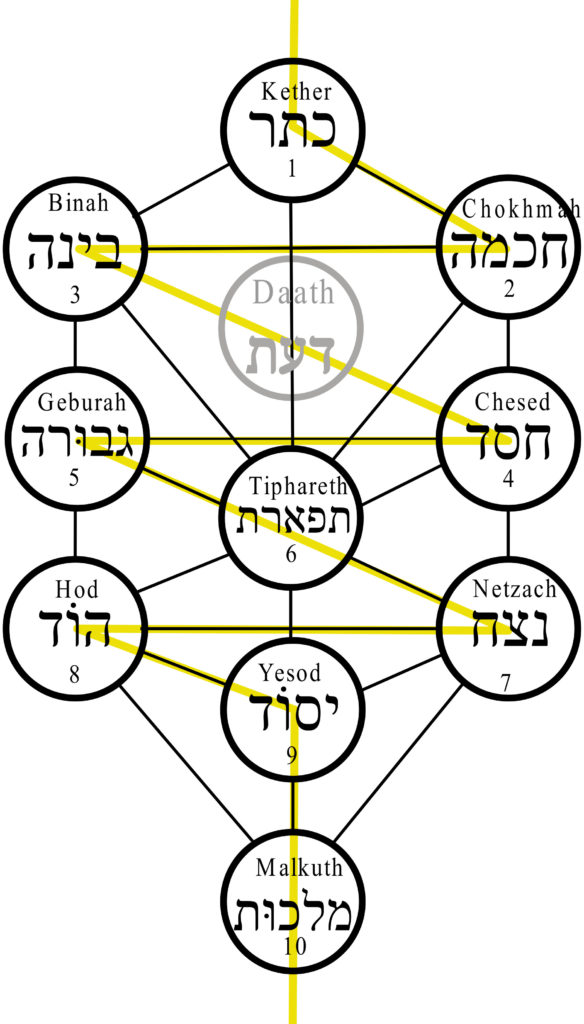
But the ambiguities may cut even deeper. Peter Levenda asserts that the structure of List’s High Armanen Order was partially inspired by the Kabbalistic “Tree of Life.”
Of course, in List’s view, the Kabbalah was “erroneously thought to represent a Jewish mystical tradition.” List held that Armanism had been the wellspring of the relevant beliefs.
Rudolf Gorsleben’s Edda Society, eventually taken over by occultist and Wiligut-disciple Werner von Bülow (1870–1947), seems likewise to have explored ostensibly Kabbalistic sigils, such as the hexagram known variously as the “Seal of Solomon” or the “Shield of David.”
On the other hand, German mythology itself is replete with “tree” symbolism. For example, there’s Yggdrasil, the “World Tree,” mentioned by Hollywood’s Marvel Cinematic Universe in movies such asCaptain America: The First Avenger and Thor, both released in 2011.
Also keep in mind that, to many of these theorists, the events of the Bible (insofar as they were considered factual at all) were construed as having taken place in Germany. For example, to the previously discussed Wiligut, Jesus Christ was really an Irminist deity named Krist.
Mutatis mutandis, all this was not too dissimilar from the views of journalist William Comyns Beaumont who believed that the “…events …of the Bible …actually took place …in Britain”!
In List’s case, knowledge of the Kabbalah may have been mediated from the British-based Hermetic Order of the Golden Dawn via William Wynn Westcott and Franz Hartmann.
And, remember, in the early twentieth century, the Golden Dawn said it was the English branch of a German Secret Society! Golden Dawn founders Samuel Liddell “MacGregor” Mathers and William Wynn Westcott claimed that their order was chartered by a mysterious – and possibly fictitious – Rosicrucian adept. Allegedly the lovechild of ousted Bavarian King Ludwig I, this adept – supposedly named Anna Sprengel – tied the British magicians to German occultism.
Similar things are said about a certain American college fraternity headquartered at Yale Univ. Some suggest that “…Skull and Bones [just is] the Yale Chapter of a German society.”
Recall that: “From 1831 to 1832, [Skull-and-Bones founder William Huntington] Russell studied in Germany. It has been suggested [that] while there, he was initiated into a German society that inspired Skull and Bones. …[Of course, t]he [original] German ‘Illuminati’ was outlawed …by an edict of the Bavarian government in 1785 and it is assumed [by those suspect this wasn’t the end of the story] that they then became a truly secretive underground organization” after that. Although it’s anyone’s guess whether Skull and Bones is literally a continuation of the Bavarian Illuminati, this much is clear. The U.S. was periodically on its guard against Freemasonry.
This was no truer, perhaps, than in the aftermath of the 1826 William Morgan Affair.
As discussed in “Presidents & Secret Societies,” William Morgan was kidnapped and believed murdered by Freemasons for exposing the secrets of their order. The episode prompted the creation of the Anti-Masonic political party – the first major “third party” of note in U.S. history.
Similarly, “[i]n 1939, on the eve of World War II,” Rudolf Hess – along with other N.S. functionaries – worried “that the Third Reich was threatened by a sinister Judeo-Masonic conspiracy, which …was fomenting the imminent conflict.”
This was elaborated upon in 1943 by French film director Maurice Remy in his sensational Forces Occultes. The story follows the activities of an intrepid “young Frenchman who infiltrates the brotherhood to expose its role in starting the war.” We’ll have more in a future video. Look for “Ten 20th-Century Mystery Men” in which we’ll name a little-known behind-the-scenes operator who stands at ground level for the contemporary “Traditional-Catholic” movement.
Speculations abound regarding Hess’s possible esoteric connexions. As discussed in our first segment, one suggestion had it that he came out of alchemist R. A. Schwaller de Lubicz’s orbit.
To hear others tell it, Hess may have covertly followed the precepts of Aleister Crowley. The suspicion was that Theosophist and Ordo Templi Orientis acolyte Martha Küntzel, in the circle of Franz Hartmann, might have introduced Hess to the “Great Beast’s” quasi-religion of Thelema.
Hess was also a known disciple of geopolitician Karl Haushofer, whom we mentioned above. If the more lurid accounts of Haushofer have any truth, they would imply that Hess was one of the high-level operators in the über-secret Thule Society.
Regardless of the truth of these conjectures, “…Hitler’s deputy Rudolf Hess” – along with Heinrich Himmler, whom we will consider momentarily – are both “said to have consulted with …astrologer[s] before making important decisions…”.
Of course, they weren’t the only world leaders who were enamored with esoteric arts. Two-time British Prime Minister Sir Winston Churchill was initiated into an order of Druids in 1908. [2nd img]
And four-term United States President Franklin D. Roosevelt had so many secret-society affiliations we dedicated a portion of an entire video sketching some of them.
On the Russian mystic Nicholas Roerich, who was connected to FDR through 33rd U.S. vice president – the Iowan Theosophist Henry Agard Wallace – see “10 Occultist Spies.”
Four decades after WWII, Ronald Reagen famously – or, infamously, as it were – arranged his presidential schedule according to the advice of his astrologers (partly at the behest of his wife).
For more on this, look for our forthcoming presentation “10 Celebrity Astrologers.”
In Hess’s case, astrological devotion had a particularly dramatic attestation. I’m thinking of his “planned [personal] …secret mission” for which he allegedly depended on occult counselors.
“On May 10, 1941, Hess [allegedly] flew alone to Scotland, [ostensibly] hoping to forge an accord between the Germans and their fellow Aryans in Great Britain.”
The story goes that “[t]he mission failed miserably…” and, after 1966, Hess ended up in virtual solitary confinement for decades until he supposedly ended his own life in 1987.
Or… did he?
Among the people to raise doubts about this account is a man described by “Big Five” Publishing giant HarperCollins as a “surgeon and forensic expert of international repute.”
According to W. Hugh Thomas, writing in his book The Murder of Rudolf Hess, the man long incarcerated in Spandau had not been Hess, but a double.
These days, the Google-approved view is that various DNA tests have put paid to this worry.
Whether this is so or not, we’ve no idea. We can’t comment on questions about the chain of evidence or about the reliability and trustworthiness of the testing procedures. But, it’s curious to us that these press releases are seldom (if ever) cross-checked with numerous mainstream admissions about widespread distortions – or outright fabrications – of genetic-test results. In the words of one U.S. attorney and “forensic pathology expert”: “In the United States[,] we take science as gospel. …The public perception is that faking science is rare. The truth is[,] it happens all the time.”
This isn’t even to note, additionally, that if facial characteristics are determined by our genetics, then it follows (fairly trivially) that two people with similar appearance will have genetic overlap – regardless of family relationship.
One-time Spandau commandant, Col. Eugene K. Bird, advanced a different hypothesis. In Bird’s view, Prisoner #7 had genuinely been Rudolf Hess. But Bird felt that many mysteries had simply been swept aside regarding Hess’s daring flight.
Why had Hess been attempting to meet with Royal Air Force Commodore Douglas Douglas-Hamilton, 14th Duke of Hamilton? Had Hitler been aware of Hess’s intentions? Had Hess been aware of the Fürher’s Operation Barbarossa, an invasion of the Soviet Union carried out one month after Hess’s arrest? Why was Hess being held by himself, presumably at lavish expense, in a fortress designed to hold hundreds?
Significantly, despite their different emphases, Bird and Thomas concurred in supposing that Spandau Prisoner #7 had been murdered. And, of course, all the lingering genetic questions go no distance toward deciding whether an arthritic 93-year-old man with limited range of arm motion could manage to have hanged himself from a window latch using an electrical cord.
2 — Otto Rahn
He was “a medievalist who had made a study of the lost cultures of Provence and Languedoc. [But, above all,] Rahn, who had lately become an officer in the SS, was fascinated with the Holy Grail. He read great significance into the passages from Parzifalin which Wolfram [von Eschenbach] describes the sources of his work,” especially the mysterious poet “Guyot.”
We may focus upon Grail mythology another time. For now, suffice it to say that there have been two main schools of thought on what the Grail is. According to one, owing to 12th-century French Troubadours Chrétien de Troyes and Robert de Boron, the Grail is a cup.
This view is commonly taken in popular depictions like John Boorman’s 1981 Excalibur and Steven Spielberg’s 1989 Indiana Jones and the Last Crusade. Usually, this sort of Grail is identified as the vessel used by Jesus Christ during the last supper and, perhaps, the one used by Joseph of Arimathea to catch Jesus’s blood when He was crucified. Following Eschenbach…
“…Rahn believed [instead]… that the grail was not a cup but a set of stone or wooden tablets on which the sum of all esoteric knowledge had been inscribed, probably in runic characters.”
The story seems to begin in the Old Testament Book of Genesis, chapter four. In the genealogy given for Adam and Eve’s son Cain, one “Lamech” appears as the father of four children.
His offspring are said to have originated various primitive arts and sciences. Several extra-biblical traditions suggest that they may have learned these from various fallen angels and that they recorded the particulars on two tablets. These stories may underlie Eschenbach.
In any case, Heinrich “Himmler and at least a few of his colleagues came to believe that the tablets might prove to be the long-lost Book of the Aryans – a pagan ‘Ten Commandments,’ which would support their notion of an Aryan super-race.”
In Parzifal, the Grail Castle – headquarters of the “Fisher King,” Amfortas (or Anfortas) – is referred to as “Munsalvæsche.” The mysterious word permits no definitive translation. But, scholars specializing in the medieval languages of Occitan and Provençal, speculate that it either meant “Wild Mountain” or “Mount of Salvation.”
Rahn identified Munsalvæsche with the old Cathar stronghold “Montségur, in Languedoc.”
Before the Cathars were slaughtered by Catholic, anti-Albigensian crusaders, “four …[knights] escaped …by lowering themselves down the cliff …on ropes and then made off with the grail.”
In this Cathar spirit, Rahn sought the Grail to restore the supposed original form of Christianity. To Rahn, this was a thoroughly Germanic neopaganism in which the truth – or the “Light” – “was [not] represented by …Jesus or Jehovah …but by …the ‘Light-Bearer’ …Lucifer.”
Twice, Himmler allegedly sent “…Rahn to rummage through the ruins of Montségur” in order to find and retrieve this Grail.
“No one can today say with certainty whether or not the grail was ever captured by Nazis. …Otto Rahn committed suicide after returning from Montségur for the second time, and he took to the grave whatever secrets he knew.”
Of course, Rahn’s mystique persists… not least in the character – Indiana Jones – he is said to have partially inspired.
1 — Heinrich Himmler
The man who served Adolf Hitler as Reichsführer of the much-dreaded Schutzstaffel (“SS”), or “Protection Squad” was also the confluence for many of the occult currents we have surveyed.
Like Hess, Himmler covered many of the occult bases that were then au courant. His interests ran to astrology, herbalism, hypnosis, runology, spiritualism, and telepathy.
Essentially, he “combined …occult revival with an illuminated nationalism.” So, Himmler was, in a sense, an Idealistic Nationalist. But, for Himmler, National Socialism had nothing to do with Communism – except for being its mortal enemy!
The sense of “socialism” was instead grounded in a “feeling of unity” – arising from shared Nordic-Teutonic ancestry – and it drove toward a thoroughly spiritual society. A more accurate phrase might well have been (something like) Germanic Tribalism.
Like Alfred Rosenberg, Himmler was keyed-in on the wavelength of Ariosophy which, as discussed in Part 1, aimed to resurrect distinctly German forms of neo-paganism.
To this end, Himmler poured the SS out of the mold of the Catholic crusaders. In fact, the SS even bore a resemblance to the much-later Jesuits. Indeed, Adolf Hitler referred to Himmler as “my Ignatius Loyola.” Ignatius of Loyola, of course, had been the principal founder of that order, whose official name is the Society of Jesus and which had been instituted as the militant right arm of the Counter-Reformation.
“In its command structure, secret oaths, and rituals, the SS was fashioned after the knightly religious brotherhoods of medieval Germany.” The SS had its own secret ceremonials and sanctuaries, including one at the previously mentioned Wewelsburg Castle.
And Wewelsburg was only one of a network of castle-sanctuaries belonging to the order.
A primary vehicle for systematizing his worldview perspective “was the organization known for short as the Deutsches Ahnenerbe, which Himmler made part of the SS.”
Under the auspices of the SS-Ahnenerbe, Himmler conferenced with various esoterics and “orientalists” with an eye toward “construct[ing] …a new Indo-[Aryan] Nazi Religion.”
The Ahnenerbe made documentary films promoting pagan ritualism.
And it undertook archaeological and exploratory expeditions. Himmler’s anthropologists sought confirmation – for example, in artifacts and runes – of root-race Theosophy.
According to Pauwels and Bergier, it was the Ahnenerbe that had made contact with the “secret masters” of Shambhala – as described in Kalachakra Tantra.
And it was the Ahnenerbe that sought fabled, and supposedly power-infused, objects like the Holy Grail and the Spear of Destiny – if Trevor Ravenscroft is to be believed.
Himmler’s occultism inspired comics such as the Hellboy franchise. As to the legendary Grail, Himmler himself looked for it at the Benedictine monastery of Montserrat near Barcelona, Spain.
The SS chief had been following up on the same lead we previously noted when we discussed Otto Rahn. In Himmler’s estimation, clues regarding the identity of the Grail castle of Munsalvæsche actually led to Montserrat.
As far as we know, Himmler came up empty handed. But the SS-Ahnenerbe’s fascination with magical totems has inspired numerous Hollywood films – including several installments of the Indiana Jones franchise – not least, the inaugural, 1987 blockbuster Raiders of the Lost Ark.
Then there are the intriguing claims of curious, Austrian-born Anthroposphist and homeopath Walter J. Stein. The one-time physician to British Prime Minister Sir Winston Churchill predicted that “…the true grail would be made manifest in the world as a global form of finance capital.”
Perhaps this is the sub rosa reason for the close connexion between economic powerhouses like the Bank of England and the Federal Reserve System and the ancient art of alchemy.
It would be tempting to say that the conclusion of the Second World War closed the book on the occult themes canvassed herein. But, several factors suggest that this is mistaken.
A direct descendant – often credited to Heinrich Himmler – is the current often called “Esoteric Hitlerism,” a seminal articulation of which was owed to Maximiani Julia Portaz. Better known as “Savitri Devi,” she associated Germans with Hindus and considered Adolf Hitler to have been an incarnation (or “Avatar”) of the major Indian god Vishnu.
We mentioned Devi, in conjunction with intelligence work, in “10 Occultist Spies.”
Another mentionable is the Chilean statesman Miguel Serrano. Serrano, who included Swiss psychologist Carl Jung and novelist Hermann Hesse among his associates, created a stream of Esoteric Hitlerism combining ceremonial magic with Kundalini Yoga.
A tangent line involves Britain’s “royals.” Shortly after abdicating, the man who was briefly King Edward VIII toured N. S. Germany – which, to quote from his Wikipedia article, “…fed rumours that he was a Nazi sympathiser.”
How wide-spread these “sympathies” might have been is a still largely unexplored question. But it’s been given renewed impetus owing to frontpage images such as (in Jan. 2005) of Prince Harry sporting a Nazi uniform – complete with a Swastika armband.
The possibly illegitimate prince, who is routinely presented by the media as something of a pariah within King Charles’s family, now says that Prince William and Princess Catherine (known as “Kate Middleton”) put him up to the stunt.
One does wonder – especially given The Sun’s revelations, ten years later, that the late Queen Elizabeth II herself may have been introduced to (well …let’s just say) now-politically incorrect beliefs when she was a girl.
When she grew older, Elizabeth was successfully wooed by a dashing scion of the German House of Schleswig-Holstein-Sonderburg-Glücksburg. Of course, by the time of their marriage in the numerologically interesting year 1947, he was styling himself Prince Philip Mountbatten.
In the post-war environment, Philip’s three surviving sisters weren’t invited to the ceremony. Two of them had married royals who became members of the National Socialist Party …
…as had Princess Cecilie who died prematurely – with her husband – in a plane crash in 1937. Brother Philip attended her funeral surrounded by “Nazi” regalia, Swastikas, and Storm-Trooper outfits. (Many of these owed their designs to R. A. Schwaller de Lubicz. And, doubtless, many were manufactured by Hugo Boss, as mentioned in Part 1 of our study.)
We also note that the Greek angle has interesting elements we may develop in a future video. To get started now, see our presentation “10 Mysterious Mediterranean Islands.”
Tie-ins may be discerned from the fact that Prince Philip was born on the Island of Corfu. He maintained a lifelong relationship with the Greek Orthodox Church. This latter fascination was reportedly passed to his son, Charles III. Obviously, British royalty has to display affection for, and involvement in, Anglican Protestantism – specifically, the Church of England.
Still, Philip and Charles made numerous, mysterious pilgrimages to Holy Mount Athos on the male-only Halkidiki Peninsula. This would be a digression, presently, were it not that, “[d]uring the German occupation of Greece, the [Holy Administration’ governing peninsular affairs] formally asked Adolf Hitler to place the monastic community under his personal protection. Hitler agreed and received the title ‘High Protector of the Holy Mountain’ …from the monks.” Evidently true to his word, Hitler’s safekeeping preserved “The monastic community … [from] significant damage during the war.”
We’d be negligent if we didn’t acknowledge “Western” appropriation of German engineers and intelligence agents. We’re thinking, of course, of the U.S. Army Counterintelligence Corps’s “Operation Paperclip,” which brought rocket scientist Wernher von Braun (&c.) into America. …possibly with the help of a Central Intelligence Agency asset named Clay Shaw.
There’s also German General Reinhard Gehlen, whose anti-Soviet “Gehlen Organization” fell under the sway of the likes of William Donovan, Allen Dulles, and Walter Bedell Smith. In other words, Gehlen came in at the ground floor of the creation of U.S. Central Intelligence.
We can’t forget Nikolaus “Klaus” Barbie, the former Gestapo chief and interrogation expert who was shielded by the CIA and the CIC and who – among other things – supposedly trained “Death Squads” in South American countries like Bolivia.
The so-called “School of the Americas” institutionalized training “for dictators, torturers and assassins,” as Noam Chomsky has observed in several places.
Apparently, the Israeli spook shop, Mossad, got in on the action by recruiting former Waffen-SS Obersturmbannführer and special-tactics expert Otto Skorzeny.
Finally, there’s the Bush family that produced the ex-Director of Central Intelligence and, later, 41st U.S. President, George Herbert Walker Bush, whom we discussed in “10 Occultist Spies.”
Family patriarch “…Prescott Bush …worked for …[the private investment-banking house] Brown Brothers Harriman (BBH), [which] acted as a U.S. base for the German industrialist, Fritz Thyssen, who helped finance Hitler in the 1930s…”.
And what rôle was played in this regard by Sosthenes Behn, founder of International Telephone & Telegraph, now known as ITT Inc.? In August 1933, Behn became one of the first American businessmen to visit “the new Chancellor of Germany, Herr Hitler…” – ostensibly on behalf of National City Bank.
Further details are suggestive – tho, admittedly, inconclusive. One is the oft-alleged complicity of the Bank for International Settlements in “…transferr[ing] …[National Socialist] money to Argentina (and other Latin American countries) via the Vatican.”
Recall that the current “Vatican Bank” (technically euphemized as the Institute for the Works of Religion), founded in 1942, is run by a Board of Superintendents who report – ultimately – to the Pope. And that office, presently, is occupied by a Novus-Ordo Jesuit going by the name “Francis.” Born Jorge Mario Bergoglio, he hails from – and was a bishop in – Argentina.
We won’t even get into Benedict XVI’s conscription into the Hitler Youth as a lad in 1939.
Antony Sutton, writing in the introduction to his 1976 investigation, Wall Street and the Rise of Hitler, remarked upon the “obvious” need to seriously consider “…the mystical origins” …and the neo-pagan historical roots of Naziism, the Bavarian Illuminati and the Thule Society…”.
On that note, which throws us back upon our current – and important – topic, look for the future video “10 Precursors to the Illuminati.” And we’ll expand our investigations. So …stay tuned!
[Note: Some hyperlinks herein resolve to Amazon.com in service our our affiliate status. Your much-appreciated purchases assist our publication and research efforts. Thanks!]
With the specialization of knowledge that has occurred post-enlightenment, many disciplines have developed their own vocabularies. Before would-be students can make progress learning the logic of an area of study, they must become accustomed to the grammar. In terms of some of the topics that are within the purview of this channel, that includes gaining familiarity with words such as “esoteric,” “gnostic,” “hermetic,” “mystic,” “neoplatonic,” “occultic,” and much else besides.
These words often lie outside the scope of what one encounters in a largely secularized primary and secondary public education. And yet they are used liberally – both individually and in combination – in explorations of alternative spirituality, whether one is interested in the contemporary scene or in its history.
So, since knowledge is power, in this presentation, I am going to tackle, and try to clarify and distinguish, ten (10) words. The list is, to an extent, personal. These terms were some of those that gave me trouble in my own reading. Therefore, this list is the one that I wish I had found myself earlier in my investigations.
In-depth treatments of each of these ten words – or, more accurately, the ideas they name – will be the subject of follow-up videos. For the time being, and in order to ensure that this isn’t 10 hours long, I will merely provide sketches.
The hope is that, with even limited outlines, the distinct definitions of these words – and, by extension, the identifying concepts – will come into view giving hearers or readers a handle with which to grab hold of more detail later on.
That said, here are my list of 10 Arcane Words That Are Frequently Confused.
Like many of the words on this list, “Neoplatonism” actually refers to a family of related views, rather than to a single outlook. I already have pages of notes tracing this more fully. But for present purposes, I want to suggest that Neoplatonism is, first and foremost, a philosophy.
To be sure, it has religious overtones and implications for theology (that is, the study of God). And those who adopt a thoroughgoing Neoplatonic perspective are frequently inclined – whether antecedently or consequently! – towards mysticism (which word we will look at in a few minutes).
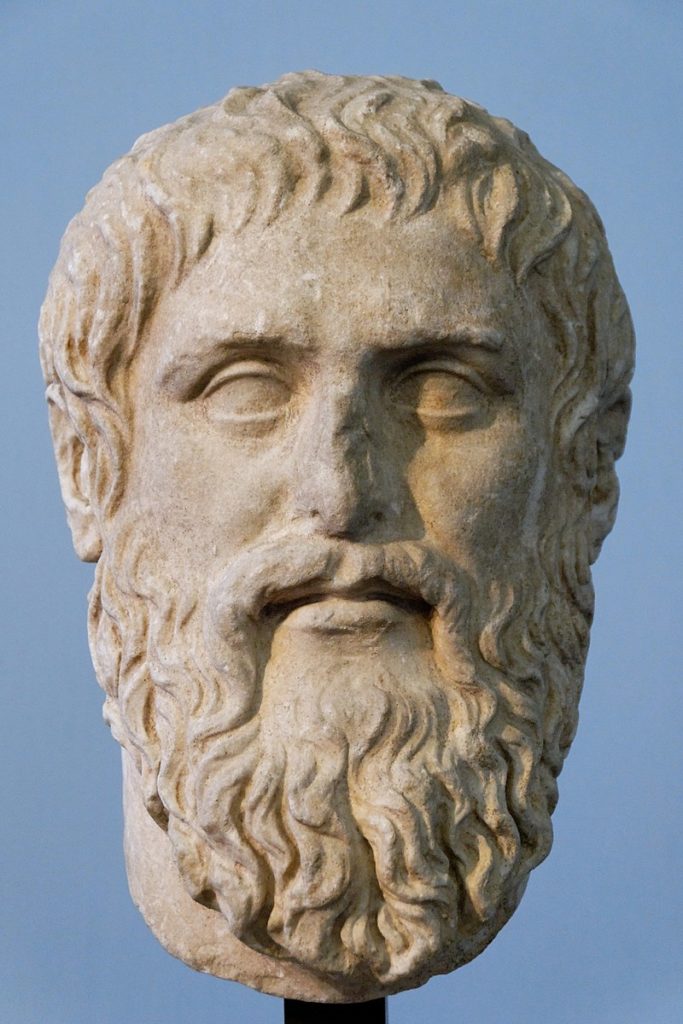
But, Neoplatonism arose out of the thought and writing of Plato, who was one of the most famous philosophers to have ever lived.
Moreover, Plato founded a school, called the “Academy,” dedicated to the study of philosophy.
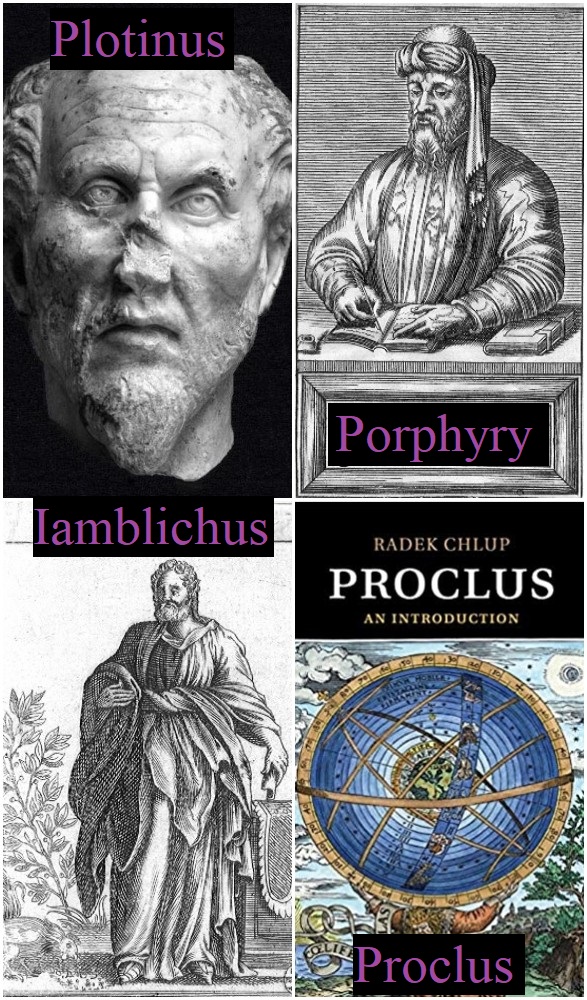
Neoplatonism’s main founders: Plotinus, Porphyry, Iamblichus, and Proclus.
The primary originators and early expositors of Neoplatonism, chiefly Plotinus, Porphyry, Iamblichus, and Proclus, are – present YouTube video notwithstanding – more likely to be mentioned in philosophy classes than in any other context.
The most prominent philosophical writing in this category is known as the Enneads (a word that, in Greek, means “the nines,” and refers to the fact that the document, based on Plotinus’s thought – as edited and arranged by Porphyry – is comprised of six groups of nine treatises.
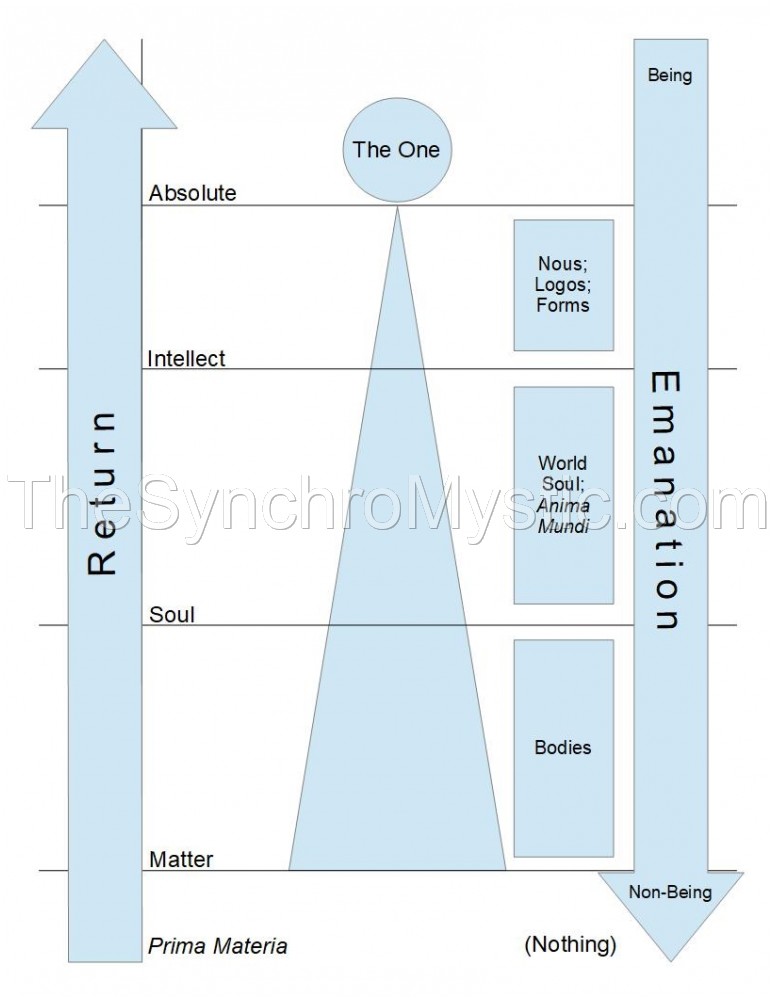
An important, distinguishing feature of Neoplatonic thought is that reality – that is, absolutely everything, from Being all the way down to non-being – is situated along a sort of hierarchy. At the very top of this “chain of being” is the One, about which we can know and say virtually nothing.
Key elements of Neoplatonic emanation, represented (i.e., approximated) visually.
However, the One emanates or radiates being in such a way as to create three lower realms of intellect, soul, and matter. For this reason, Neoplatonism is sometimes regarded as veering close to pantheism (or the idea that literally all that exists just is part of god) or the related idea of panentheism (which may be crudely thought of as the belief that the universe is something like God’s body but that God’s mind goes beyond, or transcends, the universe).
In any case, these lower worlds – and their occupants – are deficient, both ethically and ontologically (that is, in terms of their measure of existence). So, the sensitive Neoplatonist will desire to “return to the One” via a process of “ascending” up through the higher spheres on the hierarchy.
Neoplatonism had a profound impact both on traditional and alternative religion. Arguably, the Latin Catholic Church Father St. Augustine had a significant Platonic – and Neoplatonic – orientation.
Similarly, Christians – notably Michael Psellos – in the Byzantine Empire formed a belt of transmission for Neoplatonism into the high Middle Ages.
Around the fall of Constantinople to the Ottoman Turks in 1453, Neoplatonism was communicated to the west by Greek emissaries and expatriates such as Gemistos Pletho and Cardinal Bessarion.
Although traces of this Neoplatonic current are detectable in such people as the German-born Nicholas of Cusa, an especial concentration arose in Italy. Among these important Italians were those, like Marsilio Ficino and Pico Della Mirandola, who were in Florence. Later, this included people a little further afield, such as the Venetian Franciscus Patricius.
There was a curious intellectual pipeline between Italy and England where, in the 17th century, a loose confederation of diverse thinkers would develop a version of Platonism associated particularly with Cambridge University. These thinkers, including principally Ralph Cudworth, Henry More, and Benjamin Whichcote, bucked the “blank slate” empiricism of John Locke (and others) by developing a version of innate ideas that would influence linguist Noam Chomsky some three hundred years later.
Furthermore, Neoplatonic influences are detectable in the thinking of Hermetic philosopher Giordano Bruno as well as in the speculations of Swedish polymath and mystic Emanuel Swedenborg.
Gnosticism
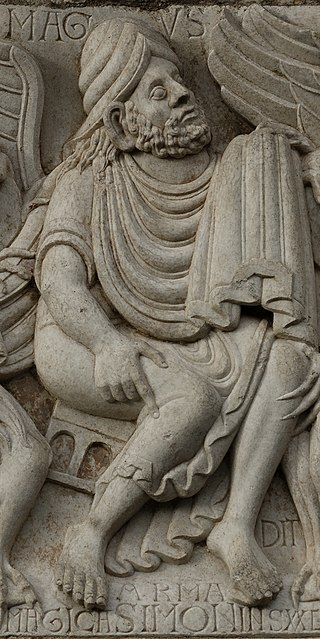
Simon Magus, reputed founder of Gnosticism (Basilica Saint-Sernin, Porte de Miegeville); source: https://upload.wikimedia.org/wikipedia/commons/thumb/f/f7/Basilica_Saint-Sernin_-Simon_Magus%28cropped%29.jpg/320px-Basilica_Saint-Sernin_-Simon_Magus%28cropped%29.jpg
As a term, “Gnosticism” was coined by the Cambridge-Platonist scholar Henry More.
As a system, Gnosticism, by contrast, and despite numerous similarities with Neoplatonism, is perhaps best characterized as a theology. To be precise, it’s an often dizzying array of competing theologies.
Of course, Gnostic thought can be analyzed and explicated philosophically.
But many of the primary exponents of Gnosticism were either regarded (in their own times, or now) as theologians or they were encountered in religious contexts.
For example, Simon Magus, sometimes described as the “founder of Gnosticism,” was himself a biblical figure. You can read about him, and his confrontation with Jesus’s apostle Peter, in the eighth chapter of the fifth book of the New Testament, titled the “Acts of the Apostles.”
Or again, Valentinus, an important second-century gnostic who lent his name to a system known as Valentianism, was a theologian who may at one time have even been a candidate for the rôle of bishop in the nascent establishment-Christian church.
Much the same description could be given of other relevant personalities, such as Basilides, Marcion, and the later, Persian prophet Mani.
Writings representative of Gnosticism include an array of ancient books, collectively termed the “Gnostic Gospels,” that includes the Gospel of Philip, the Gospel of Seth, and the Gospel of Truth.
Due to the heavy, albeit heterodox, Christian flavor of Gnosticism, it is often called a Christian heresy.
Like Neoplatonism, many forms of Gnosticism described reality as a series of overlapping spheres. And gnostics often advanced a version of the doctrine of emanation.
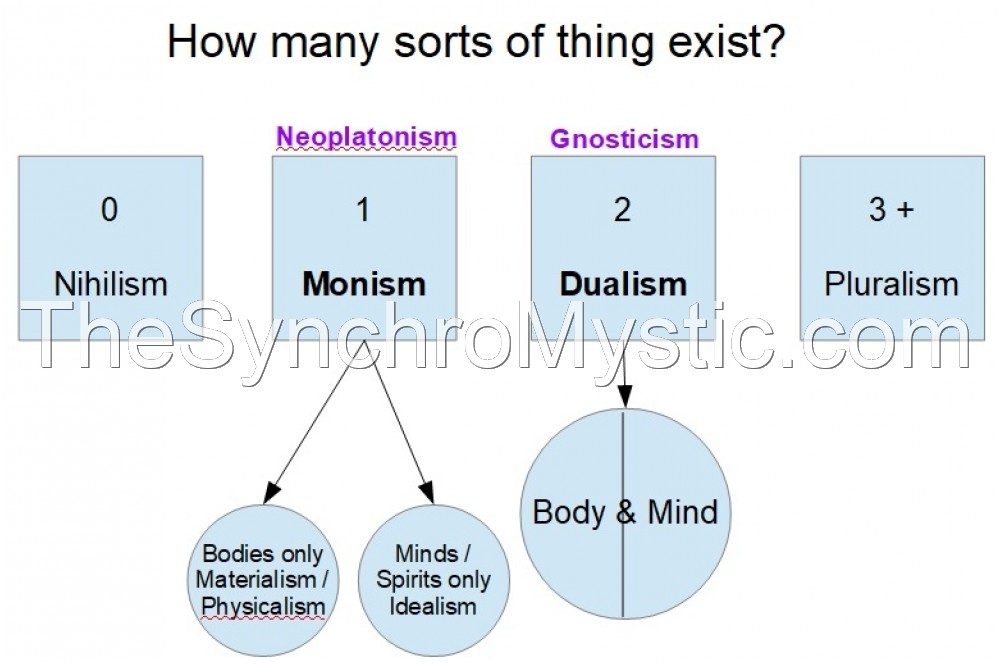
What exists? This basic metaphysical questions admits of several possible answers.
But unlike Neoplatonism, which tends to be very monistic – that is, it holds that all existing things are somehow emanations of the One – Gnosticism is explicitly dualistic.
To put it another way, gnostics held that reality was composed of two irreducible components: matter and spirit. Matter is the province of evil; spirit is associated with, and strives, for the good.
The problem is that humans (or, at least, some humans) are spirits trapped in bodily, material form.
This situation – of celestial souls unnaturally relegated to the mundane world – was frequently blamed on an entity, sometimes associated with Plato’s “Demiurge,” which had creative powers but a foolish, imperfect, or even malevolent disposition.
This character was sometimes further identified with the God of the Old Testament – or the “Hebrew Bible” – as, for example in Marcionism.
For elect humans, the path of freedom and redemption is to free these imprisoned “divine sparks” from matter. This process can only begin when a person acquires this hidden information about humanity’s true nature. This knowledge is what is meant by the word “gnosis” – which is a bit like the Eastern religious notion of “Enlightenment.”
Gnosticism crops up repeatedly in studies of those movements that were deemed heretical by the medieval church: Priscillianism, Paulicianism, Bogomilism, Catharism, and so on, all are usually classified as species of Gnosticism.
Additionally, the theological speculations of the offbeat early modern mystic Jakob Boehme are sometimes characterized as Gnostic-like. And Gnosticism is sometimes said to be the inspiration for the cryptic letter “G” that frequently appears inside the Freemasonic compass-and-square emblem.
A major restatement or revival of Gnosticism occurred within the Theosophical Society, founded in 1875 by H. P. Blavatsky, Henry Steel Olcott, William Quan Judge, and others. This organzation, in turn, influenced the creation of several Gnostic offshoots, including G. R. S. Mead’s Quest Society as well as the “Ariosophy” of Austrian occultists Guido von List and Jörg Lanz von Liebenfels.
The 19th-century “Occult Revival” – which we will continually remark upon – also gave rise (in part) to manifestly Gnostic-themed institutions such as the “Gnostic Church” (i.e., the Église Gnostique), the creation of which is attributed to Jules Doinel, and which would later be linked to the Ordo Templi Orientis and occultist Aleister Crowley.
It also shows up as a thread in the Process Theology of Hans Jonas, which was also inspired by the Process Philosophy of British mathematician and theorist Alfred North Whitehead.
Both Gnosticism and Neoplatonism seem to have arisen in the Greco-Roman world. Though, Gnosticism may have had some Jewish antecedents.
In general, these systems were part of a proliferation of worldviews that characterized the Hellenistic and early Roman periods. Part of the reason for this intellectual and spiritual volatility was the introduction of foreign ideas into Greek thought.
Due to increased trade and imperial expansion, Greeks came into contact with “oriental” philosophical concepts as well as with the mythologies and religions of other major people groups. At the time, this certainly would have included beliefs and practices from Egypt and Persia – but possibly also India.
Our third difficult word, “Hermeticism,” designates an additional set of ideas that likewise originated during this tumultuous interval, and that also represented a blending of Egyptian and Greco-Roman myth.
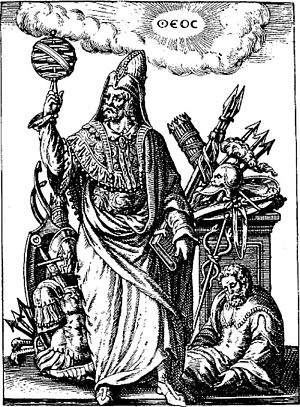
The fountainhead of Hermeticism was the legendary Hermes Trismegistus.
Hermes Trismegistus was, in the first place, a composite of the Egyptian gods Tahuti or Thoth and Hermes-Mercury from Classical mythology.
However, later hermeticists would further link this fabled character with the Hebrew patriarch Enoch and the Islamic prophet Idris.
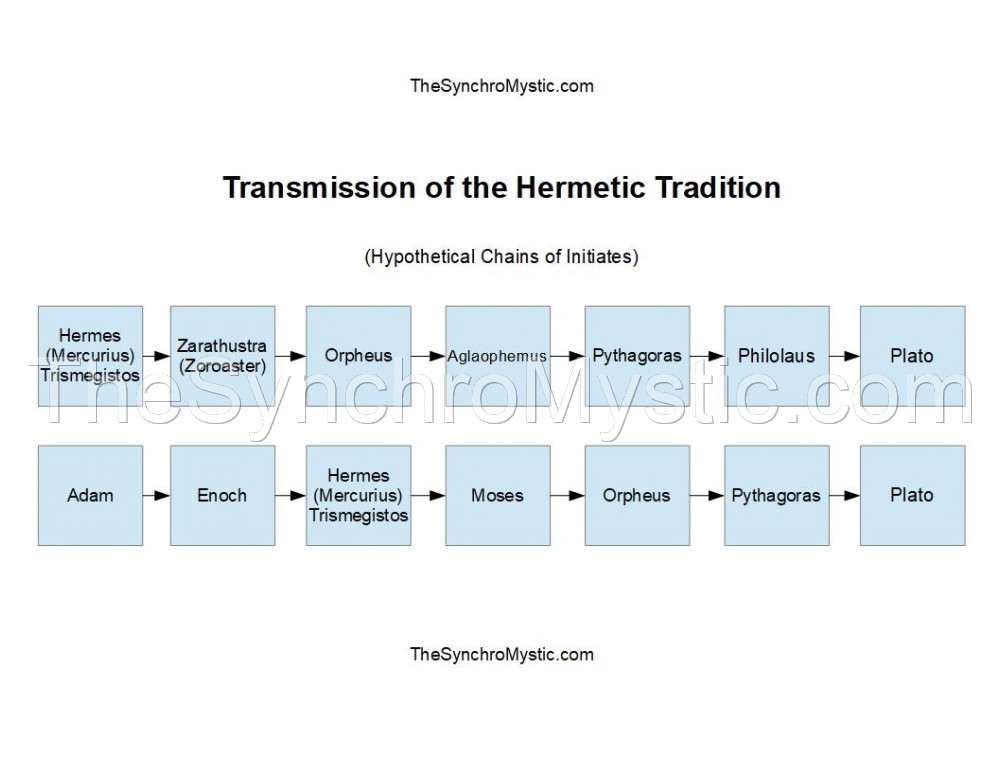
Pythagoras and Plato are among those supposedly initiated into the Hermetic Tradition.
Sometimes, these figures are conflated or identified; while, other times, they are imagined to stand in a great sequence of initiates passing down a wisdom tradition. In this latter case, Hermes was seen as a teacher who conveyed his secret teachings to various philosophers and sages, including Orpheus, Pythagoras (to whom I dedicated an entire video), and even Plato.
The name Hermes Trismegistus means “Thrice-Great Hermes,” or “Hermes Who Is Three-Times Great.” The reference, here, is understood to be Hermes’ mastery of the three subjects that were variously called the “Hermetic Arts” or the “Hermetic Sciences”: alchemy, astrology, and magic.
The thing to notice, I think, is that these disciplines are, in the first place, very practical – meaning that they are bound up with practices, as opposed to just armchair speculation about the universe.
For example, alchemy deals in chemical formulas and the manipulation of physical substances. Astrology depends upon calculations of planet and star positions that, in the ancient world, would have been made by hand. And magic, also called “theurgy,” frequently employs material objects and elaborate rituals and spells. A magician actually has to do or say certain things in order to effect results.
All these aspects of Hermeticism, arguably, held the promise of empowering practitioners to influence the world and people around them. In other words, they were practiced to bring about tangible results and not simply to gain knowledge for its own sake or even for individual illumination.
Therefore, Hermeticism is intensely – and, I’ll even say, primarily – practical. Whereas both Gnosticism and Neoplatonism are, to a large extent anyway, theoretical.
That said, various individuals may have had both practical and theoretical interests.
For instance, you find that the Neo-Pythagorean philosopher Apollonius of Tyana was said to have been a “wonder-worker” in addition to a philosopher. He was (so to speak) both a doer and a thinker.
And this combination of theory and practice also characterizes certain kinds of Neoplatonism, such as the theurgy-infused variety that started with Iamblichus.
Similarly, it is conceivable that certain forms of Gnosticism also crisscrossed with Hermeticism.
For example, the 3rd to 4th-c. figure Zosimos of Panopolis was known as both an alchemist and a gnostic. Additionally, the rich cache of documents discovered at Nag Hammadi in Egypt reveal Gnostic Gospels preserved side by side with the Asclepius, a key treatise in the Corpus Hermeticum.
It appears that Hermetic thinking and the Hermetica had a wide appeal. This is possibly due (at least partly) to the fact that, in an of itself, the lore surrounding Hermes Trismegistus is far less of a complete worldview than the other two systems previously surveyed. It’s more of a collection of stories.
I’m inclined to think that, when dedicated theorists assimilated Hermetic ideas, the overall framework could either end up as a species of Gnosticism or, more likely, a kind of Neoplatonism.
I say “more likely a kind of Neoplatonism” simply because many Hermetic practices – like the fabled goal of turning lead into gold – required interaction with matter in ways that might not have sat well with a thoroughgoing Gnostic. Recall, after all, that – generally speaking – Gnostics had an aversion towards (or even totally rejected) the material world.
Nevertheless, let’s say it this way. Hermeticism can be seen as a cluster of exercises that could appeal to more practically minded people who have no theoretical aspirations or commitments to speak of.
But …Hermetic practices could also be explained in terms of, and integrated into, more sophisticated philosophical or theological systems – such as those built by Gnostics or Neoplatonists.
Hermeticism was a feature of the thinking of Renaissance figures such as the previously mentioned Marsilio Ficino, as well as of Heinrich Cornelius Agrippa, Francesco Giorgi, and Paracelsus.
It was explicitly incorporated into the 17th– c. Rosicrucian movement by its mysterious apologists, including – in the category of possible authors – the German Protestants Johann Valentin Andreae, Christopher Besoldus, and Tobias Hess; and – in the category of sympathizers – the English Paracelsian doctor Robert Fludd and the Lutheran alchemists Heinrich Khunrath and Michael Maier.
These figures exercised a seminal influence on people such as the English antiquarian Elias Ashmole, who seems to have helped pass the torch of Hermeticism onto what, in the eighteenth century, would develop into Freemasonry.
Finally, several 19th-c. Masons would go on to found Hermetic-infused orders during the 19th and 20th centuries. Various incarnations of these Rosicrucian Societies (or Societas Rosicruciana) were established in England, Scotland, and the United States. And we cannot neglect to mention the Hermetic Order of the Golden Dawn, organized by William Robert Woodman, William Wynn Westcott, and Samuel Liddell “MacGregor” Mathers.
Apparently along a somewhat separate trajectory, 19th-c. reputed sex magician and alchemist Paschal Beverly Randolph started his own Rosicrucian Fraternity in the 1850s. And then, in the 20th century, H. Spencer Lewis launched the Ancient Mystical Order Rosae Crucis, while Max Heindel would go on to found the Rosicrucian Fellowship.
Esotericism
Late historian Nicholas Goodrick-Clarke specialized in Esotericism.
Recall that Hermeticism was centrally concerned with various applied disciplines. But, saying that Hermeticism is mainlypractical by no means implies that it had no theoretical aspects at all.
To put it roughly, in order for hermetic practices to be justified – to say nothing about their being likely to effect results – certain things would have to be true of the world. Codifying and stating these prerequisites is the purview of theoreticians.
For instance, making no claims about the truth of the discipline, it’s clear that an astrologer wouldn’t be able to analyze someone’s personality, or predict her failures and successes – even in principle – unless the stars were somehow correlated with the subject’s life. Thus, astrology requires that a correspondence exist between the celestial world and the everyday world of human experience.
When one attempts to spell out these preconditions, one discovers that Hermeticism shares a few cosmological or metaphysical ideas with Gnosticism, Neoplatonism, and derivative systems.
We can speak about some of these essential features in the abstract – without getting bogged down with the details of any particular system. To do so, it is helpful to have a word handy. And one name that is routinely applied to these underlying – or overarching – commonalities is “Esotericism.”
So… what are some of these general qualities that are observed across a wide variety of philosophical-religious systems, including Neoplatonism, Gnosticism, and Hermeticism?
According to the late British historian Nicholas Goodrick-Clarke, following French scholar Antoine Faivre, there are several hallmarks of Esotericism. I have my own list of ten that I plan to present in a separate video. But, for now, I’ll list two.
Firstly, we have the existence of Correspondences.
This is perhaps clearest in Hermeticism, where symbolical connexions between the cosmos and human beings are referred to by the dictum “as above, so below.” However, even in Gnosticism and Neoplatonism there are associations and “sympathies” between “lower realities” (such as the embodied soul) – these lower realities are called the “microcosm” – and “higher realities” (such as the Pleroma and the world soul) that are a part of the “macrocosm.”
Secondly, there is the related idea that a chain or hierarchy of being connects the microcosm and macrocosm. Goodrick-Clarke calls this intermediary realm the “mesocosm.”
Whatever it is called, and however it’s explained, it lies beneath certain theoretical notions – such as the ideas of emanation and the ascent of the soul that, in different ways, are expressed in both Gnosticism and Neoplatonism. But, it also motivates some of the practices of Hermeticism.
For example, consider that alchemical transmutation – whether of base metals into gold or of human souls into more enlightened entities – only makes sense in a system where lower realities are somehow connected to, and can access, or be transformed into, higher realities.
There’s one additional feature that we should mention. It has to do with the meaning of the word “esoteric” itself. Etymologically, the prefix “eso-” has to do with something that is “inside.”
From the standpoint of a given wisdom school, what’s in view is an “inner tradition” that one must be initiated into in order to go from being an outsider to becoming a member of the inner circle.
Let’s do a quick review.
Gnosticism and Neoplatonism are both theoretical systems (the former leaning more toward theology and the latter more toward philosophy). Hermeticism, on the other hand, is a cluster of practical disciplines. The Hermeticist need not be overly concerned with theories at all.
But, if he or she is somewhat theoretically inclined, the Hermetic arts could be combined with one theory or other. And, indeed, we named people who – historically – were taken to have combined Hermetic practices with either Gnosticism or Neoplatonism.
Nevertheless, at a high level of abstraction, Gnosticism, Neoplatonism, and Hermeticism arguably have a few things in common – not least that they represent bodies of teaching that, in some sense, one has to be initiated into. And these similarities, considered generally, might be called Esotericism.
But, these words – Neoplatonism, Gnosticism, Hermeticism, and Esotericism – are far from the only ones that might be encountered – or that may confound.
We should also consider the related word “Occultism.”
Denotatively, the word “occult” means concealed or hidden. It carries the sense of something transmitted or held in secret.
It’s arguable, therefore, that the words “occult” and “esoteric” are close cousins – even interchangeable.
Moreover, connotatively, “occult” is sometimes made to refer to that which is forbidden. In this way, something “occultic” is concealed or obscured in virtue of its being on the “dark side” of things.
Relatedly, it’s sometimes used as a way of labeling some belief or practice “irrational.”
To confuse things further, there was a tradition of using the phrase “occult sciences” to designate those Hermetic arts – alchemy, astrology, and magic – that constitute the “three parts of the wisdom of the whole universe,” according to the enigmatic alchemical text known as the Emerald Tablet.
Therefore, it is possible to employ “occultism” as a synonym for Hermeticism.
Keep in mind that our modern word “science” comes from the Latin scientia, which simply meant “knowledge.”
One cannot forgot, also, that the late-15th-early-16th-c. natural magician and scholar Heinrich Cornelius Agrippa wrote a book, published circa 1531, literally titled “Occult Philosophy” (De Occulta Philosophia). These, and other related, used show that the word certainly has a long pedigree.
But, the current academic usage of “occultism” is different than any of these. It is standard to use the word “occultism” as a technical term for the often bewildering varieties of Esotericism that emerged in the 19th century, first in France and then in America and Europe more broadly.
One crucial early figure in this so-called “Occult Revival,” is Alphonse Louis Constant, better known as Éliphas Lévi – whom we highlighted in a recent “Top 10” video.
In his 1856 book, Dogma and Ritual of High Magic, Lévi used the word “occult” (or one of its cognates) dozens of times. Some of the most oft-used and pervasive references, at least in Arthur Edward Waite’s English translation, talk of “occult philosophy” and “occult understanding” as well as something that Lévi deems “occult science.”
In his native France, Lévi influenced Gérard Encausse, also more commonly referred to by his assumed name, “Papus.” Papus was the founder of contemporary Martinism, a movement named after, and inspired by, the obscure 18th-c. magician, Martinez de Pasqually.
Lévi’s vocabulary and thinking was also transmitted into Anglo-American circles, for example, via the aforementioned A. E. Waite but also through British orientalist Kenneth R. H. Mackenzie and, later, the previous named American Rosicrucian writer H. Spencer Lewis.
Thus, similarly to Hermeticism, “occultism” has come to be partially associated with esoteric or “high-grade” Freemasonry, 19th-c. Rosicrucianism, and the Hermetic Order of the Golden Dawn.
But, things once again get confusing, not least because several of these occult currents – chiefly Freemasonry and Rosicrucianism – had earlier manifestations in the 17th and 18th centuries.
Another confusion arises from the historical fact that this occult revival also affected a broader assortment of people than members of fraternal organizations and would-be ceremonial magicians.
The phrase “occult revival” is also applied to Anglo-American Mesmermism and various students of the “paranormal,” as those coalesced, for example, in movements like “New Thought,” “Religious Science,” Spiritualism (about which we will have more to say in a moment), and the allied “Spiritism.”
We shouldn’t neglect to remark upon the growing pan-religious attitudes, seeds of which were fertilized during the Second Great Awakening, and which would be on display in the World Parliament of Religions at the World’s Columbian Exposition, held in Chicago, Illinois in 1893.
This was he atmosphere in which H. P. Blavatsky’s Theosophical Society would blossom and grow into a worldwide phenomenon, seeking to fuse Eastern and Western forms of Esotericism.
By this point, I’m sure it won’t surprise viewers to learn that the word “Mysticism” – which surfaced in conjunction with several systems of thought (for example, Neoplatonism) and multiple individuals (like Jakob Boehme) previously mentioned – has its own assortment of meanings.
On the pejorative end of the spectrum, it is sometimes used as a term of disparagement for those ways of thinking – including some just surveyed – that are perceived by critics to be somehow insufficiently based on or concerned with evidence and reason. In this vein, and similarly to one of the popular-level definitions for “occult,” “mystical” becomes synonymous with words such as “irrational” and is often contrasted with (something like) “scientific.”
But, “Mysticism” is also a technical term in theology. In that field of study, it has to do with a kind of religious experience that is usually glossed as being a direct encounter with the divine.
Like Hermeticism, which picked out a trio of hands-on esoteric exercises or occult operations, Mysticism is also essentially practical.
The mystic is a person who does something. She wants to have the mystical experience.
Things complicate at two – interrelated – levels (at least).
Firstly, there may be wide – and possibly system-dependent – disagreement about the methods available to the mystic. This can be seen by contrasting the Neoplatonists Plotinus and Iamblichus.
Arguably, both thinkers were philosophers who were concerned not only with talking about reunion with the One, but about achieving it as well. Nevertheless, at its most basic, we might say that Plotinus’s approach was thoroughly contemplative, whereas Iamblichus’s was partially magical.
The point is that within broadly the same system – in this example, Neoplatonism – two figures recommended different mystical methods.
But, secondly, there will be divergent – and certainly system-dependent – analyses of what exactly is happening during a mystical experience.
To be sure, not every mystic is concerned with analysis at all. But the variety of explanations can be dramatically illustrated by considering the perspective of a person (for example, an atheist) who denies that reality has any divine dimension. If there is no divinity, then there is nothing to experience.
Since the rise of modern psychology, it has become fashionable for atheists to explain away mystical self reports as being the result of human imagination. The idea is that somehow, purely naturalistic factors give rise, in particular people, to strong feelings or ideas that delude them into believing in divinity.
However, it’s important to realize that variation does not just appear between theists and atheists. It also surfaces within and among the diverse forms of theism and religious belief themselves.
For instance, since Neoplatonism tends toward pantheism, it is natural to take a true experience of the One as a literal, metaphysical union of the mystic with the Absolute. The mystic directly experiences the fact that, reality is interconnected, continuous, and – ultimately – an emanation from the One.
This is significantly different from the point of view of a Gnostic who believes that matter is evil. For whatever it means to have a mystical experience of the supreme deity, the Monad, it must include detachment from anything physical.
We might put the difference this way. For the Gnostic, mystical experience occurs when a human soul – which fell from a higher realm – begins its ascent to the One at the point when it is able to separate from matter.
Neoplatonic “return,” on the other hand, begins with – and in a sense includes – matter. The human being emanated from the One, body and soul. And the ascent of the human person begins right where we find ourselves: immersed in a realm of physical entities.
It is also crucial to appreciate that not all mysticism need be understood as an absorption of a soul or spirit into the divine. It is also possible to think of such experiences, in more traditionally “theistic” terms, simply as the approach of a human being to a God that is ontologically distinct.
The rub is that, for certain writers, it is sometimes hard to interpret just what sort of mysticism is being espoused or represented. For example, take the 13th-14th-c. mystic known as Meister Eckhart. His language is susceptible to multiple interpretations. For example, in one place, Eckhart declares: “When the Divine Light penetrates the soul, it is united with God as light with light.”
Now, Eckhart was a member of the Dominican religious order, the same order to which Thomas Aquinas belonged. So, some interpreters have concluded that Eckhart was a faithful Catholic whose language, where potentially problematical, should be viewed as metaphorical or poetic. On this view, when Eckhart talks of the soul uniting “…with God as light with light,” he’s just using figures of speech to convey the intimacy of a meeting that could be reported in theologically orthodox words instead.
On the other hand, other interpreters take Eckhart more literally. These people may point out that the “light with light” language suggests that both God and the soul are – so to speak – “made out of the same stuff.” In philosophical lingo, Eckhart seems to be saying that they share an essence. Or, at least it may be suspected that the boundary between God and the soul is somehow obliterated. After all, when light “mixes with” light, it is not obvious that there remains any meaningful way of distinguishing the two lights afterward.
Perhaps the lesson, here, is like that which (I suggested) applied to Hermeticism. To be more precise, it is possibly best to think of Mysticism as a practical approach to the divine – or an attitude of wanting to have a particular, intimate experience of God – the specifics of which can only be understood in the context of a particular worldview. So, there would be Neoplatonic Mysticism, Gnostic Mysticism, Traditional Christian Mysticism, and so on.
Kabbalism
Of course, it is necessary to acknowledge that not all Mysticism has a Christian complexion. Many forms did (or do) have this orientation – such as the Catholic Mysticism of St. Francis of Assisi and the religious order (the Franciscans) that bears his name, or the Lutheran Mysticism of Johann Arndt and the German Pietism that he helped to inspire.
But, there are innumerable sorts of Mysticism that lie outside this framework, just as there were both Christian Neoplatonists (such as the 5th-6th-c. Pseudo-Dionysius the Areopagite) as well as non–Christian ones (like the 4th-c. Roman Emperor Julian the Apostate).
Two main streams of non-Christian Mysticism – one of which we will do no more than simply list, here – are those that exist in the other so-called “great monotheistic religions” of Judaism and Islam. (There are also other sorts that grow out of Eastern religions, such as Buddhism and Hinduism. But, here, we will restrict ourselves to a Western variety of Esotericism.)
Islamic Mysticism, a main variety of which is called Sufism, will have to occupy us another time. For it is arguable that the tradition with the greatest impact on Western Esotericism has been that which flourished within Judaism, and whose main relevant current is referred to as “Kabbalah.”
A more detailed treatment of this complicated system will be forthcoming. Although we note that Kabbalah has interacted and intersected with Christianity, for the present, suffice it to say that Kabbalah can be thought of an outgrowth of the earlier Jewish-mystical tradition known as “Merkabah.”
Merkabah, which word means “chariot,” involves contemplation – and attempted replication – of the vision of God beheld by the Hebrew prophet Ezekiel, as recorded in the opening chapter of the Biblical book bearing his name.
In addition to this mystical strain, Kabbalah also evolved around cosmological speculations. For example, in the Sefer Yetzirah (that is, the “Book of Formation”), the world is explained as having arisen from the Hebrew language. The twenty-two letters, along with ten numerical correspondences, referred to as “Sephiroth,” are described as comprising the “thirty-two paths of wisdom” by which God created the world.
However, this basic framework would be developed by later writers. The Sefer Ha Bahir (or, the “Book of Illumination”) introduced a Hebrew version of the idea of divine emanation that we encountered first in our discussion of Neoplatonism. Though, in the Bahir, the overall orientation is often said to be more reminiscent of Gnosticism.
Perhaps the most important text in Jewish Mysticism is the Sefer Ha Zohar (variously translated as the “Book of Radiance” or the “Book of Splendor”). The Zohar is actually a collection of texts, rather than a single one. But, in general terms, the Zohar offers allegorical or esoteric commentaries on the Five Books of Moses (Genesis, Exodus, Leviticus, Numbers, and Deuteronomy), also called the Pentateuch.
The Zohar was first publicized in Spain by Rabbi Moses de León. For his part, de León credited the 2nd-c. figure Shimon bar Yochai with its authorship, though modern scholarship largely discounts this claim. Regardless of its provenance, it unquestionably helped to shape Iberian Kabbalah which, in turn, was imported into the Christian world after Spanish monarchs Ferdinand and Isabella expelled the Jews in the 15th century.
Thereafter, arises a stream of thought called “Christian Cabala.” In this tradition, people such as Pico della Mirandola and Johannes Reuchlin sought to show that esoteric Judaism and Neoplatonic Christianity could be seen as coinciding. Many of these theorists held to the Hermetic notion that there had once existing an “Ancient Theology,” or prisca theologia, that was the source for all subsequent religions – many of which had perverted its true doctrines.
Another important development in Jewish Esotericism occurred in the sixteenth century when the Rabbi Isaac Luria further embellished the ideas in these foundational Kabbalistic texts. Luria articulated an elaborate account of the origin of the universe whereby God – referred to in a Neoplatonic manner as the “Infinite,” or Ein Sof – “contracted” Itself to make space for the finite world. What follows is a jargon-laced cosmogony that could be read as an attempt to reconcile the Biblical story of creation with the esoteric concept of emanation.
The overall system, known as Lurianic Kabbalah, has been influential for centuries – including exerting a profound effect on later Christian Cabalists like Franciscus Mercurius van Helmont and Christian Knorr von Rosenroth, and the Pietist Swedenborgian Friedrich Christoph Oetinger.
In fact, Kabbalah generally has exerted a strong influence upon later associations like Freemasonry.
However, to its rabbinic advocates, the full exposition and presentation of Kabbalah has conventionally been reserved for insiders and specialists.
Fast forward to 20th-c. America, where Rabbi Philip Berg’s Kabbalah Centre undertook the popularization of many basic Jewish-esoteric concepts. His efforts provoked strong reactions – both pro and contra – from more traditional practitioners. Still, before his death in 2013, the Los Angeles, California-based Kabbalah Centre managed to attract A-list figures from the world of entertainment, including actress Demi Moore and singers Britney Spears and Madonna.
Theosophy
“Madame” H. P. Blavatsky was a principal founder of the Theosophical Society. Source: https://upload.wikimedia.org/wikipedia/commons/a/ad/Helena_Petrovna_Blavatsky.jpg
On the topic of “movements that attracted celebrities,” we may as well go on to briefly discuss Theosophy. Following its inception in 1875, it enticed littérateurs and poets George William Russell and William Butler Yeats. It drew in Indian nationalists Mohandas Gandhi and Jawaharlal Nehru. Famed American inventor Thomas Alva Edison was reportedly a member, as was pioneering psychologist and philosophical pragmatist William James. One of the Society’s early presidents was the curious career military man Abner Doubleday who, among other things, was once credited with the invention of the game of baseball.
You will recall that we encountered the word “Theosophy,” previously. We noted that the Theosophical Society, founded (or, more precisely, co-founded) by Helena Blavatsky was, in part, a restatement of Gnosticism that became a major tradition in the 19th-c. “Occult Revival.”
But the word “Theosophy” may be a bit tricky.
In common usage, it frequently refers to a syncretistic system of thought that Blavatsky pioneered in books such as Isis Unveiled and The Secret Doctrine. From here, things get a bit murky, however.
Early on, her society, which was originally established in New York City, split. One co-founder, William Quan Judge, remained in the United States, while Blavatsky herself, along with Henry Steel Olcott, removed to the city of Adyar in India.
Additionally, following Blavatsky’s death, British political activist Annie Besant and her associate, an ex-Anglican priest named Charles Webster Leadbeater, would modify some of the Society’s initial teachings – so much so that some of those wishing to remain loyal to their foundress would label their variant doctrines “Neo-Theosophy.”
The Theosophical Society also inspired the creation of other systems, which are sometimes grouped under the “Neo-Theosophy” heading. This would include Rudolf Steiner’s “Anthroposophy” – which word refers to “human wisdom” and which goes back to the writings of the 16th-c. German magus Heinrich Cornelius Agrippa and the 17th-c. Welsh alchemist Thomas Vaughan.
However, viewers should be aware that that same term – Neo-Theosophy – is also sometimes applied to the writing of “channeler” and seminal New-Age thinker, Alice Bailey. Bailey was affiliated with the Theosophical Society for a time. Although she was supposed to have been an important spokesperson for a drive to return it “back to Blavatsky,” she eventually broke with the Theosophical Society and, with the backing of her second husband, Foster, articulated her own form of Esotericism.
Similarly to Blavatsky, Bailey claimed to be in telepathic communication with an alleged Tibetan “Master.” From these extrasensory “dictations,” Bailey derived a worldview that incorporated elements of esoteric astrology, Gnostic cosmology, “Hermetic Qabalah,” and much else besides.
Via Foster Bailey’s Lucis Trust, Alice Bailey launched her Arcane School which has had a pronounced effect on Western versions of ceremonial magic, neo-paganism, the New Age Movement, parapsychology, and various forms of “psychic” or “energy” healing, such as Reiki and Shiatsu.
Although the word “Theosophy” is perhaps most frequently used as a proper name for Blavatskian Esotericism and its many offshoots – some of which were just rehearsed – there are two further complications.
Number one, it turns out that there was a group calling itself the “Theosophical Society” roughly a century years before the inception of its better-known, 19th-c. counterpart.
James and Robert Hindmarsh started a “Theosophical Society” in England, circa 1783, to study the writings of Emanuel Swedenborg.
The previous incarnation was formed in London by a group of English admirers of the 17th-18th-c. Swedish mystic Emanuel Swedenborg. The circle of Swedenborgians was instituted by James and Robert Hindmarsh and included British artists John Flaxman and William Sharp.
Number two, we observe that the word “theosophy” may also be used as a common noun.
Strictly speaking, the word means the “wisdom of God.” Because of this, one sometimes encounters references to “theosophy” in regard to systems of thought and to thinkers that predate either Blavatsky’s or Hindmarsh’s societies.
For example, historian Nicholas Goodrick-Clarke refers to both Hermeticism and Behmenism as “theosophical,” even though the former may go back as far as Hellenistic Greece (or, if you believe the legends, even earlier) and the German mystic Jakob Böhme died in 1624.
The previously named Lutheran-Swedenborgian, Friedrich Oetinger, is routinely called a “theosophist” because of his attempts to fuse his Kabbalistic-Christian mysticism with natural science.
Furthermore, at least one online dictionary defines “Kabbalah” itself as “an esoteric theosophy of rabbinical origin based on the Hebrew scriptures and developed between the 7th and 18th centuries.”1
Or, again, and as cursory visits to the relevant Wikipedia articles will reveal, similar descriptions are sometimes applied to the spiritual tradition set in motion by the Dominican preacher Meister Eckhart, and carried forward by Johannes Tauler and Henry Suso, and – later – the Protestant Valentin Weigel.
Finally, the Theosophical Society itself could be considered an occult-science institution, as two of the “three objects” of that association, as articulated in the early 20th century, make clear. Therefore, “theosophy” – in some contexts – could be considered a synonym for occultism.2
Spiritualism
The so-called “ouija board” is a common prop for mediums and Spiritualists. Source: https://upload.wikimedia.org/wikipedia/commons/thumb/f/f1/Ouija_board_-Kennard_Novelty_Company.png/800px-Ouija_board-_Kennard_Novelty_Company.png
My reference to a “spiritual tradition” segues us to our next word, Spiritualism.
Of course, the way I just employed it, “spiritual” simply means “religious” or “church-related.” But there are further, more specialized, meanings that you should be aware of.
One definition for “Spiritualism” treats it as an antonym for philosophical materialism. We’re not speaking, here, about a preoccupation with money and worldy goods – in the way that the previously mentioned Madonna referred to herself as a “Material Girl” in a popular song from the 1980s.
Crudely stated, “materialism,” in our sense, is the view that only matter exists. Materialism is often characterized as a modern revival of a philosophical doctrine called “atomism,” which owes its initial formulation to the ancient Greek thinkers Leucippus and Democritus.
Modern materialism is attributed to the 17th-c. French Catholic astronomer and priest Pierre Gassendi and is explicitly defended by his contemporary, the English political philosopher Thomas Hobbes.
The idea that reality is exclusively made up of matter – and not anything like mind or spirit – became a powerful stream in some Enlightenment thinkers, for example, the French encyclopedists Denis Diderot and the Baron d’Holbach.
In contemporary terms, the advent of energy physics prompted a reconfiguration of the view. Hobbes’s current intellectual heirs now routinely call themselves physicalists, rather than “materialists” per se. This is registers the facts that (1) energy is not obviously “material” (even if energy and matter are interchangeable). But, even so, (2) both energy and matter are, nevertheless, physical.
In protest to this sort of reductionism, there are those who believe in the separate existence of mind or spirit, as distinct from anything physical. In this broad way of talking, “spiritualism” could be considered a way of referencing these anti-materialist perspectives. As such, the word would be a close cousin to “Idealism,” “Panpsychism,” “Romanticism,” and so on.
But, as a technical term in the study of Esotericism, the word “Spiritualism” most often picks out something different. To get a fix on it, we have to turn back to the 19th-c. Occult Revival that we discussed a few minutes ago.
This sort of Spiritualism has to do with so-called “mediumship.” This is the idea that certain attuned people, called “mediums,” are able to “channel,” or otherwise communicate with, the spirit world. For those who go in for it, this realm is usually thought of as populated with the souls of dead people.
One practice, known as a séance, involves a group of participants sitting around a table. The medium attempts to establish the desired spirit contact, perhaps by entering into a trance or by using various props, like the device now known as a “ouija board.”
Devotees hold that, when a successful connexion is made, the spirits frequently produce sense-perceptible evidence of their presence. These may come in the form of lights flickering or heard noises such as “table rapping.”
Some mediums were believed to undergo physical changes during a spirit manifestation. An example of this is the alleged generation of a curious substance called “ectoplasm,” which was said to be materialization of a spirit’s energy and was used to comic effect in the 1984 movie Ghostbusters, featuring actors Dan Aykroyd, Bill Murray, and Harold Ramis.
Although there were antecedents, not least of which include the “animal magnetism” therapies of Franz Anton Mesmer and the mystical writings of Emanuel Swedenborg, Spiritualism properly so-called is typically dated to the mid 1800s.
At that time, numerous claimed mediums and Spiritualists – including Kate and Margaret Fox and Cora L. V. Scott – achieved celebrity status. Some of them – for example, Andrew Jackson Davis – were even sought after as “faith healers.”
New Thought has connexions with both Protestantism and Spiritualism.
Faith healing would later be integrated into Christian movements such as those involving Pentecostalism, “Positive Confession,” and so-called “Word of Faith” theology.
“Word of Faith” Christianity is a close cousin with Norman Vincent Peale’s “Positive Thinking.”
However, for all its apparent novelty, Spiritualism has been characterized as a warmed-over – and Americanized – version of Renaissance Neoplatonism, which we touched on previously.
The movement had a significant impact. It impressed such notables as British story writer Arthur Conan Doyle, creator of Sherlock Holmes, and Mary Todd Lincoln, wife of the ill-fated 16th American president, Abraham Lincoln.
Spiritualism carried over into the 20th century as well, in such figures as the famed clairvoyant and “New Ager” Edgar Cayce who, during trance sessions, often reported on the mysterious and possibly mythic lost continent of Atlantis.
In some quarters, interest in a wide range of occult topics, including Spiritualism, persists to the present day – as can be seen from the fact that booksellers like Amazon and Barnes and Noble continue to stock many relevant titles.
Metaphysics
Although “Metaphysics” can be a synonym for “Occult,” it is also used to designate an academic discipline otherwise known as ontology. Source: https://www.collinsdictionary.com/us/dictionary/english/metaphysics
And this brings us to the last word we’ll tackle today, namely, “Metaphysics.”
For it is not at all uncommon to hear esoteric- and paranormal-themed books, practices, and theories referred to as “Metaphysical.”
Examination of the word provides clues as to why. The prefix meta– can be translated “after” or “beyond.” So, it is natural to understand Metaphysics as a discipline dealing with phenomena that somehow “go beyond” that of the everyday, mundane, physical world.
The word “Metaphysics” also shows up in academic contexts. Take note: Students enrolling in a college Metaphysics course should not expect to spend much time on “auras” or “energy crystals.”
You see, in university parlance, “Metaphysics” denotes a major branch of Western philosophy, sometimes alternately labeled “ontology.” Other outstanding subdivisions include “epistemology,” or the study of how – and whether – human beings can have genuine knowledge of anything, and “ethics,” or the study of moral decision-making, principles, values, and so on.
In the field of Metaphysics, one is concerned with abstract issues regarding existence. What sorts of things exist? What does it mean for anything to be? What is the nature of causation? These are the sorts of questions about which the philosophic metaphysician will be preoccupied.
At least… the metaphysician who has been trained in the main lines of what is termed the “analytic” philosophical tradition.
However, in the case of the word “Metaphysics,” the two definitions can dovetail in interesting ways. After all, whether spirits and the other objects of occult speculation actually exist is a perfectly fair question to ask. And the possible answers may be of interest to anyone who wishes to think seriously about it.
And that, of course, is part of the ambition of this YouTube channel. So if, like us, you are also fascinated with things like Neoplatonism, Gnosticism, Hermeticism, Spiritualism, and other avenues of Occultism, then… stay tuned for more!
2This Theosophical-Society legacy cross-pollinated with Aleister Crowley’s myriad activities, some of which might be glossed as his attempts to do “illuminated science.”
As mentioned in the previous post, Peter Levenda is a person readers are likely to encounter as the probe the sometimes murky recesses of esotericism, occultism, and, yes, SynchroMysticism.
Levenda, similarly to Christopher Knowles, seems a bit more left-leaning than some of the individuals that we will look at in upcoming posts. Professionally, he is an author and offbeat historian of sorts. An early focus was on the obscure intersection of Nazism and, well, magic.
As a survey of the titles suggests, both Goodrick-Clarke and Levenda deal at length with personalities like Rudolf Hess (who had a well-known affinity for astrology and esotericism) and Heinrich Himmler (who had charged the Ahnenerbe with the task of validating Aryan and Nordic mythology).
But they also get into less-familiar territory and explore such controversial topics as the Teutonically tinged occult philosophy of “Ariosophy,” begun by Lanz von Liebenfels and Guido von List. Ariosophy (literally, “Aryan wisdom”) was, like Rudolf Steiner’s “Anthroposophy,” an offshoot of Russian mystic Helena Blavatsky’s Theosophical Society. Readers may recall that Blavatsky had transplanted herself to Great Britain and founded “theosophy” (the “wisdom of God”) along with Colonel Henry Steel Olcott. The society was continued by figures such as Alice Bailey and Annie Besant.
Meanwhile, the occultist R. A. Schwaller de Lubicz, who also had links to the seemingly all-pervasive Theosophical Society, represents a connection between German and French occultism. Schwaller de Lubicz is one of the candidates for having penned the alchemical treatise The Mystery of the Cathedrals, attributed to one “Fulcanelli,” who the former claimed to have once met.
At any rate, Levenda has also produced several investigative tomes that may be of more general interest to those with a SynchroMystic turn of mind.
A versatile writer, Levenda has expanded his oeuvre with volumes on Freemasonry and on the 20th-century, American horror savant H. P. Lovecraft. Lovecraft’s Cthulhu Mythos has practically achieved cultic status in the years since his untimely death on the Ides of March, 1937.