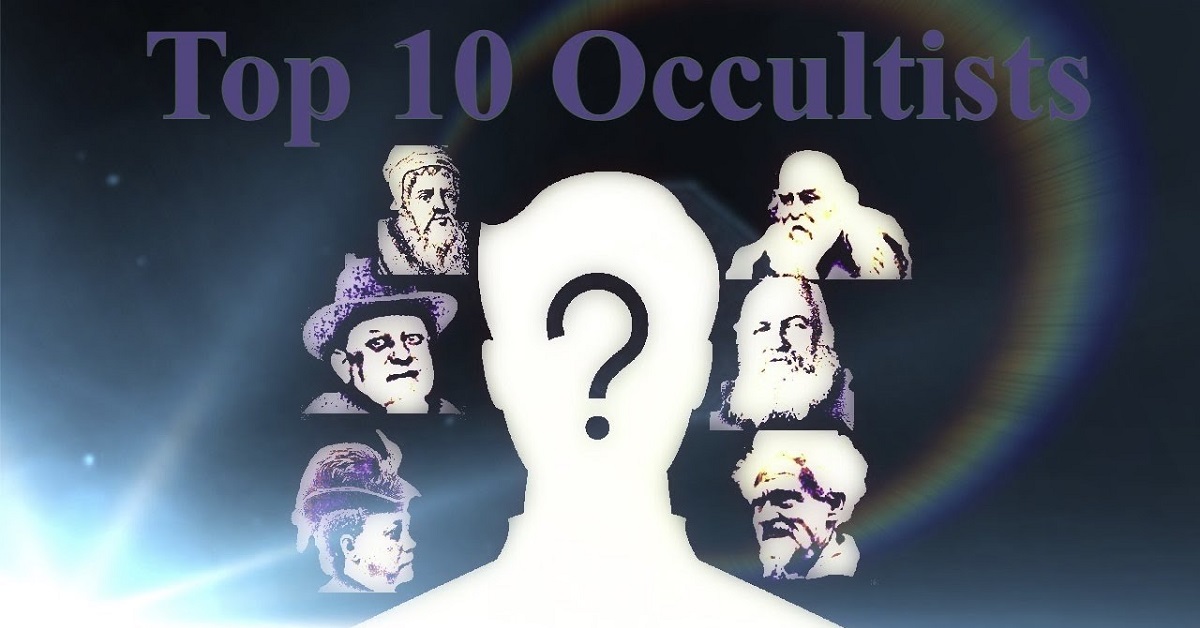


Ten Political ‘Intriguers’
Introduction
The occult is a shadowy world.
Historically, it has involved actors in sub–rosa activities, prompted the adoption of pseudonyms, and – depending upon how unfavorably ruling powers would react to discovery – resulted in the creation of clandestine networks.
All this is made to order for another area that might, at first glance, appear to be totally unrelated to these mystical or sorcerous undercurrents: namely, the world of spy craft.
But, in fact, the two arenas may overlap surprisingly frequently.
In this video, we’ll examine some of the junctures by looking primarily at ten (10) well-known occultists who have been accused of espionage.[1]
However, there is an almost unbelievably dramatic aspect to our entire saga. We will get to this in our final and climactic consideration of that much honored American Founding father who held a key to a kite string, for a Luciferian personal lightning strike. Of course, we’re referring to the man so well portrayed on the $100 bill, and who needs no further introduction now.
10. Aleister Crowley
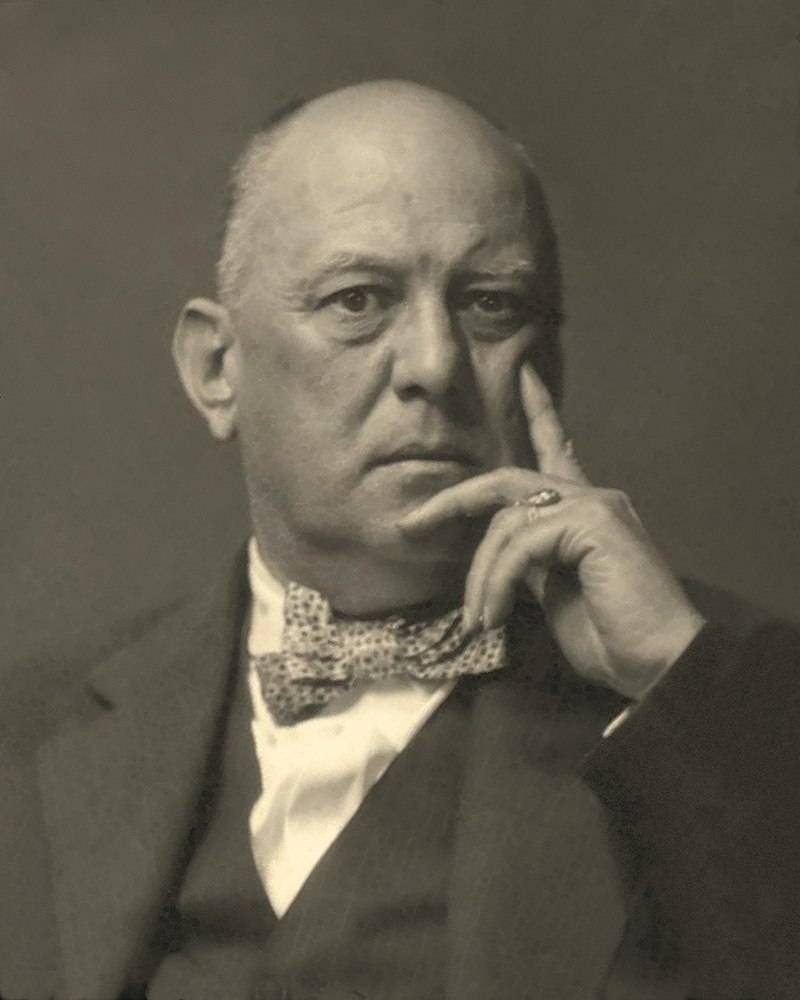
We’ll start things off – as we have done before – with the man who styled himself “The Great Beast, 666,” Edward Alexander “Aleister” Crowley.
Perhaps no one has a higher profile in 20th-century occultism than he.
If the usual biographical sketches are credible, at one time or other, Crowley dabbled in nearly every “alternative” form of religion, and joined every esoteric group, that existed. He had connexions to both English and French Freemasonry. He was initiated into the magical system of the Hermetic Order of the Golden Dawn. He made a study of Theravāda Buddhism and Tantra. He became the head of the Ordo Templi Orientis (O.T.O.).
For more on some of these currents, see “10 ‘Sex-Magic’ Cults.”
When he was dissatisfied with the status quo, he either set about reforming preëxisting institutions in his own image, or simply formed his own associations. For example, he started the A∴A∴ (usually said to abbreviate the Latin phrase Argentium Astrum, or “Silver Star”)[2] – a magical society not to be confused with Alcoholics Anonymous.
Crowley modified the high-grade masonic degrees of John Yarker. He rewrote the rituals for the Gnostic Church and the O.T.O.
Effectively, he established his own quasi-religion called Thelema.
Not to be confused with the London-based hedge fund, …
…Crowley’s Thelema was based on precepts (such as “Do what thou wilt”) that were articulated by the Renaissance writer François Rabelais.
(For more on the particulars of some of this, see our previous “Top 10 Occultists of All Time.”)
But these interests placed Crowley in numerous, out-of-the way places on the earth. And he associated with many strange people.
These facts, together with Crowley’s own (often exaggerated) bravado, led to allegations that Crowley was a spy.[3]
For example, for two years, Crowley worked as a columnist for German-born American political agitator and accused spy George Sylvester Viereck.[4] In the lead up to both world wars, Viereck was outspokenly pro-German. He published two periodicals, The Fatherland and The International, for which Crowley both edited and wrote articles ostensibly championing Germany over against his native Britain.
In his autobiography, Confessions, Crowley maintained that he had been doing “undercover” fact-finding for British Intelligence.[5]
He also associated with Gerald Hamilton,[6] a man who, for a brief interval, was reputedly as notoriously “wicked” as Crowley himself.
Also like Crowley, Hamilton seemed prone to aggrandize himself; so biographical details are a bit sketchy. But Hamilton appears occasionally to have operated as an information broker or a police informant.[7]
According to biographer Tobias Churton, Crowley met with Guy Burgess in 1942.[8]
Burgess was a principal member of the ring of British double agents known as the “Cambridge Five.” Under the direction of Harold “Kim” Philby, and from the era of World War II right through the early stages of the “Cold War,” the five spies secretly assisted the Soviet Union – to which Burgess defected in 1951.
Crowley also had dealings – some of them potentially sexual in nature – with journalist and Parliamentarian Thomas “Tom” Driberg.
Driberg may (or may not) himself have worked with the Soviet KGB or the British MI5.[9]
In any case, he wrote a biography of Burgess.[10]
Finally, Crowley was acquainted with, and influenced, German-born doctor and occultist Arnold Krumm-Heller.
Krumm-Heller was the neo-gnostic founder of the South American-based Fraternitas Rosicruciana Antiqua – a blend of Martinism, Rosicrucianism, Spiritism, Thelema, and Theosophy.
He was a personal physician to Francisco Madero, the 37th president of Mexico (until the latter’s deposition and assassination in 1913).
And, of course, Krumm-Heller was an operative in both the German and Mexican secret services.
Krumm-Heller appears to have reported to German diplomat and intelligence agent Felix Sommerfeld.
The two may have been attempting to engineer a war between Mexico and the United States. To that end, Krumm-Heller and Sommerfeld possibly engineering the bloody attack on Columbus, New Mexico by Mexican revolutionary Pancho Villa on March 9, 1916.
9. Michael Sendivogius
During the sixteenth and seventeenth centuries, it was still uncommon for non-nobility to be widely traveled. Exceptions included certain craftsmen (for example, stone masons) as well as self-styled adventurers and …occultists!
On the other hand, you have noblemen who were also esotericists. An obvious case is that of Michael Sendivogius, …
…whom we covered in “Top 10 Gold-Making Alchemists.”
Sendivogius shuttled amongst various European courts, including those of Emperors Rudolf II and Ferdinand II …and Polish[11] King Sigismund III, from the House of Vasa –…
…for whom (allegedly) he was “a double agent.”[12]
Among other things, Sendivogius seems somehow to have been mixed up[13] in the Russian affair of the “False Dmitry,” during that country’s so-called “Time of Troubles.”[14]
The gist was that a succession of various imposters – referred to as “Pseudo Dmitries” –…
…claimed to have been the youngest son of Tsar Ivan the Terrible,
…who was apparently assassinated at the age of eight.
The first of these pretenders actually managed for a time to assume rulership of the country.[15]
Espionage-related shenanigans concerning royal succession would later afflict other countries, including England – as we will see further on. And other European nations would give rise to interesting espionage-occultism interrelations.
8. Emanuel Swedenborg
And this brings us to Sweden, and to the late-17th to early 18th-century scientist turned philosopher-theologian, Emanuel Swedenborg.
Initially, Swedenborg studied physical science and became a knowledgeable mineralogist. His mechanical inventions, including one enabling ships to be transported on land, brought him to the attention – and into the favor – of government officials.
Following a series of mystical experiences in the 1740s, Swedenborg devoted himself to spiritual pursuits.
Essentially, he became convinced that he had a divine mission to reinterpret the Bible and Christianity, effectively being the conduit for a new gospel. But, he denied that he was acting on his own hook. Instead, Swedenborg claimed that he was merely delivering information obtained by “visiting” heaven and hell and conversing with angels and with God.
Swedenborg was preoccupied with the hermetic notion of “correspondence” between human beings and the cosmos – an idea we sketch in the video “10 Arcane Words.”
Several of his doctrines arguably had a neo-gnostic complexion. Some of them revolve around marital – and even sexual – concepts, as discussed in “Top 10 ‘Sex-Magic’ Cults.”
For all that, the influence of his Protestant-Lutheran background was still evident.
After his death, a few of his disciples – referred to as “Swedenborgians” – founded the Church of the New Jerusalem, or the “New Church.”
Swedenborgianism, in one form or other, attracted notables such as John Chapman, better known as “Johnny Appleseed”; Swedish entomologist Leonard Gyllenhaal, progenitor of actors Jake and Maggie Gyllenhaal; Henry James, Sr., father of important writers Henry and William James; and popular health commentator Mehmet Cengiz Öz, who is, in 2022, a senatorial candidate in Pennsylvania and who’s known professionally as “Dr. Oz”[16]
But, Swedenborg also inspired a group of French esoterics, called the Illuminés of Avignon. This was an assembly of Freemasons, led by “Dom” Antoine-Joseph Pernety and Count Thaddeus Grabianka, who introduced the so-called “Swedenborg Rite” into their masonic rituals.[17]
As to whether Swedenborg the man had himself been a member of “the Brotherhood,” the matter is hotly disputed.
In her book Emanuel Swedenborg, Secret Agent on Earth and in Heaven,[18] author Marsha Keith Schuchard has argued not only that Swedenborg was a Freemason, but also that he was a Jacobite spy in the employ of the Swedish government, during the rise of parliamentarianism.
According to her, Swedenborg was valued, in part, because of his access to “secret Masonic networks” which functioned as confidential message-relaying systems.
Schuchard places Swedenborg, an inveterate traveler, at the epicenter of prominent British Prime Minister Robert Walpole’s intelligence apparatus in Hanover, Germany.
If true, this would place Swedenborg in a class of adventurers and businessmen, operating during the heyday of mercantilism, that also veered over into spy craft. This would include Swiss-English agent John Coustos and Prussian antiquarian Philipp von Stosch – both of whom were Freemasons.
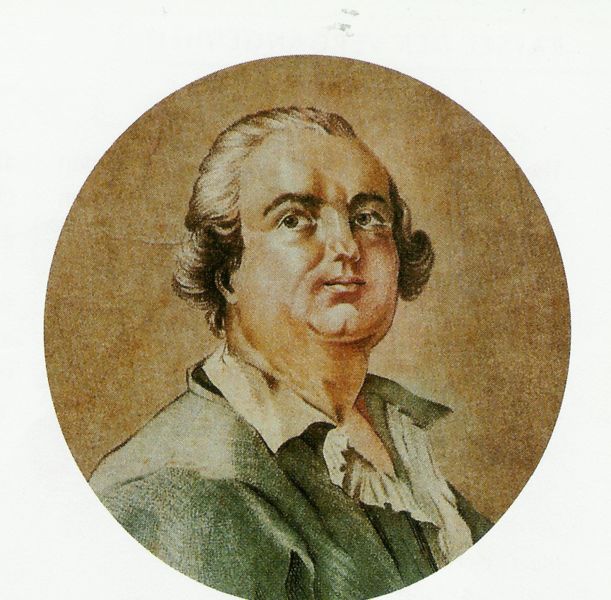
It also includes the even more mysterious Count of St. Germain,[19] who was suspected of participating in Jacobite machinations during the 1740s.[20] He claimed to have been one of the last surviving members of the Hungarian royal House of Rákóczi.[21] “…[T]here is some evidence that Saint-Germain had worked for …[Frederick the Great] as a secret diplomat (i.e. a spy) in France…”.[22]
The so-called Grand Constitutions of 1786, one of the important documents in the formation of the Scottish Rite, name Frederick as the head of that order. Masonic orders play a recurring part in state intrigues.
7. Robert Moray
Recall that, as part of the far-flung occult connexions he maintained, Aleister Crowley was a high-degree Freemason. This is suggestive – not to say instructive – not least because (as we have seen) several other historically important members of the “Craft” also spent time as spies.
For example, consider the case of Sir Robert Moray. Moray was in on the ground floor of what is termed “speculative” masonry – as opposed to the “operative” variety in which bona fide builders and stone workers would have engaged.[23]
Although the official inception of the Grand of Lodge of England wouldn’t occur until June 24, 1717,[24] Moray is recognized as having been among the men “raised” to masons as part of “[t]he first recorded initiation in England” circa 1641.[25]
Prior to that, Moray was part of a secretive coterie of Scottish military and statesmen who had some connexion to France. In fact, Moray supposedly had close contact with the distinguished Duke Armand Jean du Plessis, better known as Cardinal Richelieu.
Richelieu was a shrewd political operator and managed to attain high offices in both the Catholic Church and in the government of France, where he was King Louis XIII’s chief minister.
Among his accomplishments was that he catapulted France above Spain as the most powerful nation in Continental Europe.
He did this, in part, by negotiating tactical alliances with numerous Protestant countries (including the Dutch Republic, England, and Sweden) to oppose the Hapsburgs, who controlled both the Iberian Peninsula and the Holy Roman Empire.
To advance this master plan, Richelieu maintained a network of spies – among whom was Robert Moray. And among Moray’s tasks seems to have been that of ingratiating himself with a militant group of lowland Presbyterian Scots called the “Covenanters.”
Making short shrift of portions of Scottish history, we may summarize the situation. The Covenanters opposed Kings James VI (i.e., James I of England), and his son Charles I – at least, insofar as these rulers followed the precedent set by Henry VIII – and assumed control of the church in Scotland.
However, even though the Covenanters resented monarchial intrusions into church governance and theology, they recoiled in horror when Charles I was deposed and executed.
So, the Covenanters extended an olive branch to Charles’s son. “Moray helped to persuade the Prince of Wales, the future Charles II, to visit Scotland for his coronation as King of Scots at Scone on 1 January 1651.”[26]
Charles II was reigning when a group of twelve men, including Robert Moray, met at Gresham College in 1660 and founded The Royal Society of London for Improving Natural Knowledge. Moray was apparently instrumental in procuring the royal charter from the king.
As discussed in a previous video, the Royal Society’s initial membership included Sir Robert Boyle, the alchemist who helped launch the modern science of chemistry.[27]
In 1688, Boyle’s advocacy helped persuade Parliament to overturn a law forbidding the practice of alchemy. This paved the road for the incorporation of the Bank of England just a few years later, in 1694.
So, it’s tempting to say that part of Sir Robert Moray’s legacy was the London-based money-power apparatus that, to a certain degree, supplanted the British monarchy starting in the 17th century.[28]
But, Sir Moray was not the only “brother mason” to have entered into intelligence work. Another notable was the ponderously named individual (Charles-Geneviève-Louis-Auguste-André-Timothée d’Éon de Beaumont) later known as the Chevalier D’Eon.
We had occasion to name d’Eon in “Top 10 ‘Sex-Magic’ Cults” owing to his alleged affiliation with English poet, and Emanuel-Swedenborg discipline William Blake.[29] In that place, we noted the chevalier’s reputation as a “cross-dresser” – an usual pastime for an 18th-century gentleman.
It turns out, however, that this fact – irrespective of its possible sexual connotations and implications – figures in at least one persistent tale of international intrigue.
According to the story, recounted in the chevalier’s memoirs, the French King Louis XV wished to open a secret channel of communication with Elizabeth Romanov, then the Empress of Russia. The trouble – according to d’Eon – was that England was using its influence to prevent French emissaries (on pain of death) from entering Russia.
In order to circumvent English security, the Chevalier d’Eon claimed that he impersonated a woman and inveigled himself into “service as a maid of honour to the Empress.”
D’Eon was closely aligned with the House de Broglie, which eventually produced famed quantum physicist Louis de Broglie, who postulated the particle-wave duality of subatomic parts like electrons.
For example, he and Charles-François de Broglie, also known as the Marquis de Ruffec, were both operatives in Louis XV’s clandestine “King’s Secret” group. Among other things, the marquis worked with playwright and spy Pierre Beaumarchais, composer of The Barber of Seville and The Marriage of Figaro.
Together de Broglie and Beaumarchais lobbied the French government in support of the American Revolution. In fact, the duo was instrumental in convincing Gilbert du Motier, the Marquis de Lafayette, to intervene on behalf of the Americans to the point where he assumed command of his own troops in the Continental Army.
6. Nicholas Roerich
Nicholas Roerich was a late-19th to early 20th-century Russian painter and occultist. He achieved early public acclaim both for his Symbolist oil compositions as well as for stage-costume designs – for example, in Igor Stravinsky’s 1913 The Rite of Spring.
He and his wife, Helena, became students of Buddhism, Hinduism, mythology, and Theosophy – which, of course, owed its formulation in large measure to Russian esoteric H. P. Blavatsky.
Similarly to Blavatsky, the Roerichs claimed to be in contact with Himalayan-based “Ascended Masters.”
These “Mahatmas” prompted them to create their own, mystical system known as “Agni Yoga.”
Eventually, the pair traveled to United States by way of Finland and Great Britain. In America, the Roerichs impressed Freemason and financier Louis L. Horch, who – in 1928 – paid for the construction of the Roerich Museum in New York City.
Among those who frequented the museum, then called the “Master Building,” was masonic philosopher Manly Palmer Hall.
Nicholas Roerich also became a spiritual advisor to politician Henry A. Wallace. At the time, Wallace served as President Franklin Delano Roosevelt’s secretary of agriculture. But he would become FDR’s third-term vice president. Had he not been edged out by Harry S. Truman during the 1944 election cycle, Wallace might have become president of the United States when F.D.R. died in office in 1945.
Because of his contacts, history, and mobility, Roerich was commissioned by Wallace to search southeast Asia in search of drought-resistant grasses to offset the negative effects of the “Dust Bowl.”
But, what he may really have been doing was attempting to secure local support for an Asian union – possibly around Eastern-messianic expectations.
Roerich is now counted among the ranks of that motley assortment of characters who took up the reigns of what has been called the “Great Game” after the British Empire went into eclipse. The phrase the “Great Game” – a 19th-century coinage – was popularized by Freemason and novelist Rudyard Kipling, especially in his 1901 classic, Kim.
The degree to which masonry interconnected with political intrigue was vividly, if fancifully, showcased in Kipling’s 1888 short story, The Man Who Would Be King, which was adapted for film in 1975 by John Huston and featured actors Michael Caine, Sean Connery, and Christopher Plummer.
Also termed the “Tournament of Shadows,” the overarching power struggle between the British and Russian empires revolved around the geopolitical significance of portions of Asia, including Afghanistan, India, and Tibet.
“…[T]o many theorists [this is the]…heartland of the world, and [it is] riddled with symbolism.”
Pursuant to his mythological interests, Roerich appears to have been on the hunt for legendary locations supposedly imbued with magical powers.
For one thing, beneath the surface of Tibet – quite literally – was said to lie the mythical subterranean city of Agartha, supposed home to the Lord of the World.
Or, again, the “hidden paradise called Shambala” has long been rumored to be in the vicinity. Some claim that it is an “undiscovered city” somewhere in the Himalayas “in northern Tibet.” Others – including Roerich – seem to have searched for it in the Altai Mountains, in an area sometimes referred to as the “Russian Tibet.”
Interestingly, F.D.R. wasn’t the only world leader to fix his attentions on Tibet. Under Soviet “Chairman” Vladimir Lenin,[30] the cryptographer, spy, and Tantric Buddhist Gleb Ivanovich Bokii also attempted to locate Shambala.
Almost incredibly, one of the stated aims was to “merge” the sex-magical oriented “Kalachakra-tantra and ideas of Communism”.[31] For more on Tantra, see “10 ‘Sex-Magic’ Cults.”
Until his summary execution during Joseph Stalin’s “Great Purge,” Bokii was active in the U.S.S.R.’s numerous pre-KGB-era secret-police outfits, including the Cheka, NKVD, and OGPU.
In the next decade, then-German Führer Adolf Hitler sent his own exploratory party to the Tibetan region under zoologist Ernst Schäfer. The expedition was operated under the auspices of SS-Reichsführer Heinrich Himmler’s Ahnenerbe,[32] which basically investigated what might be termed “esoteric genealogy.” The explorers sought to establish that “….Tibet …[was] the cradle of the Aryan race…”.
Also operating in the Indian subcontinent was the eccentric, French-born Greek and occultist Maximiani Julia Portas. Portas later converted to Hinduism and changed her name to Savitri Devi.
Her Hindu sympathies stemmed from an interpretation of the history and etymology of the word “Aryan.” Devi perceived a connexion between the ancient, Indo-Iranian people group of that name and the racial identification embraced by National Socialist Germany, by way of French ethnologist Arthur de Gobineau and British philosopher Houston Stewart Chamberlain.
5. J. G. Bennett
Another interesting figure in the vicinity was John Godolphin Bennett. “J. G.” Bennett was apparently a linguistic savant who was connected, in some fashion, to British intelligence.
After mastering Turkish, he was stationed in Constantinople (Istanbul) toward the tail end of World War One.
Perhaps significantly, later American Central Intelligence chief Allen Dulles was also in the same vicinity.
“In 1916 Dulles joined the U.S. Foreign Service. …He was assigned to Constantinople (later Istanbul) from October 1920 to April 1922, and then went to Washington, D.C., to become the State Department’s specialist on the Near East.”[33]
While in Turkey, Dulles was mixed up in the hoopla surrounding the so-called Protocols of the Learned Elders of Zion. Specifically, he was among the first opinionators to label the document spurious.[34]
The Protocols are a whole other story. One commonly repeated theory holds that they are the creation of one Mathieu Golovinski, a Russian writer in France who acted as an agent for Pyotr Rachkovsky, head of the Tsar’s “secret police,” the Department for Protecting the Public Security and Order (abbreviated “Okhrana”).
Like Dulles’s experience, Bennett’s time in Turkey resulted in his own promotion under General Edmund Allenby. (Allenby had commanded Colonel Thomas Edward “T. E.” Lawrence, who became famous as “Lawrence of Arabia.”) Bennett “…was recruited to be the head of Military Intelligence ‘B’ Division, with responsibility for the entire Middle Eastern region.”[35]
Following the European war and the Bolshevik revolution, Bennett was assigned to surveil Russian émigrés and expatriates. This put him in contact with occultist G. I. Gurdjieff, and Gurdjieff’s principal disciple, P. D. Ouspensky. Apparently, the trio were introduced to one another through Prince Sabahaddin de Neuchâtel. Sabahaddin was simultaneously the scion of the House of Osman, the then-ruling Ottoman dynasty, as well as a supposed anti-dynasty agitator and proponent of democracy.
As an aside, the “Osman” name is intriguing. One recalls the following tidbit related to the terrorist attacks of September 11, 2001. “A member of a prominent Saudi Arabian family with links to the Texas Bush clan, Osama (Usama) bin Laden was known to the CIA in the 1980s as Colonel Tim Osman, a successful leader of the Mujahiddeen.”[36]
Nevertheless, these associations – and an alleged near-death, out-of-body experience – warmed Bennett up to all things esoteric. He ended up delving into Gurdjieff’s Fourth Way, Rudolf Steiner’s Anthroposophy, H. P. Blavatsky’s Theosophy, and even becoming a missionary for Indonesian guru Muhammad Subuh Sumohadiwidjojo, bringing the “Subud” movement to Britain.[37]
4. Theodor Reuss
Turning to police spies, we ought to mention Theodor Reuss.
Along with Carl Kellner, Reuss was one of the initial founders of the Ordo temple Orientis, or O.T.O.[38] We mentioned this organization in connexion with Aleister Crowley, who ratcheted its sex obsessions into the stratosphere.
For some of the lurid details, see “Top 10 ‘Sex-Magic’ Cults.”
But beyond their common interest in magia sexualis and Tantra, Crowley and Reuss shared another thing in common: supposed ties to intelligence work.
In the case of Reuss, this amounted to alleged involvement with the Prussian secret police.
As writer (and former Blondie drummer) Gary Lachman notes, this put Reuss in the orbit of anarchists and socialists. In fact, Reuss was expelled from “…the English Socialist League for spying on Karl Marx’s daughter Eleanor for the Germans…”.[39]
Bear in mind that the Prussian secret police are identified by contemporary writers as having been the motivating force behind the infamous – and previously mentioned – document known as the Protocols of the Learned Elders of Zion.
Almost universally – and variously – denounced as a “forgery” or a “hoax,” the Protocols are part of a spate of nineteenth-century, socio-politically supercharged manuscripts with questionable provenances.
Interlude 1: William Thetford
We hope to be able to enumerate ten of the most salient of these in a future video. But, for the time being, we observe that the nexus of intelligence with quasi-religious texts isn’t confined to previous centuries.
Consider, as just a single example, the ponderous tome titled A Course in Miracles.
After the works of Alice Bailey and Edgar Cayce, the writings of Marilyn Ferguson[40] and James Redfield,[41] and alongside other supposedly “channeled” treatises,[42] such as those of Judy Zebra “J. Z.” Knight[43] and Dorothy Jane Roberts,[44] A Course in Miracles has been hugely influential for “New Agers.”
The “course” contains material supposedly “channeled” by a psychologist named Helen Shucman[45] from an entity elsewhere identified as “Jesus.”
However, Shucman merely dictated the words of a perceived “inner voice” to at least one other collaborator. According to the story, this person was her colleague, William Newton Thetford.
And this is where things take a strange turn. For, consulting Thetford’s autobiographical sketch, as presented on A Course in Miracles’s website, we find that he was trained by Carl Rogers at the University of Chicago. Rogers – widely regarded was a board member for the Central-Intelligence-Agency-connected Human Ecology Fund, which appears to have been an MK-Ultra cover operation.
In a testimony to the interconnectivity of the tangled web of characters we’ve been surveying, we note – in passing – that the Cornell University-based Human Ecology Fund was also the institutional base for Louis Jolyon West. Dr. West engaged in public shadow boxing with L. Ron Hubbard’s Church of Scientology and was also consulted as a “brain-washing expert” in the trial of Patricia Campbell Hearst. Better known as “Patty Heart,” she is the granddaughter of publishing tycoon William Randolph Hearst, and become notorious when she was arrested for numerous crimes – including bank robberies – committed in connexion with a strange, leftist terror organization called the “Symbionese Liberation Army.” Heart’s defense claimed that she had been mind-controlled through rape and other forms of coercion. Dr. West successfully petitioned then-President Jimmy Carter for commutation of her prison sentence and she was later pardoned by Bill Clinton.
Back to Thetford: the psychologist further disclosed that he himself was recruited into the C.I.A. during the 1950s. According to Thetford’s account, as retold via an interview with “transpersonal” psychotherapist Frances Vaughan, the C.I.A. was expanding a battery of personality assessments that had originally been conceived by Harvard University Professor Henry Murray.
During World War II, Murray worked for William “Wild Bill” Donovan’s Office of Strategic Services, or the O.S.S. Murrary is infamous for conducting a series of barbaric human “experiments” on Harvard students – including the now-infamous so-called “Unabo(b)mer,” Theodore “Ted” Kaczynski.
During Murrary’s “research project,” an untold number of individuals were given mind-altering drugs, including LSD, or lysergic acid diethylamide, as well as psilocybin.[46] Others were – essentially – emotionally traumatized. It is entirely possible that a few hapless “volunteers” were subjected to both pharmacological and psychological abuses.
As journalist Alexander Cockburn wrote in one Los Angeles Times article in 1999: “What did Murray give Kaczynski? Did the experiment’s long-term effects help tilt him into the Unabomber’s homicidal rampages? The CIA’s mind experiment program was vast. How many other human time bombs were thus primed? How many of them have exploded?”[47]
According to an article in Psychology Today, “Murray …supervised psychoactive drug experiments, including …[those of psychedelic-drug advocate Timothy Leary].”[48] Leary once publicly stated that he had long “…been an admirer of Aleister Crowley” and believed that he had “…carried on much of the work that he started over a hundred years ago…”.[49]
In any case, Murray’s legacy was continued (in part) by John Gittinger, best known for developing a “Personality Assessment System” that C.I.A. used for creating and exploiting psychological weaknesses in targets of espionage or in recruitment scenarios.
Thetford states: The P.A.S. “…was so accurate that I began working with …[Gittinger] and others to further develop and refine it.”
As a final point, recall Helen Shucman’s claim to have heard a disembodied voice in her head. It is interesting to consider this alongside a further datum known as the “microwave auditory effect,” whereby “communications are generated directly inside the human head without the need of any receiving electronic device.”
This was described in 1961 by biologist Allan H. Frey. At the time Frey published a paper on the phenomenon – now sometimes called the “Frey Effect – he was employed by General Electric’s Advanced Electronics Center at the MK-Ultra-connected Cornell University in Ithaca, New York.[50]
The power to induce the effect in controllable and predictable ways was supposedly harnessed by Joseph C. Sharp, a neuropsychiatrist working at the Walter Reed Army Institute of Research.
In other words, we have an ostensible C.I.A. operative named William N. Thetford who, by his own testimony, was a participant in MK-Ultra psychological experiments. He’s working closely to “record,” edit, and publicize what would – partially through the promotion of media gurus like Oprah Winfrey – become hugely influential text of New-Age spirituality. And this text was allegedly obtained through a process oddly reminiscent of the “Frey Effect” – a radar-induced sensation of “inner communication” that had just been identified prior to Helen Shucman’s adventures in “inner dictation.”[51]
The case is hardly the only curious interstice between “intelligence” and contemporary culture.
As mentioned before on this channel, consider (in this vein) a man who may have inspired the fictional, Marvel Comics character Howard Stark, father of Tony Stark, billionaire playboy and tech savant …and the real-life identity for the superhero known as Iron Man.
3. Jack Parsons
Of course, I have in mind the American, California Institute of Technology-associated rocket scientist John Whiteside Parsons, better known as “Jack.”
Given his possible inspirational rôle for the movie representation of Howard Stark, I’m sure it’s just an extraordinary coinkydink that his given name, at birth, was “Marvel.”
He was also a principal member, and later head, of the so-called “Agape Lodge,” a United States branch of Aleister Crowley’s Ordo Templi Orientis.
By day, he made numerous discoveries pertinent to the manufacture of both liquid-fueled and solid-state aeronautical engines. Parsons was one of the founders of Caltech’s Jet Propulsion Lab. One important series of test explosions was fired off on Halloween (no less) in 1936. The event, which was photographed for posterity, is known as the “Nativity” and is annually recreated, in memoriam.[52]
Many of Parsons’ engineering projects were conducted under the directorship of Hungarian-born American mathematician and physicist Theodore von Kármán.
According to an article published by Britain’s august Royal Society – which we mentioned throughout “Top 10 Gold-Making Alchemists” – “…the most famous of [von Kármán’s] ancestors is Yehuda Loew ben Bezalel, the ‘Exalted’ Rabbi of Prague, a famous sixteenth-century scholar… who is …credited by legend with the creation of the Golem of Prague…”.[53]
By night, Parsons accentuated these tantalizing biographical details by performing “sex-magickal” (sic) rituals, some of which were aimed at summoning elemental spirits. The culmination of his efforts was the “Bablon Working,” the stated goal of which was the incarnation of a quasi-demonic being on earth.
For more on this aspect of Parsons’ life, see our video “Top 10 ‘Sex-Magic’ Cults.”
Eventually, and perhaps inevitably, Parsons’ path crossed with the Hughes Aircraft Company, originally founded by eccentric engineer and entrepreneur Howard Hughes. Parsons obtained a Hughes chemical-manufacturing contract. While under Hughes’s employ, he was accused of document theft. This led to charges of corporate espionage and allegations that he was spying for the newly created nation of Israel.
To complicate matters further, Parsons was – for a time – romantically involved with one Sara Northrup. Sara was the sister of Parsons’ first wife, Helen Northrup. Sara eventually broke things off with Jack and eloped with then-fellow thelemite, and later Church of Scientology founder, Lafayette Ronald Hubbard, better known as L. Ron Hubbard.
As if the love triangles weren’t bewildering enough, a tapestry of espionage intrigue was superimposed on the situation. Firstly, Hubbard denounced Sara as a Communist spy. Though, Hubbard’s allegations have largely been dismissed – and appear to have been rejected by Federal Bureau of Investigation agents – as sour grapes.
Secondly, Hubbard himself was connected to U.S. Naval Intelligence. He would later claim that his membership, along with Parsons and Northrup, in the Agape Lodge had merely been part of a covert sting operation geared toward eradicating “black-magic” cults in California.[54]
Although officially exonerated of wrongdoing himself, Parsons’ reputation – and acquaintances – resulted in the permanent revocation of his all-important security clearances. He was compelled into ancillary fields (such as pyrotechnics) to continue exercising his peculiar skill sets.
Ultimately, Parsons lost his life conducting some (obviously perilous) experiment in his home. Explanations ranged from the pedestrian – such as hastiness due to the pressures of meeting shipment demand for an order of fireworks from a Hollywood movie studio – to the exotic – such as the speculation that Parsons was attempting to animate a Frankenstein-like creature called a homunculus.
Of course, there were also those who believed Parsons had been murdered. Hypotheses included that there was some anti-Zionist conspiracy motivated by Parsons’ cooperation with Israel; that various industrial tycoons – including Hughes – might have been looking to rid themselves of their competition; or even that the Los Angeles Police Department may have sought vengeance for Parsons’ rôle in the conviction of Captain Earle E. Kynette, who had been charged with conspiracy in an attempted car bombing directed against a former detective (Harry J. Raymond) who had blown the whistle on law-enforcement corruption.[55]
This subplot “thickens,” as it were, when one discovers that Captain Kynette didn’t simply preside over beat cops. He was the head of the L.A.P.D.’s “intelligence unit.”[56] He and his officers were themselves referred to in press clippings as “police spies.”[57]
2. John Dee
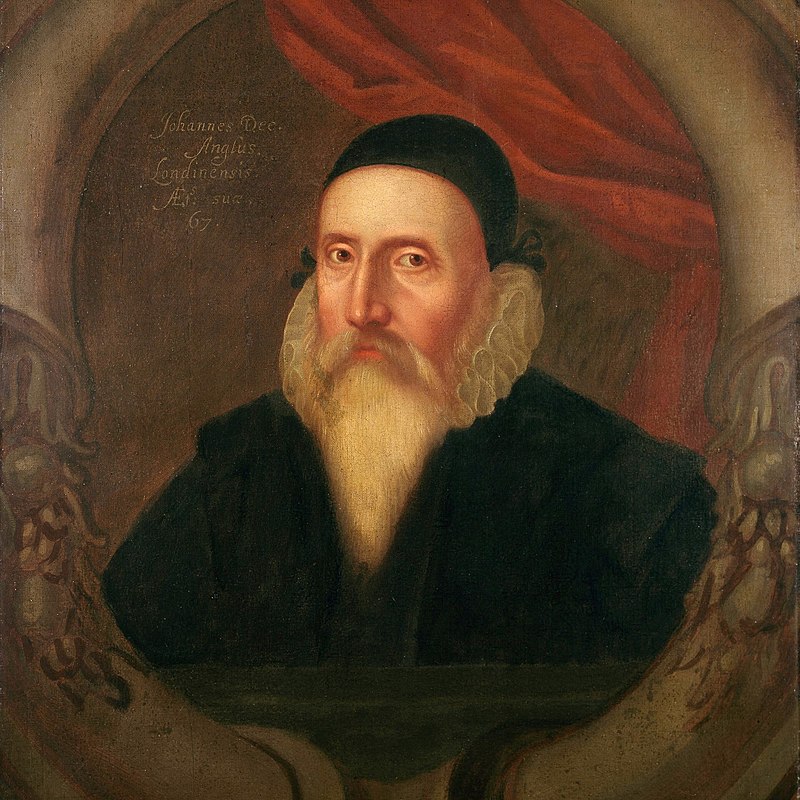
John Dee already had a reputation as a skilled astrologer, cartographer, and mathematician when he acquired a curious book that may have assisted – or even inspired – him in a more covert path.
The book, titled Steganographia,[58] had been written circa 1500 by the mysterious Benedictine monk Johannes Trithemius.[59]
The contents – and significance – of the book are still being debated (some 500 years later). But it’s clear that it uses ostensibly magical emblems and formulæ to convey groundbreaking techniques in cryptography.
In fact, the word “steganography” (albeit uncommon in conversation around the water cooler) has entered English, where it refers to “the practice of concealing messages or information within other nonsecret text or data.”[60]
And this appears to be precisely how John Dee applied the procedure. 17th-century English polymath Robert Hooke,[61] writing at the turn of the 18th century, “suggested, in the chapter Of Dr. Dee’s Book of Spirits, that John Dee made use of Trithemian steganography to conceal his communication with Queen Elizabeth I.”[62]
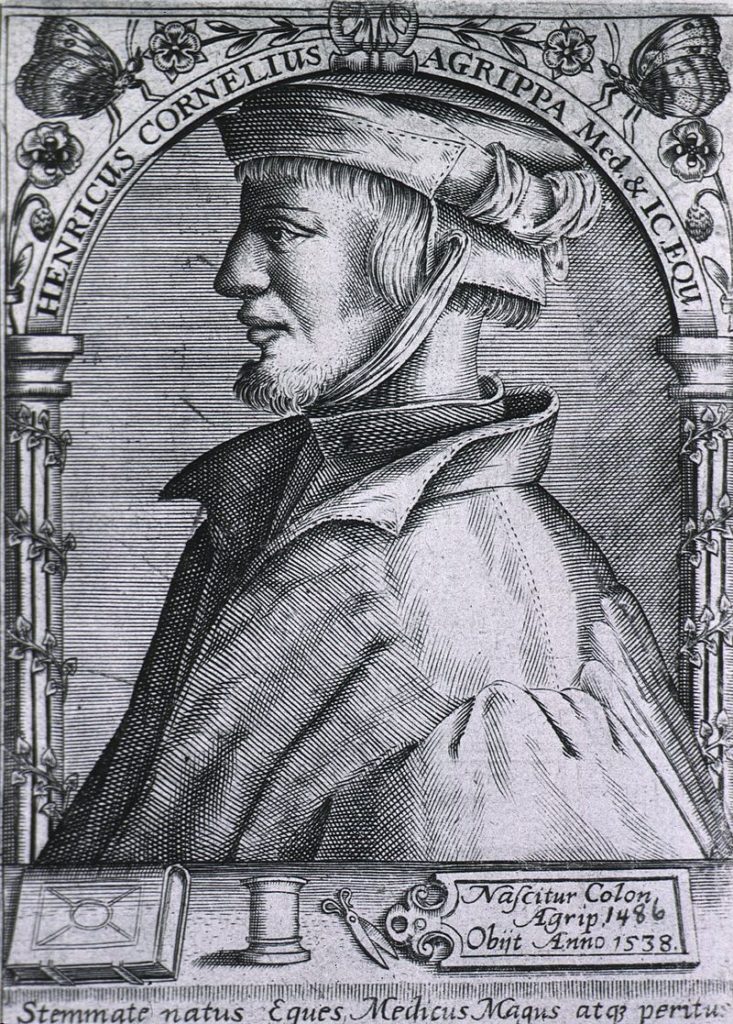
In this way, Dee – if I may be forgiven the expression – took a page out of the book of yet another Renaissance “magus” who had been influenced by Trithemius, the German polymath Heinrich Cornelius Agrippa. Like Dee, whom he inspired, Agrippa was fascinated by codes and by all things esoteric, on which he wrote the seminal Three Books of Occult Philosophy.
And like his later, English counterpart (Dee), Agrippa also seems to have been connected to the world of espionage, and may have functioned as a “diplomatic spy” for Holy Roman Emperor Maximilian I.[63]
Likewise, Dee seems to have at one time operated as an “intelligencer” for the English Crown. Reportedly, when Sir Francis Walsingham was appointed chief spy Queen Elizabeth, the rôle for which he is principally remembered, “he found it necessary to consult with the only man in England who understood encryption ciphers and who (legend has it) had long since served as the queen’s spy: John Dee.”[64]
There is an “idea of Dee as a roving James Bond of Tudor times” which, though it is “far-fetched” in certain respects – for example, Dee was certainly not regarded as a lady’s man – nevertheless has a “basis” in fact and history.[65]
For example, and remarkably, according to author Richard Deacon,[66] “…twentieth-century author” Ian Fleming “unconsciously [borrowed] as a code name for his hero the very signature used by Bond’s Elizabethan counterpart – 007.”[67]
Though Deacon admits that, overall, “despite his signature of 007, …[Dee] can better be compared to Admiral Sir Reginald Hall, Director of Naval Intelligence in World War I, than to James Bond.”[68]
“Unlike Bond, he was not directly involved in the maritime defence (sic) of the nation, but he was able to lend his technical and navigational know-how to sailors at the court of Elizabeth.”[69] To extend the analogy to Fleming-inspired characters, “[m]aybe he was a little more like Q than Bond…”.[70]
Interlude 2: Francis Bacon
We might as well continue this Elizabethan saga by speaking of the courtier to whom, according to Masonic philosopher Manly Palmer Hall, John Dee might have passed his torch of occult knowledge.
Francis Bacon[71] was a late-16th to early 17th-century English lawyer, philosopher, and politician. Intellectually, he was a trailblazing British empiricist. He articulated a method of reasoning that is still referred to a “Baconian induction” and was a forerunner of what evolved into the “scientific method.”
At his high point under King James I, Bacon became Lord High Chancellor. But his career as a member of court ended on a sour note. Bacon’s longtime enemy, the famed jurist Sir Edward Coke, brought numerous “corruption” charges – including accepting brides – against him.
Beyond his duties as a statesman, and seemingly apart from his rôle in the development of experimental science, Bacon may also have been an esoteric adept. As noted, Freemasonic writer Manly Hall, possibly drawing upon a tradition that was transmitted to him via Max Heindel’s[72] Rosicrucian Fellowship, represents Bacon as the inheritor of an occult gnosis that was transmitted to him by John Dee.
This is a story for another time. But, what is interesting from the standpoint of the current topic, is that Lord Bacon’s younger brother, Anthony, was undeniably a member of the Elizabethan-era spy network headed by the previously mentioned Sir Francis Walsingham.[73]
The Bacon family was a powerful force in England at the time. And it raises the question of how much sharing of information – and vision – might have occurred between the brothers.
In this respect, the Bacon family bears some similarity to the Dulles family.
In twentieth-century America, of course, Allen Welsh Dulles – having been instrumental in the wartime Office of Strategic Services and its successor, the Central Intelligence Agency – was indisputably one of the United States’s highest-ranking spies.
At the same time, his older brother, John Foster Dulles, was an attorney and high-level political insider. He was the Secretary of State under President Dwight D. Eisenhower, worked closely with Republican party boss Thomas E. Dewey, and was a key player in the U.S.’s early participation in the United Nations.
The Dulles brothers coordinated in at least two covert actions, both considered by Masonic President Harry S. Truman but ultimately authorized and implemented by President Dwight D. Eisenhower.
The first was Operation Ajax, by which the C.I.A. and Britain’s MI6 – in 1953 – overthrew the democratically elected Iranian leader Mohammad Mosaddegh and installed Shah Mohammad Reza Pahlavi in his place. The second was Operation PBSuccess which, the following year, ousted democratically elected Guatemalan President Jacobo Árbenz and installed a military junta.
1. Benjamin Franklin
Speaking of coups and rebellions, and as we teased in our introduction, we would be remiss if we didn’t say something about one of America’s homegrown revolutionaries.
And that brings us (at last) to number one. Benjamin Franklin, of course, was an 18th-century polymath who is most famous for his rôle in securing the United States as its own nation, independent of England.
As one of the country’s preëminent statesmen, he was a cosigner for each of three, über-important, formative documents: the Declaration of Independence, the U.S Constitution, and the Treaty of Paris.
It’s worth mentioning that Franklin arguably displays numerous similarities to Francis Bacon.
For example, along with his Italian contemporary, Galileo, Bacon is regarded as a father of modern experimental science.
Similarly, having made contributions to the studies of electricity and oceanography, Benjamin Franklin was also at the forefront of investigation during his era. Several of his inventions, including bifocal lenses and the lightning rod, are still in use.
Moreover, according to Baconian legend, the man known variously as Lord Verulam and the Viscount St. Alban, figures in Rosicrucianism and the beginning of Freemasonry.
Likewise, Franklin not only became a mason, but he was elevated to the position of master at lodges both in Philadelphia, Pennsylvania as well as in Paris, France.
There, in the “Lodge of the Nine Sisters”[74] – which (coincidentally or not) later became an important center for the bloody French Revolution[75] – he was initiated by Court de Gebelin, fountainhead of Western-occult fascination with the Tarot deck.
Franklin later personally initiated François-Marie Arouet, better known as the satirist Voltaire.
In truth, freemasonry may have just been the tip of the iceberg of Franklin’s occult involvement. Though, a word of caution is in order. The word “occult” has a range of meanings.[76] We discussed some of these in “10 Arcane Words.” For a more detailed survey, see that presentation.
But, somewhere along the “occult spectrum” lies the Bavarian Illuminati, to which Franklin can be connected through pamphleteer Thomas Paine.[77]
Paine was on intimate terms with one Nicolas Bonneville (and, incidentally, with Bonneville’s wife). Prior to the order’s office dissolution in 1787, Bonneville had been converted to Illuminism by Adam Weishaupt’s chief lieutenant, Christian Bode.[78]
At the same time, allegedly, the seeming sober-minded politician and printer was himself a member of a quasi-Satanic group known colloquially as the “Hell-Fire Club.”
Technically, the order to which Franklin is said to have belonged alternately called itself the “Brotherhood” or “Knights of St. Francis of Wycombe” and the “Monks of Medmenham” – both phrases intended as parodies of Christian (especially Catholic) religiosity. But the label “Hell-Fire Club” is the one that has stuck.
It turns out that there was a predecessor club by that exact name. This original incarnation goes back to a curious, 18th-century English duke and playboy named Philip Wharton.
At various times, and somewhat like the later Frenchman who called himself “Léo Taxil” (for the details, see “Top 10 Gold-Making Alchemists of All Time”), the paradoxical Wharton posed as both friend and enemy of Freemasonry. Supposedly, he once presided over the Premiere Grand Lodge of England as well as the Grande Loge de France.[79] However, after his alleged expulsion, he founded an even more secret society. Wharton ran this supposedly “anti-Masonic” organization – called the Gormogons – along with Andrew Michael Ramsay, a Scotsman known by the French title Chevalier, that is, “Knight.”
In a famous speech delivered in 1736, Ramsay connected Freemasonry to a group of Catholic crusaders. Later typically identified as the Knights Templar, the military order to which Ramsay referred was said to have passed its mysteries on to those men who founded masonry.
This idea, called “Templarism,” is detectable in esoteric degrees of “appendant” societies, such as the York Rite which offers a set of “Knights Templar” degrees. But even within the Ancient and Accepted Scottish Rite[80] – which, in an apparent nod to our Scottish Chevalier, is sometimes designated by the French word Écossais – one finds shades of Templarism, for example in the so-called Knight Rose Croix.
Politically, Ramsay was also a Jacobite. This group, whose name comes from the Latin Jacobus, lent its support to James II, the Catholic king of England who was deposed by Parliament during the “Glorious Revolution” and replaced by the Protestant William of Orange.
There has long been speculation that certain Jacobites, like the Chevalier Ramsay – with the possible assistance of French Jesuits – attempted to rewrite various Freemasonic rituals. Their presumed intention was to introduce these reformulations back to England to increase public support for the ousted House of Stuart and possibly for Catholicism.
At least, this line – that Freemasonry had been coopted by agents within the Vatican’s militant Society of Jesus – was pushed by the likes of Bode, Bonneville, and Weishaupt. These men billed the Illuminati as the anti-dote. Its anti-authoritarianism was pro-revolution and equally opposed to kings and popes.
Philip Wharton himself had Jacobite sympathies for much of his life. And Wharton was friends with James II’s son, James Francis Edward Stuart, known variously as the “Old Pretender” or as the rightful King James III – depending on the side one favored.
Late in his short life, Wharton seems to have abandoned the Jacobite cause and (like Emanuel Swedenborg) may have been a spy for English Prime Minister Robert Walpole. Walpole was a stalwart advocate for the Georgian Kings of the German House of Hanover, and he employed numerous covert agents, including the ostensible anti-Jacobite George Dodington, 1st Baron Melcombe.
Supposedly, George Dodington also happened to be a member of Francis Dashwood’s circle. When Dashwood rebooted Wharton’s Hell-Fire Club, beginning at London’s George and Vulture tavern, Dodington reportedly signed up, along with other influential persons – including Benjamin Franklin.
This is interesting for many reasons, not least of which is writer Richard Deacon’s contention that the club served as a “cover” for “British Intelligence” and, in effect, became a “…centre of English espionage.”[81]
And Benjamin Franklin was right in the thick of things. In fact, according to one researcher, Franklin came to England in 1758 expressly “…to discuss the future of the American colonies with Dashwood.”[82]
Additionally, Franklin had close dealings in Paris with Edward Bancroft, who was later unmasked as a double agent. It is disputed whether Franklin knew of Bancroft’s intrigues or not.[83]
As if that weren’t enough, Franklin appears to have known and corresponded with the Chevalier d’Eon, who we covered earlier. According to Deacon: “The Philadelphia philosopher and the chevalier became friendly in the 1770s when the French master spy was assigned to London and promptly joined the Hell-Fire Club.”
All this doesn’t necessarily mean that Franklin was a spy himself, that he had treasonous designs, or that he was working for the British. Tho, historian Cecil B. Currey raises this precise possibility in his 1972 study, Code Number 72 / Ben Franklin: Patriot or Spy?[84]
Admittedly, Franklin was cunning. It could be that he was hedging his bets if the Colonists were defeated.
Alternatively, Franklin may have been conspiring with a group of supporters inside George III’s own government. In this regard it’s worth recalling that Freemasonry extended throughout Britain and its colonies. American lodges frequently obtained their “charters,” or their authority to operate, from either the Grand Lodge of England.[85] So, that there existed some transatlantic, supranational confederation is not outside the realm of possibility.
One does wonder, however, just what Franklin was doing cavorting with the “Hell-Fire” group, if not simply using their meeting place as a convenient locale for hatching political schemes.
It should be remembered that Franklin was something of a ladies’ man. He himself, in his Autobiography, admitted his weakness for the opposite sex, writing that he was “…hurried …frequently into intrigues with low women that fell in [his] way.”[86]
And his womanizing ways continued well beyond his youth. As one crude, 18th-century poem put it: “Franklin, tho plagued with fumbling age / Needs nothing to excite him. / But is too ready to engage / When younger arms invite him.”[87]
The received, and sanitized, view of the club is that it was characterized by “ritual comedy, …banqueting and drinking, …and …wenching …”.[88]
Though, to read Daniel Mannix’s account, “…the Black Mass was celebrated and a solemn sacrifice [was] made to the devil of the virginity of the young girls lured into the cave system”[89] – a reference to the chalk caves directly beneath St. Lawrence Church, in West Wycombe, Southeast England, where Dashwood hosted Hell-Fire revels.
This darker complexion to the story might be dismissed as so much scandalmongering against the esteemed author of the Poor Richard’s Almanack were it not for an odd discovery made in 1998 by workmen renovating Franklin’s old digs at #36 Craven Street in London.
“…[O]ver 1200 pieces of [human] bone were retrieved… [f]rom a one metre wide, one metre deep pit…”.[90]
One of the builders who made the grisly discovery exclaimed: “It was like a horror movie”![91]
According to the London Times: “Most of the bones show signs of having been dissected, sawn or cut. One skull has been drilled with several holes.”[92]
At the time, “Paul Knapman, the Westminster coroner,” said in an official statement: “I cannot totally discount the possibility of a crime.”[93]
However, this angle was never investigated. According to the Benjamin Franklin House website: Since it was “determined that the bones were more than 100 years old …an inquest was not required.”[94]
Instead, is casually asserted that the bones are the “remnants of an anatomy school run from the House by William Hewson, son-in-law of Franklin’s landlady, Margaret Stevenson.”[95]
Even if this nonchalant reply is accepted at face value, one might worry that it glosses over several important points. For instance, there’s the issue of just where the bodies were obtained.
The further worry about why the remains of fellow human beings were so callously discarded is usually “answered” with the observation that the basement pit was “probably” used “to hide [the bones] because grave robbing was illegal.”[96] But, this solves nothing – unless, that is, learning about a Founding Father’s complicity in criminal grave robbery and evidence tampering is only worth an insouciant shrug.
That Hewson lived at the house for two years is mentioned in the usual retelling. But why Franklin shared quarters with him is evidently a question that is not interesting enough to answer. Likewise, the obvious follow-up query – namely, why Franklin would permit his home to be converted into a makeshift “anatomy school” – is apparently also of little to no consequence.
While one wrestles with these lacunae, commentators on the “Craven Street Bones” are busying themselves displaying an inexplicable omniscience in virtue of their (typically solemn) assurances that our American hero had nothing to do with the unsanctioned surgeries, themselves. Perish the thought!
Though, how Franklin’s aloofness and innocence could be ascertained without an investigation is anyone’s guess. Doubtless it is an inference from axioms such as that “he that would live in peace & at ease, must not speak all he knows or judge all he sees.”[97]
Nevertheless, on pain of being labeled gadflies, we must press this inquiry a bit further. After all, William Hewson was said to have been trained by anatomist William Hunter. In an article published in 2010 by the Journal of the Royal Society of Medicine, one may read a “prima facie case” that Hunter, along with accomplice William Smellie, “were responsible for a series of 18th-century …murders of pregnant women, with a death total greater than the combined murders committed by the famous 19th-century murderers, Burke and Hare, and Jack the Ripper.”[98]
Not only this, but – as mentioned in “Top 10 Gold-Making Alchemists of All Time” – Freemasonic reference materials ritualize the word “autopsy.” This implies that, in a bizarre – and arguably twisted – way, some Masons (perhaps like Franklin) may view this procedure both medically and esoterically. But, surely, there’s nothing to see, here!
Conclusion
Lest viewers conclude that these odd – and frankly alarming – connexions are relics of the past, we have only to ponder the career of New-World-Order booster George Herbert Walker Bush.[99]
Bush had moved in upper-level political orbits since at least the early 1950s, when he worked to support the presidential campaign of Dwight D. Eisenhower.
But he was introduced (in earnest) into federal positions by Richard M. Nixon, who appointed him the U.S. ambassador to the United Nations and chair of the Republican National Committee.
Coincidentally or not, Bush’s tenure corresponded to revelations about a sensational (and apparently bungled) burglary attempt – and ensuing coverup – at the RNC’s counterpart Democratic National Committee’s headquarters at the Watergate complex in Washington, D.C. The whole sordid business involved key personnel in Nixon’s Whitehouse and resulted in the president’s unprecedented resignation in 1974.
Reportedly, Bush’s profile was high enough throughout this period that he was considered for the vice presidency by Both Nixon and Gerald R. Ford.[100] It’s well known that Bush eventually did become V.P. under Ronald Reagan. And he nearly became president on March 30, 1981, when a would-be assassin’s bullets crippled White House Press Secretary James Brady and nearly claimed Reagan’s life.
It’s less well known that the Bushes had ties to the family of accused shooter, John Hinckley Jr. According to a New York Times article, dated April Fool’s Day, 1981: “The eldest Hinckley child, Scott, … is …a friend of Neil Bush, the son of Vice President Bush.”[101]
Neil Bush and Scott Hinckley were such close friends that the two had planned to attend a dinner together “…at the young Bushes’ home …but,” we’re told, “the dinner was canceled after the shooting.”
The “elder” Bush, who would in 1989 succeed Ronald Reagan and become the 41st president of the United States, had been tapped in 1976 by then-President Gerald Ford to assume headship of the Central Intelligence Agency.
You’ll recall that Gerald Rudolph Ford – whose birth name had been “Leslie Lynch King Jr.” – had also been a member of the President’s Commission on the Assassination of President Kennedy, better known as the “Warren Commission.”
Interestingly, although Bush denied having had any intelligence experience prior to his becoming chief spook, a provocative memo from longtime Federal Bureau of Investigation Director, J. Edgar Hoover, suggests otherwise. “Hoover reported that, on the day after JFK’s murder, the bureau had provided two individuals with briefings. One was ‘Captain William Edwards of the Defense Intelligence Agency.’ The other: ‘Mr. George Bush of the Central Intelligence Agency.’”[102]
Just a year prior to Bush’s appointment as DCI, Ford was himself the target of two assassination attempts, just a few weeks apart. The first, on September 5, 1975, involved Manson-family member Lynette “Squeaky” Fromme and occurred in Sacramento, California.
We mentioned Charles Manson in “Top 10 ‘Sex-Magic’ Cults.”
The second assassination attempt, September 22, 1975, took place in San Francisco in front of the St. Francis Hotel. This public attention on the name “Saint Francis” reminded synchromystic extraordinaire, James Shelby Downard, of the Hell-Fire Club which – as we discussed – jokingly called its members monks of “Saint Francis.”
One Sara Jane Moore was arrested and served thirty-two years for the crime, until she was paroled in 2007 – during the presidency of George W. Bush. Moore, who was at one point an informant for the Federal Bureau of Investigation, had peculiar ties to William Randolph Hearst’s organization “People In Need” and to the Patty Hearst case. According to Time Magazine, Moore made national headlines “in the early 1950s by collapsing …in front of the White House …suffering from amnesia”.[103]
That’s probably not worth looking into. Nor, I suppose, is it newsworthy that George Herbert Walker Bush had connexions to so many high-level political killings – or attempts.
As stated, and following the bizarre pair of failed assassinations on Ford, Bush, “Sr.” served as director of central intelligence. His assumption of that title came fast on the heels of previous DCI William Colby’s surprisingly cooperative testimony during Congressional investigations into C.I.A. activities.[104]
Colby himself was found dead under suspicious circumstances in 1996. Oh! I almost forgot to mention the occult angle.
Along with his son, and 43rd President, George Walker, as well as numerous other policy-making heavy hitters (like “Dubya’s” opponent in the 2004 presidential election, John Forbes Kerry), George Herbert Walker Bush was a member of the ultra-exclusive, and spookily named, secret society “Skull and Bones” operating at Yale University.
They meet in a walled-off building affectionately referred to as the “Tomb.” Supposedly, the Bonesmen have a collection of human skulls – including those previously resting on the shoulders of famous Apache elder Geronimo and of the previously mentioned Mexican revolutionary born José Doroteo Arango, but better known as “Pancho Villa.”
But that establishment-recruitment mechanism, which masquerades as a college fraternity, will have to be the subject of future study.
If you found something of interest in this presentation, please “Like” the video. If you would care to see additional content, don’t forget to “Subscribe” and turn on “Notifications.”
Copyright 2023; all rights reserved.
[1] Some figures appear to have been accused as part of character-assassination campaigns. This is the current line taken, for example, on the late-19th-to-20th-c. Russian monk and mystic Grigori Efimovich Rasputin. He had a strange and multifarious reputation that included accusations of espionage, sexual deviancy, and an almost supernatural (though plainly not inexhaustible) ability resist death. However, these claims are now usually explained as having been defamatory attacks launched by Tsarist enemies during the tumultuous year 1917, which saw two successive revolutions. See, e.g., Albinko Hasic, “5 Myths and Truths About Rasputin,” Time Magazine, Dec. 29, 2016, <https://time.com/4606775/5-myths-rasputin/>. Be that as it may, Rasputin does seem to have been involved in political intrigues. Additionally, there are those who still advocate for there having been some connexion to intelligence. According to press reports, Rasputin may even have been killed by British agent Oswald Rayner. See Karyn Miller, “British spy ‘fired the shot that finished off Rasputin’,” Telegraph (U.K.), Sept. 19, 2004, <https://www.telegraph.co.uk/education/3344528/British-spy-fired-the-shot-that-finished-off-Rasputin.html>.
[2] This is far from uncontroversial. Wikipedia (“A∴A∴,” Apr. 2, 2022, <https://en.wikipedia.org/wiki/A%E2%88%B4A%E2%88%B4>) provides a useful summary of the options. One possibility is that the phrase is actually Greek, rather than Latin. On this view, A∴A∴ stands for Άστρον Αργόν (Astron Argon or Aster Argos), which still translate to “Silver Star.”
This proposal is credited to James Eshelman, who gives an explanation based upon Jewish numerology (the Gematria of Kabbalah).
A variant on this Kabbalistic theme has it that A∴A∴ is a reference to the semitic phrase Arikh Anpin, sometimes referred to as the “Macroprosopus” (as in the Christian Cabalist Christian Knorr von Rosenroth) or the “Long Face.” This is an obscure concept in the emanationist cosmology of Jewish mysticism, and derivative systems. For more insight into the basics of both – emanation and Kabbalah – see my video “10 Arcane Words.”
A further option is that A∴A∴ represents the chimeric notion of a sublime, Acanum Arcanorum, that is, a “secret of secrets.” Indeed, Crowley appeared much taken with this sort of concept. Specifically, O.T.O. founders Carl Kellner and Theodor Reuss both professed to have discovered such an, ahem… penetrating mystery in the complicated subject of “sex magic,” to which I devoted an entire presentation. (See “Top 10 ‘Sex-Magic’ Cults.”)
Alternatively, one sees the phrase “Angel and Abyss” crop up periodically. Crowley certainly placed heavy emphasis both on the notion of a “Holy Guardian Angel” as well as of the indispensable significance of “crossing the Abyss” on one’s journey toward gnosis.
The Wiki authors also state that 20th-c. American novelist Lyon Sprague de Camp floated “Atlantean Adepts” as a candidate in his 1980 book, The Ragged Edge of Science (Philadelphia: Owlswick Press).
To round things out, Robert Anton Wilson and Robert Shea asserted (in their The Illuminatus! Trilogy, New York: Dell, 1975) that A∴A∴ doesn’t represent anything. To hear them tell it, anyone who presumes to decode the name gives himself away as a pretender.
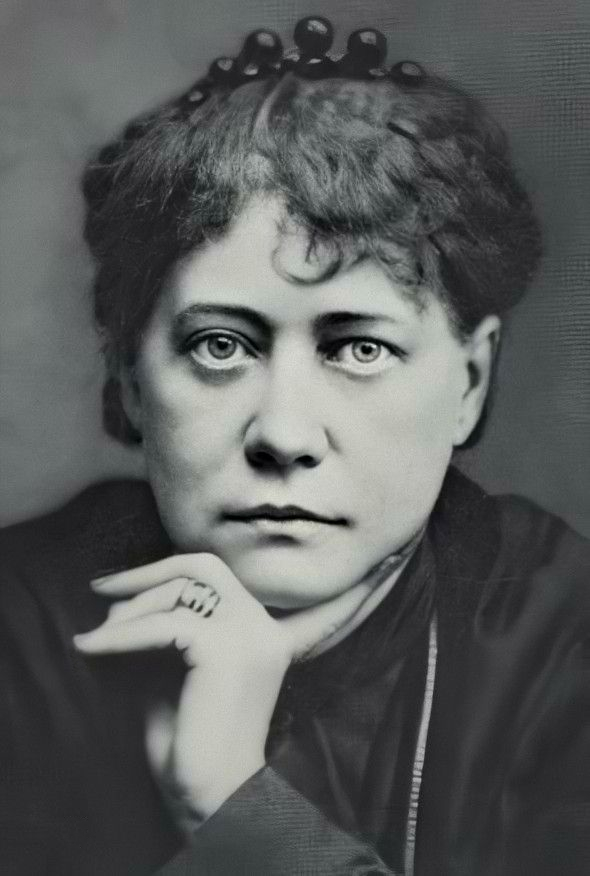
[3] Theosophical Society (co-)foundress, Helena Blavatsky, has also been suspected of being an intelligence agent. She was interviewed by the British-based Society for Psychical Research. At the end of 1885, its highly critical was report was circulated. In it, principal investigator Richard Hodgson (who was an associate of both William James and Henry Sidgwick) denounced her as a fraud and “…accused Blavatsky of being a spy for the Russian government…”, according to “Helena Blavatsky,” Wikipedia, Aug. 31, 2022, <https://en.wikipedia.org/wiki/Helena_Blavatsky>; citing Bruce F. Campbell, Ancient Wisdom Revived: A History of the Theosophical Movement, Berkeley, Cal.: Univ. of Cal. Press, 1980, pp. 92–93; Nicholas Goodrick-Clarke, Helena Blavatsky, Berkeley, Cal.: North Atlantic Books, 2004, p. 13; Gary Lachman, Madame Blavatsky: The Mother of Modern Spirituality, New York: Jeremy P. Tarcher; Penguin, 2012, pp. 228–230 and 236–237; and Peter Washington, Madame Blavatsky’s Baboon: Theosophy and the Emergence of the Western Guru, London: Secker & Warburg, 1993, pp. 82–83. On Hodgson’s associations, see Nevill Drury, “Hodgson, Richard,” The Dictionary of the Esoteric, Delhi, India: Motilal Banarsidass Publ., 2004, p. 144. Hodgson’s conclusions were questioned by Vernon Harrison. See Goodrick-Clark, op. cit., p. 14.
[4] E.g., Crowley’s main Wikipedia article – “Aleister Crowley” – refers to Viereck as a “German spy.” At least, in the version available as of Sept. 24, 2022, <https://en.wikipedia.org/wiki/Aleister_Crowley>. Though, Viereck’s own article contains no such reference, and merely calls him a “pro-German propagandist.” See “George Sylvester Viereck,” Wikipedia, Aug. 8, 2022, <https://en.wikipedia.org/wiki/George_Sylvester_Viereck>.
[5] Gary Lachman, Aleister Crowley: Magick, Rock and Roll, and the Wickedest Man in the World, p. 196.
[6] Supposedly born Gerald Souter.
[7] See Peter Parker, “The Long and Disgraceful Life of Britain’s Pre-Eminent Bounder,” book review, Tom Cullen, The Man Who Was Norris, Spectator (U.K.), Jul. 19, 2014, <https://www.spectator.co.uk/article/the-long-and-disgraceful-life-of-britain-s-pre-eminent-bounder>.
[8] Tobias Churton, Aleister Crowley in England, Rochester, Vt.: Inner Traditions, 2021, p. 207.
[9] “Tom Driberg,” Wikipedia, Oct. 13, 2022, <https://en.wikipedia.org/wiki/Tom_Driberg>.
[10] Tom Driberg, Guy Burgess: A Portrait With Background, London: Weidenfeld and Nicolson, 1956.
[11] And later Finnish and Swedish ruler.
[12] “Michał Sedziwoj,” Wikipedia, Aug. 25, 2022, <https://de.wikipedia.org/wiki/Micha%C5%82_S%C4%99dziw%C3%B3j>.
[13] Michał Sedziwoj,” loc. cit.
[14] No fewer than three, and perhaps four. They were: False Dmitry I (fl. 1582-1606), False Dmitry II (fl. 1607-1610), and False Dmitry III (fl. 1611-1612). If there were a fourth (False Dmitry IV), he would have been active circa 1611-1612.
[15] Of course, Ivan the Terrible, was married to Anastasia Romanovna, through whom proceeded the House of Romanov. This dynasty would end with the abdication, and eventual murder, of Tsar Nicholas II of Russia by the Bolsheviks. As an aside, Tsar Nicholas II bore an uncanny resemblance to his cousin, King George V of Britain, as can be seen from a famous 1913 photograph depicting the two side by side. See <https://commons.wikimedia.org/wiki/File:Tsar_Nicholas_II_%26_King_George_V.JPG>.
[16] Mehmet Oz supposedly also is an adherent of Sufism.
[17] Elsewhere, it is referred to as the Rite hermétique (“Hermetic Rite”).
[18] Marsha Keith Schuchard, Emanuel Swedenborg, Secret Agent on Earth and in Heaven: Jacobites, Jews and Freemasons in Early Modern Sweden, Leiden: Brill, 2011.
[19] Also written: Comte de Saint Germain. He is also said to have used a panoply of other titles, including: Comte Bellamarre, Marquis de Montferrat, Prince Ragoczy, Chevalier Schoening, Comte Soltikoff, Graf Tzarogy, and Chevalier / Count Weldon. See Isabella Cooper-Oakley, The Comte De Saint Germain, 2nd ed., London: Whitefriars Press, 1912, passim.
[20] See, Horace Walpole, “The Rebel Army Has Retreated From Derby…,” letter to Horace Mann, Dec. 9, 1745, Letters of Horace Walpole, vol. 1, Charles Duke Yonge, ed., London: T. Fisher Unwin; New York: G. P. Putnam’s Sons, 1890; online by Ted Garvin and Linda Cantoni, eds., Project Gutenberg, <https://www.gutenberg.org/files/12073/12073.txt>.
[21] Or Rákóczy.
[22] Colin Wilson, The Occult: A History, New York: Random House, 1971, p. 360.
[23] There is a rough – and perhaps prototypical – distinction between “practical” and “speculative” aspects of many occult disciplines, chief examples are alchemy and Jewish Kabbalah.
[24] This coincides with “St. John’s Day,” that is, the Nativity of John the Baptist. Whether deliberately or not, it’s celebrated on what was apparently referred to as “Midsummer Day” in certain pagan contexts. “St. John’s Day,” Wikipedia, Mar. 28, 2022, <https://en.wikipedia.org/wiki/St._John%27s_Day>.
[25] See the article by that title: “The First Recorded Initiation in England,” Grand Lodge of British Columbia and Yukon, Dec. 1, 2010, <https://freemasonry.bcy.ca/texts/moray_r.html>; a reproduction of, and citing, Dudley Wright, The Builder, 1921.
[26] “Robert Moray,” Wikipedia, May 13, 2022, <https://en.wikipedia.org/wiki/Robert_Moray>. Before his restoration, Charles II was spied upon by agents of Oliver Cromwell. One such spy, Henry Manning (not to be confused with the 19th-c. Anglican-turned-Catholic Cardinal Henry Edward Manning), reported to spymaster John Thurloe before he was discovered and executed. See John P. Kenyon, The Stuarts: A Study in English Kingship, Glasgow: Fontana Collins, 1979 [London: B.T. Batsford, 1958], p. 103; archived on Google Books, <https://books.google.com/books?id=vdA_AAAAYAAJ>. Relatedly, Cromwell was interfacing with Jewish spies – or “intelligencers” – such as Antonio Fernandez Carvajal (who may have been an agent of Manasseh ben Israel). See Joseph Jacobs, “Carvajal, Antonio Fernandez,” Jewish Encyclopedia, 1906, online, <https://www.jewishencyclopedia.com/articles/4089-carvajal-antonio-fernandez>.
[27] Moray was also friends with alchemist Thomas Vaughan.
[28] Of course, William of Orange came from the Netherlands (the Dutch Republic). The predecessor of the Bank of England (and, for that matter, the bank of Sweden, est. 1668) was the Bank of Amsterdam (1609).
[29] Portrait artist Richard Cosway also figured in the same Masonic-Swedenborgian circle. Among other subjects, Cosway painted George Augustus Frederick, then the Prince of Wales and the future King George IV. George Augustus Frederick’s father, of course, was King George III, against whom the American Revolutionaries successfully revolted and for whom the Prince of Wales served as regent during George III’s extended periods of mental incapacity. Cosway’s wife, Maria, was also alleged involved with French “Illuminism” and is said to have had a romantic entanglement with American Thomas Jefferson when he was an ambassador to France. See, e.g., “Maria Cosway,” Wikipedia, Sept 22, 2022, <https://en.wikipedia.org/wiki/Maria_Cosway> and “Richard Cosway,” Wikipedia, Jul. 19, 2022, <https://en.wikipedia.org/wiki/Richard_Cosway>.
[30] Born Vladimir Ilyich Ulyanov.
[31] “Gleb Bokii,” Wikipedia, Sept. 27, 2022, <https://en.wikipedia.org/wiki/Gleb_Bokii>.
[32] Literally, “ancestral heritage.”
[33] Kirk H. Beetz, “Dulles, Allen Welsh,” Scribner Encyclopedia of American Lives, Thematic Series: The 1960s; online at Encyclopedia.com, May 17, 2018, <https://www.encyclopedia.com/people/history/us-history-biographies/allen-welsh-dulles>.
[34] “Allen Dulles,” Wikipedia, Aug. 29, 2022, <https://en.wikipedia.org/wiki/Allen_Dulles>.
[35] “John G. Bennett,” Wikipedia, Aug. 15, 2022, <https://en.wikipedia.org/wiki/John_G._Bennett>.
[36] Alison Broinowski, “Many Happy Returns of al-Qaeda,” Australian Institute of International Affairs (online), Aug. 11, 2018, <https://www.internationalaffairs.org.au/australianoutlook/many-happy-returns-of-al-qaeda/>.
[37] See “Bennett,” Wikipedia, loc. cit. and “Subud,” Wikipedia, Mar. 5, 2022, <https://en.wikipedia.org/wiki/Subud>.
[38] Others associated with the group’s earliest period include Franz Hartmann and Heinrich Klein.
[39] Gary Lachman, Aleister Crowley: Magick, Rock and Roll, and the Wickedest Man in the World, p. 175. As Lachman later observed, the comingling of occultism and sex (in a European context) had been prefigured by the curious Moravian Nicolas Zinzendorf and the Swedish mystic Emanuel Swedenborg.
[40] The Aquarian Conspiracy (Los Angeles: J.P. Tarcher, 1980).
[41] The Celestine Prophecy: An Adventure (Hoover, Ala.: Satori: 1993).
[42] Some people might include others in this category as well, e.g., Elizabeth Clare Prophet, Neale Donald Walsch, and others.
[43] Born Judith Darlene Hampton, she supposedly channels an entity known as “Ramtha.”
[44] She is responsible for a slew of material communicated to her by a being named “Seth.”
[45] Born Helen Dora Cohn.
[46] Suspiciously, Louis Jolyon West was also active at the Haight Ashbury Free Medical Clinic in San Francisco, California during the height of the 1960s “hippie-countercultural revolution” – at least, as it was depicted by mainstream media outlets like Time-Life. Military psychologist James Sanford Ketchum was also in attendance.
[47] Alexander Cockburn, “We’re Reaping Tragic Legacy From Drugs,” L.A. Times, Jul. 6, 1999, <https://www.latimes.com/archives/la-xpm-1999-jul-06-me-53482-story.html>.
[48] Jonathan Moreno, “Harvard’s Experiment on the Unabomber, Class of ’62: An odd footnote to Kaczynski’s class reunion,” Matt Huston, reviewer, Psychology Today, May 25, 2012, <https://www.psychologytoday.com/us/blog/impromptu-man/201205/harvards-experiment-the-unabomber-class-62>.
[49] “Timothy Leary: I carried on Aleister Crowley’s work,” interview excerpt, [PBS,] chellow2, YouTube, uploaded May 1, 2008, <http://www.youtube.com/watch?feature=player_embedded&v=2gY3dSqs68A>.
[50] “The Work of Allan H. Frey,” Cell Phone Task Force, <https://cellphonetaskforce.org/the-work-of-allan-h-frey/>.
[51] Another participant in the creative process was a neo-gnostically inclined psychologist named Kenneth Wapnick.
[52] John Carter, Sex and Rockets: The Occult World of Jack Parsons, Port Townsend, Wa.: Feral House, 2005, p. 15; online at <https://books.google.com/books?id=TIWoTlHT4xYC>. Another character in the mix was Brooklyn, N.Y.-native Martin Summerfield (1916-1996). Perhaps apropos of nothing, the German intel chief Felix Sommerfeld – whose surname is merely “summer field,” auf Deutsch – has no recorded date of death on his Wikipedia page. The ultimate paragraph of the article on Sommerfeld reads: “In June 1918, Sommerfeld was interned in Fort Oglethorpe, GA as an enemy alien.[19] He was released in 1919. A few trips back and forth to Mexico have been recorded in the 1920s and 30s. However, the German agent disappeared in the 1930s, though he does show up in 1942 at age 63 residing at 117 West 17th Street in New York City,[20] after which his whereabouts remain unknown. …[19] The Washington Post, June 21, 1918, “Held as Enemy Alien.” [20] Ancestry.com. U.S., World War II Draft Registration Cards, 1942 [database on-line]. Lehi, UT, USA: Ancestry.com Operations, Inc., 2010.” All online at: “Felix A. Sommerfeld,” Wikipedia, May 7, 2022, <https://en.wikipedia.org/wiki/Felix_A._Sommerfeld>.
[53] Sydney Goldstein, “Biographical Memoirs of Fellows of the Royal Society: Theodore Von Kármán, 1881-1963,” Nov. 1, 1966, <https://doi.org/10.1098/rsbm.1966.0016> & <https://royalsocietypublishing.org/doi/10.1098/rsbm.1966.0016>.
[54] “Hubbard broke up black magic in America …L. Ron Hubbard was still an officer of the U.S. Navy, because he was well known as a writer and a philosopher and had friends amongst the physicists, he was sent in to handle the situation. He went to live at the house and investigated the black magic rites and the general situation and found them very bad… Hubbard’s mission was successful far beyond anyone’s expectations. The house was torn down. Hubbard rescued a girl they were using. The black magic group was dispersed and destroyed and has never recovered.” Source: “L. Ron Hubbard,” Wikipedia, Oct. 3, 2022, <https://en.wikipedia.org/wiki/L._Ron_Hubbard#cite_note-355>; citing “Scientology: New Light on Crowley,” The Sunday Times (U.K.), Dec. 28, 1969, n.p.
[55] See, e.g., “Police Captain Earle E. Kynette sits in court after being charged with conspiracy to commit murder, Los Angeles, 1938,” archived photograph, Los Angeles Daily News, February 1938; Univ. of Cal., Los Angeles, <https://digital.library.ucla.edu/catalog/ark:/21198/zz0027z90w>. Two others implicated were Fred Browne (ultimately acquitted) and Roy J. Allen (eventually convicted along with Kynette). The name “Allen” is an interesting study in its own right. For example, Ethan Allen Hitchcock was a major general during the American Civil War. He was also interested in – and wrote on the topic of – alchemy. His mother, Lucy Caroline Hitchcock (née Allen), was the daughter of famed militiaman, Ethan Allen, founder of the Green Mountain Boys. The name “Ethan Allen” recurs in the lore surrounding the “Zodiac” killer(s), in that it is the name of the father of suspect Arthur Leigh Allen. According to the dossier on ZodiacKiller.com, “Ethan was a retired, highly decorated naval commander.” “The Arthur Leigh Allen File,” Zodiac Killer, <https://www.zodiackiller.com/AllenFile.html>. Leigh Allen himself had enlisted in the U.S. Navy in 1957. Though, again according to the posted biographical data, the official record indicates that “…in 1958 he [Leigh] was less-than-honorably discharged from the Navy after two years of service.” Ibid. Investigators in the Zodiac case pursued leads (specifically, the “wing-walker” shoe prints discovered at the Lake Berryessa crime scene where Cecelia Shepard was murdered, Sept. 27, 1969) suggesting that their killer (or killers) might have had a connexion to the military in general, or the navy in particular.
[56] “Police Captain Earle E. Kynette…,” ibid.
[57] Cf. <https://tessa.lapl.org/cdm/ref/collection/photos/id/16045>.
[58] Around 1518, Trithemius wrote a companion volume, Polygraphia, expanding upon themes introduced in the seminal Steganographia.
[59] John Dee copied Trithemius’s manuscript in his own hand circa 1591.
[60] According to the Google definition.
[61] Hooke was an architect, biologist, geometrician, paleontologist, and member of the Royal Society. Some of his scientific apparatuses helped innovate inventions like microscopes and vacuum pumps. And he assisted and collaborated with the great chemist Sir Robert Boyle, about whom we spoke in the presentation “Top 10 Gold-Making Alchemists of All Time.” The Frenchman Denis Papin also associated with Boyle.
[62] “Johannes Trithemius,” Wikipedia, Jun. 6, 2022; citing Robert Hooke, The Posthumous Works of Robert Hooke, London: Richard Waller, 1705, p. 203. Hooke was inclined toward naturalistic explanations. For example, Hooke is credited with prefiguring later theories of biological and geological evolution and with opposing Biblical-literalist calculations for the age of the Earth.
[63] Donald Tyson, ed., ann., Three Books of Occult Philosophy Written by Henry Cornelius Agrippa of Nettesheim, James Freake, transl., Llewellyn’s Sourcebook Series, St. Paul, Minn.: Llewellyn Worldwide, 2004 [1993], p. xvi. <https://books.google.com/books?id=5YjXnoAaYowC&pg=PR16>.
[64] Aaron Leitch, The Essential Enochian Grimoire: An Introduction to Angel Magick from Dr. John Dee to the Golden Dawn, Woodbury, Minn.: Llewellyn Publ., 2014, p. 35. Tho, the two would eventually have something of a falling out. Walsingham assigned agents to tail Dee, and his shady companion Edward Kelley, alias Edward Talbot. (The name is sometimes spelled “Kelly.”) For his part, Dee was frequently able to evade his pursuers. Ibid., p. 36.
[65] Richard Deacon, John Dee: Scientist, Geographer, Astrologer, and Secret Agent to Elizabeth I, London: Muller, 1968, p. 5, <https://books.google.com/books?id=N–2AAAAIAAJ>.
[66] Pseud. for Donald McCormick.
[67] Deacon, loc. cit.
[68] Ibid.
[69] “The Original 007?” weblog post, Univ. of Cambridge, n.d., <https://www.cam.ac.uk/news/the-original-007>.
[70] Ibid.; quoting history researcher Jenny Rampling.
[71] In “Top 10 ‘Sex-Magic’ Cults,” I introduced the curious concept of “Nick”-names. On that wavelength, it is interesting that our statesman’s father’s name was Nicholas Bacon. The elder Sir Bacon was Queen Elizabeth I’s Lord Keeper of the Great Seal.
[72] Heindel was born Carl Louis von Grasshoff.
[73] Anthony Bacon was stationed in France until he became embroiled in a scandal stemming from allegations that he was a homosexual.
[74] La Loge des Neuf Sœurs, also referred to as the “Lodge of the Nine Muses.”
[75] The lodge was, at one time or other, associated with people such as Jean Sylvain Bailly, Jean Pierre Brissot, Nicolas Chamfort, Marquis Nicolas de Condorcet, Georges Danton, Camille Desmoulins, and Joseph-Ignace Guillotin. Franklin was also friends with the likes of Count Mirabeau.
[76] Suffice it here to say that we may distinguish forms of “mysticism” from Enlightenment rationalism, the latter being “occultic” at least in virtue of its political and religious subversiveness.
[77] To trace some of the complex currents of this novel political radicalism, former Librarian of Congress James Billington follows the word “Philadelphia,” meaning brotherly love. Manifestly, the city by that name was Ben Franklin’s American base of operations and became the first capital following the Revolutionary War. According to Billington, “Philadelphia” was also a code word. E.g., various orders sprang up with that label. One stream extended from the 16th-17th-c. German mystic Jakob Böhme, to English Hermeticist and minister John Pordage, whose “Behmenists” would create the “Philadelphian Society” under Jane Leade. See “Philadelphians,” McClintock and Strong Biblical Cyclopedia; archived online at: <https://www.biblicalcyclopedia.com/P/philadelphians.html>. The previously named Chevalier Ramsay was influenced by these Philadelphians prior to his conversion to Catholicism. See: Martin I. McGregor, “A Biographical Sketch of Chevalier Andrew Michael Ramsay Including a Full Transcript of his Oration of 1737,” Pietre-Stone’s Review of Freemasonry, Feb. 18, 2008, <http://www.freemasons-freemasonry.com/ramsay_biography_oration.html>. A second current likewise arose out of Germany, in connexion with (and possible opposition to) Baron Gotthelf von Hund’s “Rite of Strict Observance.” This strand surfaced in Narbonne as the “Primitive Rite of Philadelphians” and led to the formation, in Paris, of the Lodge of the Nine Sisters. See James H. Billington, Fire in the Minds of Men: Origins of the Revolutionary Faith, London: Routledge, 2017, pp. 108f.
[78] Johann Joachim Christian Bode.
[79] See “Philip Wharton, 1st Duke of Wharton,” Wikipedia, Aug. 20, 2022, <https://en.wikipedia.org/wiki/Philip_Wharton,_1st_Duke_of_Wharton> and “Grand Loge de France,” Wikipedia, Sept. 1, 2022, <https://en.wikipedia.org/wiki/Grande_Loge_de_France>.
[80] By the way, the then early Scottish Rite met (ca. 1733) in the City of London at the Devil Tavern. Was this locale the setting for the planning stages of use of the key Kabbalistic number “13” in the curious deployment of England’s otherwise ill-fitting New World “thirteen colonies”? The political activism associated with the Devil Tavern goes back at least to the late 17th-c., when “…some 150 members of the House of Lords, including Sir Thomas Clarges, Heneage Finch …, Sir Robert Sawyer, and Sir Christopher Musgrave, met at the Devil Tavern Club in the City of London… pp. 197, <https://books.google.com/books?id=OWFnAAAAMAAJ>. Among other things, when Parliament passed the “Act of Toleration” in 1688-1689 (which was dutifully signed by William of Orange): “The Devil Tavern Club group was in accord, and William [III] gave his consent on May 24,” ibid., p. 202. There’s this also this tantalizing factoid: “In [the revolutionary year!] 1776 some young lawyers founded there a Pandemonium Club; and after that there is no further record of the ‘Devil’ till it was pulled down and annexed by the neighbouring bankers,” Walter Thornbury, “Fleet Street: General Introduction,” Old and New London: A Narrative of Its History, Its People, and Its Places, vol. 1, London: Cassell, Petter and Galpin, 1878, pp. 32-53; online at British History Online, <http://www.british-history.ac.uk/old-new-london/vol1/pp32-53>. It was evidently the meeting place of choice for numerous, powerful persons – not all whose actions are matters of public record. And there is a literary tie-in as well. “As well as [Ben] Jonson, members of the club are said to have included William Shakespeare, Jonathan Swift, Alexander Pope and Dr. Samuel Johnson. Samuel Pepys is also said to have frequented the tavern,” “Lost London – The Devil Tavern…,” Exploring London, Oct. 17, 2014, <https://exploring-london.com/2014/10/17/lost-london-the-devil-tavern/>.
[81] Deacon, op. cit., pp. 23 & 108.
[82] Christian J. Pinto, Secret Mysteries of America’s Beginnings, Volume 1: The New Atlantis, dvd, N.p.: Antiquities Research Films, 2005; citing Michael Howard, The Occult Conspiracy: Secret Societies, Their Influence and Power in World History, Rochester, Vt.: Destiny Books, 1989.
[83] The Americans did have an acknowledged espionage apparatus as seen, for instance, in the Culper Spy Ring which was organized in reaction to intelligence failures (such as the capture and execution of Nathan Hale). Benjamin Tallmadge ran operations for George Washington. Agents included Robert Townsend and Abraham Woodhull – and, possibly Bancroft, Silas Deane, and James Rivington.
[84] Cecil B. Currey, Code Number 72 / Ben Franklin: Patriot or Spy? Englewood Cliffs, N.J.: Prentice-Hall, 1972.
[85] Or …from the Grand Lodge of Scotland. Allegedly, several prominent American families – including the Standishes – had descended from Jacobites who decamped for the “New World” after a series of unsuccessful revolts failed to restore the Stuarts to the throne in the Kingdom of Great Britain.
[86] Benjamin Franklin, The Autobiography of Benjamin Franklin, reprint ed., Bedford, mass.: Applewood Books, n.d. [orig.: Chicago: Lakeside Press; R. R. Donnelley & Sons, Co., 1903], p. 103, <https://books.google.com/books?id=Y32wOLkDz1oC&pg=pa103>.
[87] Quoted by William Ecenbarger, “Ben Franklin’s Dangerous Liaisons,” Chicago Tribune, May 6, 1990, <https://www.chicagotribune.com/news/ct-xpm-1990-05-06-9002070774-story.html>.
[88] Geoffrey Ashe, The Hell-Fire Clubs: A History of Anti-Morality, Towbridge, Wiltshire [U.K.]: Redwood Books, 2000 [orig.: London: W. H. Allen & Co., 1974], p. 133, <https://archive.org/details/hellfireclubshis0000ashe/page/132/mode/2up>.
[89] Daniel P. Mannix, The Hell-Fire Club, New York: Ballantine, 1959, p. 107.
[90] N.a., “Craven Street Bones,” Benjamin Franklin House, n.d., <https://benjaminfranklinhouse.org/the-house-benjamin-franklin/craven-street-bones/>.
[91] N.a., “Skeletons in the Closet,” The Craven Street Gazette, No. 2, Fall, 1998, p. 1, <http://www.benjaminfranklinhouse.org/site/sections/news/pdf/Issue2.pdf>.
[92] Robin Young, “Remains of Ten Bodies at Ben Franklin’s Home,” The Times (London), Feb. 11, 1998.
[93] Ibid.
[94] “Craven Street Bones,” loc. cit.
[95] Ibid.
[96] Young, loc. cit.
[97] “Benjamin Franklin’s Famous Quotes,” Franklin Inst., n.d., <https://www.fi.edu/benjamin-franklin/famous-quotes>; citing Poor Richard’s Almanack, 1736.
[98] Don C. Shelton, “The Emperor’s New Clothes,” Journal of the Royal Society of Medicine, Vol. 103, No., 2, Feb. 1, 2010, pp. 46-50, <https://www.ncbi.nlm.nih.gov/pmc/articles/PMC2813782/>.
[99] Joseph S. Nye, Jr., “What New World Order?” Foreign Affairs, Spring 1992; online, <https://www.foreignaffairs.com/united-states/what-new-world-order>.
[100] Real name: Leslie Lynch King Jr.
[101] Joseph B. Treaster, “A Life That Started out With Much Promise Took Reclusive and Hostile Path,” New York Times, Apr. 1, 1981, p. A19, <https://www.nytimes.com/1981/04/01/us/a-life-that-started-out-with-much-promise-took-reclusive-and-hostile-path.html>.
[102] Russ Baker, “PoppyLeaks, Part 1,” Who What Why, Mov. 16, 2015, <https://whowhatwhy.org/politics/government-integrity/poppyleaks-part-1/>.
[103] “Making of a Misfit,” Time, Oct. 6, 1975, <http://www.time.com/time/magazine/article/0%2C9171%2C913511%2C00.html>; archived at <https://web.archive.org/web/20070930060025/http://www.time.com/time/magazine/article/0,9171,913511,00.html>.
[104] These were conducted in 1975-1976 by the Church and Pike Committees in the Senate and House, respectively.